- What a weekly marketing routine should include
- Choose the marketing problem to work on this week
- A complete weekly marketing plan for a service business
- Prepare the material before the writing session
- Distribute the work without creating another full-time job
- Make room for enquiries and follow-up
- Improve the page that interested people reach
- Measure the routine without confusing activity with results
- Change the plan when the evidence changes
- Your minimum weekly marketing plan
- Frequently asked questions about a weekly marketing routine
In this blog post, I'll explain how to build a weekly marketing routine for a small business when client work already fills the diary. You'll learn how to choose the work that deserves your time, turn it into a realistic weekly plan, follow up the interest it creates and use the results to decide what happens next. I'll work through a complete example, including the week when the plan needs to change.
Useful alongside this: GEO Strategy: A 90-Day Plan for Showing Up in AI Answers.
The difficult part is rarely knowing that you should market the business. You know. There is probably a document somewhere explaining it to you in colours. The difficult part is deciding what gets done when a customer needs something, an invoice needs chasing and the hour you put aside has become twenty minutes.
I'd build the routine around those conditions. It needs a small amount of preparation, a clear connection to something you sell and enough flexibility to survive a busy week. It also needs to include the unglamorous work after publication. If a useful enquiry disappears into an inbox, publishing another post is an oddly elaborate way to avoid answering it.
What a weekly marketing routine should include

A useful routine covers planning, creating or improving an asset, putting it in front of relevant people, responding to interest, checking the route to an enquiry and reviewing what happened. Those activities need different amounts of time in different businesses. A consultant with three warm enquiries needs a different week from a new service business that nobody has heard of yet.
The routine sits underneath your content marketing strategy. Strategy decides who you want to reach, why they would buy and what you want to be known for. The weekly plan turns that into work somebody can finish. If those decisions are still missing, give the first planning session to them; don't conceal the gap with a larger publishing calendar.
This also gives you a useful boundary around the work. My guide to creating a content marketing calendar deals with organising topics and publication. Here, we're accounting for the surrounding jobs as well: answering a potential buyer, improving a service page, finding out why a form submission went missing and leaving the next session ready to start.
Start with the time you can protect
Look at the last two ordinary working weeks. How much time went on marketing, where did it go and which jobs were interrupted? Record what happened rather than what your calendar claimed happened. A ninety-minute writing block that contained three client calls was not ninety minutes of writing. The time audit cheat sheet gives you a place to separate the activities before you decide how much capacity is available.
Then choose a weekly allowance you can protect without taking time you have already promised to customers. Keep part of it unallocated. A reserve is useful because some replies deserve a considered answer, forms occasionally break and a factual check can take longer than the sentence it supports. If every available minute is committed before the week begins, the first ordinary interruption makes the plan wrong.
I use four hours in the example below. That is an illustrative budget for an established business with an offer, a website and a way to reach buyers. It is not a claim that four hours will generate a particular number of leads. A new website, paid campaign or unfamiliar channel needs separate setup time. Record it separately so you can see the true investment.
Choose the marketing problem to work on this week
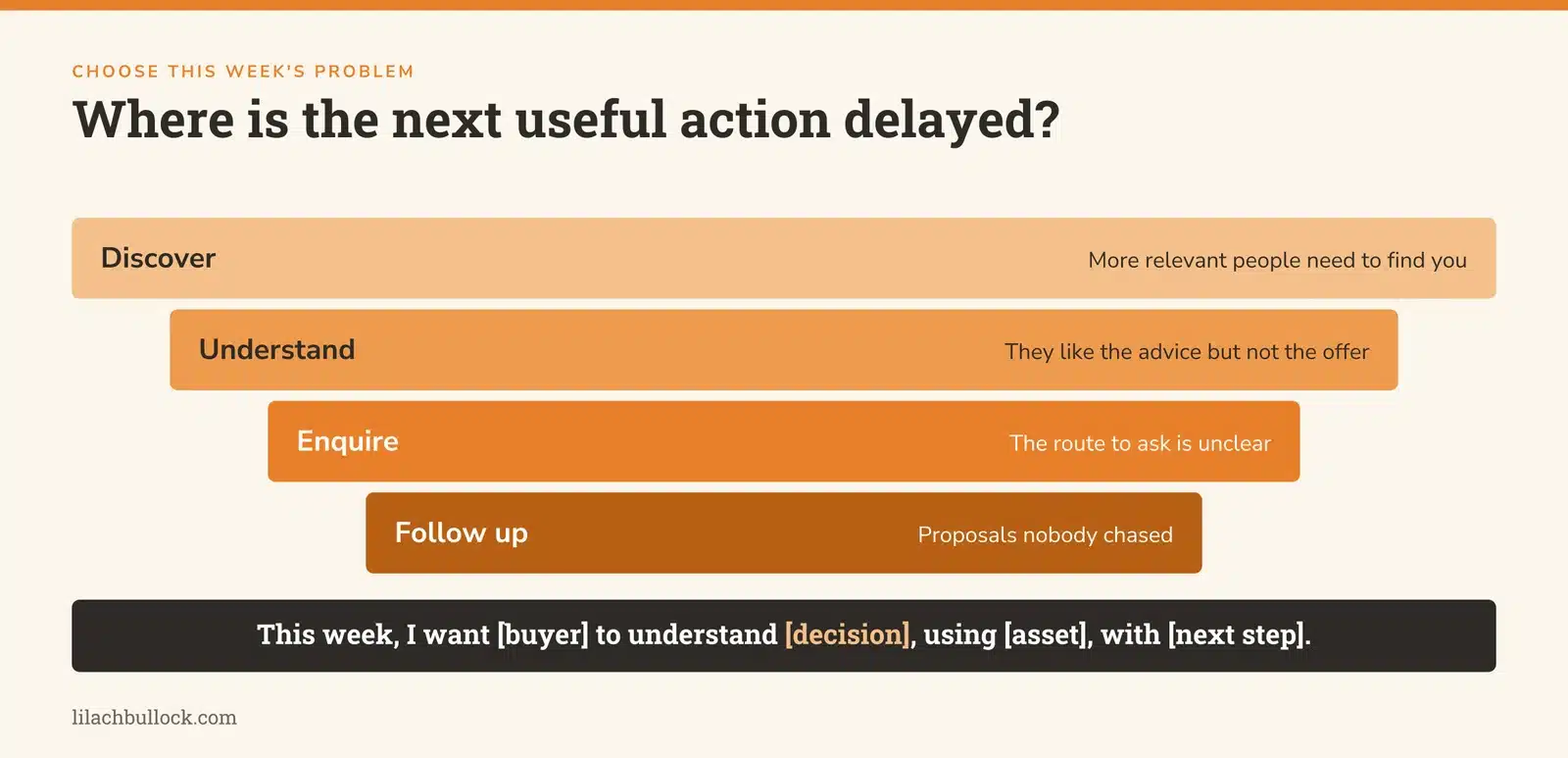
Before adding tasks, look at the last few enquiries and the work already in progress. Where is the next useful action being delayed? You might need more relevant people to discover you. You might have an audience that enjoys the advice but cannot tell what you sell. You might have enough interest and a collection of proposals nobody has followed up.
Follow the journey in order. The content marketing funnel helps distinguish someone discovering a problem from someone comparing suppliers. An introductory post will not answer every question a buyer has before committing, and a detailed proposal will not help someone who has never encountered the business. Give this week's work a particular reader and a particular decision.
For example, "get more visibility" could become: "Help independent retailers recognise when their existing product photographs are limiting a website refresh, and show them how to request a shoot." That decision gives you a topic, a useful example and somewhere to send interested people. It also helps you reject attractive distractions. A popular post about your favourite camera may reach other photographers without helping a retailer buy photography.
If you are guessing at the question, use customer language from enquiries and support conversations before writing. Save the exact question, where it came from and the context. Remove identifying details before reusing it. "Do you deliver square and landscape versions?" is a better starting point than an invented content pillar called Visual Excellence.
When the records are too thin, speak to a customer. Ask what was happening before they looked for help, what made them act and what they needed to know before choosing. The customer interview prompts can help you prepare that conversation. Don't ask whether they would enjoy your proposed content series; people are very kind about imaginary newsletters.
Write one sentence at the top of the week: "This week, I want [specific buyer] to understand [decision], using [asset], with [next step]." It won't do the marketing for you. It will stop you completing five unrelated jobs and discovering that none of them served the same purpose.
A complete weekly marketing plan for a service business

Let's use a hypothetical commercial photographer, Jo, who works with independent retailers. Jo has a small portfolio, an existing enquiry form and permission to show one previous product shoot. The business offers product photography for online shops. The example, enquiries and results below are invented to make the decisions visible; they are not a client case study.
Jo keeps hearing a version of the same question: "We are changing our website. How do we know which photos need replacing?" The week's asset will be a short website guide explaining how a retailer can review an existing image set. Jo will show the difference between an image that is too small, one that lacks a useful angle and one that is perfectly serviceable. The invitation is to send a product count, intended uses and launch date for a paid-shoot enquiry.
That is enough material for a week. Jo does not need to turn the same question into a webinar before lunch.
| Work block | Minutes | What Jo will finish |
|---|---|---|
| Review and choose | 30 | Check existing enquiries, confirm the buyer question and open the source photographs and service page |
| Create or improve | 60 | Finish the guide with three labelled examples, a preparation checklist and a clear enquiry route |
| Distribute | 35 | Publish one relevant social post, share with an existing interested contact and check the live destination |
| Respond and follow up | 45 | Three short passes through active conversations, with a dated next action recorded for each |
| Repair the buying route | 35 | Clarify the information needed for a quote and test the enquiry form on a phone |
| Close and prepare | 15 | Record the week's evidence and attach the inputs for next week's first task |
| Reserve | 20 | Cover extra response time or a repair; leave it unused if it is not needed |
Total: 220 planned minutes and 20 minutes of reserve.
Put the longer creation block where you can concentrate. Put short response passes around existing inbox checks. The energy-mapping and time-blocking sheet is useful if your diary gives every task the same treatment even though you know perfectly well that writing at the end of a day of calls is ambitious fiction.
The timings are a starting estimate. Jo's sixty-minute guide is feasible only because the photographs, permissions, offer and website already exist. If those inputs are missing, the first week becomes a preparation week. The finish line might be a verified outline and approved images, with publication moved to the next cycle. Writing "sixty minutes" beside a task doesn't make it sixty minutes long.
Prepare the material before the writing session

A useful brief for Jo contains the buyer question, the point the guide should explain, the three photographs, any necessary permission, the existing service-page link and the information needed to request a quote. Keep those together. Searching for the image half an hour into the writing session is part of production time, however administrative it feels.
For a recurring routine, make a small bank of ready topics. Each needs supporting material and a reason a buyer would care. Three questions backed by evidence are enough to start. The authority content planning guide can help you connect those questions over a longer period, but the weekly task should still be small enough to finish. An ambitious ninety-day plan does not excuse an empty first week.
If you have several similar pieces to prepare, use the weekly content batching template to separate choosing material from producing it. Batch the repeatable decisions: image sizes, document format, where approved files live. Don't force unrelated subjects into the same session merely because the calendar calls it content time.
Once the asset is ready, place it in your monthly content calendar with its destination and purpose. Use the calendar you already maintain. You do not need one spreadsheet for the idea, another for the draft and a third to tell you where the other two went.
What Jo's guide needs to say
The guide could explain that a retailer should collect the pages and placements where the photographs will be used before booking a shoot. A square product listing, a wide website banner and a close-up showing texture have different jobs. Jo can then show an approved example of each and explain what information helps produce a useful shot list.
A practical closing checklist would ask the retailer to gather the products, the planned website layouts, required image uses and the launch date. It would explain what Jo will review before confirming scope. That helps a potential buyer prepare and reduces the amount of information Jo has to request later.
Notice how much more useful this is than "professional photography builds trust" followed by a booking button. The reader can do something with it before becoming a customer. They can also see why they may want the work done by someone who understands the details.
AI can help organise a supplied brief or identify a missing explanation. It cannot provide permission to use a photograph or turn a suggested example into an event that happened. The lesson from my independent AI audit belongs here: check claims against the underlying material, even when the draft sounds finished. Keep verification inside the production allowance.
Distribute the work without creating another full-time job
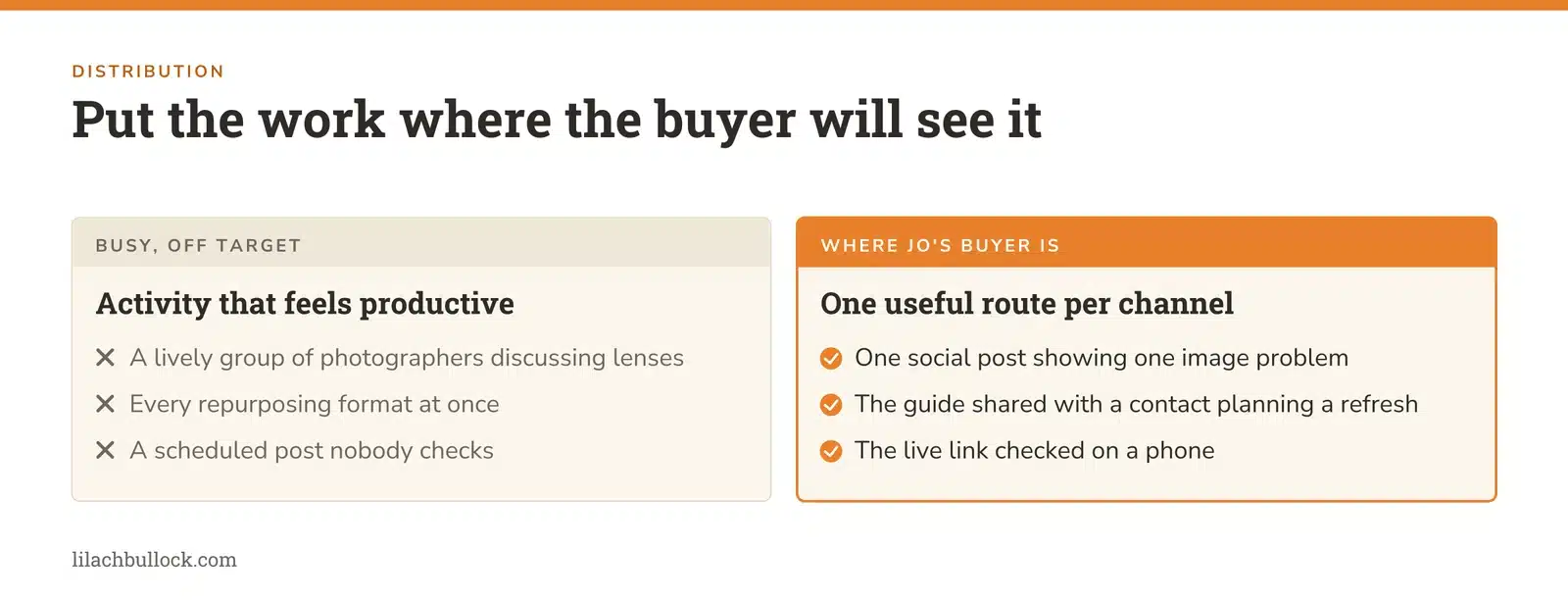
Publishing is one step in distribution. Decide in advance where the intended buyer is likely to encounter the work and why it belongs there. For Jo, a short social post can show one image problem and link to the full guide. An existing contact who asked about a website refresh may welcome the same explanation. A photography group discussing lenses is a different audience, however lively the comments might be.
The existing guide to repurposing a blog post into supporting content is useful once you have an asset worth sharing. Choose one adaptation for the channel you use. The content repurposing prompts offer more formats when you need them; they are options, not an instruction to produce all of them this week.
Check the published version from a reader's position. Does the image make sense on a phone? Does the link reach the right page? Can someone understand the invitation without reading the whole profile first? Save the live URL in the plan so the review is based on what people saw, not the nicer version still sitting in a document.
Scheduling can remove repeated uploading, but it introduces another thing to verify. My guide to social posting automation for small teams covers that narrower job. A scheduled post still needs someone to notice a failed publication or an outdated offer. Give that check an owner before considering the task finished.
Make room for enquiries and follow-up
Jo's three response passes are there to stop conversations accumulating unnoticed. They are not a service promise to answer only three times a week. Keep whatever response standard your business has agreed. If a buyer needs more attention, use the reserve or reduce production. A live conversation about paid work deserves a place in the week.
Want AI doing the heavy lifting in your marketing?
I build the systems that handle the boring 80 percent, so you get your week back. Done properly, with the human kept in.
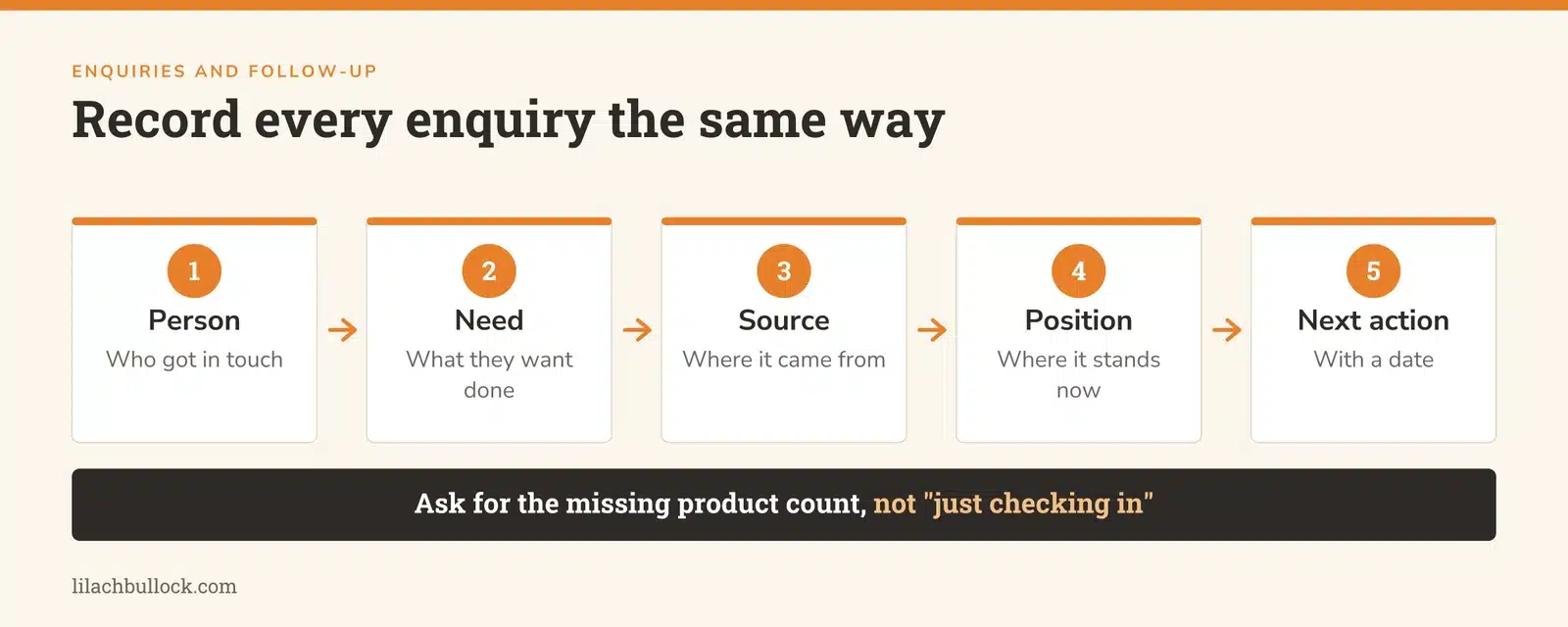
Record the person, their need, where the enquiry came from, the current position and the next action with a date. If you use a CRM, the article on making a small-team CRM useful explains why a few maintained fields beat a large collection nobody updates. Don't create a second sales record inside the marketing planner.
Suppose a retailer asks Jo for a quote but sends neither a product count nor the intended uses. The next action is to request those two things and explain why they affect the scope. Sending a generic follow-up saying "just checking in" doesn't move the decision very far. The follow-up email examples organised by sales situation can help you match the reply to the point where the conversation stopped.
If several enquiries arrive together, prioritise using known fit and a concrete next step. Jo's retailer with a confirmed launch date and product list is further along than someone asking for a portfolio with no project details. The lead-scoring sheet offers a starting structure, but its point values need adapting to your business. An email open alone is weak evidence of buying intent.
Where enquiries go missing between a form, inbox and teammate, solve the handoff. The lead-routing guide covers assigning a destination and owner. Test the path with a clearly labelled test enquiry, confirm where it appears and make sure someone knows what to do if the usual owner is unavailable.
Improve the page that interested people reach
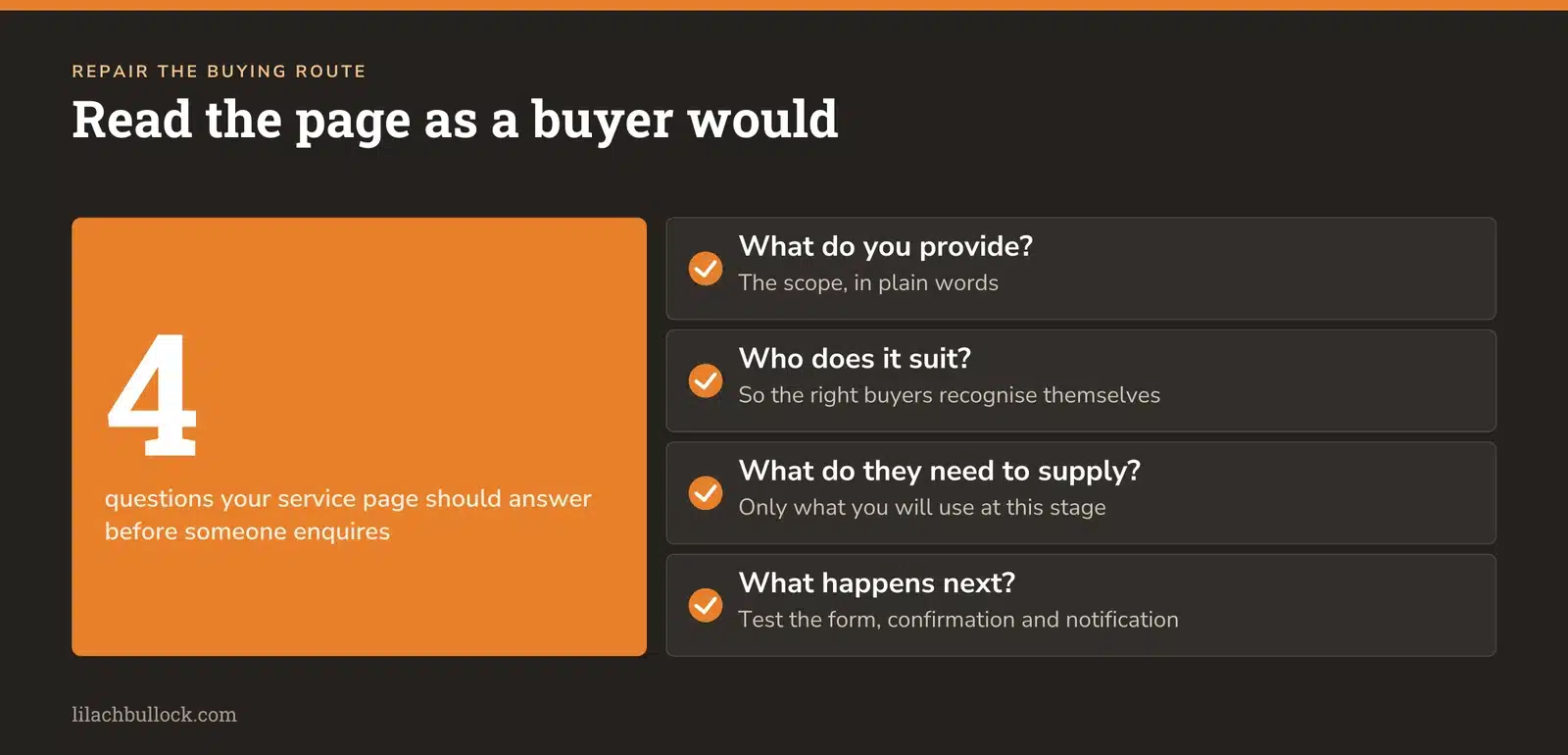
The repair block is where this routine can do more than produce another week's posts. Read the destination as a buyer who has just encountered the offer. Can they tell what you provide, who it suits, what they need to supply and what happens after they enquire?
Jo's service page might show beautiful photographs but say nothing about preparation or delivery. The guide attracts interest, then the page leaves the buyer to guess. My landing-page guidance is useful for examining that next decision. Improve one meaningful gap: explain the scope, add a relevant example or make the enquiry route easier to find.
The form deserves its own test. Only request information you will use at this stage, label fields clearly and check the confirmation and notification. The form-conversion checks give you a broader inspection list. Jo needs enough detail to assess a shoot, but does not need the retailer to prepare a complete production brief before making contact.
If you are changing several things, record them. In my newsletter design experiment, the difficulty of separating design, volume and link choices became part of the lesson. Your small business will not always have enough traffic for a meaningful split test. You can still preserve a useful record of what changed and avoid claiming certainty the evidence doesn't support.
Measure the routine without confusing activity with results

Keep three kinds of evidence together: whether the work was completed, whether relevant people responded and whether enquiries progressed. They answer different questions. A published guide proves delivery. A retailer asking about their own products shows relevance. A confirmed booking is a commercial outcome. Counting all three as leads makes the spreadsheet look cheerful and the decision less useful.
For a small business, start with time used, completed assets, relevant responses, distinct new enquiries, existing conversations advanced and confirmed business. Add a note on source and uncertainty. The marketing metrics reference helps with definitions and calculations. Use your own baseline and buying cycle when interpreting them; a generic benchmark is not a diagnosis.
Here is a hypothetical four-week record for Jo. All numbers are illustrative, and each new enquiry is counted once even if the person used more than one channel.
| Week | Time used | New enquiries and evidence | Decision for the next cycle |
|---|---|---|---|
| 1 | 235 minutes | Two enquiries; one named the guide, one source unknown; neither booked yet | Keep the topic and clarify the information needed to quote |
| 2 | 250 minutes | One new enquiry; two earlier conversations supplied missing details | Extra replies exceeded the reserve by ten minutes; reduce new production next week |
| 3 | 205 minutes | No new enquiries; one week-one enquiry confirmed a booking | Record the booking against its original enquiry; don't credit it to a post published this week |
| 4 | 230 minutes | Two new enquiries; one outside Jo's service area | Make service area clearer and review whether distribution is reaching the right retailers |
This record does not prove that the routine caused the booking. It tells Jo what happened, what is known about the source and where the next useful change may be. A small sample leaves plenty uncertain. The honest response is to keep observing, not convert one result into an average you expect every week.
Use the marketing dashboard template if you need a single view across sources. For a simpler closing decision, the weekly marketing review gives you a place to record what to continue, change or stop. Choose the lightest record that makes the next decision easier. Updating a dashboard should not become the largest work block.
Batch your posts in a scheduler like Later or a rival.
Change the plan when the evidence changes
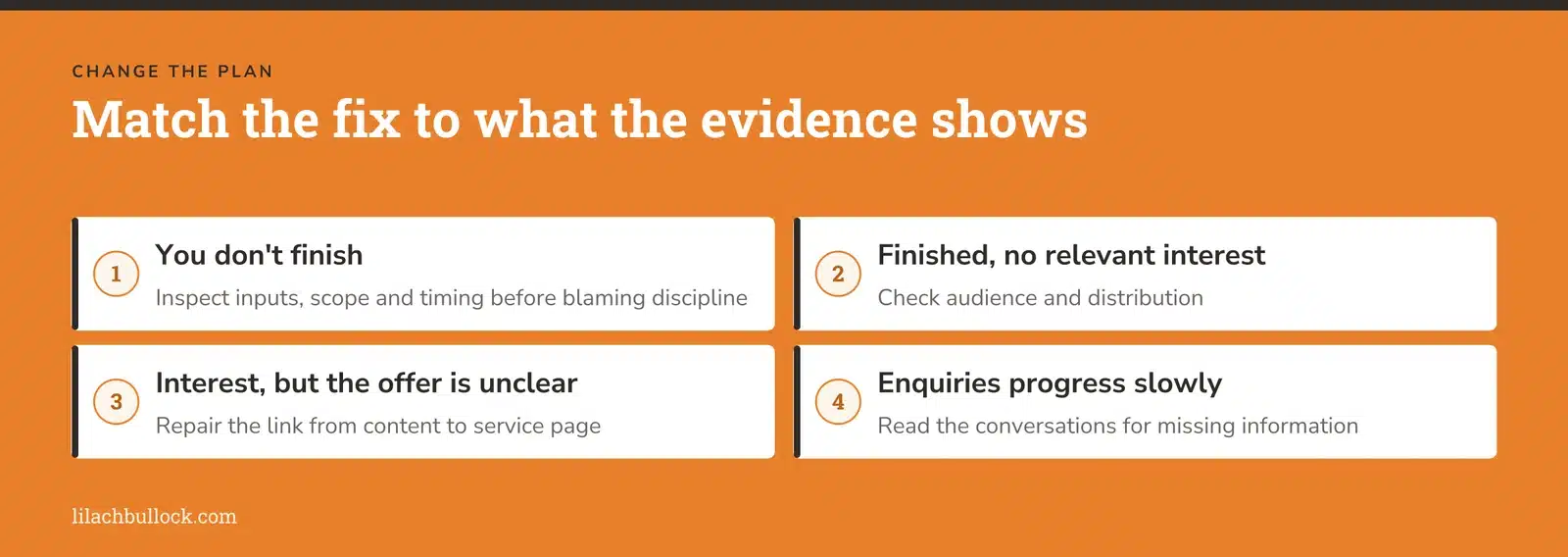
If you repeatedly fail to finish, inspect the task before blaming your discipline. Was the source material ready? Did the guide need original research? Was the owner interrupted? Reduce the scope, prepare the inputs or move the block to a more workable time. Measuring only output hides why the plan was unrealistic.
If you finish but attract no relevant interest, check audience and distribution. If relevant people arrive but cannot explain the offer, repair the connection between the content and service page. If enquiries progress slowly, read the conversations. They may reveal missing information, a poor fit or a buying timetable longer than your weekly reporting cycle.
Jo's second week illustrates why the plan must move. The ten-minute overrun is recorded as part of the cost of that week. In the following week, Jo can update an existing piece instead of making a new one and give the released time to replies. The routine survives because its purpose is clear enough to change the task.
If the same handoff keeps failing, write a short instruction with the trigger, inputs, owner and finish line. The SOP-writing prompts can help make that instruction usable by another person. If you later automate a step, map its trigger and failure route with the marketing automation map. Automating the whole weekly plan before you know where it fails is an expensive way to learn its contents.
End the week by checking your KPIs.
Your minimum weekly marketing plan

For a week with only ninety minutes available, keep the work closest to a useful next step. Allow thirty minutes for current buyer conversations, twenty-five to check and reshare an existing asset, twenty to fix one important problem on the buying route and fifteen to record what happened and prepare the next task. These are suggested allocations, not promises about what your workload will fit.
If urgent responses consume the entire allowance, handle them and record why the rest moved. If ninety minutes becomes your normal capacity, plan around that reality. You may need fewer channels, a smaller production commitment or support. My Founder Dependency Audit can help identify where the business relies on you before you hand over a recurring job.
Before closing the week, leave one instruction that another version of you can understand without reconstructing everything: "Open the approved image set, add the service-area sentence to the guide, check the form and save the live link." Attach the files and destination. That is a considerably better gift to your next working session than "do marketing".
The finished plan should show the buyer decision, the work blocks, the inputs, the time allowance, the next action on each enquiry and the result you will review. The companion planner lets you record those fields, but the decisions matter more than the container. Use a document, a sheet or the system already open in your business.
Download the weekly marketing planner (CSV): Jo's illustrative week in one column and a blank column for your own plan.
A weekly marketing routine earns its place when useful work continues, interested people get an answer and you can explain why next week looks the way it does. Start with the capacity you have, follow the evidence and leave the next job ready. You have enough things in the business that require a fresh burst of enthusiasm. Marketing doesn't need to be another one.
Related: working with an how to hire an ai consultant for small business.
If you want to reach new readers without running ads every week, my guide to blog advertising for small brands covers articles, roundups and newsletter features.
There's a short guide to to-do list apps for solo workers.
Frequently asked questions about a weekly marketing routine

How many hours should a small business spend on marketing each week?
Start with the time you can protect and the work your business needs. The four-hour example here includes production, distribution, responses, repairs and review; it is not a universal target. Track your first few weeks, including setup and overruns, before deciding whether the allowance or the scope needs changing.
Do I need to publish something new every week?
No. Updating a useful page, sharing an existing guide with a relevant audience or progressing a buyer conversation can be the right job. Publish something new when you have a worthwhile buyer question and enough supporting material to answer it. A weekly routine is a commitment to useful marketing work, not a requirement to manufacture a new topic.
How long should I try the routine before changing it?
Fix broken links, missed enquiries and unrealistic time estimates as soon as you find them. Judge commercial results over a period that reflects your buying cycle, keeping a record of enquiry dates and sources. A weekly review gives you opportunities to improve the work; it does not mean every article must produce a sale within seven days.
What is the simplest way to start?
Choose one buyer question, one existing channel and one clear next step. Gather the material, reserve time for responses and write down what you will check at the end of the week. Use the worked plan above as a starting structure, then adjust the allocations to your capacity and current conversations.