- What is causing the overload?
- A worked example: a training business with nine hours of recurring admin
- First, remove the work you should not hand over
- Which parts need ordinary automation, AI or a person?
- Write the brief before you buy the solution
- Test the difficult cases before you measure the speed
- Compare the total hours and costs on the same basis
- When hiring is the better answer
- Decide who owns the system after the trial
- Frequently asked questions about hiring vs automation
In this blog post, I'll explain how to choose between hiring someone, improving a process and using automation when your small business has more work than you can comfortably handle. You'll learn how to identify the cause of the overload, compare the hours and costs each option leaves behind, and test a change before making a bigger commitment. I'll work through a hypothetical training business so you can see what the decision looks like with numbers attached.
The short answer is to fix avoidable work first, use ordinary automation for stable rules, test AI where interpreting information would help, and hire for the responsibility or capacity that remains. That order is a starting point, not a requirement to spend six months building software before you are allowed to employ a person. If customers need support while you are delivering work, you may need another human now.
Being busy does not tell you which of those problems you have. Neither does the sight of an empty Friday disappearing under twelve things marked urgent. Before you price a new role or subscribe to another tool, you need to know what you are buying relief from.
What is causing the overload?

Start with one recurring piece of work that repeatedly gets stuck. "Admin" is too broad. Preparing a course booking, answering a delivery question or turning meeting notes into an agreed action list is something you can observe from beginning to end.
Look at the last few completed examples, including an awkward one. Record what arrived, where the information lived, who touched it, what had to be corrected and what counted as finished. The time audit cheat sheet gives you a place to capture the week, but the useful evidence is in the individual tasks. A calendar full of meetings does not reveal the forty minutes spent finding the date agreed in one of them.
Separate working time from waiting time. A booking might require twenty minutes of effort yet take three days to confirm because only the owner can approve it. Drafting the confirmation faster would reduce the twenty minutes. Giving a trusted person authority to approve standard bookings could reduce the three days. Those are different improvements, and your customer may care much more about the second.
Then identify the cause. Missing information points towards a better intake process. Repeated copying points towards integration. A decision that requires expertise points towards a qualified person. Work that is clear but exceeds the available hours points towards capacity. Work that can move only when you appear points towards a decision or ownership problem, which the founder dependency audit examines in more detail.
Several causes can sit inside the same task. That is why "Should I hire an assistant or use AI?" often produces a less useful answer than "Who should collect these details, prepare the response, approve the exception and make sure it gets finished?"
A worked example: a training business with nine hours of recurring admin
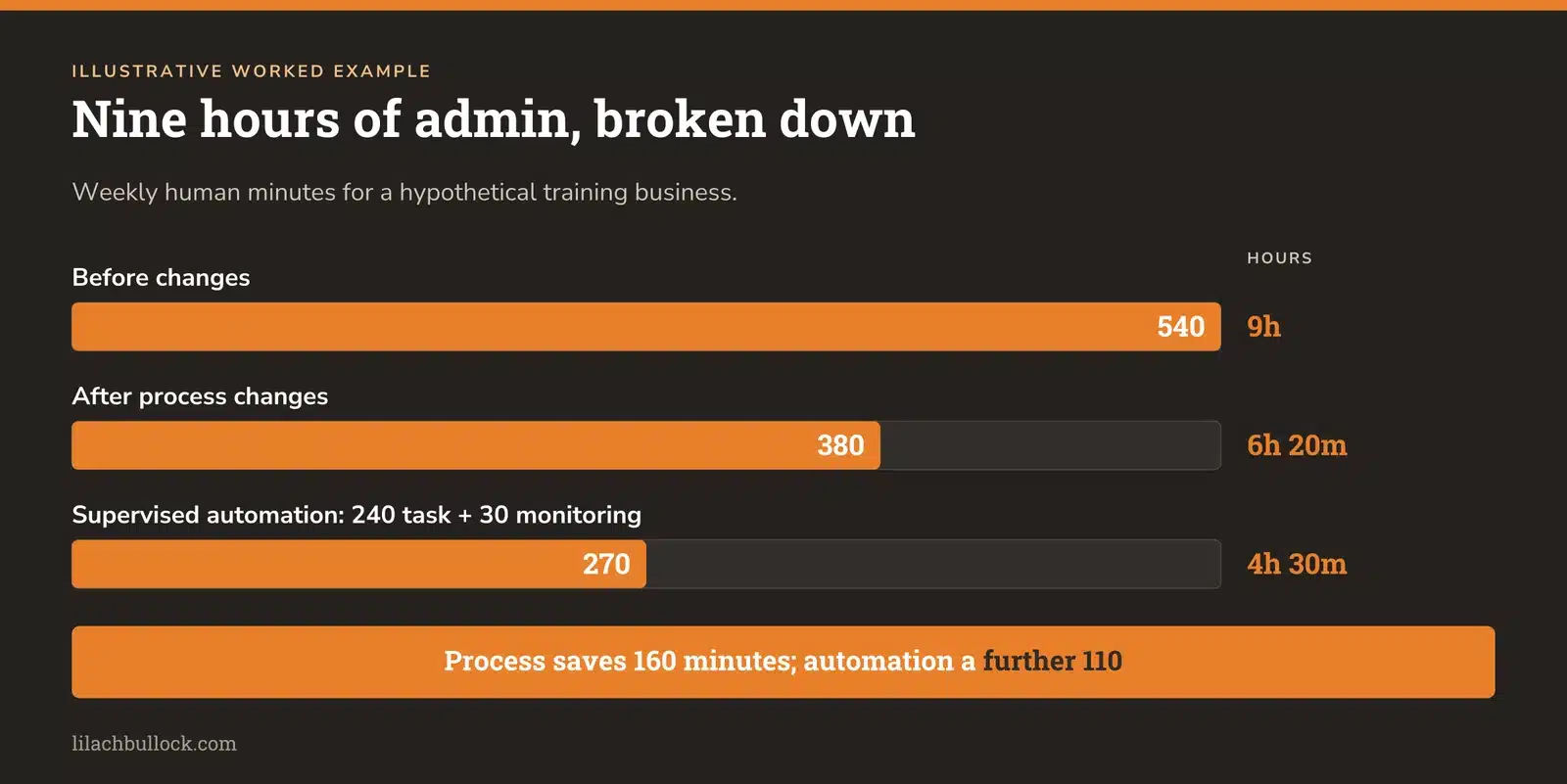
Consider a hypothetical business that runs practical workshops for small employers. The owner delivers some sessions and works with two freelance trainers. Each week, the owner also handles bookings, assembles workshop packs and deals with learner questions.
All the volumes, timings and prices below are illustrative. They demonstrate the comparison; they are not results from a client or a forecast for your business.
The owner records nine hours of recurring work in a representative week. Rather than calling all nine hours a hiring requirement, she breaks them down and tests a simpler process first.
| Weekly task | Current minutes | After process changes | After supervised automation |
|---|---|---|---|
| Check and prepare 12 bookings | 180 | 120 | 60 |
| Assemble 4 workshop packs | 120 | 80 | 40 |
| Triage and draft 20 learner replies | 160 | 120 | 80 |
| Reconcile records and resolve exceptions | 80 | 60 | 60 |
| Total | 540 | 380 | 240 |
The final column includes checking and correction for those tasks. It does not yet include thirty minutes of weekly monitoring across the whole workflow. Add that, and the proposed system still needs 270 minutes, or four and a half hours, of human work each week.
That is the number the owner must plan around. The fact that software can produce a booking confirmation in seconds does not remove the need to check whether the requested trainer is available.
The table also prevents double counting. Process changes remove 160 minutes. Supervised automation then removes a further 110 minutes after its thirty-minute monitoring allowance. Claiming that AI saved all four and a half hours would give it credit for work that disappeared before it arrived.
First, remove the work you should not hand over
Before the trial, course details live in a booking form, an email thread and a spreadsheet. The owner checks all three because none is consistently current. A workshop pack is rebuilt by copying the previous one and then hunting for everything that needs changing. Learner questions are answered from memory, including questions whose answers are already in the joining instructions.
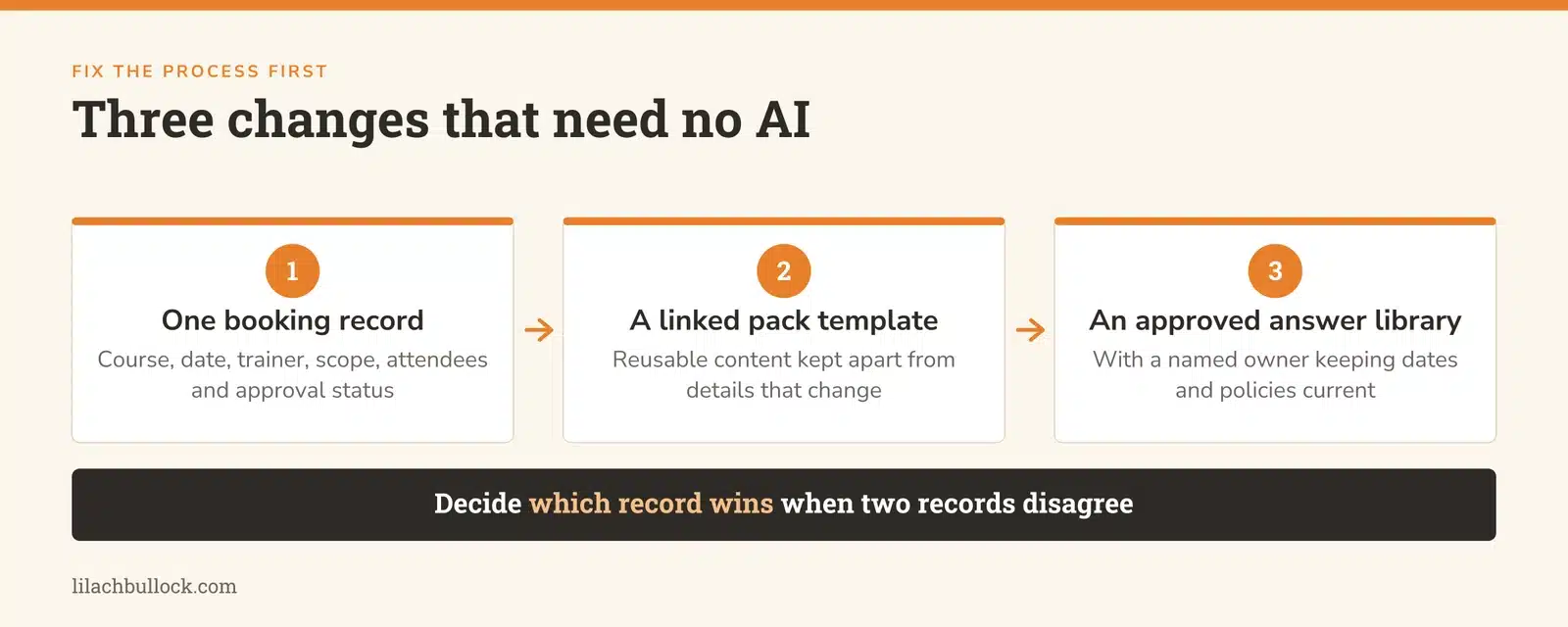
The first change is one current booking record. It holds the course, date, trainer, agreed scope, attendee details and approval status, with a link to the relevant correspondence. An incomplete booking has a visible missing-information status. It does not sit among confirmed bookings hoping someone remembers the difference.
The second change is a pack template linked to the current course material. The owner separates the reusable content from the details that change each time. The third is an approved answer library for routine questions, with a named person responsible for keeping dates and policies current.
None of this requires AI. It requires deciding which record wins when two records disagree. That question will otherwise follow you into every tool and every new hire, wearing a different hat.
If the process exists mainly in your head, record yourself completing one normal task and one exception. Use the SOP writing prompts to turn the explanation into steps, completion checks and handovers. Then run the instructions against another example. If they leave out the point where you usually make a judgement, add it before handing the document to anyone.
For a process that crosses several people or systems, the operations workflow prompts help separate actions, decisions and ownership. Keep the first version faithful to what happens today. You cannot assess whether a change helped if your starting point was an imaginary version of the business where everyone filled in the form correctly.
This is the groundwork in preparing a small business for AI automation. Stop here if the simpler process already removes the pressure. There is no prize for automating a problem you have finished solving.
Which parts need ordinary automation, AI or a person?

Ordinary automation is suitable when the rule and the required action are explicit. When an approved booking becomes confirmed, create the preparation task and attach the correct template. If a required field is empty, mark the record incomplete. A language model adds little to a rule that a form or workflow can apply directly.
AI becomes more useful where the input varies but the desired output is bounded. A learner writes three paragraphs describing a problem; AI can suggest a category, extract the relevant details and draft a response from approved information. The interpretation helps. The resulting reply still needs checking, especially when the learner asks for something outside the normal arrangement.
A person is needed where the work requires authority, relationship judgement, specialist competence or dependable coverage. A trainer cancels. A customer disputes what was agreed. A learner needs an arrangement the standard process does not cover. Producing sentences about those situations is easier than deciding what the business should do about them.
Use the delegation decision guide to sort the individual steps. Avoid labelling the entire customer support function "AI" because some questions are repetitive. In this example, routing a routine question, drafting its answer and agreeing an exception are three separate jobs.
For booking enquiries, a lead routing map can make the destination and owner explicit. For the AI drafting step, the small business workflow guide takes you from one defined task through a trial. Neither replaces the decision about who is responsible when the normal route fails.
Write the brief before you buy the solution

The training business starts with learner replies because it can test drafts without sending them. The brief is narrow: read the incoming question and the current approved course information; prepare a draft answer; identify any missing information; route exceptions to the owner.
A usable brief names the source of truth, output, limits and completion check. For this task, an acceptable draft answers the question using the correct course record, includes only confirmed dates and arrangements, and flags anything the approved information cannot answer. It must not agree a refund, change a booking or promise an accommodation. Those decisions belong to an authorised person.
The AI agent brief template provides a fuller specification if you are building a connected workflow. For a small pilot, a shared document is enough. What matters is that "done" means a checked, usable answer, rather than text appearing in a box.
You can use this prompt to expose gaps in your own brief. It helps structure your evidence; it cannot supply missing business rules.
Review this proposed task handover using only the information I provide.
Task and weekly volume: [fill in]. Current steps and measured time: [fill in]. Approved information sources: [fill in]. Required output and deadline: [fill in]. Actions that need human approval: [fill in]. Known exceptions: [fill in].
Identify missing instructions, conflicting rules and decisions that still need an owner. Separate steps suited to fixed rules, steps that may benefit from AI interpretation and steps requiring a person. Do not invent policies, savings or success rates. Return a draft trial plan with normal cases, failure cases and measurable acceptance checks.
For customer questions, the support agent prompt pack can help you express approved-answer and escalation rules. Treat the prompt as one part of the setup. Saying "never send" in a prompt is weaker than also removing sending permission during the trial. The agent guardrails checklist helps connect written instructions to actual access and approval controls.
Want AI doing the heavy lifting in your marketing?
I build the systems that handle the boring 80 percent, so you get your week back. Done properly, with the human kept in.
Test the difficult cases before you measure the speed
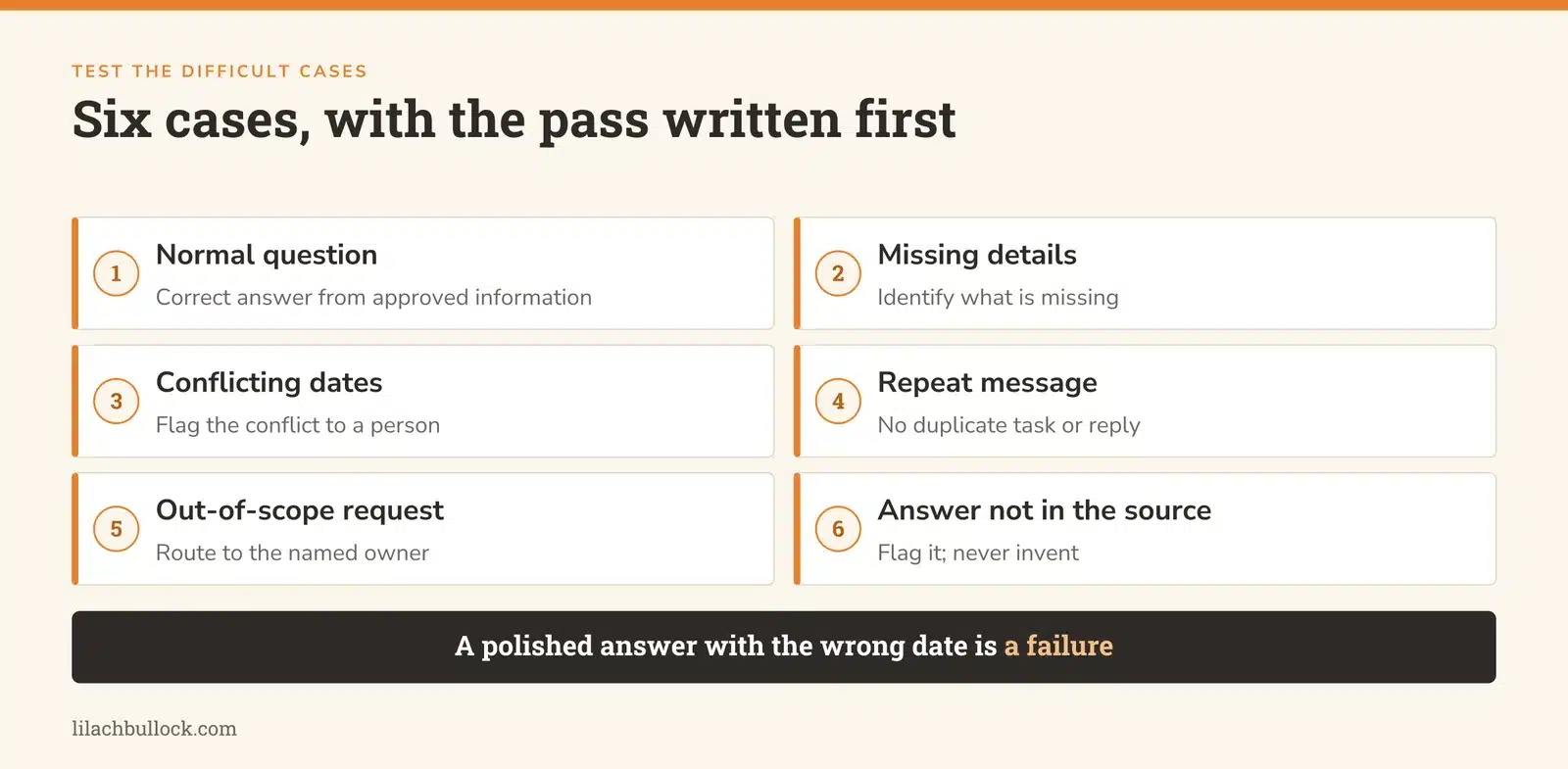
Start with examples you can check, using only information you are permitted to use. Include straightforward questions, but deliberately add an incomplete booking, conflicting dates, a repeat message, an out-of-scope request and a question whose answer is absent from the source material.
Write the expected handling before running the test. For conflicting dates, success is a flagged conflict routed to a person. Picking one date and writing a polished answer is failure. For a repeated message, success includes avoiding a duplicate task or reply. You are checking the behaviour of the whole process, not awarding points for fluent English.
In the hypothetical trial, the first version drafts a response using an old joining document when the booking record contains a newer date. The owner changes the brief and source selection so the current approved record controls the answer, then reruns that case alongside the others. Until the revised process handles the conflict correctly, drafts stay out of the live sending path.
A second test sends an exception to the right queue but gives nobody responsibility for checking that queue. Technically, the handover succeeds. Operationally, the customer is still waiting. The fix is an owner, a review time and a fallback if that person is unavailable. The handoff-to-human guide is useful at precisely this point.
My AI cold email automation breakdown is a related warning about checking complete journeys, including duplicates and replies, rather than assuming that a successful individual step proves the system works. Your trial does not need a large campaign to expose that problem. One deliberately repeated test record can be more informative than twenty easy examples.
Agree the pass conditions in advance. In this example, every test must use the correct source or flag the conflict, every exception must reach its named owner, and no unapproved external action may occur. You also record correction time. A draft that takes longer to inspect and repair than to write has not passed the capacity test, however attractive the first demonstration looked.
Passing this set does not prove the system will never fail. It earns a supervised trial on normal work, with checks repeated after changes. The AI auditing guide gives you another way to challenge output, but an AI reviewer is additional scrutiny, not proof that an answer is correct.
Compare the total hours and costs on the same basis

Return to the training business. After the process changes, the work takes 380 minutes a week. After supervised automation and monitoring, it takes 270. The additional gain from automation is therefore 110 minutes, or about 1.83 hours, a week.
Now give the build an eight-week evaluation period. Assume it needs six hours of owner setup time and costs $30 a week in incremental software and usage charges. Those are invented planning figures. Replace them with your own measured time and quoted costs; they are not market prices.
Across eight weeks, automation releases 880 operating minutes: 110 multiplied by eight. Subtract the 360 minutes spent setting it up and the net release is 520 minutes, or eight hours and forty minutes. Software costs total $240. You have spent cash to recover that time, and you still need someone to do the remaining work.
For a direct comparison, suppose a contractor quotes $40 an hour to perform the improved manual process. At 380 minutes a week over eight weeks, delivery would cost about $2,027. Add an assumed four hours of owner onboarding and half an hour of owner review each week. The owner would spend eight hours managing the handover instead of roughly 50.7 hours doing the task, releasing about 42.7 owner hours.
| Eight-week option | Incremental cash cost | Owner time required |
|---|---|---|
| Owner runs improved manual process | $0 in this example | 50 hours 40 minutes |
| Owner runs supervised automation | $240 software | 36 operating hours + 6 setup hours |
| Contractor runs improved manual process | About $2,027 delivery | 4 onboarding hours + 4 review hours |
The contractor option buys more owner capacity and costs more cash. The automation option is cheaper in this example but leaves the owner operating and checking the system. You can combine them later, but you would need a new estimate for contractor review, maintenance and your own oversight. Do not add the full savings from both options as if neither affects the other.
Download the hire-or-automate task worksheet (CSV): the illustrative training-business figures in one column and a blank column for your own task.
These figures exclude costs that do not change between the options. A real quote may also include minimum hours, setup fees or other charges. If you are considering an employee, compare the full employment cost and required coverage using figures appropriate to your business, rather than treating the contractor's hourly rate as an employee salary.
The AI ROI cost checklist is useful for remembering setup, running and maintenance costs. Keep cash savings separate from the value you assign to your time. Multiplying recovered hours by your sales rate does not put that amount in the bank. It becomes additional income only if you use the capacity for paid work you can win and deliver.
For an early estimate, the AI savings calculator can help you organise assumptions. Replace those assumptions with trial measurements before making the commitment. In a small business, being able to stop working at a sensible time can also be a valid benefit. You do not have to invent a revenue forecast to justify wanting your evening back.
When hiring is the better answer
Hire when the remaining work needs sustained ownership or coverage that you cannot provide, even if individual steps can be automated. In the training example, four and a half hours still remain after automation, and some of those hours occur while the owner is teaching. Faster draft preparation does not make the owner available to resolve a same-day problem.
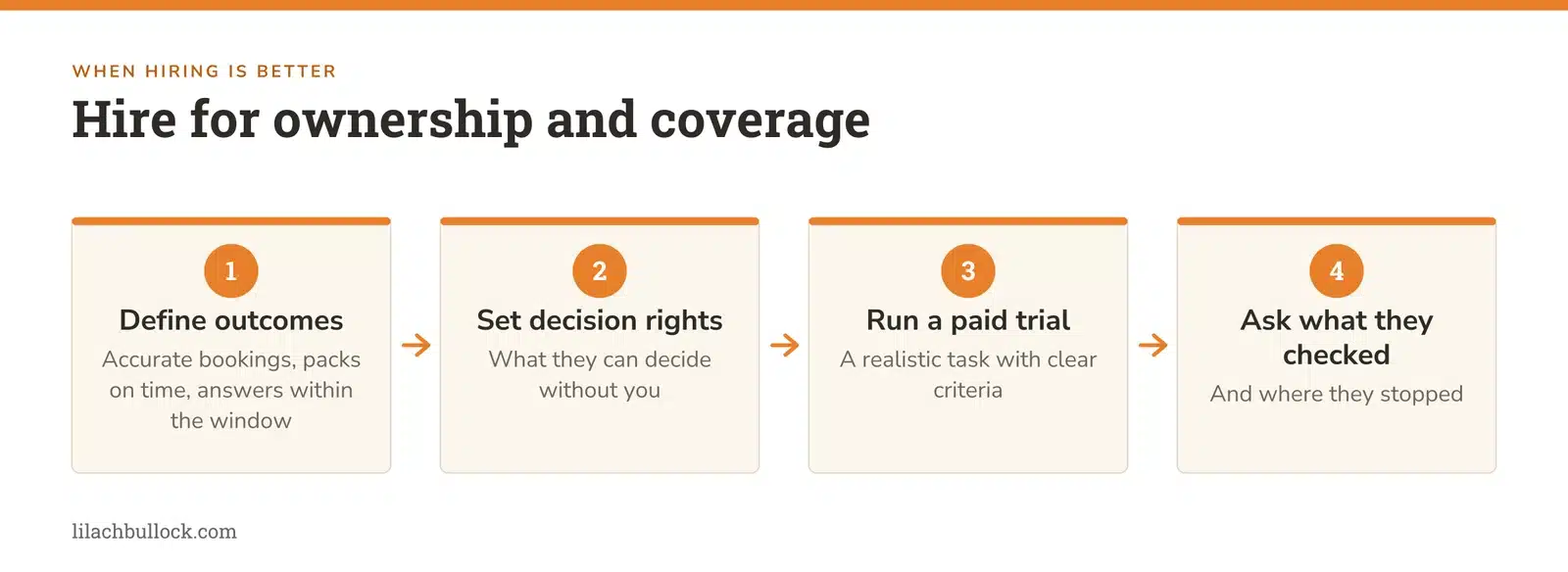
Write the role around outcomes: bookings are accurate, workshop packs are ready by the agreed deadline, learners receive answers within the promised service window, and exceptions reach someone authorised to resolve them. Then specify what the person can decide independently. Otherwise, you risk paying someone to wait for your permission while you continue doing the decisions between sessions.
A paid trial assignment can show how a candidate follows instructions, handles missing information and escalates an exception. Use a realistic task with a clear scope and evaluation criteria. Do not judge only the neatness of the finished file. Ask them to explain what they checked, what they could not confirm and where they stopped. Those habits matter when you are no longer sitting beside them.
The delegation playbook for solo founders helps define what you retain and what someone else can own. Revisit those boundaries as trust and competence develop. Every minor decision routed back to you reduces the capacity you thought you had bought.
Sometimes the missing person is an implementation specialist rather than ongoing admin support. If the task is clear but integration, testing or maintenance is beyond your available time or competence, the guide to hiring an AI consultant helps frame that separate purchase. Ask for a defined working outcome, documentation and a handover. Installing a tool is not the same deliverable as leaving your team able to run it.
Here's how I'd tackle a related job: how to optimize your business and automate your work.
Decide who owns the system after the trial

An automation needs a named owner even when the person who built it leaves. Write down where failures appear, when they are checked, who can change the instructions and how the work continues if the system is unavailable.
For the training business, a failed draft leaves the original learner message visible in the work queue. The fallback is the approved answer library and a manual response, not repeated automatic retries that might create duplicates. Changes to course information have an owner and a date, and a changed template is tested before it is used for the next workshop pack.
The agent failure-mode playbook helps you think through stale inputs, failed connections and repeated actions. Choose the cases relevant to your setup and write the recovery step. A warning nobody reads is documentation of a problem, not recovery from it.
Review the decision after several normal cycles and any meaningful change in workload. Track total human minutes, correction time, missed deadlines and unresolved exceptions alongside volume. If the volume doubles, a higher total time might still represent an improvement per booking; if errors rise, the time saving may no longer be worth keeping.
For the follow-up question, read tools that automate your social media posts. Guest writers can start with marketing automation blogs that accept guest posts.
Frequently asked questions about hiring vs automation
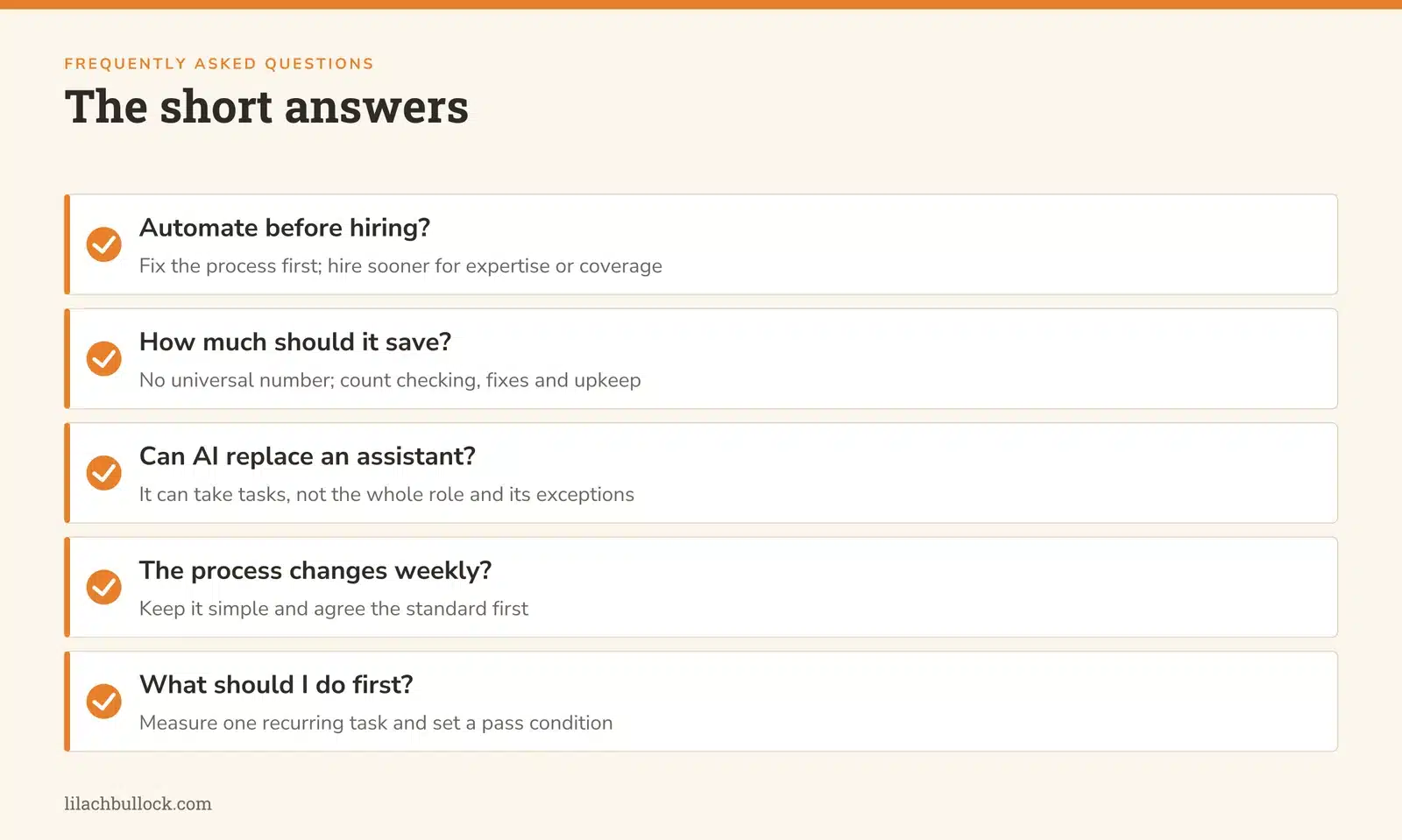
Should a small business automate before hiring?
Improve obvious process problems first, then decide from the remaining workload. Automation deserves a trial when the task is repeatable, the inputs are usable and you can check the result. Hire sooner when you need expertise, relationship judgement or coverage at times you are unavailable. You can improve the process while recruiting; the two do not need to be sequential projects.
How much time should automation save to be worthwhile?
There is no universal number. Compare net time recovered after setup, review, corrections and maintenance with the cash cost and importance of the task. A small time saving may still be useful if it removes a recurring interruption. A large claimed saving is weak evidence if nobody has counted the checking that follows it.
Can AI replace a virtual assistant?
It can perform or assist particular tasks within an assistant's workload. That does not establish that it can own the whole role. My AI inbox management article shows the distinction between sorting and drafting work and the decisions around sending. Map the role into tasks, then decide who owns the exceptions, deadlines and customer relationship.
What if the process changes every week?
Keep the workflow simple and close to a person who understands the changes. Use templates and assisted drafts where they help, but avoid building a complicated automatic route around unstable rules. Record why the process changes. If the cause is inconsistent instructions rather than customer needs, agree the standard before adding more machinery.
What should I do first this week?
Choose one recurring task, inspect several recent examples and record its working time, waiting time and corrections. Write down what finished means and remove one avoidable step. Then select a small trial of process improvement, automation or human support with a review date and a clear pass condition. You will have a decision based on your business, rather than the most persuasive demo you watched on Tuesday.