This founder dependency audit starts with one uncomfortable question: if you disappeared from the day-to-day running of your business for 14 days, what would stop first?
Not forever. Not in a dramatic succession-planning scenario. Just two weeks in which you could not answer every question, rescue every process or carry the entire company in your head.
Would leads still receive a response?
Would client work reach the right standard?
Would invoices go out and payments be followed up?
Would your team know what to decide, what to pause and when to escalate?
Would your AI systems keep useful work moving, or would they create a faster, less visible mess?
This is the founder dependency problem. It exists in solo businesses as well as teams, and growth does not automatically solve it. In many companies, growth makes it worse because more customers, tools and promises become attached to the same person's memory.
I have just spent three weeks travelling for work while continuing to serve clients and operate the business. AI agents and workflows carried a meaningful share of the repeatable work. That did not happen because I found a magical tool. It happened because enough of the business had been made explicit: the context, the steps, the standards, the permissions and the points where the work had to come back to me.
This audit will show you where your business still depends on your constant presence and what to change first.
How to score the audit
Score every statement from 0 to 3:
- 0: This exists only in my head or fails without me.
- 1: Someone could probably work it out, but the process is inconsistent.
- 2: The process is documented and works, but still needs regular founder intervention.
- 3: The process runs reliably, has a named owner, and escalates only defined exceptions.
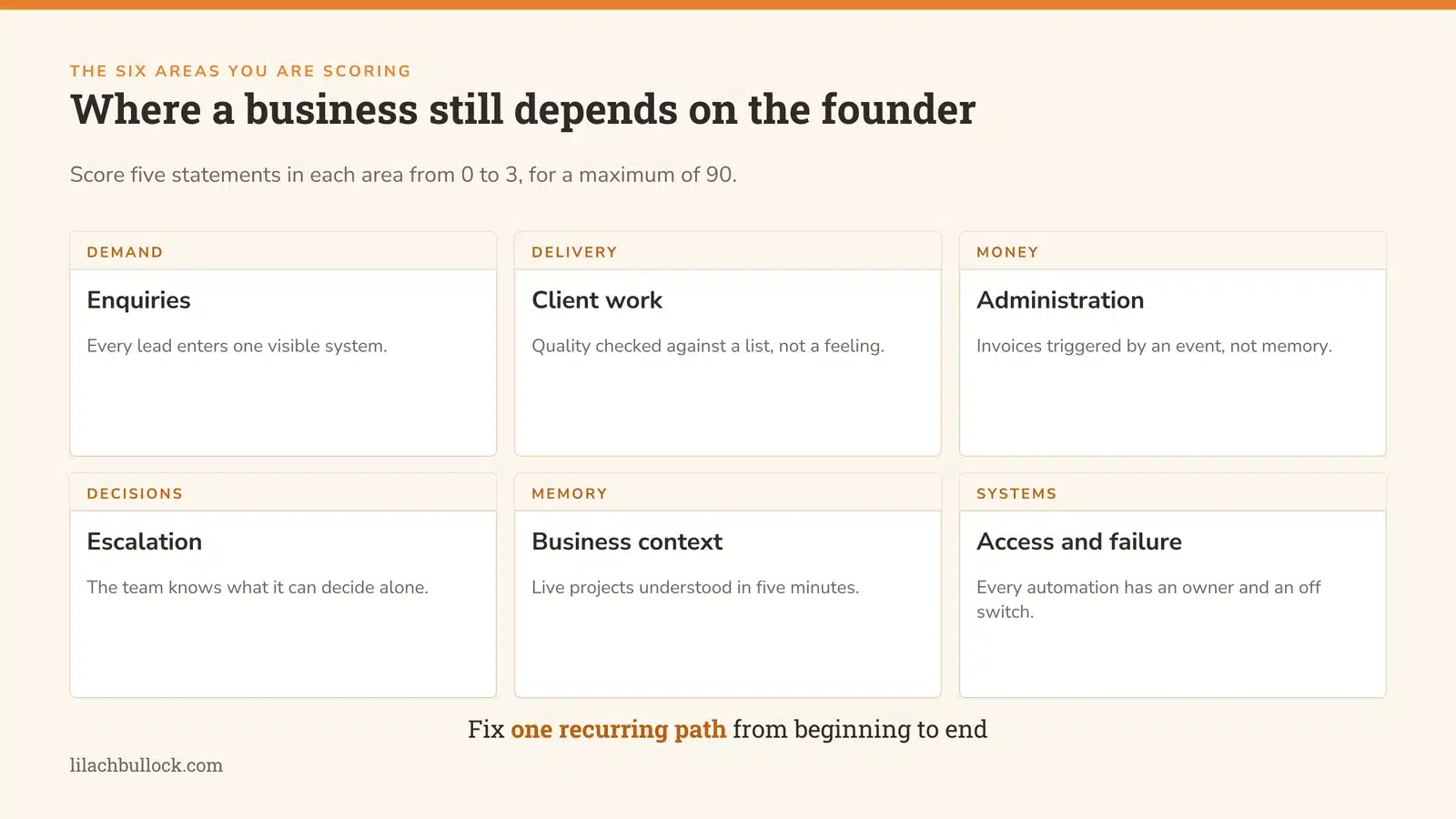
There are 30 statements across six areas. Your maximum score is 90.
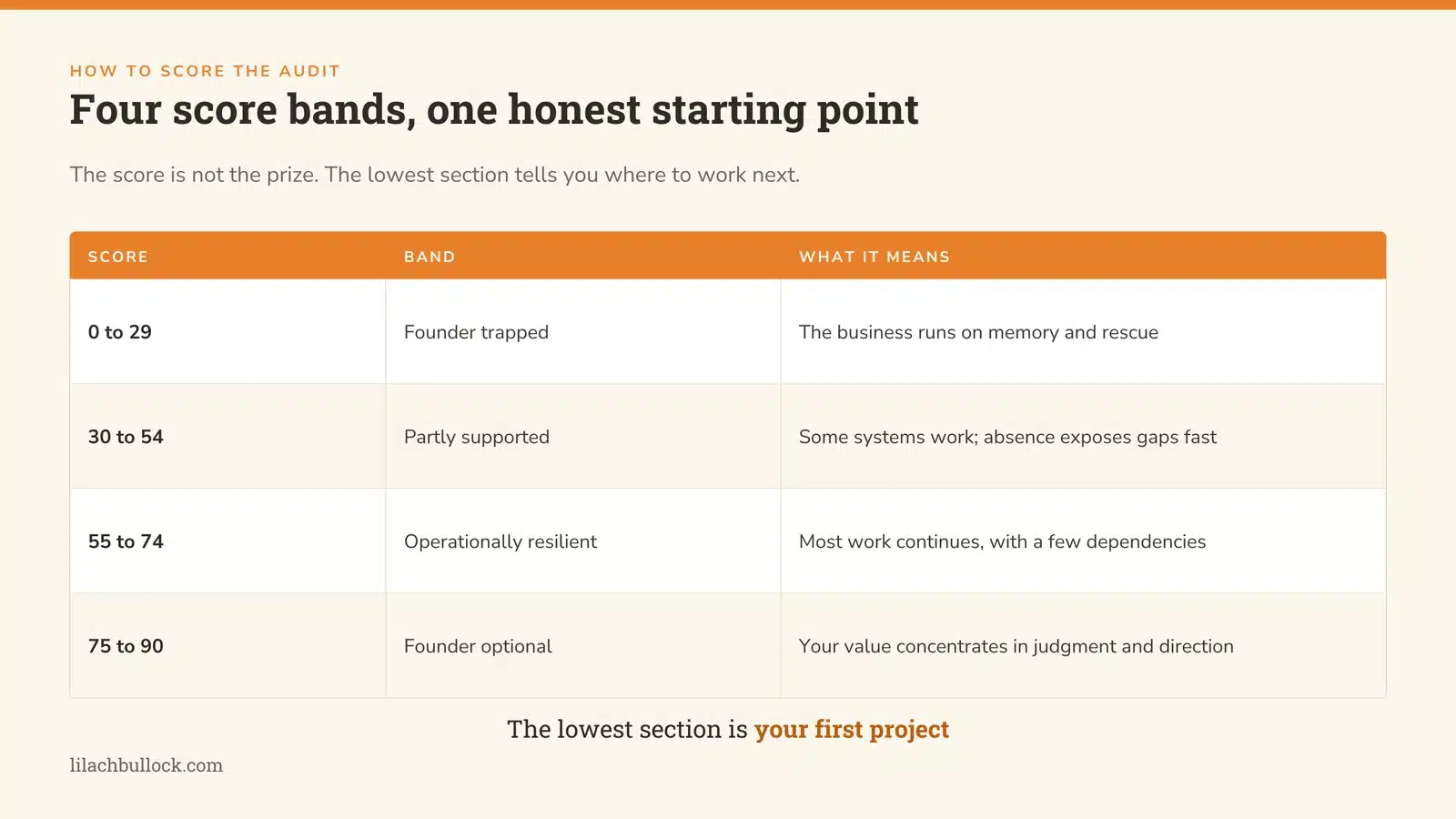
- 0 to 29: Founder trapped. The business is running on memory and rescue.
- 30 to 54: Partly supported. Some systems work, but absence will expose gaps quickly.
- 55 to 74: Operationally resilient. Most work can continue, with a few concentrated dependencies.
- 75 to 90: Founder optional in routine work. Your value is increasingly concentrated in judgment, relationships and direction.
The score is not the prize. The lowest section tells you where to work next.
1. Demand and enquiries
Score each statement:
- Every new enquiry enters one visible system, not a mixture of inboxes, DMs and memory.
- The business can distinguish a genuine commercial opportunity from noise without waiting for me.
- Routine enquiries receive a timely, accurate response or a prepared draft.
- High-value or unusual opportunities are flagged to a named person.
- No lead can disappear because only I knew it existed.
My verdict
Most small businesses do not have a lead-generation problem as often as they have a lead-containment problem. Demand arrives, but the next action is unclear, inconsistent or trapped inside the founder's inbox. A well-used CRM in a small team gives that demand somewhere visible to go.
Use it in your business
Choose one capture point for all commercial opportunities. Create four statuses: new, qualified, waiting and closed. Define the evidence required to move between them. Let AI prepare the lead follow-up; let a person decide value, fit and terms.
Keep this human
A prospect is not a row to be processed. Any conversation involving price, scope, trust or negotiation remains human-led.
2. Client delivery
Score each statement:
- Every recurring deliverable has a written definition of done.
- The source information, templates and examples are stored somewhere another authorised person can access.
- Quality can be checked against a list, not against whether it "feels like me".
- Deadlines, owners and dependencies are visible without asking me.
- A client can receive continuity without receiving lower standards.
My verdict
If quality depends on the founder personally touching every item, the business has a craft system but not a delivery system. The answer is not to remove the founder's judgment. It is to stop spending that judgment on formatting, reconstruction and preventable corrections.
Use it in your business
Take your most repeated deliverable and save three things together: one excellent example, one checklist and one list of unacceptable mistakes. Ask an AI agent to prepare the next version against all three, then measure how much correction it needs.
Keep this human
The person accountable to the client approves the final interpretation, recommendation and claim.
3. Money and administration
Score each statement:
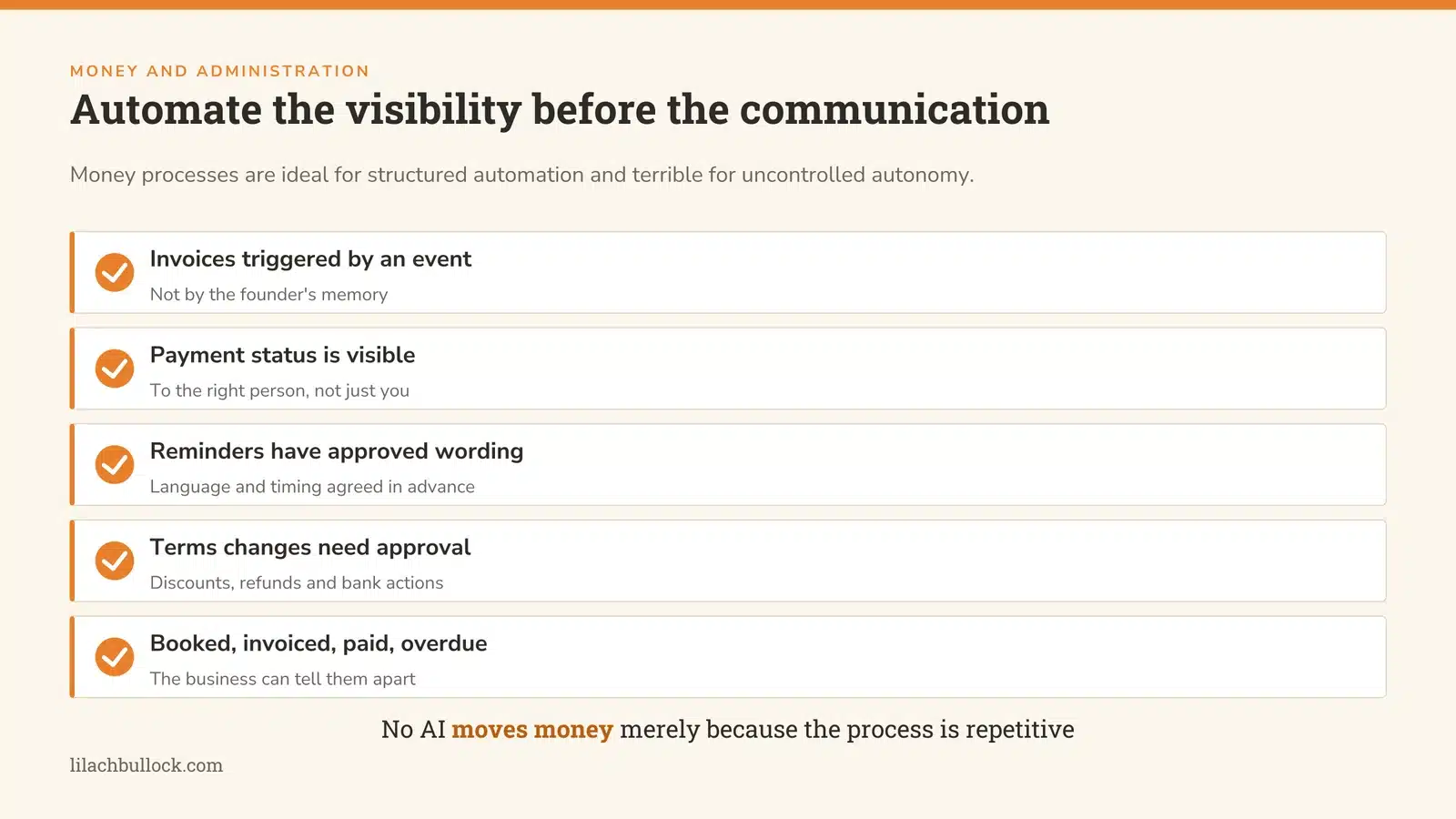
- Invoices are triggered by a visible event rather than by my memory.
- Payment status is visible to the right person.
- Routine reminders have approved language and timing.
- Discounts, refunds and changes to terms require explicit approval.
- The business can tell the difference between revenue booked, invoiced, paid and overdue.
My verdict
Money processes are ideal for structured automation and terrible for uncontrolled autonomy. The rules are often repetitive, but the exceptions can damage a relationship quickly. Even invoice volume in a small business matters less than making each invoice visible and owned.
Use it in your business
Automate the visibility before the communication. Build a daily or weekly list of invoices due, paid and overdue. Let a system prepare reminders in draft. Keep price changes, refunds, bank actions and commercial terms behind approval. The same principle applies when booking systems reduce no-shows: automate the routine reminder, not the sensitive judgment.
Keep this human
No AI gets permission to move money or make a financial commitment merely because the process is repetitive.
4. Decisions and escalation
Score each statement:
- The team knows which decisions it can make without me.
- Spending, publishing, sending and customer-record changes have explicit thresholds.
- Every important workflow has a stop condition.
- Exceptions reach the right person with enough context to decide quickly.
- "Ask the founder" is not the default answer to ordinary uncertainty.
My verdict
A business becomes less dependent on its founder when decision rights become clearer, not when more decisions are automated. Ambiguity creates interruptions. Clear boundaries create autonomy, which is one reason AI agents need defined limits.
Use it in your business
Write a one-page decision table with three columns: proceed, prepare for approval, stop and escalate. This also reduces the risk of AI hallucinations becoming business actions. Add examples. For instance, a system may draft a standard follow-up, prepare a bespoke proposal for approval, and stop if the prospect asks for a contract change.
Keep this human
Judgment is not a failure of process. The process should identify where judgment begins.
5. Business memory
Score each statement:
- Every live project has a current state that can be understood in under five minutes.
- Important decisions are recorded with the reason, not only the outcome.
- Client preferences and approved facts are stored outside one person's chat history.
- AI tools receive controlled context rather than improvised recollections.
- The next action is visible at the end of every working session.
My verdict
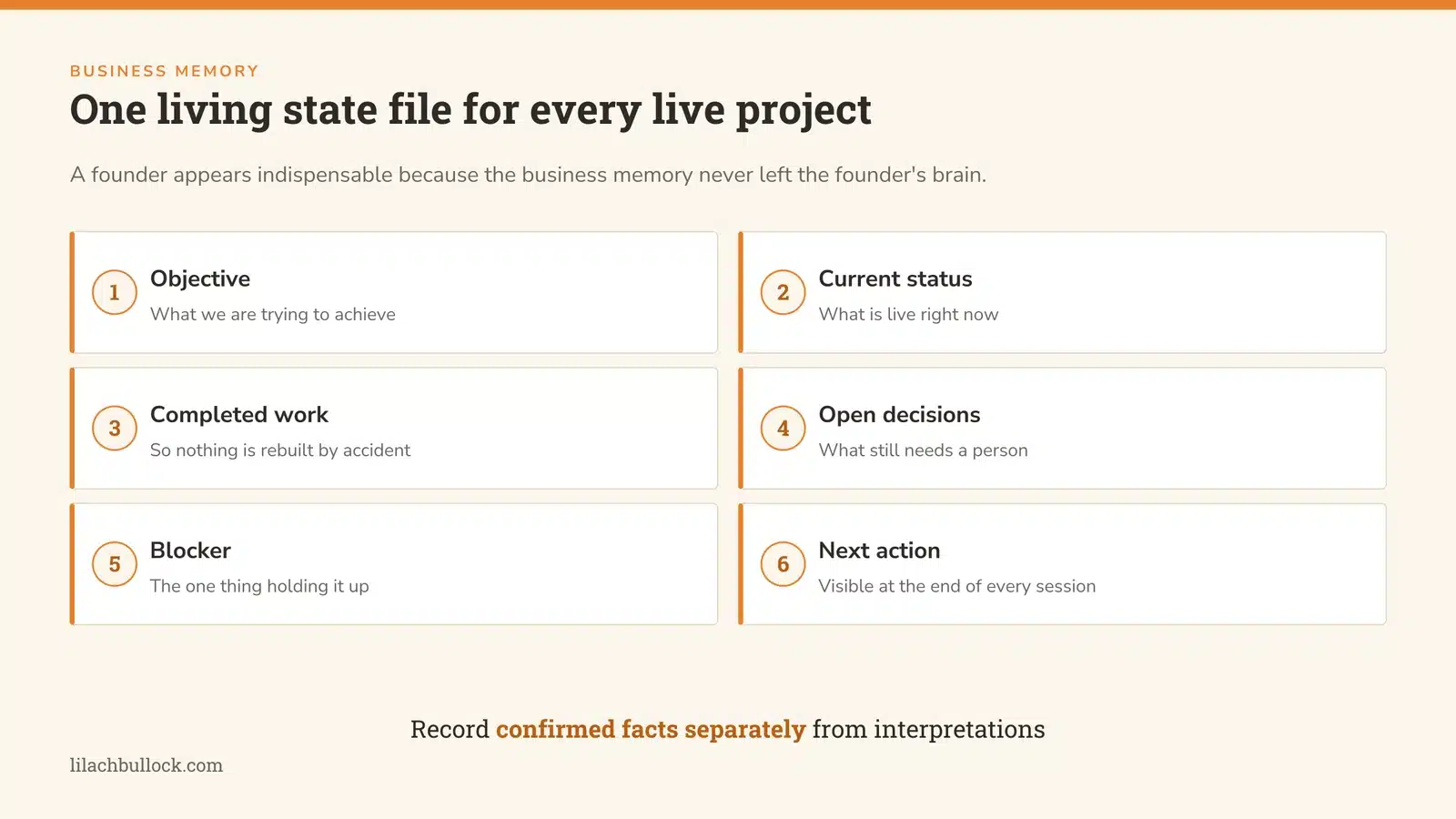
A founder often appears indispensable because the business memory has never left the founder's brain. When context is scattered, every handoff looks harder than doing it yourself. This is also why whether AI agents remember between tasks matters in daily operations.
Use it in your business
Want AI doing the heavy lifting in your marketing?
I build the systems that handle the boring 80 percent, so you get your week back. Done properly, with the human kept in.
Create one living state file for each important project. It turns project management from stress into continuity. Keep it short. Include objective, current status, completed work, open decisions, blocker and next action. Update the same file instead of creating dated handover documents nobody will read.
Keep this human
Record confirmed facts separately from interpretations. AI will repeat a founder's hunch with the confidence of a policy if you store them together.
6. Systems, access and failure
Score each statement:
- Every automation and agent has a named owner.
- Business-critical work runs on business-controlled accounts.
- Each system has only the permissions required for its task.
- Logs, alerts and a working shutoff method exist.
- A replacement process exists if a vendor, integration or account fails.
My verdict
A workflow is not resilient merely because it is automated. Resilience means you know how it fails, who notices, what stops and how work continues. Every list of AI automation ideas for small business needs this warning attached.
Use it in your business
Build an eight-column register: system, purpose, owner, trigger, access, external actions, last test and fallback. A practical AI automation consultant should help you simplify this map, not sell you more disconnected tools. Review the highest-risk item first, not the most interesting one.
Keep this human
The person who owns a system must be able to stop it without asking the system how.
Your results
Add the five scores in each section.
| Area | Score out of 15 | What a low score means |
|---|---|---|
| Demand and enquiries | Opportunities can disappear or wait for you. | |
| Client delivery | Quality and deadlines depend on your direct intervention. | |
| Money and administration | Cash flow relies on memory or risky access. | |
| Decisions and escalation | Ordinary uncertainty becomes founder interruption. | |
| Business memory | Context cannot travel between people or systems. | |
| Systems, access and failure | Automation may increase rather than reduce operational risk. | |
| Total | /90 |
Circle the lowest-scoring section. That is your first project.
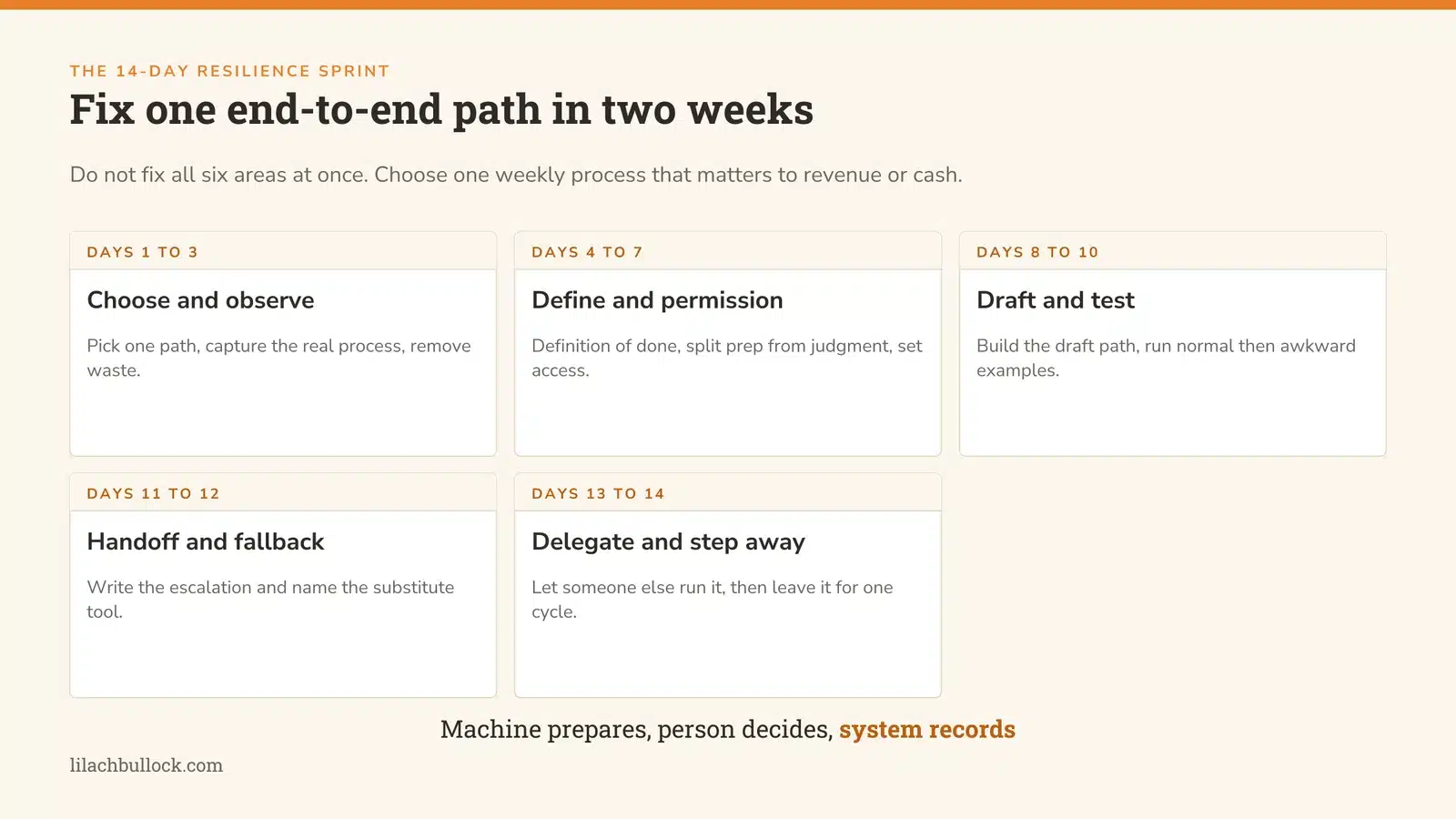
Do not try to fix all six areas at once. A founder dependency audit can easily become a six-month operations project that creates more work than it removes.
Fix one recurring path from beginning to end.
The 14-day resilience sprint
Day 1: Choose one path
Select a process that happens at least weekly and matters to revenue, delivery or cash. Good examples include handling a qualified enquiry, producing a client report, onboarding a customer or following up an unpaid invoice.
Day 2: Observe the current process
Complete the task normally and write down every source, decision, copy-and-paste step, check and exception. Do not design the better process yet. Capture the real one. If it feels muddled, begin with what a marketing automation audit involves.
Day 3: Remove work
Delete duplicate checks, unnecessary reporting and steps nobody uses. The cheapest automation is the task you stop doing, which starts with knowing what to outsource or remove.
Day 4: Define done
Write the required output, deadline, accuracy standard, tone, file location and approval point. Include one strong example. This is what makes AI agents useful for small teams rather than impressive in a demo.
Day 5: Separate preparation from judgment
Mark each step as machine prepares, person decides or system records. This prevents the common mistake of automating the visible task while leaving all the mental work with the founder. For examples, look at how AI agents work for business owners.
Day 6: Put context in one place
Create the source document or project folder the workflow needs. Remove conflicting versions and clearly label what is current. This is one of the most important things to consider before implementing AI automation.
Day 7: Set permissions
Begin read-only wherever possible. Add access only when the task requires it. Put explicit approval before sending, publishing, spending, deleting or changing customer data. Do this before you prepare a small business for AI automation at scale.
Day 8: Build the draft path
Make the system prepare the output without releasing it. Do not optimise for speed. Optimise for a visible, reviewable result. This is how AI workflow automation reduces labour while keeping accountability clear.
Day 9: Test normal examples
Run three examples that represent ordinary work. Record accuracy, correction time and missing context. The correction time helps you judge how much an AI agent costs to build or run against completed value.
Day 10: Test awkward examples
Use an angry customer, incomplete information, conflicting instructions, a discount request and a case outside policy. The edge cases show whether you built a workflow or a demo, and expose why AI agents give incorrect information before a customer does.
Day 11: Create the handoff
Define what the system sends to a person when it stops: the original request, relevant context, action already taken, risk and decision required. It is the same continuity principle behind keeping a business running through disruption.
Day 12: Build the fallback
Write the manual process and name the substitute tool. Export prompts, templates and records from any system you depend on. Even the best productivity tools for entrepreneurs can change, break or disappear.
Day 13: Let someone else run it
Give the process to another authorised person or run it yourself without using information outside the written system. Every extra explanation is missing documentation and evidence that the productivity tool still depends on the solo operator.
Day 14: Step away
Do not touch the process for one cycle. Review what happened afterwards. Measure completed outcome, correction time, interruptions and exceptions. The goal is the kind of resilience that lets founders combine travel with business productivity without pretending to be permanently unavailable.
What AI should carry
AI is strongest when it carries repeatable cognitive weight:
- collecting and sorting information;
- turning transcripts into structured notes;
- preparing first drafts from approved sources;
- checking output against a defined standard;
- monitoring for known conditions;
- keeping project state current;
- surfacing an exception with context.
It is weakest where the job depends on unspoken relationship history, ambiguous authority, moral responsibility or a commitment that cannot be easily reversed.
That is why the useful target is not "a business that runs without me".
The useful target is "a business that does not need me to carry repeatable work in my head". That is the practical promise behind AI agents for small business.
Five traps that make founder dependency worse
1. Automating before documenting
You turn an inconsistent habit into a faster inconsistent process. Observe first, simplify second, automate third. The same order appears in real-world AI agent examples that create value.
2. Giving one agent every permission
Convenience becomes a single point of failure. Split research, preparation and external action. Keep the final action behind approval, especially because AI agents can go rogue when permissions and instructions collide.
3. Storing the process inside a private chat
The founder is still the integration. Put the brief, examples and state in business-controlled files so AI memory between tasks is controlled rather than assumed.
4. Measuring activity instead of completed outcomes
Ten drafts created is not ten jobs completed. Measure what reached the required standard and how much correction it needed.
5. Keeping every exception for yourself
If every unusual case climbs to the founder, the system never learns its proper boundaries. Turn repeated exceptions into rules. Preserve consequential judgment.
Final takeaway
Your business does not need to forget you for 14 days.
It needs to remember its own work without asking you to reconstruct everything.
Run the audit. Choose the lowest section. Fix one end-to-end path. Give the machine preparation, give the person judgment, and give the system a record of what happened. That is how marketing automation works for a solo operator without erasing the founder's value.
The result is not a founder who matters less.
It is a founder whose attention finally goes where it matters most.
Lilach