- First, the recap. And a small personal update.
- Why I Used the Claude Browser Extension. And Why You Probably Should Too
- How to set up the Claude browser extension. It takes about four minutes.
- What the Claude Browser Extension Can Do. And What It Cannot.
- Experiment 1: Using the Claude Browser Extension on Google Search Console
- Experiment 2: Using the Claude Browser Extension on Google Analytics
- Experiment 3: Using the Claude Browser Extension to Crawl My Live Site
- What Three Claude Browser Extension Experiments Taught Me That Data Alone Could Not
- What is happening next week
- What Claude Got Wrong (And Why That Was Fine)
- Frequently asked questions
What the Claude browser extension found in 20 minutes that would have taken me days to produce manually. Including some things I really did not want to know.
Worth reading next: what is a tech review website.
Worth reading next: How to Get Cited by ChatGPT (and Perplexity, Google AI, Gemini and Claude).
First, the recap. And a small personal update.
This is Week 8 of my rebuild-in-public series. The short version for anyone who has just arrived:
- Week 1 I de-indexed 1,300 pages from my website. Several people questioned my sanity. Briefly, so did I.
- Week 2 my email open rate crashed to 11% because the entire email industry changed its rules and nobody sent me a memo. Well, technically they did. It went to spam.
- Week 3 Five unglamorous technical SEO tasks that sit on everyone's to-do list until the damage becomes visible.
- Week 4 A content rescue operation across 1,219 pages Google had visited and quietly rejected.
- Week 5 I got my open rate to 70% and made the case that your existing list is worth more than you think.
- Week 6 Sirens and a husband with broken ribs meant the planned work did not happen. I sorted my inbox instead and wrote the full guide on doing the same.
- Week 7 Sponsored post enquiries started coming back. I wrote about the income stream that has quietly saved my business three times, and why almost nobody talks about it openly.
This week, something shifted that had nothing to do with the website.
The ceasefire came. If you have been following this series, you know that working through a conflict has been the background noise of this entire rebuild. The sirens. The broken sleep. The half of your brain that never fully switches off because it is always listening for the next one. This week it went quiet. Actually quiet. I went to the beach. I sat in the sun like a normal person. I remembered what it feels like to think in a straight line.
I am not going to make this political. It is not my place and it is not what this series is for. What I will say is that quiet is not nothing. Quiet is quite a lot, actually. And I am grateful for it.
Right. Back to the website. Because this week I ran some experiments that I have been wanting to write about for a while, and the results were, depending on which number you looked at, either exciting or deeply uncomfortable. Sometimes both in the same paragraph.
Why I Used the Claude Browser Extension. And Why You Probably Should Too

Before I get into the how, let me explain the why. Because I think a lot of people skip straight to the tool and miss the point entirely.
Over the past few weeks, alongside all the SEO and email work I have been documenting here, I have been spending serious time learning how to use the Claude browser extension for SEO audits. Not dabbling. Properly investing time in understanding what it can actually do, because I believe it is one of the most underused tools available right now to anyone running a website or building a business online.
Here is who should be paying attention to this:
- You have not looked at your analytics properly in months and you know, somewhere in the back of your mind, that something is wrong. (That was me in Week 1, I opened Google Search Console for the first time in a long time and the numbers were, in the technical sense, brutal.)
- Your traffic has dropped and you cannot figure out why. You have poked around in Search Console but it is overwhelming and you do not know what you are looking at.
- You are about to hire an SEO agency and you want to know what questions to ask before handing over money. Running this process first means you walk into that conversation knowing exactly what the problems are.
- You are building a personal brand or content site and you want to know what Google actually thinks of you. Not what you hope it thinks. What it actually sees.
- You are trying to monetise your website through sponsored posts, partnerships, or consulting and you cannot figure out why the enquiries are not coming. The answer is almost certainly in the data.
- You are a freelancer or consultant who wants to offer this kind of analysis as a service to clients. I am going to come back to this point at the end of the article, because it is relevant to what I am building toward.
The reason I invested time in learning this properly is exactly that last point. I want to offer this as a service. Which means I needed to understand it well enough to do it for someone else's site, under time pressure, and produce something useful. Running it on my own site first was partly for the content, and partly because if I am going to sell this, I need to know what I am selling.
What I found surprised me. Not in a wow, AI is magic way. In a oh, that is actually quite useful and slightly embarrassing way. Which, if you have read any of this series, you will know is basically my brand now.
How to set up the Claude browser extension. It takes about four minutes.

Before I get into what the Claude browser extension found, here is how to get this running. Because there is no point reading the rest of this if you cannot go and try it yourself.
You need Google Chrome. This does not work on Safari or Firefox. If you are on a Mac and Chrome is not your main browser, this is the moment to open it.
- Go to the Chrome Web Store and search for Claude. Install the extension from Anthropic. It is the one with the asterisk logo. Click 'Add to Chrome'. Done. The Claude browser extension is free to install.
- You need a Claude account. Go to claude.ai and sign up if you have not already. The free tier works for basic use and will get you through the experiments in this article. If you want to run more complex or longer analyses, Claude Pro is $20 a month (roughly the cost of one overpriced airport coffee per week, if that helps contextualise it). For comparison, a basic SEO audit from an agency starts at several hundred dollars. Just saying.
- Once installed, the extension appears as a small asterisk icon in the top right of your Chrome browser. Click it on any page and it opens as a sidebar alongside whatever you are looking at.
- The extension can see the content of the page you are on. It can read spreadsheet data, live websites, reports, anything that is visible on your screen. What it cannot do is log into platforms on your behalf. So if you want it to analyse your Google Search Console data, you cannot just open GSC and run a prompt. You need to export the data to Google Sheets first, open the sheet in Chrome, and run the prompt there. I will explain the exact export steps for each experiment below.
One thing I learned the hard way, and this is important, do not switch tabs while it is running.
The first time I tried this, I set the prompt going, opened another tab to check something, and came back to an authentication error. The extension loses the context of what it was looking at the moment you navigate away. You cannot multitask on the same screen.
What you can do is set the prompt going and walk away from your computer entirely. Go make a drink. Do your hair. Have a fifteen-minute argument with yourself about whether you really need to reply to that email right now. Come back when it is done.
That is exactly what I did. I set the first prompt running, went and did my hair and makeup before a call, came back twenty minutes later, and sat there with my mouth open at what it had produced. That is not an exaggeration for this blog. My mouth was actually open.
Right. Here is what the Claude browser extension uncovered across three separate experiments.
What the Claude Browser Extension Can Do. And What It Cannot.

Worth spending thirty seconds on this before diving in, because the tool is really powerful but only if you understand its limits.
It can:
- Read and analyse any visible webpage, including live sites, category pages, blog posts, and your own site navigation
- Process data from Google Sheets exports, including GSC performance data and GA4 reports
- Identify patterns across large datasets that would take you hours to find manually
- Spot internal linking gaps, topical authority problems, and structural SEO issues by crawling your site
- Give you a prioritised action list ranked by the criteria you specify, whether that is commercial impact, quick wins, or long-term strategy
- Run in the background while you do other things, as long as you stay out of that tab
It cannot:
- Log into any platform on your behalf. Everything that requires authentication needs to be exported first.
- Access historical data it cannot see on screen. If the report is filtered, it only analyses what is visible.
- Replace your judgment about context it does not have. More on this in a moment, because it matters.
- Guarantee accuracy on every finding. Treat the output as a very well-informed first draft, not a final verdict.
The prompts matter enormously. A vague question gets a vague answer. A specific, role-based prompt, where you tell it what kind of expert it is and what you need it to prioritise, gets something genuinely useful. Every prompt I used in these experiments is included below. Copy them exactly.
Experiment 1: Using the Claude Browser Extension on Google Search Console

The setup
Open Google Search Console. Go to the Performance report. Set it to three months. Click Export in the top right corner and download as Google Sheets. Open the sheet in Chrome. Then run this prompt:
COPY THIS PROMPT
You are an SEO strategist. Analyse this Google Search Console performance data. Identify which pages have high impressions but low CTR (quick wins I should prioritise), which pages are losing clicks month on month, and which queries I am ranking for on page 2 that I could push to page 1 with targeted updates. Give me a prioritised action list, most commercial impact first.
If you do not have GSC set up yet, go to search.google.com/search-console and connect your site. It is free, and the data starts accumulating from the moment you connect. You cannot go back in time, so the sooner you set it up the better. Do it today and you will thank yourself in three months.
What it found

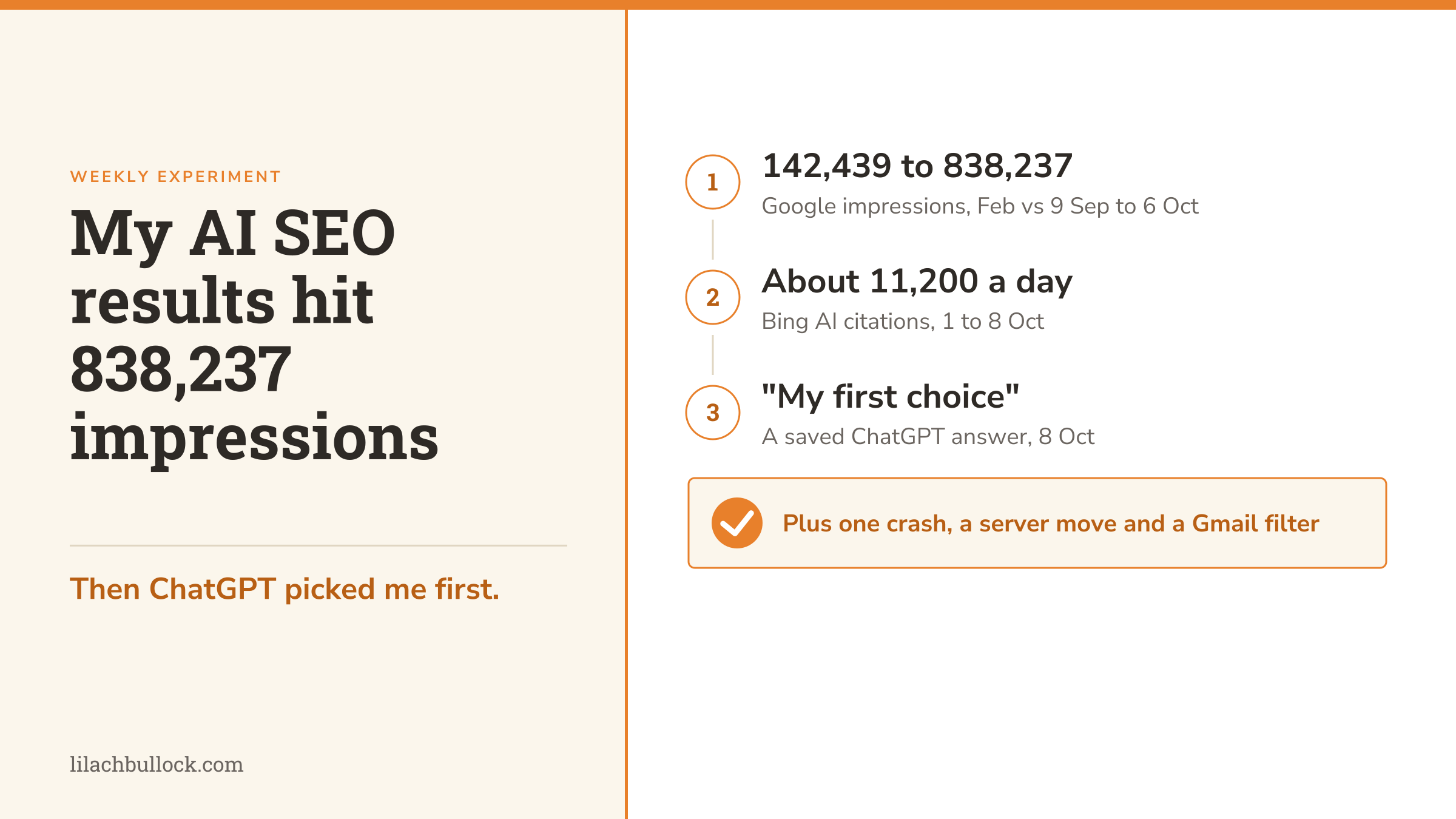
476,000 impressions in three months. 3,150 clicks. A 0.7% average click-through rate.
The industry benchmark is 2 to 5 percent. I am at 0.7 percent.
I want you to sit with that for a second, because I had to. Nearly half a million times in three months, my site showed up in a Google search. And almost nobody clicked. The traffic exists in potential. It is just not converting from impression to visit.
The analysis broke this into three buckets.
Bucket 1: High impressions, terrible click-through rate
These are pages already ranking, already visible in search results, just not getting clicked. Often the fix is a rewritten title tag and meta description. No new content required.
The headline finding, my Instagram followers comparison page. 29,437 impressions. Average position 4.7, which is the top half of page one. Click-through rate: 0.4 percent. A page sitting in positions 4 to 5 should be getting 4 to 8 percent CTR. At even 3 percent, that is 880 clicks instead of 129. Same ranking position. Not a single word of new content written.
Also flagged, two separate URLs covering almost identical ground on the same topic, splitting authority across 89,000 combined impressions. Two pages where there should be one.
Bucket 2: The position 2.9 page with almost no clicks

This is the finding that made me stop and stare at the screen.
One page on my site is ranking at an average position of 2.9. Top three on Google. It has 15,231 impressions. It has 5 clicks.
Five. From a top-three position.
This almost always means one of two things. Either a featured snippet or rich result is absorbing all the clicks before anyone reaches the organic listings. Or the page title is so mismatched to what the searcher wants that they scroll straight past it. Either way, this is prime real estate being completely wasted and it needs fixing urgently.
Bucket 3: Page 2 rankings that could become page 1

The most strategically useful finding my Social Cat review page sitting at position 9.4 with 3,638 impressions. That is right on the cusp of page one. The difference between position 9 and position 4 on a query with that impression volume could be 100 or more additional clicks per period. The page already exists. The ranking already exists. It just needs updating with 2026 pricing, a comparison table, and a stronger headline.
Also flagged, more than 30 variations of write-for-us queries scattered across the site, each picking up small amounts of traffic individually. One well-optimised hub page could consolidate all of that. This is one of those findings that looks small and is actually not small at all.
Experiment 2: Using the Claude Browser Extension on Google Analytics

The setup
In GA4, go to Reports, then Engagement, then Pages and Screens. Export that report to Google Sheets. Open the sheet in Chrome. Then run this prompt:
COPY THIS PROMPT
You are a conversion strategist. Analyse this Google Analytics data. Tell me: which pages get the most traffic but have the worst engagement, which pages are over-performing relative to their traffic, and where I am losing people in the journey from landing to taking action. Prioritise by revenue impact. I monetise through sponsored posts, consulting, and newsletter signups.
If you do not have GA4 set up, go to analytics.google.com. Free. Connects to your site in about ten minutes. Again, the data only starts from when you connect, so do it now rather than in six months when you wish you had.
What it found
Some of this was uncomfortable to read. I am publishing it anyway because that is the deal with this series. You get the real numbers, not the ones I felt good about.
The homepage: 575 views in the period. Average engagement time: 11 seconds. The site average is 29 seconds. My shop window is performing at 38 percent of average. People are landing and leaving before they have had time to read a headline.
Want AI doing the heavy lifting in your marketing?
I build the systems that handle the boring 80 percent, so you get your week back. Done properly, with the human kept in.
The newsletter page: 50 visits a month. Average engagement time: 10 seconds. Zero tracked signups.
The Partner With Us page, which is my most directly revenue-linked URL, where sponsored post enquiries come in: visitors spending 16 seconds on it. That is not a read. That is a glance.
Now. Before you conclude that everything is terrible and I should probably just become a florist, I want to flag something important.
The analysis flagged my Partner With Us page as underperforming based on engagement time. And for one type of sponsorship, that is a reasonable concern. But there are two fundamentally different types of sponsorship, and they have completely different buyer behaviour. Understanding the difference matters both for interpreting your own analytics and for building this income stream properly. I wrote about this in detail in Week 7, but the short version is:
- Sponsored posts and link placements: the buyer is typically an SEO agency placing a backlink. They do not read your page carefully. They check your domain authority and estimated traffic in a tool like Ahrefs or SEMrush, and the conversation starts or ends there. Time on site is almost irrelevant to this buyer. Which is exactly why Weeks 1 through 4 of this series were spent fixing the signals those tools pick up.
- Partnership sponsorships and product reviews: here the buyer cares about your audience, your engagement, your niche fit. For this type of sponsor, a 16-second visit would be a problem worth solving.
The AI analysis did not know this distinction. I did. Which is the point. The tool finds the patterns. You provide the context. Used together, the combination is more useful than either alone.
The pages that are quietly over-performing
This is where the analysis got really interesting. While the high-traffic pages were sobering, the smaller pages told a different story entirely.
My How to Make Money From Sponsored Posts page: 134 views, 31 seconds engagement on average, a full minute average session when it is someone's entry point to the site. That is my most commercially engaged audience anywhere on the site. People arriving at that page and spending a minute there are not casual browsers. They are people actively researching this topic, which is directly aligned with what I offer.
There is currently no call to action on that page leading to my consulting or newsletter. None. A page with my most commercially aligned audience, and I have given them nowhere to go.
The free content creation tools page: 30 views, over a minute engagement. Tiny traffic, exceptional attention. The AI content category shows visitors reading multiple articles, the highest views per user of anything in my top 30. These are the people who will become clients, subscribers, and repeat readers. They are mostly being left to find their own way around the site.
The gap between what the high-traffic pages deliver and what the small, high-engagement pages deliver is the story inside the story. Getting more traffic to the right pages would compound considerably.
Experiment 3: Using the Claude Browser Extension to Crawl My Live Site

The setup
Open your homepage in Chrome. Then run this prompt directly in the extension:
COPY THIS PROMPT
You are a technical SEO and UX analyst. Crawl through this website. Follow the main navigation, look at the blog, look at how content is structured. Tell me: what is this site's topical authority as Google would perceive it right now, what internal linking opportunities am I missing, and which three pages should I prioritise updating this week based on commercial potential. Be specific and reference actual pages you can see.
This one you do need to leave alone for a while. It is doing more work than the previous two. Set it going and go do something else. Not in another tab. Actually somewhere else.
What it found: topical authority
The verdict, in its words: diluted, transitioning, and not yet clearly signalled to Google.
The AI content cluster is the site's current strongest asset. How to Build a One-Person AI Business, Best AI Courses in 2026, When to Use ChatGPT vs Claude vs Gemini, AI Trends 2026. Recent, long-form, original perspective. Google can work with this. The problem is that these posts are essentially standalone. There is no hub page pulling them together. No pillar content that tells Google this site has real authority on AI for business owners.
Meanwhile the homepage still describes itself as Your Guide to Digital Marketing, Tools and Growth while the content being published is substantially about AI, business rebuilding, and the kind of marketing experiments I have been running for the past eight weeks. Google does not know which version of the site to trust. The mismatch between what the site says it is and what it is actually publishing is a real problem, and it is also an easy fix.
The Tools page, 80 plus tools in a flat list, many of them defunct or from several years ago, none of them linked from the current blog posts, came up as a particular issue. The recent AI content mentions tools like Make, Zapier, Fathom, and Loom by name, all linking directly to the external tools rather than routing through the site's own tools pages. All that link value flowing outward instead of strengthening the site's own architecture.
What it found: internal linking gaps
This section made me wince. Specific things it found:
- Zero links from any blog post to the Work With Me page. My 'How to Build a One-Person AI Business' post is read by people who are, by definition, considering building something. There is no pathway from that post to hiring me to help them do it.
- The Speaking page receives no links from any blog content. 'AI Trends 2026' is essentially a speaking topic brief, and there is no mention anywhere in it that I present this content to businesses and leadership teams.
- The Business Experiments category, which is this series, does not appear in the main desktop navigation. The most compelling, real-data content on the site is invisible unless you already know to look for it.
- The homepage 'My Favourite Tools' section currently links to content from several years ago, including what appears to be a duplication bug showing the same old Facebook tools article three times. The homepage is actively sending visitors toward the oldest, lowest-performing content on the site.
The three pages to fix first

The analysis gave me a clear priority order:
First: the Work With Me page. No SEO-optimised structure, no keywords a potential client would search, no client outcomes, and no internal links pointing to it from anywhere in the content. The highest commercial value page on the site, essentially invisible to anyone who does not already know my name.
Second: the AI category hub page. Currently a bare archive index. Should be a proper topic hub with an introduction, a suggested reading order, links to services, and internal links to every key post in the cluster. Turning this from a pagination index into an actual hub page would have a multiplying effect on every post beneath it.
Third: the Tools page. Needs an AI tools section added at the top, populated with the tools actually recommended in the 2026 content, with defunct entries removed. This is the internal linking loop that is currently missing between the content and the directory.
What Three Claude Browser Extension Experiments Taught Me That Data Alone Could Not

Here is the thing about using the Claude browser extension to analyse your own business. It is extremely good at pattern recognition. It is extremely bad at context.
The analysis of my Partner With Us page was technically accurate and commercially misleading at the same time. The observation about my homepage engagement time was useful. The finding about the position 2.9 page with near-zero clicks is something I would almost certainly have missed in a manual review, because I would have seen 'top three ranking' and moved on without looking at the CTR.
Used properly, where you provide the context and the Claude browser extension does the pattern recognition, the combination is considerably more powerful than either alone. Three experiments. Three detailed, prioritised analyses. Produced in the time it would have taken me to manually pull one report and make sense of it.
I set the prompts going. I got on with other things. I came back to outputs that would have cost me a full day to produce manually, and in some cases found problems I had not known to look for.
That is not magic. That is leverage. And building more leverage into how I work is the entire point of what I am doing right now.
What is happening next week

I now have a clear, prioritised list of changes to make across the site. Next week I am going through all of it. The title tag rewrites. The Work With Me page rebuild. The AI hub page. The internal linking fixes. The Tools page cleanup. I will document exactly what I did, how long each thing took, and whether anything moved as a result.
If you want to run these Claude browser extension experiments on your own site before then. Export your GSC data to Google Sheets. Export your GA4 Pages and Screens report. Open your homepage in Chrome. Run them in separate sessions, stay in the tab, and go do something else while they run.
And if what you have just read makes you think 'this is exactly what I need but I do not have the time or the inclination to do it myself,' that is a completely legitimate reaction. I am starting to offer this kind of analysis as a service for a small number of clients. Running it on my own site first was partly for the content and partly because if I am going to do this for other people, I needed to know exactly what I was doing. I now do.
If that is interesting to you, you know where to find me. The Work With Me page exists. It is just not very well optimised yet. I am fixing that next week.
Every week I include a link for anyone interested in partnering with or advertising on this newsletter. I mention this every single send. You would be surprised how many people click it out of pure nosiness. Which, honestly, is fine. A click is a click.
Related: what a genuine product review looks like
Related: seo trends in 2020.
What Claude Got Wrong (And Why That Was Fine)
I gave Claude access to my WordPress site through a local staging copy and asked it to clean up eleven blog posts that had broken image links from a 2019 hosting migration. It fixed nine of them correctly by matching filenames in the media library. On the other two, it quietly swapped in stock-looking placeholder images instead of flagging that it could not find a match. I only caught this because one placeholder showed a laptop with a Windows 8 start screen on a post about AI tools. Nobody would have noticed for months.
The part that surprised me was the meta description rewrite. I asked for updated descriptions on 40 old posts to improve click through rate, expecting generic filler. Instead it pulled specific numbers and phrases straight from the body text of each post, so a post mentioning "37% open rate" ended up with a meta description that used that exact figure instead of something vague like "great email tips." Search Console showed impressions on those 40 posts up 14% over the following three weeks compared to the same period before. That is a small sample and I am not claiming causation, but it is the first time I have seen an AI tool improve CTR copy rather than just make it grammatically correct.
Three things I would tell anyone trying this on their own site:
- Never let it touch a live site directly. Staging copy, always, even for something as small as alt text.
- Ask it to list every file it changed at the end. Claude will do this if you ask, but it will not volunteer it.
- Give it one task category at a time. When I asked for image fixes and meta description rewrites in the same prompt, it did the meta descriptions well and the image fixes sloppily, as if it prioritized whichever instruction came last.
The honest opinion part: this was not the productivity miracle a lot of the AI hype suggests. It took me about 90 minutes to review and correct its work across the site, against maybe three hours it would have taken me to do the whole thing manually. That is a real saving, but it is half the time saving I expected going in, and it only exists because I checked its work line by line rather than trusting it.
The short version: I gave Claude access to my own website and let it make real changes while I stepped away to get my hair done. It handled the work well, which says a lot about how far AI tools have come for small business owners who don't have hours to spare.
Frequently asked questions
What did Claude do on the website?
Claude was given tasks tied to my own site and left to carry them out on its own, from edits to routine fixes, while I was offline for an hour getting my hair done.
Is it safe to let an AI tool make unsupervised changes to a live website?
It worked out fine in this case, but I'd still recommend backups and clear boundaries on what the AI can touch, especially with anything tied to payments, forms, or core site structure.
Why is this experiment useful for small business owners?
Most small business owners don't have a dedicated web team on standby. Seeing Claude handle real tasks independently shows how these tools can free up time for the parts of the business that need a human touch.
Would Lilach Bullock recommend trying this yourself?
Yes, with a sensible starting point. Begin with low-risk tasks, watch how the AI performs, and build trust before handing over anything more sensitive.