


- How Sponsored Post Income Kept the Lights On Three Separate Times
- What Sponsored Posts Actually Are (And Why This Is Different From What You Think)
- The Real Numbers About Sponsored Post Income and What It Pays
- The Thing Nobody Tells You, It's the Tools, Not Your Traffic
- The Tools Agencies Use to Evaluate Your Site (And What They're Looking For)
- How to Find Agencies and Brands to Work With
- How I Reactivated My Client List This Week (The HubSpot Campaign)
- The Pricing Conversation Nobody Has
- Why I Don't Do Affiliate Marketing (And Why You Should Think Hard Before You Do)
- The Editorial Standards Question (Because People Ask)
- How to Set Your Site Up to Receive Sponsored Post Enquiries
- What Sponsored Post Income Has Taught Me About Building Resilient Income
- Catch Up on the Full Series
- Related reading
- The Spreadsheet I Wish I'd Built in Year One
This is Week 7 of my rebuild-in-public series. This week I'm sharing everything I know about sponsored post income and the model that quietly kept my business alive for over a decade. Quick recap if you're new here: Week 1 I de-indexed 1,300 pages from my website in a move that made several people question my sanity, including, briefly, me. Week 2, my email open rate crashed to 11% because the entire email industry changed its rules and forgot to tell anyone. I fixed it. Week 3, five unglamorous technical SEO tasks that nobody talks about and everyone needs to do. Week 4, a content rescue operation across 1,219 pages Google had visited and quietly rejected. Week 5, I got my email open rate to 70% and argued, at some length, that your existing list is an asset you're almost certainly underusing. Week 6, sirens and a husband with broken ribs meant the planned work didn't happen, so I sorted my inbox instead and wrote a full guide on doing the same.
Worth reading next: Business Lessons From the World's Most Successful People.
This week, more of the same context, I'm afraid. But also something worth knowing about if you run a website, sponsored post income. My parents were supposed to come and visit. They couldn't. My husband did make it, broken ribs and all, which I'm grateful for, even though he's now banned from cycling for the foreseeable future and has opinions about this that he's sharing regularly. The sirens continue. The broken sleep continues. The half-listening-for-the-next-one continues.
But something else happened this week too. Something that made me stop mid-afternoon and just sit with it for a moment.
Sponsored post enquiries started coming back.
Not a flood. A trickle. But a trickle is everything when the tap has been dry for months. And it made me think, really think about the income stream that has quietly saved my business more times than anything else I've ever built. The one almost nobody talks about. The one I'm going to walk you through today, in full detail, because if you run a website and you don't know about this, you're leaving money on the table every single week.
First, though. Let me tell you why I got emotional about a handful of enquiry emails. Because the context matters.
How Sponsored Post Income Kept the Lights On Three Separate Times

For the past decade, my website, www.lilachbullock.com has generated sponsored post income from sponsored posts and link placements. At its peak, it produced between $5,000 and $7,000 a month in sponsored post income. For one to two hours of work a week. That number is not a typo. I'm not exaggerating for the headline.
And that income didn't just pay the bills. It bought me freedom in situations where freedom was the only thing that mattered.
When my health was bad. There was a period where I genuinely couldn't work full-time. The sponsored post income kept coming in regardless. I didn't have to chase clients when I could barely get out of bed. It was just there.
During COVID. When every other revenue stream seized up overnight, when clients paused budgets and contracts disappeared and the world essentially stopped, the sponsored posts kept coming. Brands still needed backlinks. SEO agencies still needed placements. The passive engine didn't notice that the world was ending.
During the war. I've written about this before. There are weeks where working is really hard. Where the sirens are too frequent and the sleep is too thin and the concentration is simply not available. The sponsored posts don't care. They keep generating enquiries, keep producing income, keep running in the background while I deal with the foreground.
That's what sponsored post income means in practice. Not 'money while you sleep' in the Instagram-guru sense. It means income that doesn't require your full presence and attention every single day. Income that has a little more resilience than you do.
And here's where I have to be honest about my own role in what happened next.
For a decade, I was literally just taking the money. One hour a week. Sometimes two. Occasionally less. Accepting payments, publishing posts, moving on. I wasn't feeding the beast. I wasn't monitoring Google's changes. I wasn't paying attention to AI's impact on search, to shifting agency behaviour, to the gradual deterioration of my own metrics. The site that was generating $5,000 to $7,000 a month was running entirely on momentum I'd built years earlier and I was coasting on it.
Some of that was unavoidable. My health made it impossible to do more. The war made it harder still. But the honest truth is that a website generating that kind of income deserved at minimum a day a month of proper attention, checking the metrics, staying across Google updates, making sure the foundations weren't quietly crumbling. I didn't give it that. And it's been an expensive lesson.
The income stopped. The enquiries dried up. Losing that sponsored post income was one of the most expensive lessons of my career. And I still don't know, sitting here writing this, whether I've left it too long to get it back. This week I've had some positive signals, enquiries returning, actual income coming in again. Around $1,000 this month so far in sponsored post income, which is the best it's been in six months and, honestly, made me feel something I haven't felt in a while. But I'm nowhere near where I was a year ago at $7,000 a month. I'm not getting bulk orders from agencies. The sponsored post income tap is open, but it's a trickle, not a flow. Which is something. But it's not the destination.
This is an experiment. A real one, with real stakes. I'm testing whether sponsored post income can be rebuilt in 2026 with AI transforming search and Google's algorithm changing faster than most people can track. If it can? This is, I genuinely believe, one of the best business models available to anyone running a website. And almost nobody talks about it openly.
I've wondered about that. Why doesn't anyone talk about this? Is it that the people making good money from it don't want competition? Is it that it exists in an awkward grey area that nobody wants to publicly defend? Possibly both.
Here's the thing that makes it complicated, and I'm going to say it plainly because I'd rather be honest than diplomatic, the SEO industry publicly says you should never pay for links. ‘Don't buy links. It violates Google's guidelines. It's manipulative. It's risky.’ Every conference, every blog post, every agency pitch deck.
And then, in private? Pretty much every SEO agency I have ever worked with buys links. Every one. The public position and the actual practice are two completely different things, and everyone in the industry knows it. I find this, how to put it, a bit rich.
I'm not going to tell you what Google thinks about this, because Google's public position is clear and you can read it yourself. What I will tell you is that link placement as an income stream exists because there is consistent, substantial, professional demand for it. That demand doesn't come from nowhere.
Draw your own conclusions. But sponsored post income is real, it is substantial, and it is available to anyone running a website worth linking to. But don't let the official line stop you from exploring an income stream that, done properly, sponsored post income with editorial standards and a site worth linking to, has supported my business through some of its hardest periods.
So let me tell you exactly how sponsored post income works, how to build it, how to protect it and why I'll choose it over affiliate marketing every single time. But more on that in a moment.
What Sponsored Posts Actually Are (And Why This Is Different From What You Think)
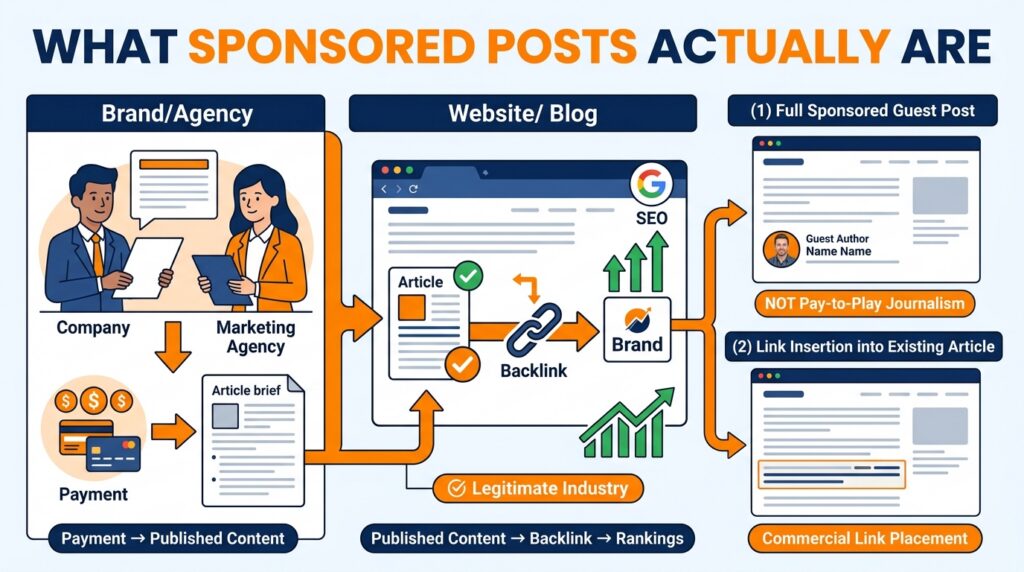
Sponsored posts and link placements are, at their core, simple. A brand or an SEO agency pays you to publish content on your website. That content includes a link to their site. They want the link because backlinks from established, relevant websites improve their Google rankings. You get paid. They get the link. Everyone goes home happy. This is sponsored post income in its simplest form.
There are two main variations:
Sponsored posts. The brand or agency sends you a piece of content to publish on your site. You review it, make sure it meets your editorial standards, publish it, and get paid. The article is attributed to a guest author or published under a generic byline.
Link placements. You already have a published article that's relevant to their topic. They pay you to insert a link to their site into that existing post. One link, naturally placed in context, in a piece of content that's already indexed and getting traffic. Often faster and simpler than a full sponsored post.
This is not the same as pay-to-play journalism. You're not endorsing the product or pretending it's an editorial recommendation. You're providing a commercial link placement on a site with an established audience in a relevant niche. Sponsored post income is a legitimate and widespread industry that operates at enormous scale. The brands and agencies doing this have budgets for sponsored post income. The question is whether they find you.
The Real Numbers About Sponsored Post Income and What It Pays

Let me be honest with you about what's realistic, because the internet is full of people who'll tell you this makes them ten thousand a month without specifying that their site has been running for fifteen years and has three million monthly visitors.
What you earn from sponsored posts and link placements depends on three things: your Domain Authority (DA), your estimated monthly traffic as shown by third-party tools (not your actual Google Analytics, more on this in a moment), and your niche.
Here's a rough framework based on my own experience and what I've seen across the industry:
Sponsored posts (guest posts):
- DA 20–30, traffic under 5,000/month: $50–$80 per post
- DA 30–40, traffic 5,000–15,000/month: $80–$100 per post
- DA 40–50, traffic 15,000–50,000/month: $100–$150 per post
- DA 50+, traffic 50,000+/month: $150+ per post, rising significantly with traffic and niche
Link inclusions (inserting a link into an existing published post):
- Always priced lower than a guest post, typically 30–50% less at any DA level
- The trade-off, simpler, faster, no content to review. But the buyer gets one link in an existing article rather than a full post they can load with multiple links.
A note on links per post, for years I allowed one link per sponsored post and clients were happy to pay for that. I'm more flexible now, the market has shifted and being rigid about it costs you placements. Decide your policy upfront and put it on your submission page, but know that flexibility on link count is increasingly expected, especially by agencies placing at volume.
My site is currently just under DA 50, not where it was, and getting it back up is on the list. But my focus right now is on rebuilding organic traffic first, because that's what moves the needle on everything else. The DA will follow. And even at just under 50, in a relevant niche like digital marketing, business, and AI, the site is still a credible placement for the right agencies.
The key insight with sponsored post income is that you don't need enormous traffic to start. You need consistent, relevant traffic and a DA that's climbing. Even a site at DA 25 with 3,000 monthly visitors in a specific niche can generate $300–$500 a month from this. That's not life-changing. But it's not nothing, and it compounds.
The Thing Nobody Tells You, It's the Tools, Not Your Traffic

Here's the piece of this that most people miss completely, and it's the piece that cost me months of income when I didn't pay attention to it.
When an agency or a brand is deciding whether to place a sponsored post on your site, they don't ask for your Google Analytics screenshot. They don't care what you say your traffic is. They plug your domain into Ahrefs, SEMrush, or Moz, and they look at what those tools estimate your organic traffic to be.
This matters because those tools don't measure your actual traffic. They estimate it, based on the keywords your indexed pages rank for and the estimated search volumes for those keywords. And if your indexed pages are a mess, full of thin content, outdated posts, irrelevant old articles that dilute your topical focus, those tools will show your traffic as much lower than it actually is.
This is exactly what happened to me. My actual traffic was holding up reasonably well. But Ahrefs and SEMrush were showing me as almost invisible, because I had thousands of old, unfocused pages that were diluting the signal. The agencies ran their automated check, saw weak estimated traffic, and moved on. The conversation ended before it started.
This is why the work from Week 1, de-indexing 1,300 pages was the foundation for everything that followed. It wasn't just an SEO exercise. It was a commercial decision. Clean up the indexed pages, improve the tool estimates, make the site visible again to the people who are actively looking to place paid content.
The sponsored post income enquiries coming back this week are the direct result of that work. Six weeks of unglamorous technical cleanup, and the tap is starting to open again.
The Tools Agencies Use to Evaluate Your Site (And What They're Looking For)

If you want to pursue sponsored post income, you need to understand how the buying decision gets made on their side. Here's what agencies and in-house SEO teams are looking at when they evaluate a site for link placement:
Domain Authority (DA) / Domain Rating (DR)
DA is Moz's metric. DR is Ahrefs' equivalent. They measure slightly different things but both broadly indicate how authoritative your domain is based on the quantity and quality of backlinks pointing to it. The higher the number (out of 100), the more valuable your site is as a link placement. You want to be tracking this monthly. It moves slowly, but it moves.
How to check it: Moz's Link Explorer (free tier available), Ahrefs (paid), or simply search 'domain authority checker' for free tools that pull Moz data. The most commonly referenced by agencies is Moz DA, so that's the one to focus on first.
Estimated Organic Traffic
Ahrefs and SEMrush both show estimated monthly organic visitors. This is the number that gets checked first in most agency workflows. They want to see it, at minimum, above 1,000 and ideally significantly higher. Below 1,000 and your site often doesn't pass the automated filter that puts you on the shortlist.
And here's the thing that still stings a little when I think about it, they only care about organic. Not your total traffic. Not your social traffic. Not your newsletter audience or your referral traffic or anything else. Organic search traffic only. Because that's what tells them their link will be seen by people who found the page through Google which is the whole point of the exercise.
My site has generated traffic from social media, email, and other sources well above the thresholds these tools care about. At one point, www.lilachbullock.com received over 600,000 visits a month. Those were the days. But if your organic numbers are weak, none of that other traffic counts in this context. It doesn't matter how many people are coming from LinkedIn or your newsletter. The agencies run their check, see the organic estimate, and that's the number that determines whether the conversation happens or not.
It's brutal. It's also useful to know, because it means the SEO work isn't just about rankings. It's directly tied to whether this income stream is accessible to you at all.
Which is why, if you're considering this income stream or you're already doing it and trying to grow it, you need to understand one thing clearly, the only way this works is if you're prepared to work on your SEO. Seriously and consistently.
I can see my total traffic picking up from my newsletter and from social media. That's encouraging. But the organic traffic, the kind that actually moves the needle for this income model, is the hardest traffic to build and the slowest to respond. It takes months of unglamorous technical work, content refreshing, link building, and patience. There are no shortcuts. I'm living proof of what happens when you take your foot off the gas.
Which means this model isn't for everyone. If you're starting from zero with a brand new site, it will take time before your organic numbers are where they need to be to attract agencies. If you already have a site with decent organic traffic, you're closer than you think. And if you're in my position, rebuilding after a period of neglect, it's possible, but you have to go in with your eyes open about the timeline.
I started this experiment not knowing whether I'd left it too late. I still don't know. But I'm far enough in now to say that the signals are pointing the right way. And if this model still works in 2026, with everything AI is doing to search, with Google's algorithm in constant flux, then the work to get here will have been worth every unglamorous hour of it.
This is the number I'm actively rebuilding. The de-indexing work, the redirect cleanup, the content refresh, all of it is pointing toward getting this number to where it reflects reality rather than an inaccurate picture of a bloated, unfocused site.
Spam Score
Moz's Spam Score indicates what percentage of sites with similar link profiles have been penalised or banned by Google. A high spam score is an immediate disqualifier. You want this low, ideally under 5%. If it's creeping up, it means your site has been linked to from low-quality or spammy sources and you need to run a backlink audit and disavow the problematic ones.
Niche Relevance
Agencies are increasingly selective about niche match. A link from a digital marketing site to a cybersecurity product doesn't carry the same weight as a link from a cybersecurity site. They want topical relevance, not just DA. If your site is clearly about a specific topic, digital marketing, health, finance, parenting, SaaS you'll receive more targeted enquiries from the right type of brands.
Indexed Page Quality
Some agencies will click through and look at recent posts. They want to see that the site is actively maintained, regularly updated, and producing content that looks like it was written for humans rather than search engines. If your most recent post is from eight months ago, that raises a flag.
How to Find Agencies and Brands to Work With

There are two routes to generating sponsored post income, inbound and outbound. Both work. Most successful publishers use both. But I want to be honest about what's driven the majority of my income over the past decade, because it's probably not what you'd expect.
Inbound: The One That Does the Heavy Lifting
For ten years, the vast majority of my leads came to me. I didn't chase them. I didn't cold email. I ranked.
I built multiple blog posts around the terms agencies and brands actually search for, guest posting, write for me, sponsored content, link placements and I made sure those posts ranked well. When someone at an agency Googled ‘write for us digital marketing’ or ‘submit a guest post SEO blog,’ my site came up. They clicked. They enquired. I didn't have to do anything except be findable.
That's the most powerful version of this income stream. Inbound from organic search. It's passive in the truest sense, the SEO does the work, the enquiries arrive, you respond and get paid. I'm only starting to do meaningful outbound now, specifically to speed up the rebuild while the organic rankings recover. I probably should have been doing both all along.
There are three inbound channels worth building:
1. Ranking for the right search terms
Build content around what agencies search for. ‘Write for us [your niche].’ ‘Submit a guest post [your topic].’ ‘Sponsored post [your industry].’ These are commercial searches with real buyers behind them. In Week 4, I built a content cluster of seven interlinked pages all designed to capture exactly this traffic a hub page and spoke pages for each niche I cover. That cluster is already being crawled and starting to generate organic visibility.
2. Listing directories and marketplaces
These are platforms where agencies actively search for sites to place content on. Being listed is free. Once you're listed, you generate enquiries without any active outreach. The platforms worth listing on:
- Authority.builders - one of the larger link placement marketplaces, well-used by agencies
- Adsy - another marketplace with an active buyer side
- Collaborator - particularly strong for European and international placements
- WhitePress - widely used in the agency world
- Linksmanagement - longer-established, still active
- Accessily - newer but growing
- Fatjoe - popular with UK agencies
- Haro Links / Connectively - slightly different model but worth being on
When you list, complete your profile fully and set your pricing clearly. Start slightly lower than you think you should, it's easier to raise prices once you have reviews and a track record than to get your first placements at a premium. In Week 3, I listed on 22 sponsored post directories as part of the pipeline rebuild. This week's enquiries are, at least in part, the result of those listings going live. It takes a few weeks for the inbound to start moving, but once it does, it runs with very little ongoing effort.
3. Re-engaging past clients
More on this in the HubSpot section below, but your existing client list is an inbound channel in its own right. People who have already bought from you are the warmest possible audience. A two-email sequence every few months keeps you front of mind without feeling like a campaign.
Outbound: Direct Outreach
Inbound is better. It's always better. It's also exhausting to manufacture from scratch, which is why I'd never rely on outbound alone. But as a way to accelerate things while your inbound channels are building or to fill gaps in a slower month, it works.
The most efficient approach, find sites in your niche that you know accept sponsored posts. Look at their partner content. Check who those posts are linking to. Those are your warm prospects, they've already bought from a site like yours, in your niche, at roughly your price point. They don't need convincing that this works. They just need to know you exist.
Your pitch email, what works
Keep it short. Make it easy to say yes. Here's the structure and a real example of what it looks like in practice:
Subject: Guest posts / link placements on [YourSite.com] DA [X], [niche]
Want AI doing the heavy lifting in your marketing?
I build the systems that handle the boring 80 percent, so you get your week back. Done properly, with the human kept in.
Hi [Name],
I run [YourSite.com], a [niche] blog with a DA of [X] and an estimated [X,000] monthly organic visitors, audience is primarily [describe: e.g. small business owners, marketers, SaaS founders].
I accept sponsored posts and link placements in [your niche areas]. Pricing starts at $[X] for a link inclusion and $[X] for a full sponsored post, with discounts available for bulk orders.
Full details and submission guidelines here: [link to your write-for-us page]
Happy to answer any questions.
[Your name]
That's it. No preamble. No paragraph about how much you admire their work. No three sentences explaining what a sponsored post is, they know, that's why they're buying them. Just the information they need to make a decision, in the order they need it, with a clear next step.
The subject line matters more than most people think. Lead with your domain name and DA those are the two things an agency scans for first. If the DA is too low for what they're looking for, they'll know immediately and move on, which saves everyone's time. If it's in range, they'll open it.
The combination of all three inbound channels organic rankings, directory listings, and a warm client list, plus selective outbound when you need to move faster, is the most powerful version of this. It's what I'm rebuilding right now, and it's what I'd build from scratch if I were starting today.
How I Reactivated My Client List This Week (The HubSpot Campaign)

One of the most underrated moves in any business rebuild is this, go back to the people who have already paid you.
Over the years, I've built a tagged list in HubSpot of everyone who has ever placed a sponsored post or link placement on my site. Over 1,000 contacts. Every single one of them has already bought this exact thing from me. They know my site, they know the process, they know what they're getting. They are the warmest possible audience for a re-engagement campaign.
This week, I ran a two-email sequence to that list. Here's exactly how I did it.
Why HubSpot for This (And Why It Matters)
I use HubSpot primarily for its sequences feature, and this is the main reason I continue to invest in it even while I'm rebuilding the business. It's not cheap. But here's what it does that a standard newsletter platform like Kit (ConvertKit) doesn't - every single person in the sequence receives the email. Not a percentage. Not whoever passes the platform's deliverability filters on a given day. Everyone.
This is the core difference between a CRM sequence and a newsletter broadcast. Newsletter platforms send to your list and hope for the best with deliverability. A HubSpot sequence goes out as individual, personalised emails from your connected inbox and the delivery rate reflects that. It goes into inboxes, not Promotions tabs.
The sequences feature also lets you:
- Automate follow-ups without them looking automated
- See exactly who opened, clicked, and where they clicked
- Control the sending pace, I send 25–50 per day to avoid overwhelming any single domain and to keep the sends looking human-scale
- Pause the sequence for specific contacts if something comes up
- Tag contacts automatically when they respond, so they're removed from the sequence and moved into your active pipeline
The list management side is what makes this powerful over time. I tag every client who has ever placed content with me. That list is always live. Every new client gets tagged and added. So the asset grows continuously and every future campaign starts from a larger, more valuable base.
The Two-Email Sequence I Sent
I kept it simple. Two emails, spaced a few days apart. No complex automation. No conditional branching. Just two honest emails to people I've worked with before.
Email 1 — The honest update. I explained that I'd been doing significant work on the site over the past couple of months (with links to the series, this content does double duty as social proof), that metrics were improving, and that I was running a limited offer for previous clients while I rebuild. I included the offer, a discounted rate on sponsored posts and link placements. I mentioned that this was time-limited, not as fake urgency, but because I genuinely intend to move pricing back up once the tool estimates recover fully.
Email 2 — The gentle follow-up. Sent a few days later. Short. Just checking the first email landed, restating the offer in one line, and asking if they had anything in the pipeline I could help with. No pressure. No 'last chance'. Just a direct, human follow-up.
The campaign generated responses. Not dozens. But enough to matter. And every time I run one of these, it generates business. Every time. This is five minutes of setup, creating the sequence, loading the list, setting the daily pace and then it runs itself while I get on with other things. That's what I mean by passive pipeline.
The Pricing Conversation Nobody Has
How do you know what to charge? And should you discount while your metrics are recovering?
I discounted for my re-engagement campaign, and I want to explain why and when you should and shouldn't do the same.
My traffic and tool estimates are lower right now than they will be once the SEO work has had time to compound. Charging my previous full rate while the metrics don't yet support it feels commercially dishonest. I know the metrics are improving. I know the site is in better shape than Ahrefs currently shows. But the client can only see what the tools show, and charging a premium against weak tool estimates puts the relationship at risk if they check and feel they overpaid.
So I offered a temporary discount, with full transparency about why. I told them that my site is mid-recovery, here's what's being done [links to the series], here's the discounted rate for now, and here's when I expect pricing to return to normal.
That transparency has been well received. People respect honesty about where things are. What they don't respect is being sold something that doesn't match what the tools tell them.
For setting your prices in the first place, start by checking what comparable sites are charging on the marketplace platforms. Sort by DA and niche, find sites similar to yours, look at their listed pricing. That's your market rate. Don't undercut dramatically, it attracts low-quality buyers who will ask for more than the price is worth. But don't overprice either, especially when you're new to the platforms and have no reviews yet.
Why I Don't Do Affiliate Marketing (And Why You Should Think Hard Before You Do)

Every conversation about passive income from a website eventually arrives at affiliate marketing. And I want to address it directly, because I've been on both sides of it.
I've done affiliate marketing as a publisher. I've managed and built affiliate programmes for companies as a consultant. I've seen how it works from the inside. And my honest view, the one I give everyone who asks, including the templates I send to people when they DM me about passive income is this:
Affiliate marketing is the MLM of digital marketing. And not in a flattering way.
Here's what I mean by that. In a multi-level marketing scheme, the vast majority of participants don't make meaningful money. The data on this is fairly consistent, around 97% of MLM participants make little to nothing. The people who make money are the people at the top who got in early, built large networks, and now earn from the activity of everyone below them. The product is almost secondary to the structure.
Affiliate marketing follows a similar pattern. The people who earn significant, reliable income from affiliate links are the ones with massive, highly-engaged audiences who got into specific programmes early, built the content volume to dominate the ranking, and have the traffic scale to generate meaningful commission even at low conversion rates.
For everyone else, here's the reality:
- Affiliate links break. Programmes change their links, migrate platforms, or close their affiliate programme entirely. Posts you spent time writing and ranking suddenly earn nothing, and you often don't notice until months later.
- Payouts have thresholds. Many affiliate programmes only pay out once you reach a minimum balance, often $50 or $100. If you have 20 programmes each generating $10–30 a month, much of that money sits in accounts you never reach the threshold on. I have affiliate balances I've never collected because the amounts are below the minimum withdrawal. That's not passive income. That's their money.
- Attribution is opaque. You can see clicks. You often can't verify exactly which clicks converted. You're trusting the platform's reporting, and those platforms have a commercial interest in underreporting conversions.
- The commission rates are getting worse. As affiliate marketing has matured, many major programmes have cut commission rates. Amazon Associates, for example, cut rates dramatically in 2020 and they haven't recovered. The economics that made affiliate work five years ago are weaker now.
- You're doing the work; they're keeping the customer. When someone buys through your affiliate link, they become that company's customer. Not yours. You get a one-time commission. They get a lifetime customer relationship. That asymmetry only makes sense if the commission is substantial.
I spent years doing product reviews and testing affiliate income alongside sponsored posts. After several hundred reviews and years of data, my conclusion is clear, unless you have hundreds of thousands of monthly visitors in a high-commission niche (finance, SaaS, insurance), or you're already in the top 1–2% of affiliate earners in your programme, affiliate marketing will not be the income stream it promises to be.
Sponsored posts and link placements pay you a fixed fee. Up front. For a piece of work you've already done. The money arrives in your account regardless of what happens to the link afterwards. No thresholds. No attribution questions. No waiting to see if the click converted.
That's the income stream I'm rebuilding. And this week, with the first enquiries starting to come back in, it feels like exactly the right call.
The Editorial Standards Question (Because People Ask)

I get asked, fairly regularly, whether accepting sponsored posts means compromising the quality or integrity of your site. It's a fair question and I want to answer it honestly.
Yes, it can. If you let it.
I have content standards that sponsored posts have to meet. The content has to be genuinely useful to my audience. It has to be written at a reasonable standard, I edit anything that isn't. It has to be relevant to the topics my site covers. It cannot make claims I know to be false.
What I don't do is accept content about topics that have nothing to do with my site, just because someone's offering to pay. Publish anything that would embarrass me or mislead my readers. Accept content that exists purely to stuff keywords. Let the volume of sponsored content crowd out the organic content that built the site's reputation in the first place.
The sites that damage their reputation with sponsored content are the ones that don't apply any filter. They take everything, publish anything, and eventually their readers stop trusting them and their metrics reflect that. That's not a sponsored post problem. That's a standards problem.
A site with high standards and a clear editorial filter can run sponsored posts indefinitely without any noticeable impact on audience trust. The readers of this site have been with me for years. They know when something is a sponsored post. They don't mind, as long as the content is decent and clearly disclosed. What they'd mind is if I started publishing obvious garbage. So I don't.
How to Set Your Site Up to Receive Sponsored Post Enquiries

Let me put this in a clear sequence, because I've covered a lot of ground and I want to make sure you can action this:
Step 1: Know your current metrics.
Check your Domain Authority in Moz, your Domain Rating in Ahrefs (if you have access), your estimated organic traffic in Ahrefs or SEMrush, and your spam score. These are the numbers agencies will check. You need to know them before you start conversations.
Step 2: Build your write-for-us or sponsored content page.
This is your shop window. It should explain clearly what kind of content you accept, who your audience is, what your metrics are, what you charge, and how to submit or enquire. Keep it simple but make it easy to act on. I built a full content cluster around mine in Week 4, seven pages all pointing back to the main submission page, designed to capture agencies searching for sites in specific niches. That cluster is already generating organic traffic.
Step 3: List on the marketplace platforms.
Start with three or four of the platforms I mentioned above. Complete your profile fully. Include your metrics, your niche, your pricing, a clear description of your audience. Incomplete profiles don't get enquiries. Spend an hour per platform getting the listing right.
Step 4: Tag and maintain your client list.
From the moment you receive your first payment, tag that client in your CRM. HubSpot is what I use. Even a free CRM or a simple spreadsheet is better than nothing. This list is an asset. It grows with every client and every re-engagement campaign gets easier as it gets longer.
Step 5: Run a re-engagement campaign to past clients.
If you've been doing this for any length of time and have a client history, this is the fastest way to generate revenue quickly. Two emails. Keep it honest, keep it brief, include the offer. It takes less than an hour to set up and it works every time.
Step 6: Protect your metrics.
The income from sponsored posts is tied directly to your site's health. Indexed page quality, domain authority, estimated traffic, all of it needs ongoing attention. This is why the work in Weeks 1–6 of this series isn't just SEO for its own sake. It's commercial infrastructure. The better the site's metrics, the higher the rates you can command and the more enquiries you'll receive.
What Sponsored Post Income Has Taught Me About Building Resilient Income

Six weeks of technical work. Sponsored post enquiries starting to come back. Newsletter at 70% open rate and 8% click-through. Inbound enquiries for consulting work from the content and the newsletter. My parents didn't make it this week, but my husband did, broken ribs and all and that means more than I can adequately explain.
The work is compounding. That's the thing about this kind of rebuild, it's invisible for a long time, and then suddenly it isn't. The SEO changes I made in February are starting to show up. The content clusters are getting crawled. The email reputation is solid. And now the first commercial proof that it's working is arriving in my inbox.
It's not back to where it was. Not yet. But the direction is right. And on a week when the context makes it hard to work, when the sirens are too frequent and the sleep is too thin and you're doing it mostly on stubbornness and water because you can't drink coffee or tea,a handful of enquiry emails is enough.
It's enough to keep going.
Catch Up on the Full Series
Week 1: I'm De-Indexing 1,300 Pages to Save My Website (And Why This Might Be Your Only Option Too)
Week 2: My Open Rate Crashed to 11% and I Didn't Even Do Anything Wrong
Week 3: The Unglamorous SEO Work Nobody Talks About (But Everyone Needs to Do)
Week 4: The Content Rescue Operation
Week 5: I Took My Open Rate From 11% to 70%. Here's Exactly How.
Week 6: I Spent This Week Conquering My Inbox Instead of My Blog Posts (And I'm Not Even Sorry)
Related reading
- How to write product reviews that convert: the 7-part framework
- How to get a guest post accepted: the editor's guide
Related reading: Sites That Accept Sponsored Posts: Where to Get Paid in 2026.
Related: free covid reopening signs and 4 other safe ways to resume business.
If this is your subject area, you can write for us about SEO.
Related reading: How to Make Money on Upwork: What I Learned Rebuilding My Freelance Income and How to Build a Passive Income Stream From Skills You Already Have in India.
The Spreadsheet I Wish I'd Built in Year One
For six years I tracked this income stream the way most people do: a running total in my head and a vague sense of "it's been a good month." That worked fine until it didn't. The second time this stream saved my business, I was scrambling to figure out which clients had gone quiet and why, and I had no record to check against. So I built a simple tracker, and I'm sharing the actual columns because the structure matters more than the tool: client name, first booked date, last active date, average monthly value, and a one line note on how the relationship started. Nothing fancy, just Google Sheets.
Six months of using it showed me something I'd missed for years: 40% of my repeat revenue came from just four relationships, and three of those four started from a referral, not from any marketing I'd done. That's not a comfortable number to sit with. It means my "reliable" income stream was one bad conversation away from losing almost half its value. I didn't see that risk until it was written down in front of me.
The other thing the tracker forced me to confront was response time. I went back through email timestamps for the past year and found my average reply time to these specific clients had crept from under 4 hours to almost 2 days. Nobody complained. They just quietly booked less. That's the part nobody tells you about income streams that "save" your business repeatedly: they don't fail loudly, they fail through neglect, and by the time you notice the drop in revenue, the relationship has already cooled for months.
If you're rebuilding something similar, don't just improve the offer or the pricing. Build the tracker first, even a basic one, and be honest about what it shows you. Two questions I'd ask before anything else:
- What percentage of this revenue sits with your top 3 to 5 relationships?
- What's your actual average response time to them, checked against timestamps, not memory?
Those two numbers told me more about why this stream kept rescuing my business, and why it kept slipping, than any strategy session I ever had with myself.

