


- Key takeaways
- Key Takeaways
- Why I Wrote This Guide of the Best AI Courses in 2026
- The Best Free AI Courses in 2026
- 5. IBM SkillsBuild AI Learning Paths
- 6. Harvard CS50: Introduction to AI with Python
- 7. Elements of AI (University of Helsinki)
- 8. HP LIFE: AI for Business
- The Best Paid AI Courses in 2026
- 9. IBM Applied AI Professional Certificate (via Coursera)
- 10. DeepLearning.AI Generative AI with LLMs (via Coursera)
- 11. DataCamp AI Fundamentals Certification
- 12. Google Professional Machine Learning Engineer Certification
- 13. AWS Certified Machine Learning Specialty
- 14. Kellogg School of Management: AI for Business Strategy
- 15. IBM AI Engineering Professional Certificate (Advanced)
- Which of the Best AI Courses in 2026 Is Right for You?
- Frequently Asked Questions About the Best AI Courses in 2026
- Related reading
- More on AI implementation and consulting
- Which Certificates Get Noticed When You Hire (A Test I Ran With My Own Team)
In this blog post I'm walking you through the best AI courses available in 2026, split into free and paid, covering everything from completely beginner-friendly options that require no technical background whatsoever, to more serious programmes for people who want to go deep. Whether you're a business owner who wants to stop nodding along at the word AI as if you know exactly what it means (you don't, and that's fine, neither did I once), a marketer who needs to upskill fast, or someone who genuinely wants a new career direction and suspects AI might be it, this is the list I wish someone had handed me. Consider this your no-nonsense guide to the best AI courses in 2026.
Short answer: the strongest starting points in this list are AI for Business for non-technical learners, Google AI Essentials for a fast free grounding, DeepLearning.AI for depth, and Microsoft's AI-900 path if you want a recognised certification. The full list below covers free and paid options with what each is actually best for.
Key takeaways
- The best AI courses in 2026 range from free introductions to paid, hands-on programmes with projects and certificates.
- Start free to learn the fundamentals (prompting, core concepts, common tools), then pay for a course only when you need a certificate, structured projects or a specific specialism.
- For marketers and business owners, prioritise practical, tool-based courses over heavy theory.
- Check the last-updated date: AI moves fast, so a course refreshed in 2026 is worth far more than an older one.
Key Takeaways
- The best free AI courses right now come from Google, DeepLearning.AI, Microsoft, and the University of Pennsylvania on Coursera.
- All of them require zero technical experience to start.
- Paid courses range from around $49 a month on Coursera to university programmes costing thousands. The expensive ones are only worth it if you have a specific reason to need that credential.
- For most business owners and marketers, the free courses will get you surprisingly far.
- The ones who end up needing paid programmes are usually people moving into technical AI roles or wanting a certificate from a name-brand institution.
- Start free. Go paid only when you've outgrown what's available for nothing.
Why I Wrote This Guide of the Best AI Courses in 2026
I'll be honest with you, which if you've read anything else I've written, you'll know is basically my default setting.
A few months ago I was at an event and someone asked me which AI courses I'd recommend. I rattled off two or three names. Later that evening I sat down to actually check whether the ones I'd mentioned were still good, still free, still relevant in 2026 rather than 2023. Some of them had changed. Some had added paid tiers. Some had been superseded by better options.
That was annoying. And useful. Because it made me realise there wasn't one good up-to-date list that covered both free and paid, explained who each course was for, and gave an honest opinion rather than just a directory of logos.
So I've made one. You're welcome. What follows is my honest take on the best AI courses in 2026, split into free and paid
I've split this into free courses first, then paid. Within each section I've gone roughly from most accessible to most advanced, so if you're starting from zero, begin at the top and work your way down until you hit something that feels like it's pitched slightly above where you are. That's the one to start with.
The Best Free AI Courses in 2026
1. AI for Business: One of the Best AI Courses in 2026 for Non-Technical Learners
FREE | 4 weeks | No experience needed | Certificate included

The University of Pennsylvania, which is, before you ask, a prestigious institution and not something made up for the purposes of this article, offers this course completely free on Coursera. And it's good. Properly good.
It covers AI fundamentals in plain English, how AI is being used in marketing, finance, HR, and management, and how to think about AI strategy for a company or a business you run. The course is designed for people who want to understand how AI works in a business context rather than how to build it themselves. Which, let's be honest, is most of us.
Four weeks long. Five to ten hours a week. Self-paced. Certificate at the end that you can stick on LinkedIn and feel quietly pleased about.
If you're a business owner, a marketer, or anyone who needs to have intelligent conversations about AI without accidentally saying something that makes the technical people in the room wince, this is where I'd tell you to start. It won't turn you into an AI engineer. It will stop you being confused in meetings, which is more immediately useful than people give it credit for.
Who it's for: Business owners, marketers, managers, anyone who needs AI literacy fast without the technical deep-dive.
2. Google AI Essentials
FREE | Approximately 10 hours | No experience needed | Certificate included
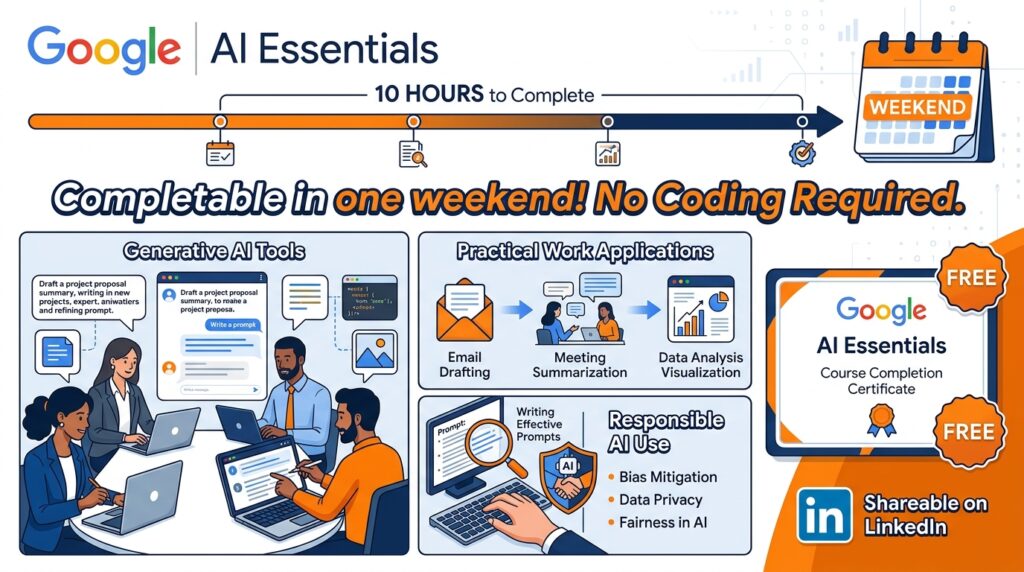
Google made a short, sharp, completely free AI course aimed at people who want to understand what generative AI actually is and how to use it in their work. And unlike a lot of corporate free courses that are essentially extended product demos, this one is genuinely useful.
You'll learn how generative AI works without anyone expecting you to understand the maths behind it, how to write effective prompts, how to use AI tools responsibly, and how to spot opportunities to apply AI in your day-to-day work. No coding. No prerequisites. You could complete this over a weekend if you had a weekend, which statistically speaking most entrepreneurs reading this do not have, but theoretically you could.
There's a certificate at the end that Coursera hosts, so it goes on your LinkedIn with Google's name attached to it. Which is not nothing.
This is a good second course if you've done the University of Pennsylvania one and want to get more practical and tool-focused. It's also a perfectly good first course if you want to skip straight to how do I actually use this stuff rather than the strategic overview.
Who it's for: Anyone. Genuinely. If you've been using ChatGPT by guessing at prompts and hoping for the best, this will immediately improve your results.
3. DeepLearning.AI (Various Free Courses and Specialisations)
FREE | Varies by course | Some suitable for beginners, some more technical | Certificates on some courses
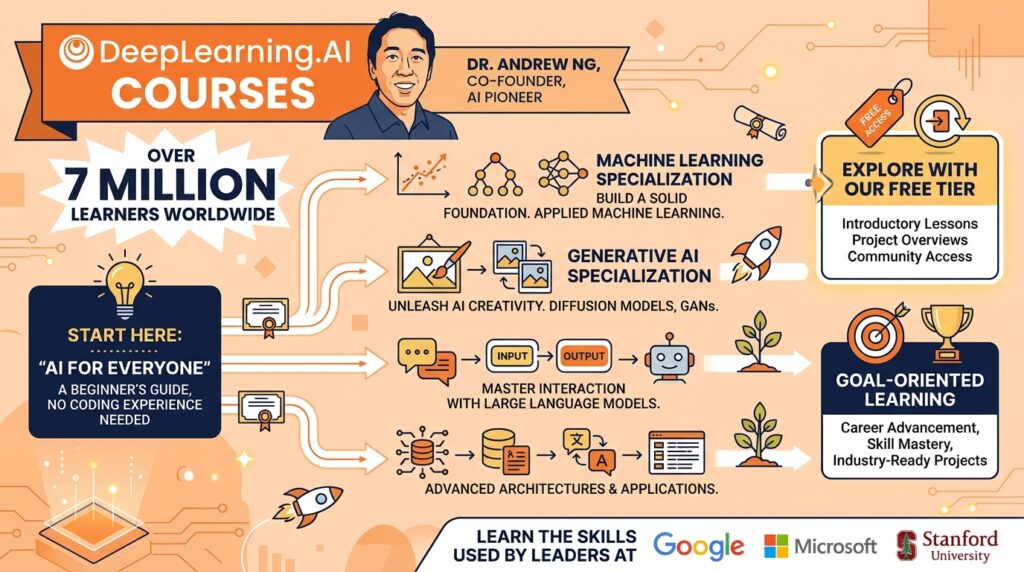
DeepLearning.AI was founded by Andrew Ng, who is one of the most respected names in AI education and one of the few people in the field who is good at explaining complex things simply. The platform has over 7 million learners and their courses are considered good enough that Google, Microsoft, and Stanford use them to educate their employees.
The free tier is substantial. You can access entire specialisations covering machine learning, generative AI, prompt engineering, and large language models without paying anything. If you want a certificate you'll need to pay for Coursera's subscription (more on that in the paid section), but the learning itself is free.
For beginners, the AI For Everyone course is the one to start with. It's specifically designed for non-technical people and focuses on understanding AI strategically rather than building it. For people who want to go deeper into the actual technology, they have more advanced courses that don't require a computer science degree to follow, though they do require a willingness to sit with slightly uncomfortable new concepts for longer than you'd like.
The honest caveat, there's a lot of content here and it can feel overwhelming if you arrive without a clear sense of what you're trying to learn. Have a goal before you start. I want to understand what large language models are and how to work with them is a goal. I want to learn AI is not specific enough to stop you from spending three weeks clicking around and finishing nothing.
Who it's for: Business owners wanting strategic AI literacy, and more technically inclined people who want to go deeper into the actual workings of AI models.
4. Microsoft AI Learning Path (Azure AI Fundamentals / AI-900)
FREE to learn | 10-20 hours | Beginner to intermediate | Exam costs approximately $165 if you want the certification
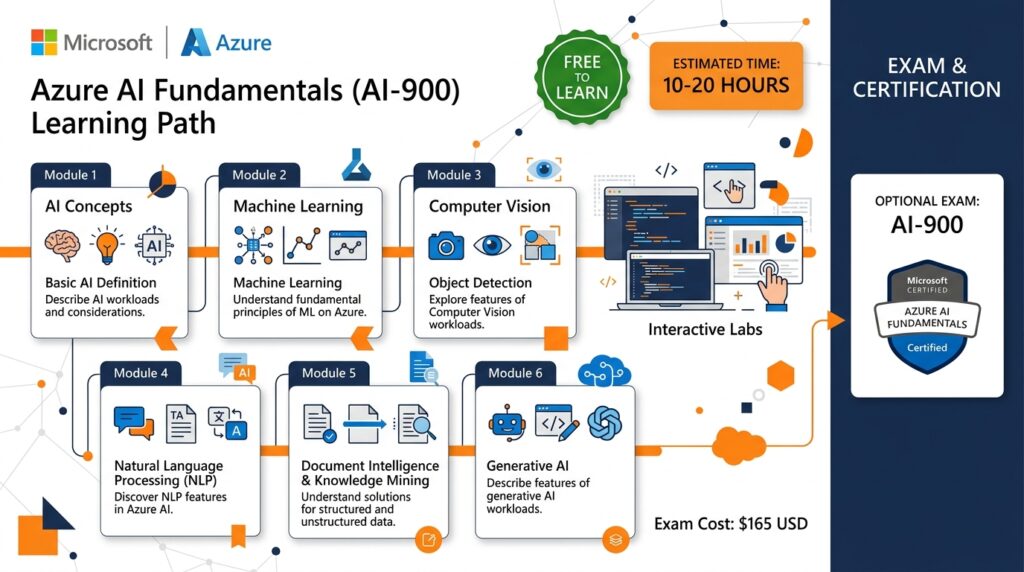
Microsoft offers a completely free learning path through their Learn platform that covers AI fundamentals with a focus on how AI is applied in real business contexts. The content is solid. Interactive labs, short modular lessons, genuine depth on topics like machine learning concepts, natural language processing, and computer vision explained in terms a non-engineer can follow.
The catch, and it's a small one, is that the learning is free but if you want the actual AI-900 certification at the end of it (the one that employers recognise), you'll need to pay for and pass the exam, which costs around $165. The learning path is the free preparation. The certificate is the paid bit.
That said, even without sitting the exam, the learning path itself is worth doing. It's well structured in a way that a lot of free content isn't, and it gives you a solid grounding in how AI fits into business operations rather than just what it is in theory.
One thing I'd note, this is Microsoft's ecosystem, so there's naturally a tilt towards Azure services and Microsoft tools. That's not a problem if your business already uses Microsoft products. If you're entirely Google-stack, just be aware the examples will feel slightly less immediately applicable.
Who it's for: Business professionals who want structured AI learning with a possible certification pathway, particularly those already working in Microsoft environments.
5. IBM SkillsBuild AI Learning Paths
FREE | 10-20 hours | Beginner | Digital credentials included

IBM's SkillsBuild platform offers free AI learning paths that are genuinely good for non-technical learners and specifically designed for people who want to understand how AI fits into organisations rather than how to code it. You cover AI and machine learning concepts in plain language, how AI is applied across finance, healthcare, and retail, and you spend real time on ethics and responsible AI, which matters more than most beginner courses acknowledge.
The learning is modular and self-paced, which is either a blessing or a curse depending on whether you're the kind of person who works well without structure. If you're someone who needs a schedule and accountability to finish anything (most people, including me, honestly), you'll want to be intentional about setting aside specific times rather than vaguely planning to fit it in around everything else.
Digital credentials are included at no cost, which you can share on LinkedIn. Not the same weight as a formal certificate, but they're something.
Who it's for: Business-focused learners who want to understand AI in an organisational context, particularly anyone in HR, operations, finance, or leadership roless
6. Harvard CS50: Introduction to AI with Python
FREE via edX | 7 weeks self-paced | Some technical knowledge helpful | Certificate available for a fee

This is the more technical option in the free section, and I'm including it because some of you reading this are not terrified of technical content and would actually like to understand what's happening underneath the surface of AI tools rather than just how to use them.
Harvard's CS50 AI course covers graph search algorithms, machine learning, reinforcement learning, how to design intelligent systems, and how to use AI in Python programmes. It's a real university course from an institution that has been doing this a very long time, and it shows in the quality of the material.
The reason I'd recommend it for the right person is the depth. Most beginner AI courses teach you what AI can do. This one teaches you why it works, which means you'll be better equipped to adapt as the technology changes rather than needing to relearn everything every eighteen months when a new tool becomes dominant.
The learning is free. If you want the actual Harvard certificate at the end, there's a fee, but the education itself costs nothing.
Who it's for: Anyone with some comfort around technical concepts who wants a deeper, more durable understanding of how AI actually works rather than just which tools to use.
7. Elements of AI (University of Helsinki)
FREE | 30 hours across 6 weeks | No experience needed | Certificate included
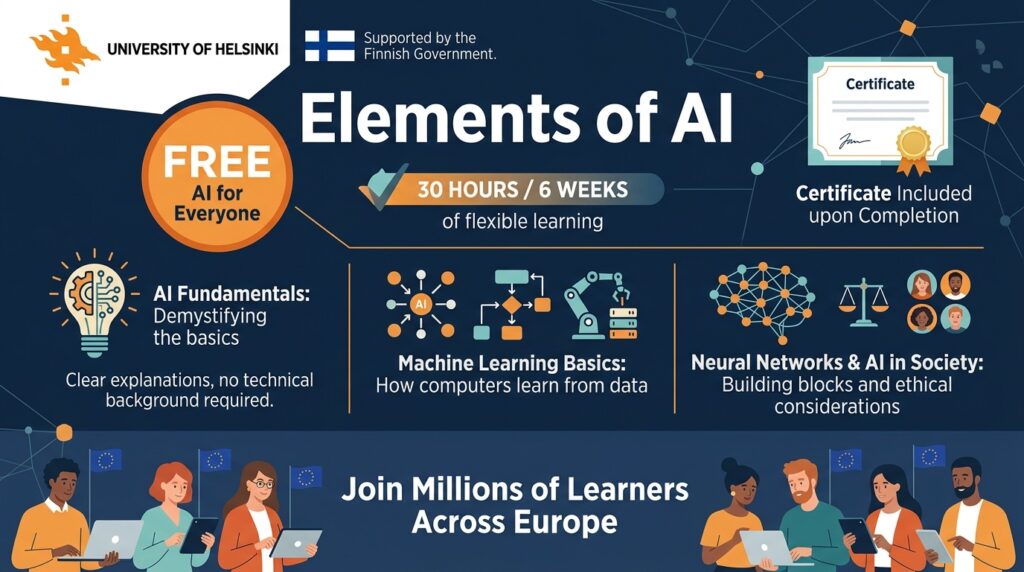
This one is slightly under the radar compared to the big tech company offerings, which is a shame because it's one of the best introductory AI courses available. Built by the University of Helsinki and partly funded by the Finnish government as part of a national AI literacy initiative, it's been taken by millions of people across Europe and beyond.
It covers what AI is, how machine learning works, how neural networks function, and the implications of AI for society and for work, all without requiring any technical background. The explanations are genuinely clear. Not dumbed down, just well written, which is harder than it sounds.
The certificate at the end is free and it's linked to the University of Helsinki, which is a real accredited institution. For a course that costs nothing, the credential carries more weight than you'd expect.
Who it's for: Complete beginners who want a thorough conceptual understanding of AI before deciding which direction to go next.
8. HP LIFE: AI for Business
FREE | Self-paced | No experience needed | Certificate included

HP Life is one of those resources that almost nobody talks about and more people should. It's completely free, it's run by HP, it covers how to use AI specifically to improve business operations and productivity, and it includes guidance on AI ethics and the difference between AI tools and AI-integrated features, which is actually a useful distinction that a lot of introductory courses skip entirely.
It's practical rather than theoretical, which means you leave knowing what to do rather than knowing a lot of interesting things about AI that you're not quite sure how to apply. For small business owners and entrepreneurs who are time-poor and want usable knowledge rather than a comprehensive education, this is worth an afternoon.
Who it's for: Small business owners and entrepreneurs who want practical, immediately applicable AI knowledge without a significant time commitment.
The Best Paid AI Courses in 2026
A note before we get into this section. The free courses above will really take most people a long way. If you're a business owner or marketer who wants to use AI more effectively, you don't necessarily need to spend money. The paid options below are worth considering if you want a more rigorous credential, you're moving into a technical AI role, or you've outgrown what's available for free and want to go deeper. Prices are as accurate as I can make them at the time of writing but do check before you commit. These things change.
9. IBM Applied AI Professional Certificate (via Coursera)
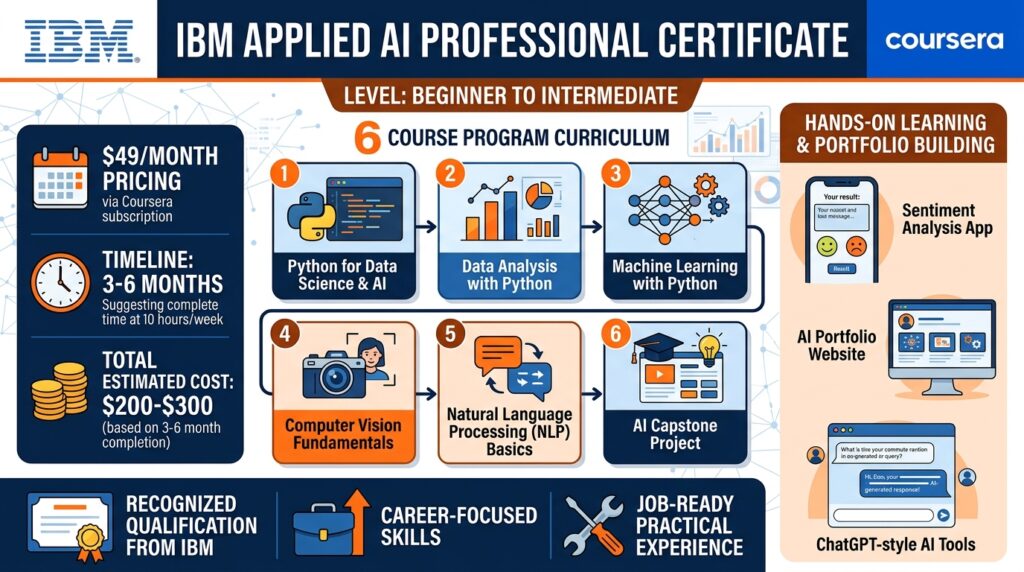
PAID | Approximately $49/month on Coursera | 3-6 months | Beginner to intermediate
IBM's Applied AI Professional Certificate on Coursera is one of the most practical and accessible paid options available, which is why it keeps appearing at the top of recommendation lists that aren't just repeating each other.
It's a six-course programme covering AI applications, Python basics, machine learning, computer vision, and natural language processing. You don't need prior programming knowledge to start, and IBM structures it in a way that builds from foundations rather than assuming you already know the basics.
The standout element is the project work. You'll build a sentiment analysis application, create a portfolio website, develop ChatGPT-style tools. This matters because a certificate alone is less convincing to a potential employer or client than a certificate plus evidence you can actually do things.
At $49 a month on Coursera's subscription model, the total cost depends on how fast you work through it. Most people finish in four to six months, which puts the total cost somewhere between $200 and $300. For the credential and the skills, that's reasonable.
Who it's for: People who want a recognised IBM-branded qualification and practical project experience without needing a prior technical background.
10. DeepLearning.AI Generative AI with LLMs (via Coursera)
PAID | Approximately $49/month on Coursera | 3-4 weeks | Intermediate
Want AI doing the heavy lifting in your marketing?
I build the systems that handle the boring 80 percent, so you get your week back. Done properly, with the human kept in.

If you already have some AI foundations and want to go deep on large language models, generative AI, and how to actually work with these systems in practice, this is one of the best short courses available. It's co-developed with AWS, which means the practical applications are grounded in real infrastructure rather than abstract theory.
You'll cover how large language models are trained, how to fine-tune them for specific applications, how to optimise them, and how to deploy them in real contexts. This is several levels more technical than the beginner courses above and it's worth being honest with yourself about whether you're ready for it before you start.
It's relatively short, three to four weeks, which makes the cost modest if you're already on a Coursera subscription. The certificate carries Andrew Ng's name, which in AI education circles carries genuine weight.
Who it's for: People with existing AI foundations who want to specialise in generative AI and large language models.
Most teams get faster results from practical AI training than from another tool.
11. DataCamp AI Fundamentals Certification
PAID | Subscription from approximately $25/month | Around 10 hours | Beginner
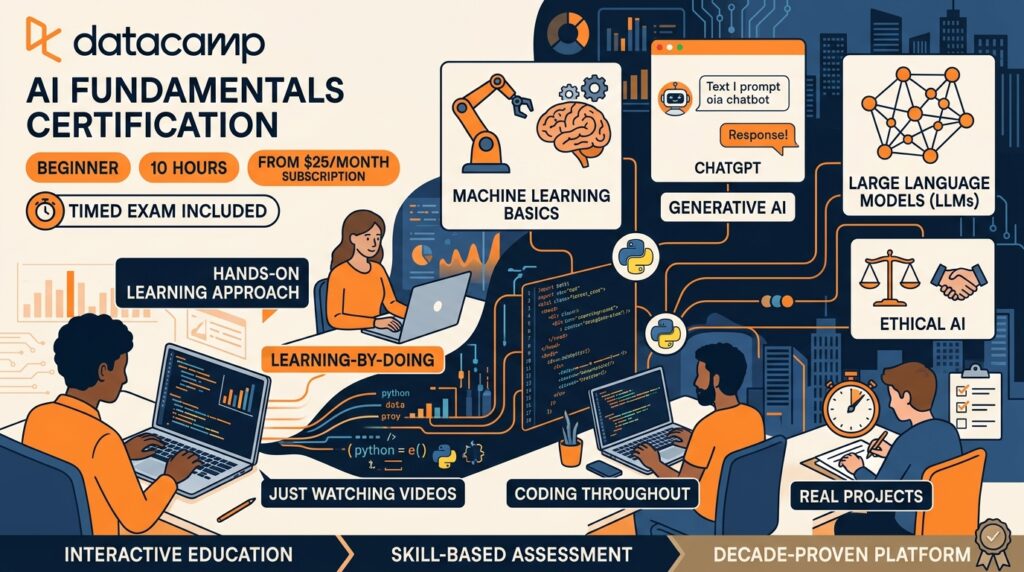
DataCamp has been around for over a decade and has a deserved reputation for practical, hands-on learning that actually sticks. The AI Fundamentals certification is their entry point, covering machine learning basics, generative AI including ChatGPT and large language models, and the ethical dimensions of AI in practice.
What DataCamp does differently from most platforms is the learning-by-doing approach. You're writing code and working with real projects throughout, not just watching videos and answering multiple choice questions. The timed exam at the end is a genuine test rather than a checkbox exercise.
For beginners, this is one of the most practically useful introductions available. You'll leave able to do things rather than just knowing things, which is the distinction that tends to matter when you're trying to apply any of this in the real world.
For more advanced learners, DataCamp offers deeper certifications across data analysis, AI engineering for developers, and specialist tracks. The platform scales with you, which is worth knowing before you commit.
Who it's for: Anyone who learns by doing rather than watching, and wants a certification that tests practical skills rather than theoretical knowledge.
12. Google Professional Machine Learning Engineer Certification
PAID | Exam costs approximately $200 | Preparation time varies | Advanced

This is a professional certification from Google that validates you can build, deploy, and manage production-level machine learning systems at scale. It's not for beginners and it's not pretending to be. The exam is genuinely difficult and the preparation requires serious commitment. The reason it's worth including is the return on investment. Studies consistently show this certification correlates with meaningful salary increases for people in technical roles, and it appears on a significant number of job descriptions for ML engineer positions. For someone moving into technical AI work, it's one of the more recognised credentials available.
Google offers free preparation materials through their Cloud Learning platform, and there are Coursera courses that specifically prepare you for the exam. The $200 exam fee is relatively modest given what the credential represents.
Who it's for: Technical professionals and engineers who want a recognised Google-branded credential for machine learning roles.
13. AWS Certified Machine Learning Specialty
PAID | Exam costs approximately $300 | Preparation time varies | Advanced

AWS's machine learning certification focuses specifically on building and deploying AI systems using Amazon Web Services infrastructure. It's aimed at developers, cloud engineers, and technical professionals who want to bridge the gap between understanding AI conceptually and being able to implement it within cloud environments.
The newer AWS AI Practitioner certification (launched 2024) is a lower barrier entry point for those who aren't technical but want AWS credentials. The ML Specialty sits above that and requires real hands-on experience to pass.
If your business or career is AWS-oriented, this is the natural certification to pursue. If you're primarily working with Google Cloud or Azure infrastructure, the equivalent certifications from those providers will be more directly applicable.
Who it's for: Cloud engineers, developers, and technical professionals working within AWS environments who want a recognised machine learning credential.
14. Kellogg School of Management: AI for Business Strategy
PAID | Approximately $2,600 to $2,900 | 8 weeks | Intermediate to advanced, non-technical

For business leaders, senior managers, consultants, and executives who want serious strategic AI education from a name-brand institution, Kellogg's programme is worth knowing about.
It's eight weeks. It's delivered via Emeritus. It includes business simulations, industry case studies, a final capstone project, and instruction from Kellogg faculty. The areas covered include customer personalisation, predictive analytics, organisational design, and change management, which is to say it's genuinely focused on what senior business people need to know rather than being a technical course wearing a business suit. No prior technical expertise required. The credential from Kellogg Executive Education carries weight in corporate and consulting environments in a way that a Coursera certificate simply doesn't, which is partly what you're paying for.
At $2,600 to $2,900 this is a meaningful investment. It makes sense if the credential matters for your specific career context, you're in a senior role where strategic AI credibility has real commercial value, or you're advising clients on AI strategy and want something more rigorous than a self-directed Coursera path to point to.
Who it's for: Business leaders, consultants, and senior professionals who need strategic AI education and a credible institutional credential.
15. IBM AI Engineering Professional Certificate (Advanced)
PAID | Approximately $49/month on Coursera | 4-6 months | Advanced, technical

If the Applied AI certificate is IBM's accessible entry point, this is the serious programme for people who want to build AI systems themselves. Thirteen courses. Deep technical content. Real work on neural networks, deep learning, and machine learning model deployment.
It requires some prior experience, basic Python skills, and a reasonable comfort level with high school-level mathematics. If those prerequisites sound like a stretch, start with the Applied AI certificate and work up. If they sound manageable, this is one of the most comprehensive technical AI programmes available at this price point.
The portfolio you build during the programme is genuinely useful because it's evidence of what you can actually do rather than just what you know, and that distinction matters when you're trying to move into or advance within technical AI roles.
Who it's for: Technically inclined learners who want to go deep into AI engineering and build a portfolio alongside their certification.
Which of the Best AI Courses in 2026 Is Right for You?
I know. You've just read through fifteen courses and now you want someone to tell you which one to start with.
Fine. Here's how I'd think about it. Here's my honest breakdown of the best AI courses in 2026 by situation. If you're a business owner or marketer who wants to understand AI well enough to use it, make decisions about it, and stop feeling like everyone else in the room knows something you don't, start with the University of Pennsylvania AI for Business course on Coursera. It's free. It's four weeks. It's specifically designed for people like you. Do this one first.
If you want to get practical with AI tools fast and care about writing better prompts and using AI in your daily work, do Google AI Essentials next. Also free. Also fast.
If you want to go deeper on how AI actually works without committing to a technical career, Elements of AI from the University of Helsinki is the most underrated free option on this list.
If you want a paid certification that's genuinely useful and not just a piece of paper, IBM Applied AI Professional Certificate on Coursera is the one I'd point most people towards. Practical, project-based, respected, and relatively affordable at $49 a month.
If you're technical and want to specialise, DeepLearning.AI for LLMs or the Google/AWS cloud certifications are your next destinations.
If you're a senior leader and the credential from a prestigious institution matters for your specific context, Kellogg is worth the investment.
The one thing I'd say regardless of which course you choose, start. Not next month when you've finished the current project. Not when things calm down, which they won't. Now. Or at least this week. The people who are going to look back at this period as the moment they got ahead of the curve are the ones who started before they felt completely ready. Which is always how it works with things that matter. And right now, starting with the best AI courses in 2026 is one of the smartest investments of time you can make.
Frequently Asked Questions About the Best AI Courses in 2026
Do I need a technical background to start learning AI?
No. The majority of courses on this list require zero technical background and are specifically designed for people who have never written a line of code. AI for Business, Google AI Essentials, Elements of AI, and the IBM SkillsBuild paths are all built for non-technical learners. The technical courses like Harvard CS50 and the IBM AI Engineering Certificate are there for people who want to go deeper, but they're not where you have to start. The best AI courses in 2026 are designed with exactly this in mind.
Are free AI courses worth anything?
When it comes to the best AI courses in 2026, free doesn't mean inferior. The free courses from the University of Pennsylvania, Google, DeepLearning.AI, and the University of Helsinki are not consolation prizes for people who can't afford the real thing. They're genuinely good programmes that happen to be free. The certificates from these courses carry real credibility, particularly the Google AI Essentials certificate and anything with DeepLearning.AI's name on it. Free or paid, the best AI courses in 2026 will take you further than you think.
How long does it take to become fluent in AI?
The honest answer is it depends what you mean by fluent. If you mean comfortable using AI tools in your day-to-day work and able to make informed decisions about AI in your business, that's achievable in 30 to 90 days of consistent learning and practice. If you mean technically proficient in building and deploying AI systems, that's a 6 to 12 month project at minimum. The gap between these two things is larger than most people realise, which is why it's worth being specific about what you're actually trying to achieve before you start.
Is a paid AI certification worth it for career advancement?
For technical roles, yes, particularly certifications from Google, AWS, and IBM that appear regularly in job descriptions. For business and leadership roles, the credential matters less than the knowledge, with the exception of programmes from genuinely prestigious institutions like Kellogg, where the name carries weight in specific professional contexts. For entrepreneurs and business owners using AI to run their own businesses better, the free courses are almost always sufficient and the money is better spent on tools and implementation.
What is the best AI course for small business owners?
AI for Business from the University of Pennsylvania is the one I'd recommend first. It's free, it's specifically designed for business contexts, and it covers strategy, marketing, HR, and operations rather than technical implementation. Google AI Essentials is a strong follow-up for getting practical with tools. HP LIFE's AI for Business is worth an afternoon if you want something short and immediately applicable.
Do AI certifications expire?
Some do and some don't. Microsoft's AI-900 certification expires after one year, though Microsoft offers a free renewal exam. Google's Professional Machine Learning Engineer certification also needs periodic renewal. Coursera-based certificates from IBM and DeepLearning.AI do not expire, though the knowledge they certify will become outdated faster than the certificate does. In a field moving as quickly as AI, ongoing learning matters more than any single credential. It's worth factoring this in when choosing from the best AI courses in 2026
Can I learn AI for free and still get a job in the field?
For non-technical AI roles, yes. AI product managers, AI strategists, AI consultants, and business professionals implementing AI solutions are often hired based on demonstrated knowledge and experience rather than specific paid certifications. For technical roles like machine learning engineer or AI developer, free learning supplemented by a project portfolio and eventually a recognised paid certification is the typical path. The portfolio is often more important than the certificate. The best AI courses in 2026 for this path combine free learning with a strong project portfolio.
Which AI course is best for marketers?
Google AI Essentials is the fastest way for marketers to get practically useful. The University of Pennsylvania AI for Business course covers AI in marketing specifically and is worth doing as a foundation. If you want to go deeper into how to use AI for content, campaigns, and customer data, DataCamp has specialist tracks worth exploring.
Related reading
More on AI implementation and consulting
Related: entrepreneurs essentials for building a productive remote office.
Free resource: The Free-to-Paid Upgrade Nudge Swipe File.
And if you are weighing up learning this yourself against bringing someone in, here is how much an AI consultant costs in 2026 so you can compare both routes honestly.
Related reading: 20 Free and paid webinar software tools for 2026 and 30 Actually Free Business Tools (No Trials, No Upsells, No Paid Versions).
Which Certificates Get Noticed When You Hire (A Test I Ran With My Own Team)
Last year I asked my marketing assistant to screen 40 applications for a content role, and I told her to flag any AI course certificates on the CVs so we could compare them. Nineteen candidates listed one. Only three mentioned a course from this list that made me pause and check the syllabus myself: Google's Prompting Essentials, DeepLearning.AI's short courses with Andrew Ng, and the Wharton Generative AI for Business program on Coursera. The rest were generic "AI for Everyone" badges from platforms nobody on my team had heard of, and honestly they told us nothing about whether the person could use the tools day to day.
What changed my mind about free versus paid was not the price tag but the assessment style. The free Google course has you complete real prompt exercises with graded feedback, so a candidate can show actual output, not just a certificate. The paid Wharton course cost one candidate 199 dollars and included a group project she could describe in her interview in specific detail, including which model she used and why it failed the first two times. That is the difference worth paying for: a story you can tell, not just a line on a CV.
If you are choosing a course to list on your own profile, here is what I now tell clients to check before they enrol:
- Does the course end with a project you can show, not just a quiz you can guess your way through
- Is there a discussion forum or cohort element where you had to explain your reasoning to another person
- Can you name one specific thing you built or fixed using what you learned, within a week of finishing
My honest opinion after going through this exercise is that most of the free courses on this list are fine for building basic fluency, but if you want a credential that changes how someone reads your CV, the paid options with a graded capstone project are worth the money. I would rather hire someone who spent 40 dollars and can walk me through a real prompt they debugged than someone with five free badges and nothing to show for them.

