


There's a version of my story that sounds like a masterclass in business strategy. Forbes Top 20. Oracle Social Influencer of Europe. Number One Digital Marketing Influencer in the UK. Built, scaled and sold an agency. Clients including IBM, Twitter, Dropbox. A hundred stages worldwide.
Worth reading next: Dropbox Marketing Strategy: How They Built a Brand That Wins.
That version is true. It's just not the whole truth.
The whole truth is that a significant chunk of what made me successful wasn't strategy. It was luck. It was timing. And if I'm going to be rebuilding everything in public, which I am, this is part of my ongoing rebuild series, then I think it's worth being honest about that. Because I think a lot of us in business quietly know this about ourselves and never say it out loud.
So. Let's say it out loud.
I got in early. That's not a strategy. That's a lottery ticket.

I started using social media in 2006. Not because I was visionary. Because I was curious and I had time and the internet was doing something new and interesting.
I went all in on Twitter before most people in business had even heard of it. By the time Twitter became something people were actively trying to figure out, I already had over 100,000 followers and had spent years understanding how it worked. When businesses started looking for people who could help them with social media and they all started looking at roughly the same time, I was already there, already credible, already visible.
That is timing. I didn't invent Twitter. I didn't predict social media would become the dominant marketing channel of the next decade. I just happened to start playing with it before everyone else, and then I happened to be standing in the right place when the wave arrived.
The research backs this up, by the way. Studies on market timing consistently show that being early to a category is one of the strongest predictors of long-term success, more reliable than having a better product or being more talented. Research published by the Harvard Business Review found that market pioneers hold a long-term market share advantage of nearly 30 percentage points over later entrants. Thirty points. Just for showing up first.
That's not small. That's the difference between building a career and not building one.
Luck is real. We just don't like admitting it.

Here's the other thing we don't say enough in business, luck matters. Not exclusively. Not instead of hard work. But alongside it, in ways we don't control and often don't even notice.
Researchers at the University of Catania ran a simulation of a career economy and found that the most talented people were almost never the most successful. Success correlated strongly with luck, being in the right place, meeting the right person, having the right thing happen at the right moment. Talent was necessary but not sufficient. Luck was the multiplier.
I think about this when I think about some of the pivotal moments in my career. A connection made at an event that turned into a major client. A piece of content that went viral not because it was my best work, but because it hit at a specific cultural moment. Being featured by Forbes at a time when that kind of recognition carried enormous weight for building an online following.
Was I working hard? Yes. Was I competent? I think so. Was I also lucky? Absolutely.
The uncomfortable thing about acknowledging luck is that it can feel like undermining yourself. Like you're saying I don't really deserve this. But that's not what it means. You can work hard, be skilled, make smart decisions and also benefit from factors that had nothing to do with your merit. Both things are true.
What matters, what I'm sitting with right now in the middle of this rebuild, is what happens when the luck runs out.
What happens when the luck runs out.
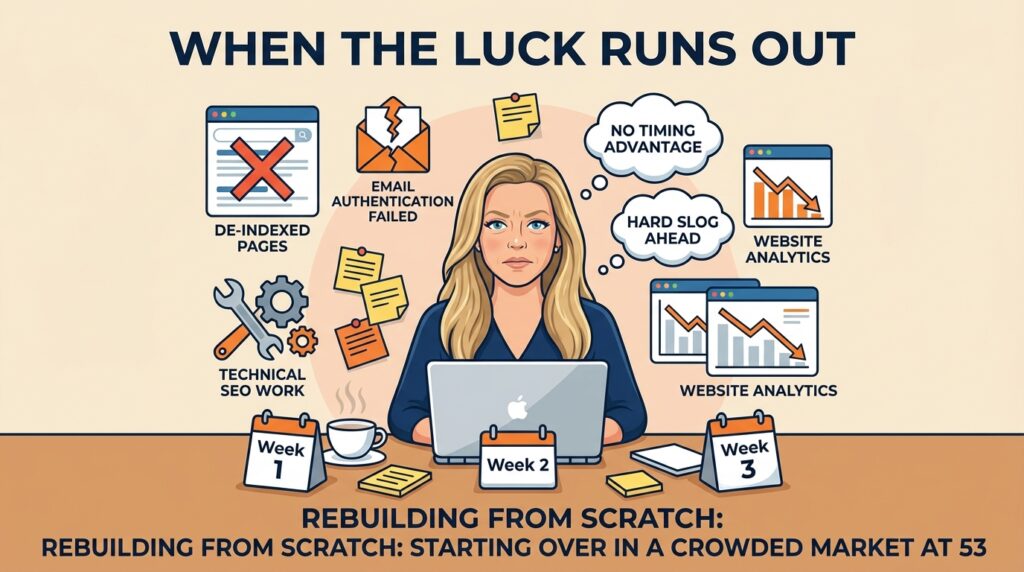
In January 2026 I started rebuilding my business from scratch. In public. Every week on this blog.
Week 1: I de-indexed 1,300 pages from my website to try to save my SEO. People thought I'd lost the plot. Honestly, fair. [Full breakdown here →]
Week 2: My email open rate crashed to 11% because the entire email industry changed its authentication rules and nobody told me. (Well. They probably did. It went to spam.). [Full breakdown here →]
Week 3: I went five levels deep into technical SEO, fixing dead pages, cleaning up redirect chains, auditing over a thousand pages Google had quietly rejected, and submitting to every newsletter sponsorship platform, speaker directory and media source database I could find. Unglamorous. Necessary. [Full breakdown here →]
I'm not telling you this to be dramatic. I'm telling you this because it's real, and because the context matters for what I'm about to say.
Right now, I don't have timing on my side. I'm not early to anything. The market I operate in, digital marketing, AI, business growth is the most crowded it has ever been. There are more coaches, more strategists, more newsletters, more content creators in this space than at any point in history, and more are starting every single day. There is no whitespace. There is no wave to catch.
I'm also 53. Which I say not as an apology, but as a fact. The people who are building audiences quickly right now are mostly younger, more fluent in short-form video, more comfortable with the pace of platforms I spent years mastering and now have to learn again differently. The energy and speed that made me effective in my 30s feel different now. Some days harder. Some days wiser. But different.

And I don't feel like I have luck on my side either. I spent two years in a wheelchair. Not a twisted ankle wheelchair. A surgeons-are-circling-and-nothing-is-working wheelchair. I went through a period where the business I'd spent 20 years building went quiet, not with a bang, just a slow silence, the income disappearing the way guests stop coming to a party nobody told you was over.
I lost 54kg. I got out of the wheelchair. I'm the healthiest and strongest I've ever been. And I'm starting over.
So if I can't rely on timing, and I can't rely on luck, what exactly am I relying on?
How to create luck when you don't have it
I want to be careful here, because there's a version of this section that would be deeply annoying. The version where someone says actually you make your own luck! in a tone that suggests they've never had a bad year.
That's not what I mean. You can't manufacture the kind of luck that comes from being in the right place at the right time during a once-in-a-generation technological shift. That's not available on demand.
But there are things you can do that increase the surface area for luck to find you. And there are things you can do when timing isn't on your side. I'm actively trying all of them right now.
1. Do it in public.

The rebuild-in-public thing isn't a content strategy. Or it's not only a content strategy. It's a positioning strategy too, because radical transparency in a world full of polished highlight reels is itself a differentiator.
Research on what makes content shareable consistently shows that vulnerability and authenticity outperform expertise alone. A 2021 study in the Journal of Marketing Research found that content showing failure and struggle generated significantly more trust and engagement than success-only narratives. People share things they recognise. They share things that make them feel less alone.
So the 11% open rate article? I wrote it because it happened and it was relevant. But it also got shared by people who'd had the same thing happen and felt relieved someone was talking about it honestly. That's not luck. That's a deliberate choice to be real in a space where most people are only honest in retrospect, once everything worked out.
2. Build the asset you actually own.

One of the lessons from being early to Twitter is also one of the hardest ones. I built an audience on someone else's platform. When Twitter changed and it changed, dramatically, that audience didn't come with me automatically. I had to rebuild.
Want AI doing the heavy lifting in your marketing?
I build the systems that handle the boring 80 percent, so you get your week back. Done properly, with the human kept in.
The only asset you actually own in the content world is your email list. Not your Instagram following. Not your LinkedIn connections. Not your Twitter/X audience. The email list.
I'm building mine aggressively right now. Every piece of content, every article in this series, every experiment, it's ultimately in service of the email list. Because when the platform changes again (and it will), the algorithm shifts (and it will), or some new thing arrives that makes everything I'm currently doing look dated (and it will), the email list is what I keep.
3. Stop trying to compete on their terms.
When you're late to a category, you can't out-resource the people who got there first. You can't out-reach them, out-budget them, or out-distribute them. Trying to play the same game and win is a losing strategy.
What you can do is play a different game.
For me, that means being more specific, not less. The noise in digital marketing and AI is enormous, but most of it is generic. Most of it says the same things in slightly different fonts. My advantage isn't in being louder. It's in being more honest, more specific, more willing to share the actual numbers and the actual failures, not just the lessons I've tidied up into tidy takeaways after the fact.
I can't be the freshest voice in the room. But I can be the most real one.
4. Bet on compounding, not virality

When timing is on your side, virality works. You put something out, it catches a wave, it explodes, you get 10,000 subscribers overnight.
That's not available to me right now. And honestly, it's probably not available to most people reading this either.
What's available is compounding. One good article a week. One honest email a week. One relationship built at a time. Slow, boring, unsexy compounding that takes 18 months to look like anything and 36 months to look like something real.
Research by the Content Marketing Institute found that content marketing results compound, sites publishing consistently for three or more years see traffic growth rates dramatically higher than newer sites. Not because of any single piece of content, but because of the cumulative authority built over time.
I'm not going to out-time my competition. So I'm going to out-last them.
5. Use the experience you have.
Here's the one genuine advantage I have over someone starting at 23, I've seen multiple cycles. I was there for the social media boom. I watched the content marketing gold rush. I saw SEO strategies rise and fall. I built and sold an agency. I've made the expensive mistakes and I've made the ones that worked.
That pattern recognition is not nothing. In a space full of people who are very confident about what's working right now, I'm someone who's been wrong before and learned from it. That's super valuable. Not in a way that shows up on a follower count. But in a way that shows up in the quality of the thinking.
The question is whether I can translate that into something people actually want to engage with. That's the experiment I'm running in public right now.
The honest version of where I am

I don't know if this rebuild is going to work. I'm doing it anyway.
I don't have the timing advantages I had when I started. I know that. I don't feel particularly lucky right now. I know that too.
What I have is 20 years of hard-won experience, a genuine willingness to be honest about what's working and what isn't, and a very clear memory of what it felt like to get out of a wheelchair when the surgeons weren't sure I would.
If I could do that, I can do this.
But I'm not going to pretend it's easy, or that I've got it figured out, or that I have some special insight that bypasses the reality of trying to rebuild something meaningful in a saturated market at 53.
I'm just doing the work. Publicly. With the numbers showing.
If you're in a similar position, later to things than you wanted to be, in a market that feels too crowded, wondering if the window has already closed, I don't have a magic answer for you. I have a genuine one, the window is smaller than it was. The wave doesn't work the same way anymore. But doing the work consistently, honestly, and in public still creates something. Just slower and less glamorously than we'd like.
That's the version of luck I'm trying to create. Not the lightning bolt kind. The slow-building kind.
I'll let you know how it goes.
And if you want to follow along in real time, the wins, the numbers, the weeks where nothing works and I write about it anyway, my newsletter is where it all happens first. Every week, one honest update from the rebuild. No pretending I've got it more figured out than I do.
The short version: Success isn't sustainable when it relies on external factors you can't control, which is why I've shifted my entire approach to building a career based on consistent skills and intentional relationships instead. The truth is, once luck stops working in your favor, you have to become your own competitive advantage.
Frequently asked questions
What do you mean by "luck and timing" no longer working for you?
I spent years getting opportunities because I happened to be in the right place at the right time, or because I knew someone who knew someone. But those conditions change. Industries shift, relationships fade, and you can't predict or control when the next lucky break arrives. I realized I'd never built a sustainable system for creating opportunities for myself.
How are you replacing luck with something more reliable?
I'm focusing on three things: developing expertise people actively seek out, showing up consistently in spaces where my audience already is, and deepening genuine relationships with people who understand my work. Instead of waiting for opportunity, I'm creating the conditions where opportunity becomes inevitable.
What's the biggest change you've made in your daily work?
I stopped being reactive and became intentional. That means planning content and outreach weeks in advance, tracking what works, and doubling down on the activities that produce real results rather than hoping something sticks. It's less exciting than riding a lucky streak, but it's far more predictable.
Can luck still play a role in your new approach?
Absolutely. But now it's a bonus, not the foundation. When you're visible, skilled, and connected, luck amplifies what you're already building rather than being your only advantage.
Related reading: Fun Careers for Women That Pay Well: 10 Real Jobs That Don't Feel Like Work and I Built a Private AI Trained on My Own Business, Here's Exactly How to Do It in an Afternoon.

