- What switching Claude accounts did to my working day
- How I built a Mac app without being a developer
- What happens now when an account runs low
- I gave AI my PayPal. I swore I never would.
- The numbers I'd want to see if this were somebody else's business
- The weekly experiments that got me here
- Frequently asked questions
I now have four Claude accounts and one Codex account, and I'm buying another two.
These aren't the free ones. They're paid, high-allowance accounts. The Claude ones are all on the Max plan at its 20x level, and I still run out. I had three when I wrote the 15 November experiment. The amount of work I'm putting through them has gone up that much in a fortnight.
Here's what I don't understand. I love Claude. I love ChatGPT. I would cheerfully pay for one enormous account that lets me get on with my work. I'm standing here with my card out, trying to give somebody more money, and somehow what I end up with is more email addresses to remember.
Claude, pretty please, can I give you more money and remember fewer passwords?
I don't know why the plans work that way. I only know what it was like on my side of the screen, and that's what this week's experiment is about. I got so fed up that I built my own app to fix it. And while I was in a letting-go mood, I did something I swore I never would. I gave AI my PayPal.
What switching Claude accounts did to my working day
I'm halfway through a job. The account I'm on is about to run out of its weekly allowance.
So first I have to work out which of the others has enough left. Then I sign out. Then I sign in with a different email address. Then I go to the right inbox, which is never the one I've got open, and wait for the code.
Meanwhile the thing I was halfway through is still sitting there.
Will the work carry on where I left it? Will the browser be on the same account as the app? How long am I going to spend getting back to something I was already doing?
I can't entirely explain why waiting for a login code gave me so much anxiety, but it did. It's six digits. I've run a business for 23 years. And there I was, staring at an inbox, waiting for an email from one robot so I could carry on talking to another.
I was worried about losing time, and I was worried about my workflow changing under me. Every switch felt like the moment it could all come apart. That's why I built the switcher.
How I built a Mac app without being a developer
I'm not a developer. I've never built an app in my life. What I could do was describe this particular annoyance in considerable detail, and that turned out to be the qualification I needed.
I told AI what happened every time I switched accounts, where I lost my place and what I wanted to have in front of me afterwards. It wrote the app. I used it. Then I came back and complained, and it fixed what I'd complained about. That's the whole method. I was the only customer, and I knew exactly what she'd moan about if we got it wrong.
It didn't work first time, and I'd like you to know that, because nobody mentions it.
The first time I tried to add an account, the app had to close Claude to do it. Claude refused to close because it was still in the middle of five jobs. My app waited 30 seconds, gave up and did nothing. I'd built a switcher that was too polite to switch.
Then one afternoon it vanished from my menu bar. I assumed it had crashed. It hadn't. Its label was a bit too wide, a meeting reminder had turned up next to it, and between them they'd pushed my lovely new app behind the camera notch on my MacBook. It had been running the whole time. It was just hiding behind the camera. I dragged it along a bit and there it was.
And one click didn't mean one second. That first week a switch took about six minutes, because every time it moved me it carefully copied every conversation I'd ever had, three times, to be safe. Very thorough. Not what I'd call fast.
Try it in your own business. Next time you catch yourself saying "hang on, I've got to find it again", notice what "it" is. Say you're preparing a quote. You've got the customer's email open, you go off to find the agreed price, and now you've lost the email with the quantity in it. There's your brief. Describe what you want on the screen when you get back. An email, a price and a quantity are considerably easier to build around than "please make my business more efficient".
What happens now when an account runs low

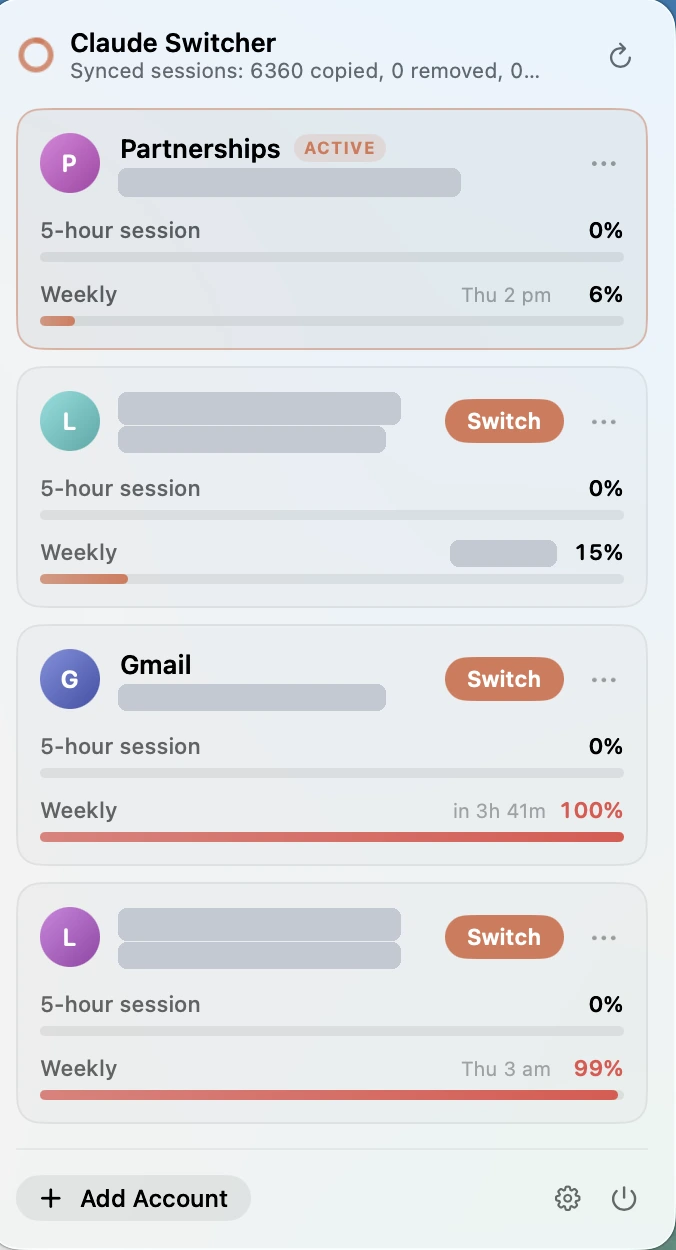
The app lives in the menu bar at the top of my Mac, along from the wifi symbol. It's a little ring with a percentage beside it. That's how much of this week's allowance I've used on the account I'm in.
Click it and I can see all four Claude accounts. Each one shows how much of its week it has used, how much of the shorter five-hour limit, and when it resets. There's a Switch button beside each one. So the question I used to answer by signing in to things, which account has room, is now a glance.
It checks every five minutes. When the account I'm using reaches 90%, it asks if I'd like to move. I click once.
Here's the detail I care about most. The job I was doing when the warning appeared comes with me. Claude closes and reopens on the next account with my work still there, so I pick up where I stopped. And because I use Claude in my browser to work on the website, the browser extension switches to the same account at the same time. I don't end up with the app on one account and the browser on another, wondering which of us is confused.
No signing out. No second inbox. No code.
I gave AI my PayPal. I swore I never would.
Two weeks ago I wrote about the invoice job I'd finally stopped supervising. I was quite pleased with myself. The work carried on by itself once the money arrived. But I was still sending the invoice. Every one of them. Me, personally, like a woman who doesn't trust the post.
I used to swear I'd never hand PayPal over. Money was the bit that had to go through me.
Here's what happens now. Someone asks for an invoice. My system creates it in PayPal and sends it straight to the buyer. I don't see it first. When they pay, the system picks up the payment, publishes the order on my website, emails the buyer their live link and updates my CRM. I don't have to do anything.
This from the woman who, a fortnight ago, had a customer looking for her on LinkedIn so they could pay her.
I can't believe it took me so long to stop being so controlling. Work has got so busy, and the more I let go, the bigger and better the results. All that time I spent insisting an invoice had to go through me, and what that meant in real life was a buyer waiting for an invoice.
Want AI doing the heavy lifting in your marketing?
I build the systems that handle the boring 80 percent, so you get your week back. Done properly, with the human kept in.
There's a fair question here. How do I know the buyer got what they paid for?
On 27 November we checked all 108 PayPal payments for the month so far. For each payment, we looked for the work the buyer had received. One paid order had been missed. It was found and delivered that same day.
I keep coming back to that one buyer. If you'd shown me a list of everything we'd published, I could have read the whole thing and never noticed theirs was missing. Starting with who'd paid gave us a name to look for. Seeing every invoice before it went out wouldn't have told me a thing about whether that person got what they'd bought.
Try it in your own business. Open a payment from last month. Now find what the customer received. If you sell a service, that might be a report or a booking confirmation. If you sell a product, it might be the delivery record. Could someone other than you match the two? If the only evidence is that you remember doing it, start there. You can try this with two lists and a cup of coffee. PayPal access can wait.
The numbers I'd want to see if this were somebody else's business
Here are the figures I shared on 15 November beside the latest ones. If you only look at one comparison, look at enquiries. November was already 74% ahead of the whole of October by the 28th, and the inbox had slowed down since I last wrote. Both felt rather important to mention.
Enquiries | 3,091 by 28 November
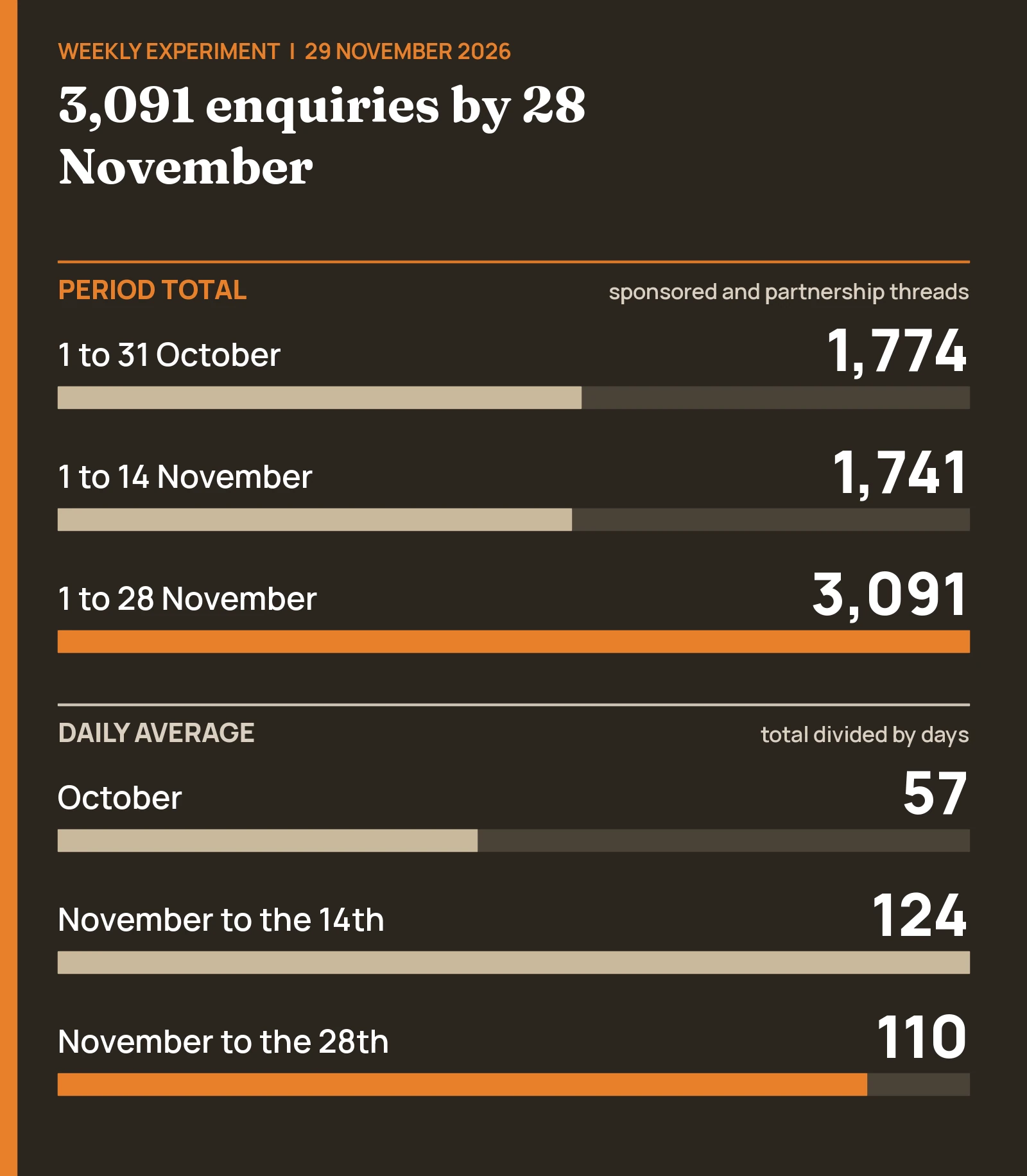
- October: 1,774 enquiries, about 57 a day.
- 1 to 14 November: 1,741, about 124 a day.
- 1 to 28 November: 3,091, about 110 a day.
In the second fortnight alone, 1,350 enquiries came in. That works out at about 96 a day. Some relief after 124, although if you'd offered me 96 enquiries a day in October I'd have wanted to know where you were getting them. These are incoming sponsorship and partnership conversations, counted the same way each time.
Try it with your inbox. Take one enquiry that turned into a sale and count how many times the buyer had to come back to you. Did they ask for something you could have included in your first reply? When I looked at what happened after 83 enquiries came in on one day, it was the replies that had to keep up.
Newsletter | 76% more new subscribers than in October
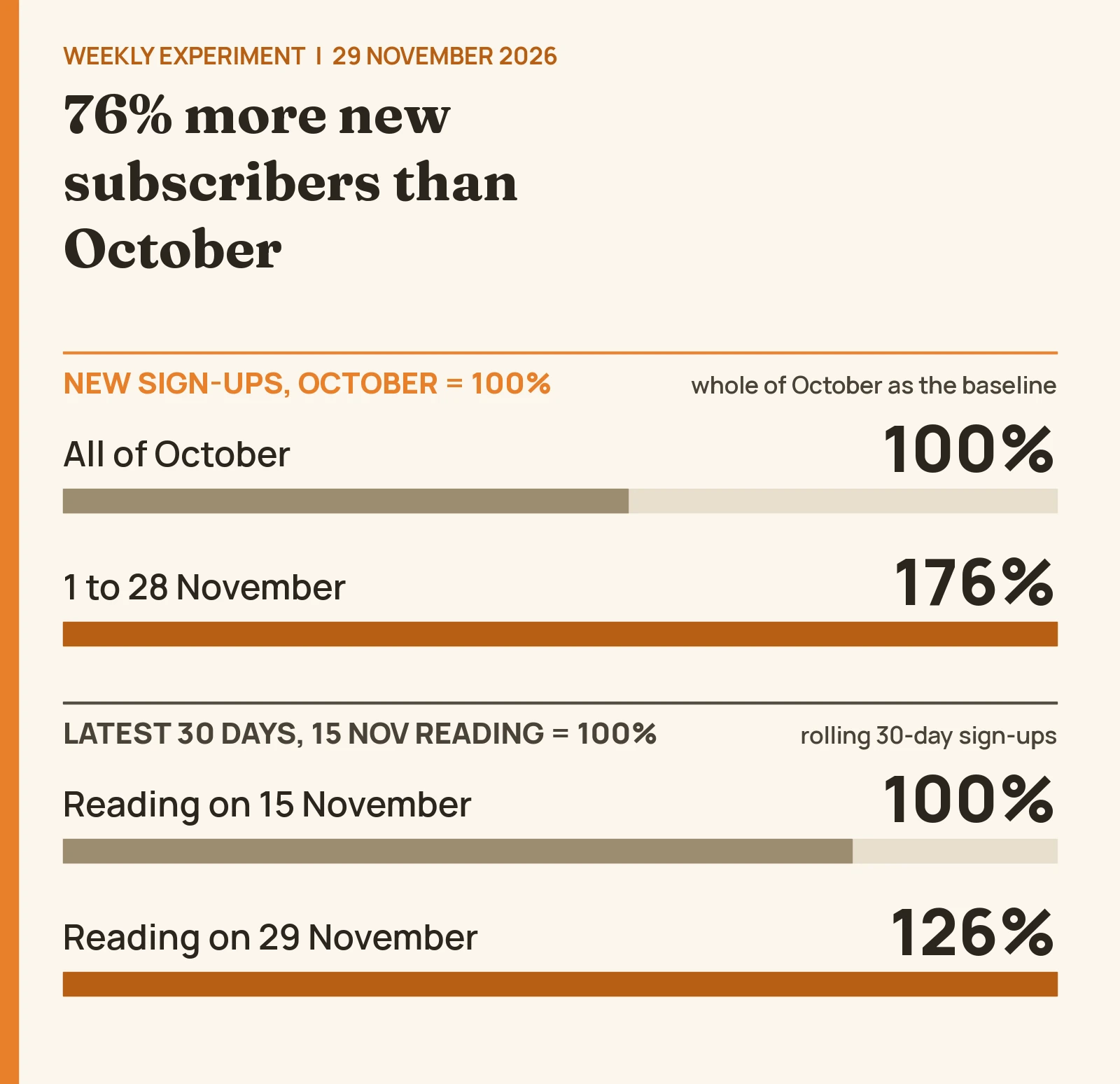
- First 14 days of November: more than four fifths of October's new signups in a fortnight.
- By 28 November: 76% more people had signed up than in the whole of October.
- Latest 30 days: new signups were more than 25% higher than in the 30-day figure I shared on 15 November.
That's a lot of people getting their first issue from me. They didn't sit through the bit where I redesigned the newsletter and it backfired. They don't know the history of the website or why I'm telling them about my PayPal account. The first issue they open has to make sense on its own. It's one reason I link back to the bit of the story that got me here.
Try it with your newsletter. Give someone the signup page and the last issue you sent. Can they point to the thing in the issue that persuaded them to subscribe? If you promise real examples, let them read one before they give you their email address.
Google visibility | 9.9 million impressions in 28 days
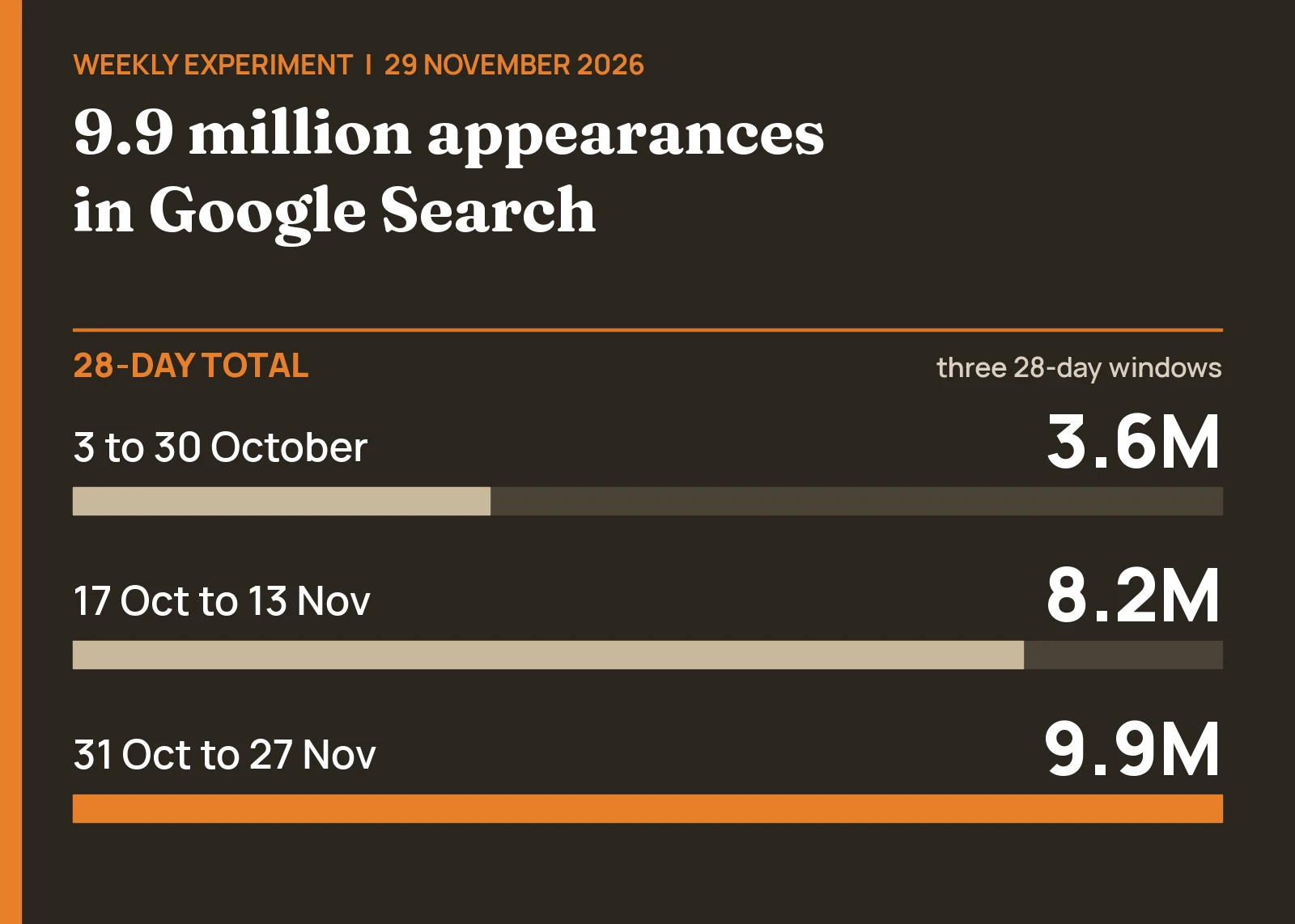
- 3 to 30 October: 3.6 million appearances in Google Search.
- 28 days to 13 November: 8.2 million.
- 28 days to 27 November: 9,920,716, up 20% on the previous reading.
I spent one of these experiments trying to understand why Google had crawled my pages and still wouldn't index them. I rather like being able to put 9.9 million next to that sentence. But these are appearances in search results. To see how many times somebody chose to come through, you need the clicks further down. Also worth knowing if you're comparing the figures at home: the two November readings have a fortnight in common.
Try it on one page. In Search Console, open the queries for a page that gets plenty of impressions. Pick one you recognise from a real customer conversation. Now read your headline as that customer. Can they tell you cover the thing they need, or do they have to click and hope?
AI visibility | About 29,500 citations a day
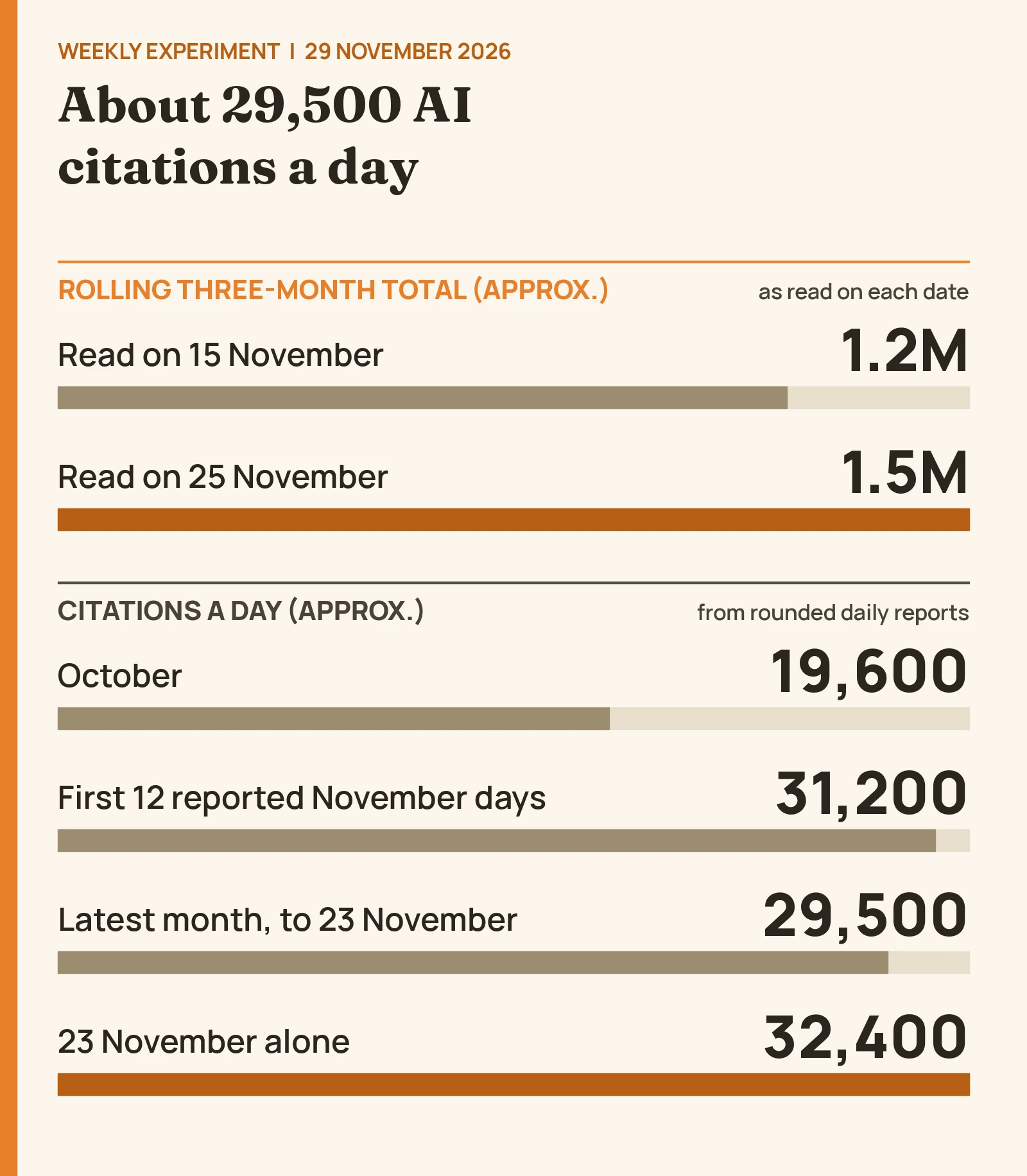
- October: about 19,600 citations a day.
- First 12 reported days of November: about 31,200 a day.
- The latest month in the report, to 23 November: about 29,500 a day. On 23 November alone, about 32,400.
- Rolling three-month total: about 1.2 million when I checked on 15 November and about 1.5 million on 25 November.
A citation is an occasion when an AI answer uses one of my pages as a source. The reader can get their answer without ever coming to my site. My favourite thing about the experiment where ChatGPT recommended me was that I could follow what happened to a person. These figures tell me how often the pages were used. They can't tell me who's sitting at the other end.
Try it with a question customers ask you. Read the bit of your page that answers it. Could someone lift that paragraph and still get the answer right? If delivery takes two days after the customer approves the artwork, that last bit belongs beside the two days. Anyone who's ever waited for artwork will know why.
Website traffic | 46,290 clicks from Google in 28 days
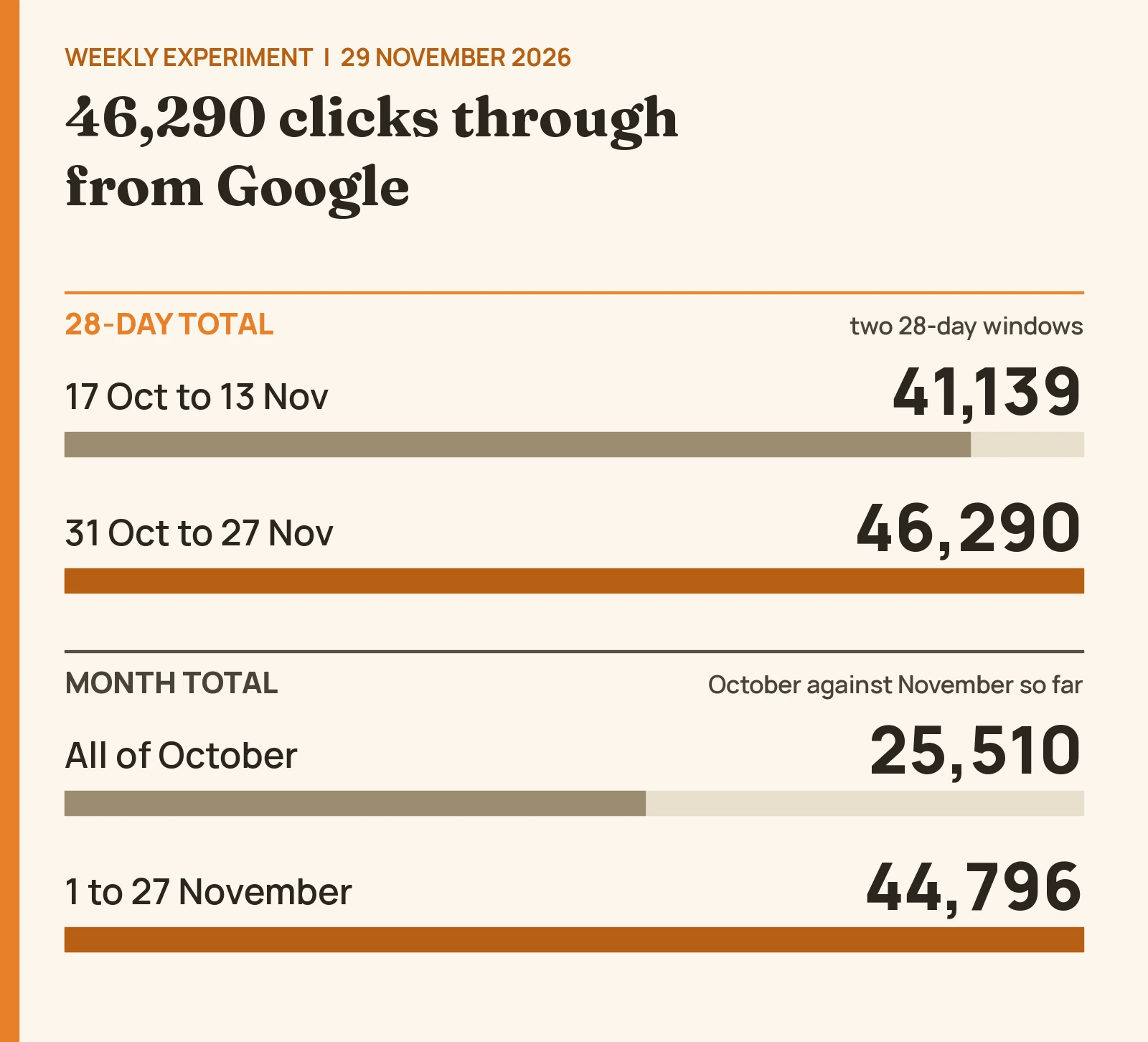
- 28 days to 13 November: 41,139 clicks.
- 28 days to 27 November: 46,290 clicks, up 13%.
- From the start of the month: 44,796 clicks by 27 November, against 25,510 in the whole of October.
If you've been following the traffic rebuild since the 8 November experiment, the 28-day figures are the ones to put side by side.
Try it with a traffic dip. Pick a page that lost clicks and look up its biggest search query for the same dates. Did the page appear less often for that query, or did fewer people click when it appeared? I'd want the answer to that before I spent an afternoon rewriting the page.
Media income | Up 154% on October by 28 November
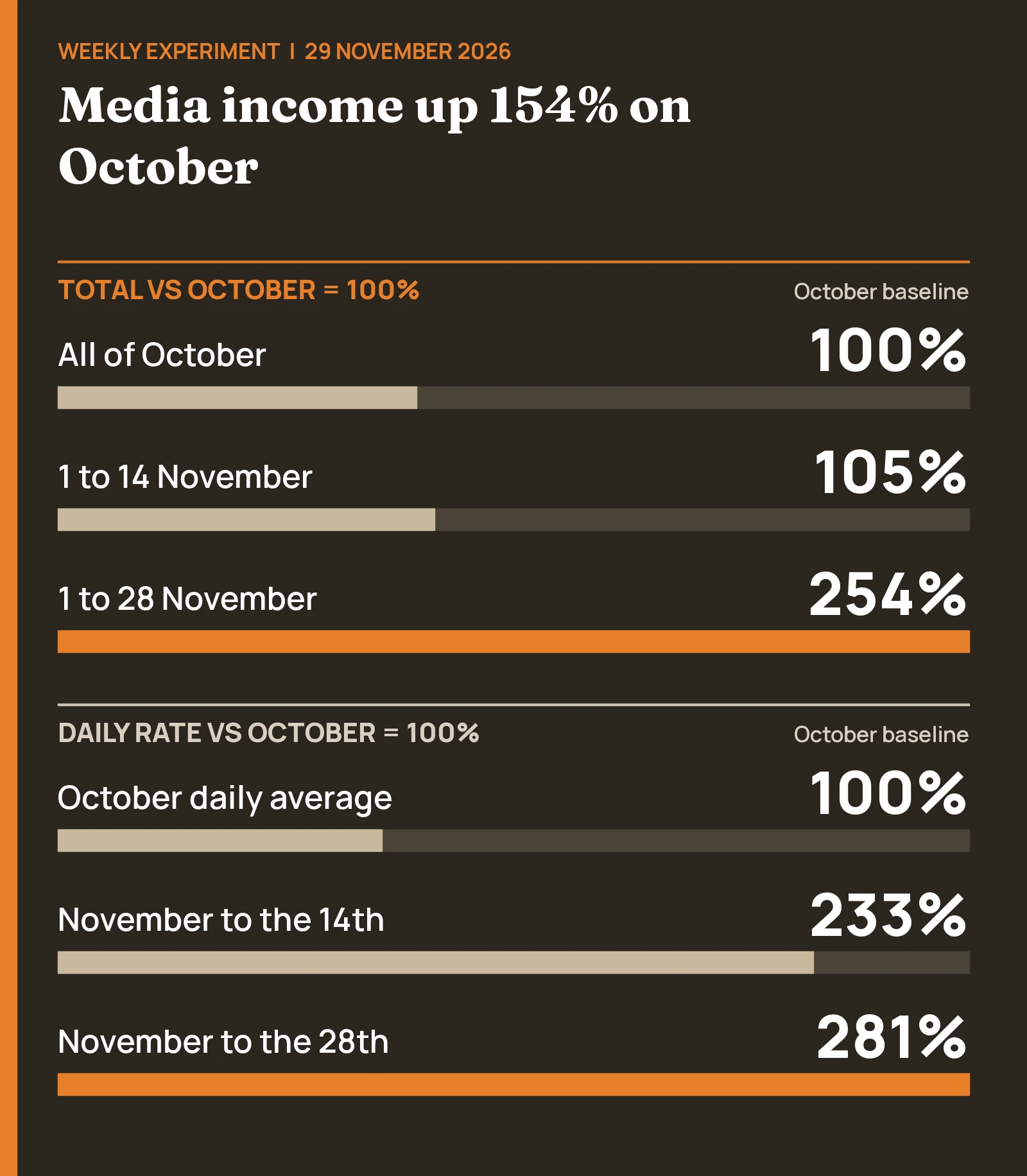
- By 14 November: media income had reached 105% of the whole of October. Average daily income was up 133% on October.
- By 28 November: media income was 154% above the whole of October. Average daily income was up 181%.
- Paid and delivered orders: 71 in October, 72 by 14 November and 179 by 28 November.
This is the money from sponsored posts, product placements and newsletter sponsorships. I've written about how the sponsored side of the business started paying me again. What I hadn't appreciated then was how many times a day I'd be interrupting myself if every buyer still needed me personally to send an invoice.
The 179 counts orders paid and delivered by the 28th. The 108 in the PayPal story counts payments checked on the 27th. Different records and different dates. The figure I wanted beside the income was how much work we'd finished for the people who'd paid us.
Try it with your sales figures. Put the number of completed orders next to the money received for the same period. Then pick the oldest payment still waiting for delivery. How long has that customer been waiting, and do they know what's happening? I found one person who was owed their order. That was worth knowing even in a month when the income figure looked lovely.
Two weeks ago I was writing about a customer trying to find me so they could pay. Now a buyer can ask for the invoice, pay and get their live link while I'm doing something else. Of everything I've handed over this month, that's the bit I wish I'd done sooner.
The weekly experiments that got me here
- Week 1: I de-indexed 1,300 pages to save my website
- Week 2: My newsletter stopped getting opened
- Week 3: The unglamorous SEO work nobody talks about
- Week 4: The crawled-but-not-indexed problem
- Week 5: Getting my newsletter opened again
- Week 6: Conquering my inbox instead of my blog posts
- Week 7: The sponsored post experiment that helped rebuild my business
- Week 8: I let Claude loose on my website
- Week 9: The newsletter redesign that backfired
- Week 10: Automating my WordPress publishing
- Week 11: Rescuing the pages I'd de-indexed
- Week 12: Getting AI to help with my inbox
- Week 13: The month my website started paying me again
- Week 14: The rebuild in public numbers
- Week 15: Getting found by AI
- Week 16: Setting up cold email with AI
- Week 17: My hands-free cold email disaster
- The five-month passive income comeback
- Week 19: I asked one AI to audit another
- Building an AI agent to run my newsletter
- My AI SEO results and the ChatGPT recommendation
- My experiment with AI in everyday life
- Week 20: My enquiries hit 83 in a day. My email system had to catch up
- 8 November: How I grew website traffic and what it cost me to keep up
- 15 November: Growth isn't linear, and a customer had to find me on LinkedIn to pay me
Frequently asked questions
How do I switch between four Claude accounts on my Mac?
I use the small menu bar app I built. It checks each account's weekly allowance every five minutes and offers to switch when the current account reaches 90%. One click moves me to the next account with my open work, and switches the browser extension too.
Does the switcher handle my Codex account as well?
The four accounts in the switcher are my Claude accounts. Codex is separate.
Do I approve a PayPal invoice before the buyer gets it?
No. The buyer's request starts the process. The system sends the invoice, detects payment, publishes the order, emails the buyer their live link and updates my CRM. I don't have to step in to move the order along.
How did I find the paid order that had been missed?
On 27 November we started with all 108 PayPal payments for the month so far and matched them one by one to what we'd delivered. One payment had no delivery to go with it. That buyer got their order the same day.
How could I try this if I still do all my invoices by hand?
Start at the buyer's end. Pick a paid invoice and see if you can find their delivery email from the payment record. That will tell you what information your invoicing and delivery records need to share, even if you decide to keep sending every invoice yourself.