- First, the experiments that got me here
- What are my AI SEO results so far?
- How did I use AI to recover my website?
- What did ChatGPT say when asked who to hire?
- How often is AI citing my website now?
- So how did I manage to crash the website?
- What went wrong after the hosting move?
- How much SEO work can the system do now?
- What would I do first on your website?
- Questions about AI SEO and getting cited by AI
- Want your business to be the name AI recommends?
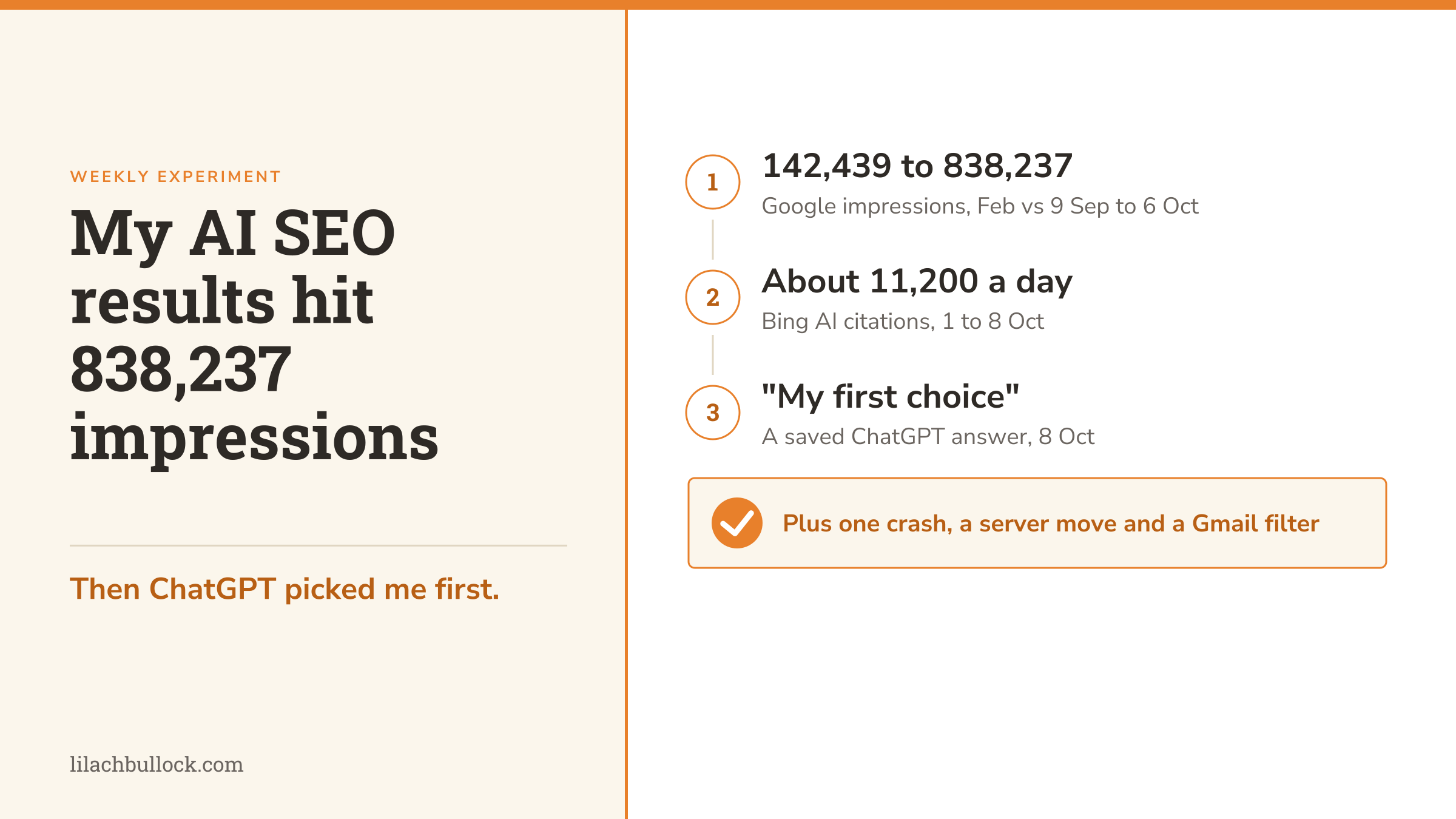
In this blog post I'm going to share how I rebuilt my website from 142,439 Google impressions in February to 838,237 in the 28 days to 6 October, and the AI SEO results that now include ChatGPT putting my name at the top of a recommendation.
I'm super excited about this. Nearly six times the Google visibility. Around 11,200 AI citations a day in the first eight days of October. More sponsored enquiries. And an answer to a question about hiring an AI marketing consultant that opens with "My first choice: Lilach Bullock".
I'll take that.
However, it hasn't all been plain sailing. In between those numbers, I crashed my website, moved it to a bigger server and discovered that some of my missing enquiries were sitting in Gmail's Trash. I'd been blaming the host. The filter was mine.
So I'm going to walk you through what I changed, how I started getting cited by AI, what broke and how I fixed it. If you want more of your buyers finding you through Google, ChatGPT or Perplexity, there's plenty here to use on your own site.
And if you'd rather have me do the work, I'll explain that too. This is the work I'm now offering to other businesses.
First, the experiments that got me here
This is the latest chapter of my rebuild in public. If you've been following along, thank you. You've sat through a fair amount of things going wrong before we got to this bit.
If you're new, here's the story so far. You can start anywhere:
- Week 1: I de-indexed 1,300 pages to save my website
- Week 2: My newsletter stopped getting opened
- Week 3: The unglamorous SEO work nobody talks about
- Week 4: The crawled-but-not-indexed problem
- Week 5: Getting my newsletter opened again
- Week 6: Conquering my inbox instead of my blog posts
- Week 7: The income stream that saved my business three times
- Week 8: I let Claude loose on my website
- Week 9: The newsletter redesign that backfired
- Week 10: Automating my WordPress publishing
- Week 11: Rescuing the pages I'd de-indexed
- Week 12: Getting AI to help with my inbox
- Week 13: The month my website started paying me again
- Week 14: The rebuild in public numbers
- Week 15: Getting found by AI
- Week 16: Setting up cold email with AI
- Week 17: My hands-free cold email disaster
- The five-month passive income comeback
- Week 19: I asked one AI to audit another
- Building an AI agent to run my newsletter
There's also my experiment with AI in everyday life, if you'd like to see how far this obsession extends beyond work.
The quick result: My site reached 838,237 Google impressions over 28 days, up from February's 142,439. Bing's AI report now shows about 328,700 citations across three months, averaging around 11,200 a day during 1-8 October. And in a saved answer on 8 October, ChatGPT named me its first choice for a small-business AI marketing consultant question. Here's what I've been doing.
What are my AI SEO results so far?
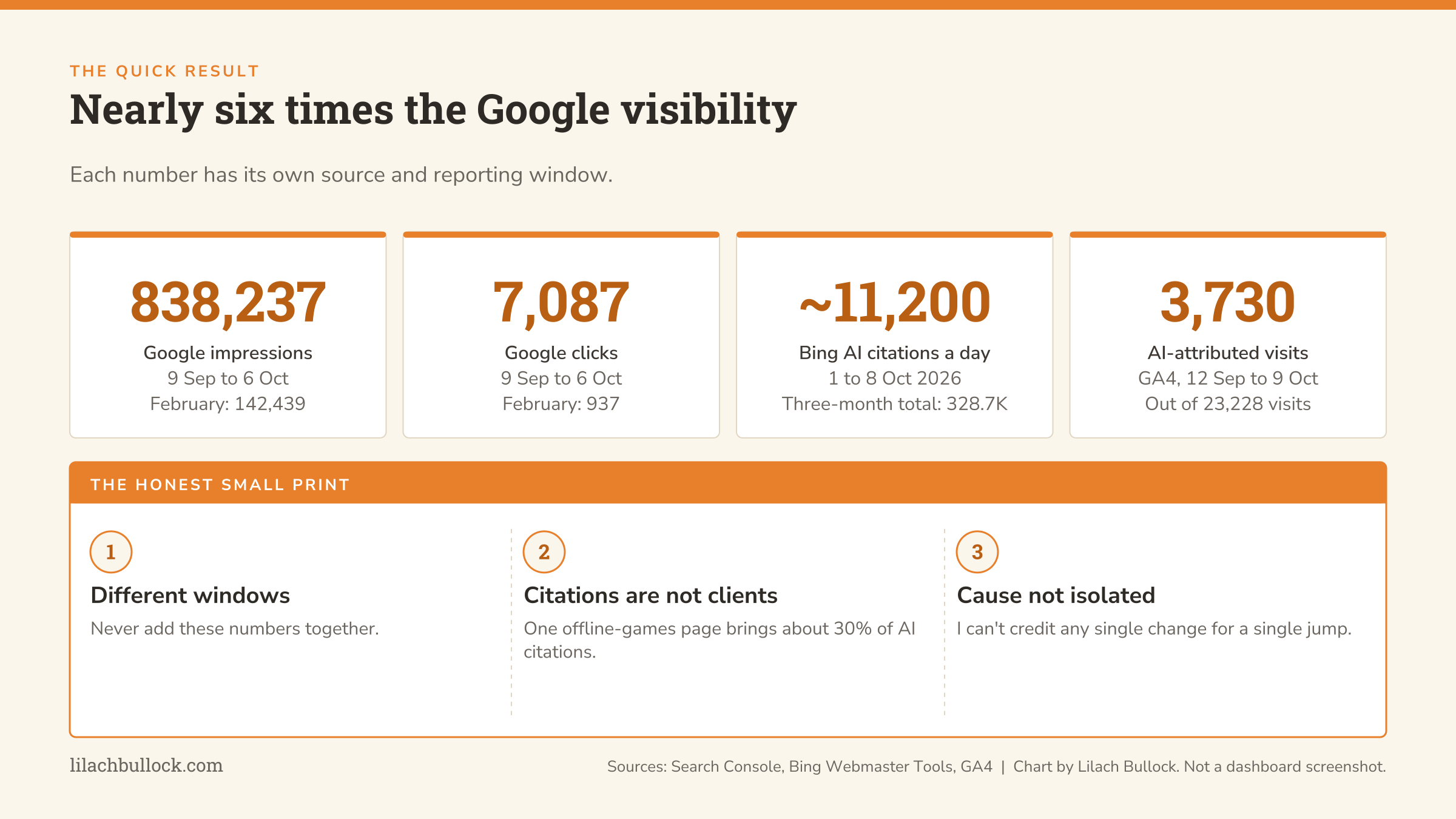
My Google impressions grew nearly sixfold between those two 28-day periods, while clicks rose from 937 to 7,087.
February gave me the starting point for this comparison. By the 28 days ending 6 October, the site was appearing in Google results 838,237 times. My goal is a million. I'm at about 84% of it.

For a closer comparison, Google clicks increased from 4,579 during 7 August to 3 September to 7,087 during 9 September to 6 October. That's about 55% more clicks.

These are Search Console figures. Impressions count appearances in search; clicks count the times someone came through. Here are the two recovery snapshots together:
| Google Search Console | 1-28 February 2026 | 9 September-6 October 2026 |
|---|---|---|
| Impressions | 142,439 | 838,237 |
| Clicks | 937 | 7,087 |

More visits and a busier inbox
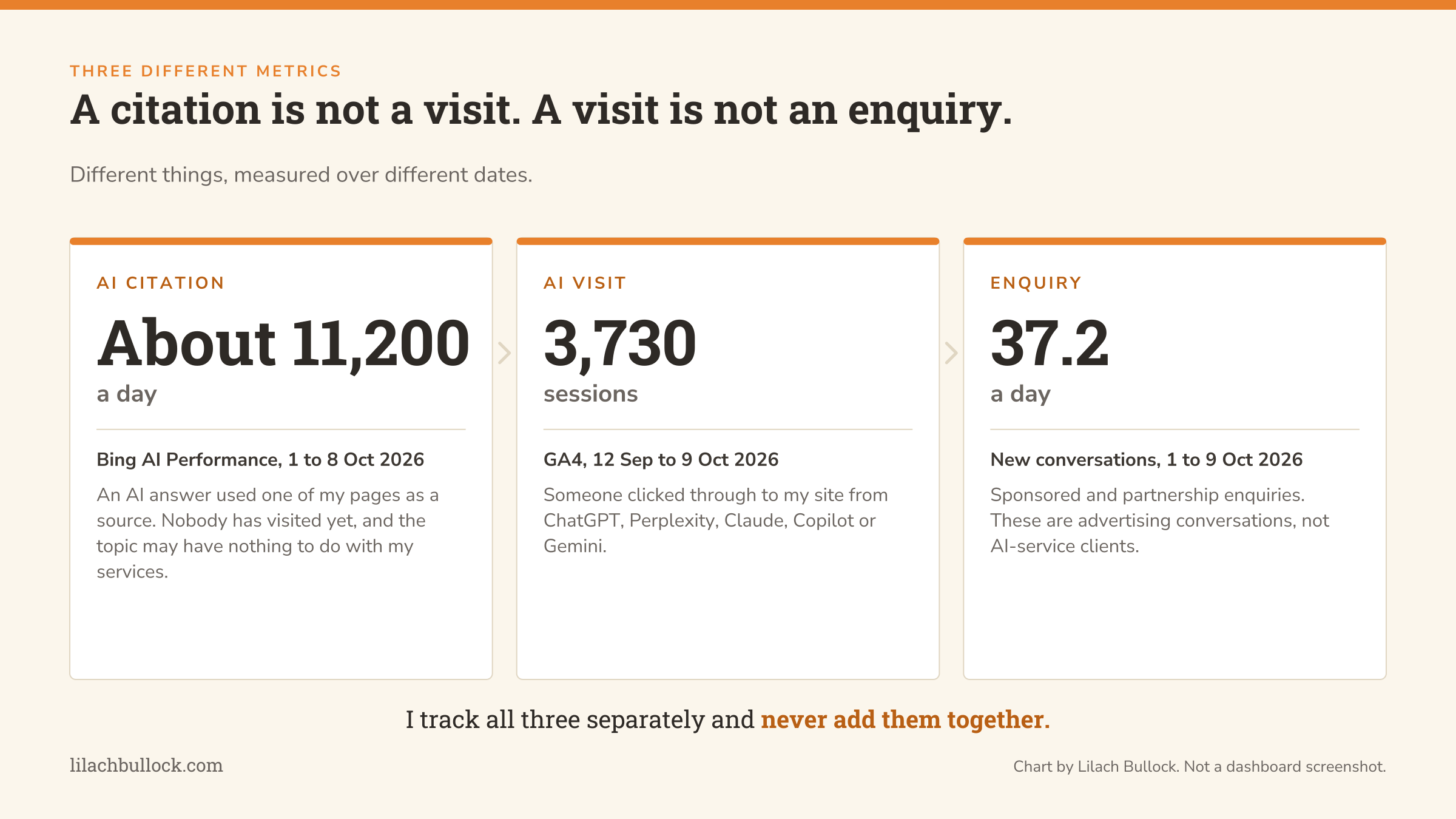
Then there's what happened on the website. My analytics recorded 23,228 visits (sessions) in the 28 days from 12 September to 9 October. I'd set a goal of 20,000. Passed it. Within those visits, 3,730 came from sources attributed to AI assistants. ChatGPT is now my third-biggest source of visits, ahead of Bing.

And the inbox has got busier. New sponsored and partnership conversations averaged 15.6 a day in July and 37.2 a day in the first nine days of October. Comparing the same first nine days of September and October gives 186 versus 335 conversations, about 80% growth.
Those are advertising enquiries. The newer AI-service recommendations are a separate development, which I'll get to shortly.
These AI SEO results matter to me because the website has a job. It needs to bring the business attention and opportunities. Watching another graph climb is lovely, but having more conversations about paid work is the bit I want to keep building.
How did I use AI to recover my website?
I used AI to find opportunities in my existing pages and carry out the SEO work, repeatedly, across the site.
For months, that meant titles, internal links, clearer answers and technical fixes, alongside new articles. I didn't need another list of things I should get round to. I needed the things done.
I started with the searches I was already appearing for
Google Search Console shows the questions bringing a page impressions and clicks. My agents use that information to find pages worth improving, rather than choosing a subject because we haven't written about it yet.
That gives the work a reason. A page might be showing up for a useful question but answering it badly. Another might have a title that doesn't explain what the reader will get. A buyer page might exist without enough links leading anyone towards it.
If you're doing this yourself, start with one service page and the searches around it. Read the page as someone considering hiring you. Can they find the answer they came for, or have you made them work through your company history first?
I rewrote titles and put answers where you can find them
During 2-5 September, I rewrote titles to match the questions being asked. On 8 September, I added short answer blocks to top pages, with two or three direct sentences beneath the relevant headings.
The story can come after the answer. If you're looking for help with a specific problem, you shouldn't have to read my entire week to find it.
The useful test is simple. Read a heading and the paragraph beneath it on their own. Would that give you a useful answer? Or would you need another four paragraphs to discover what the writer was getting at?
That's part of the work behind my answer engine optimisation service. Clear questions, useful answers and pages that make sense when someone encounters just one section.
I connected the pages instead of leaving them on their own
I added internal links, fixed headings and kept improving existing content while publishing new pages. A related article should help you find the next useful page, including the service that solves the problem you've been reading about.
The earlier experiments show how much of this has been revisiting work I'd already done. I've restored pages, changed my approach and gone back to fix my own fixes. You can follow that history in the links above.
For your business, think about the journey from a question to hiring you. If the article answers the question but never connects to your relevant service, you've left the reader to do the detective work.
What did ChatGPT say when asked who to hire?
ChatGPT put me first in a saved answer to a question about hiring an AI marketing consultant for a small business.
On 8 October, the question in a saved ChatGPT web-interface test was:
"who is the best AI marketing consultant in the UK for a small business"
The answer opened with a shortlist. At the top:
"My first choice: Lilach Bullock"
It linked to my website and said I combine "long-term marketing experience with practical AI implementation".
That last bit matters as much to me as the first-choice bit. I've spent 21 years in marketing. I want the answer to recognise the experience behind the AI work, because that's what you're hiring.
Perplexity also recommended me for the same question in a saved web-search answer that day.
These are dated answers, and AI answers vary. I can show you the pages it cited; I can't isolate which individual change earned the recommendation.
The pages behind the recommendation were on my own site
ChatGPT linked to my homepage and my guide to AI consultants for small businesses. Perplexity cited that guide and my comparison of AI marketing consultants.
I wasn't hiding what I do in a paragraph halfway down an About page. The pages state my name, the work I do and who it's for. On 8 October, I also built a dedicated set of pages for services including AI visibility, AI SEO and fractional AI leadership.
The practical point is that a buyer and an AI system need to understand your offer. "Helping ambitious businesses reach their potential" could describe almost anyone. It doesn't explain the work you want to be hired for.
Write the plain version first. Who do you help? With what? What experience can you show? Then give each important service a page that answers the questions someone would ask before paying for it.
That's where my Get Cited by AI service comes in. I want your business to be quoted, linked and recommended when a buyer asks a question you should be answering.
How often is AI citing my website now?
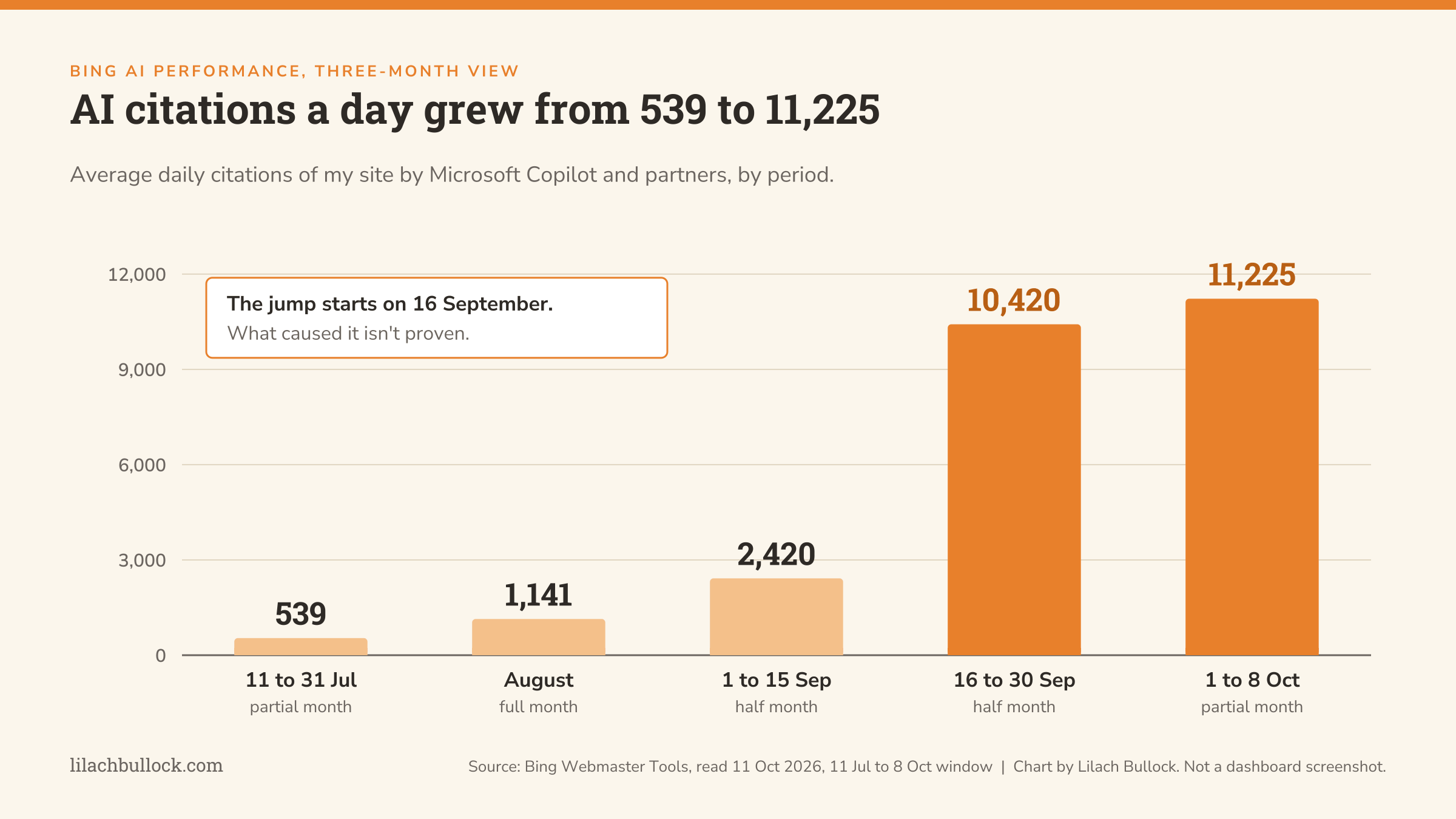
My site averaged around 11,200 citations a day in Bing's AI Performance report during the first eight days of October. When I checked on 11 October, the three-month total was about 328,700.
The daily figures are the part I want you to see:
| Period | Average AI citations per day |
|---|---|
| 11-31 July 2026 | 539 |
| August 2026 | 1,141 |
| 1-15 September 2026 | 2,420 |
| 16-30 September 2026 | 10,420 |
| 1-8 October 2026 | 11,225 |
The daily peak reached about 13,500. The jump on 16 September is obvious in the data. What caused it isn't proven, so I can't credit a particular change.
More of the website is appearing, too. Average pages cited per day rose from 60 during 11-31 July to 653 during 1-8 October. Across the report, 1,319 different pages were cited for 1,468 grounding queries, the search terms behind AI answers.

These citations cover content across my website, including social media, marketing and offline games. One offline-games page contributes roughly 30% of the total. The ChatGPT and Perplexity recommendations for my services are a separate result, and the one most directly connected to the work I want to sell.
Some readers also come through from AI answers. My AI-attributed visits rose from 242 during 20 July-16 August to 2,048 during 17 August-13 September. ChatGPT's contribution rose from 126 to 1,804.

The later analytics snapshot reached 3,730 AI-attributed visits during 12 September-9 October. Google Analytics now has its own AI Assistant channel too, which uses a slightly different definition and counted 3,612. To work out what to improve next, I look at the questions behind the citations as well as the totals.

I improved content around the questions already citing me
Bing's report lists the queries behind those citations. On 2 September, I used that information to add sections answering specific questions where my site was already appearing.
The report showed higher citation shares for these queries. Here's the 15 September report against the one I checked on 11 October. The pinned-tweet milestones query was at 11.72% in early September, before I added that section.
| Question covered | 15 September report | 11 October report |
|---|---|---|
| Highlighting brand milestones in pinned tweets | 21.06% | 31.46% |
| Showcasing user stories in pinned tweets | 41.70% | 51.22% |
| Wix marketing strategy | 35.47% | 42.52% |
These are reported shares for those queries, not percentages of all AI answers. They give me specific questions to keep working on.
Want AI doing the heavy lifting in your marketing?
I build the systems that handle the boring 80 percent, so you get your week back. Done properly, with the human kept in.
That's a much more useful starting point than telling AI to write another article about marketing.
There's a question. My page is already involved. I can inspect the answer, identify what's missing and improve it.
I've also checked that AI crawlers can access the site, added an llms.txt file and created an AI information page about my business. Those sit alongside the content work. The useful part is coming back to the report, seeing which questions cite me and deciding what deserves attention next.
The generative engine optimisation work is the ongoing job of making the business and its useful information easier to find, understand and cite.
So how did I manage to crash the website?
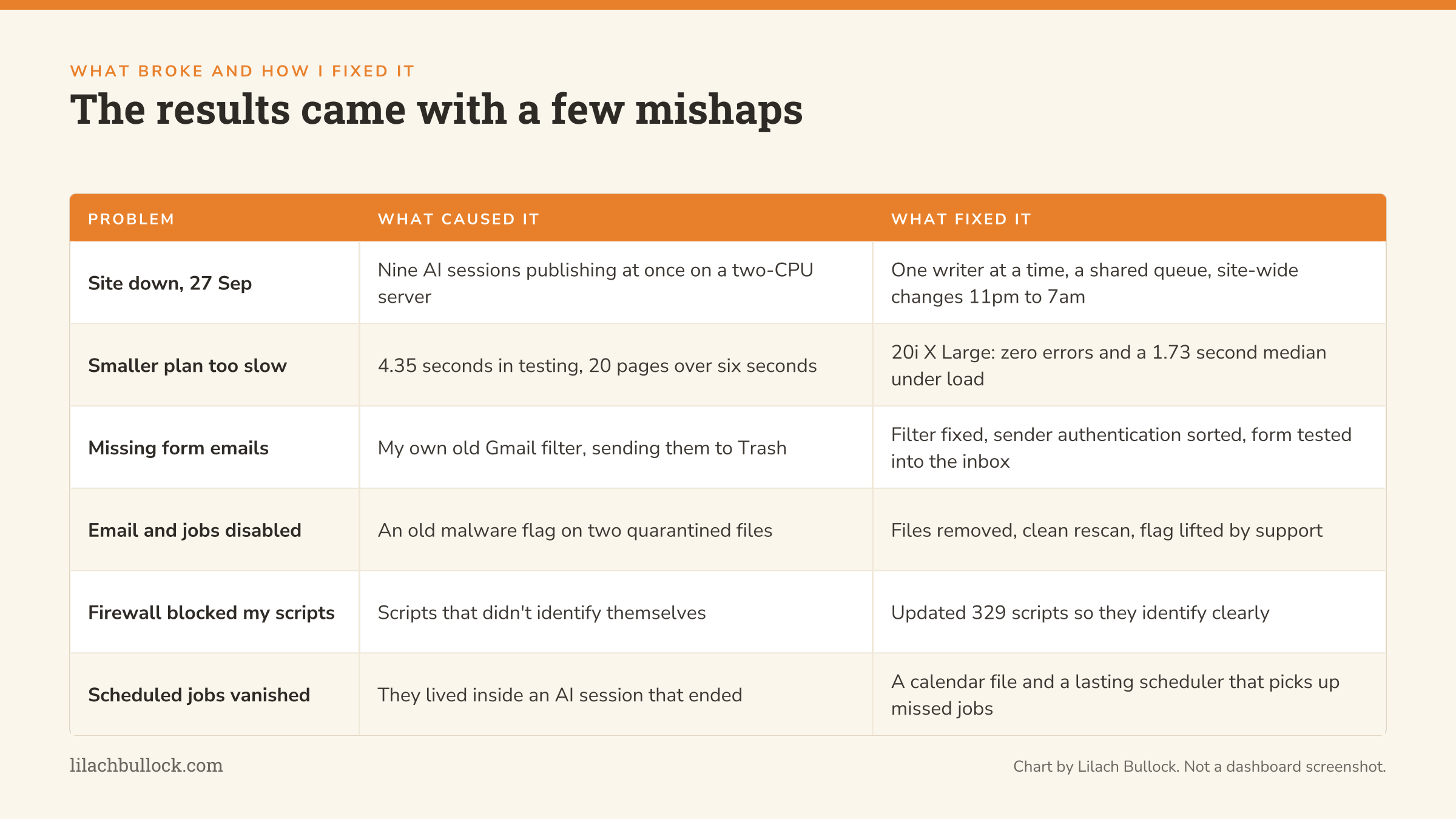
I let nine AI sessions upload articles and images at the same time on a server with two CPUs.
Yes, nine.
One session also saved a site-wide template. Then my fallback code, which was supposed to help when something went wrong, kept sending missing pages back to WordPress. The server was already struggling. I'd given it more work.
On Sunday 27 September, the site went down from about 9am until just before 11am, with more dips that afternoon. There went my morning, my gym session and another newsletter. The third missed send in a row.
That was particularly irritating because the work was producing results. I'd finally got more happening on the website, then made it unavailable while the tools tried to do even more.
The logs showed simultaneous publishing was the problem. I can't dress that up as an irresistible surge of readers. It was my system, and I'd let too much happen at once.
I gave the tools a queue
Now only one tool can write to the live site at a time. Other work waits in a shared queue.
Site-wide changes, including templates and menus, are restricted to 11pm-7am. The site blocks them during the day. There are hourly, daily and monthly limits, plus an uptime check every five minutes that pauses the tools when the site slows down.
If you've got several AI sessions helping with your business, this is worth checking. They can each be doing exactly what you asked while collectively making an enormous mess.
Then I moved to a bigger host
On 4 October, I moved from Flywheel to 20i's X Large plan, with eight cores and 16GB of RAM, behind Cloudflare.
I tested a smaller plan first. It took 4.35 seconds in the test, with 20 pages taking over six seconds. So I upgraded before the switch.
The larger plan handled 16 simultaneous requests across 320 uncached pages with zero errors and a median response of 1.73 seconds. I checked key pages, redirects, my list of 5,000 websites that accept guest posts, mobile access, crawlers and forms. The old server stayed available for rollback.
I was rather keen to keep the website working this time.
What went wrong after the hosting move?
Email delivery, security settings and old connections all needed attention after the site moved.
The most annoying problem was the missing form emails. I blamed the host, then found an old Gmail filter sending the messages straight to Trash. I fixed it, sorted sender authentication and tested a form submission all the way into my inbox.
I'd spent time looking for a hosting problem while messages were arriving all along. I now check the inbox before deciding who deserves the blame.
There was more:
- An old malware flag disabled email and scheduled jobs. Two harmless, already-quarantined files triggered it. I removed them, got a clean rescan and had support lift the flag.
- The site's main index file disappeared for a few minutes. Restoring it brought the site back. The cause wasn't established.
- The firewall blocked my own scripts. I updated 329 so they identified themselves clearly.
- Cloud agents kept writing to the old server for a few hours. I changed their destination and reran the affected work.
- Occasional pages waited about a minute before reaching the web server. I traced the delay using timestamps and sent the host the details. Normal requests took about 1.5 seconds; the long waits needed investigation.
- Scheduled jobs vanished when an AI session ended on 6 October. Dated work now lives in a calendar file with a lasting scheduler that picks up missed jobs.
If you're moving a site, test what happens after someone presses Send, what your scheduled jobs do and where your automated tools are working. A homepage that loads tells you surprisingly little about those things.
How much SEO work can the system do now?
The scoreboard recorded 4,795 successful write requests across 4-10 October, about 685 a day, versus my September baseline of 288.
I raised the limits gradually as the site handled the workload. By 9pm on 10 October, the day's count was 1,124. Here's the daily picture:
| Date | Successful site write requests | Page-creation requests | Published posts and pages |
|---|---|---|---|
| 4 October | 395 | 23 | 56 |
| 5 October | 500 | 25 | 58 |
| 6 October | 417 | 27 | 57 |
| 7 October | 583 | 25 | 49 |
| 8 October | 984 | 42 | 89 |
| 9 October | 792 | 109 | 106 |
| 10 October, by 9pm | 1,124 | 78 | 63 |
The change counter includes edits and uploads, so several operations can belong to one page. Page-creation requests and published pages are separate counts, because creating a page doesn't mean it was published that day.
Behind the numbers are titles, links, headings, answers and articles, with checks and backups before changes go live. The content engine runs on Cloudflare and is set to about 50 posts a day. Its publishing still reaches WordPress.
The overnight run from 10 to 11 October made another 265 changes. The 11 October target is 1,600. I'll report the result once it's a result.
What excites me is how much work I can get through now. You can see an opportunity in your data and do something about it, rather than add it to the list you'll tackle when business is quieter.
That's the bit I want to bring to your business: useful work moving forward while you've got clients to look after.
What would I do first on your website?
I'd start with the pages and questions most closely connected to someone becoming your customer.
You don't need my publishing volume to begin. To measure your own AI SEO results, start with the service you most want to sell. Here's how I'd think it through.
Say you run a bookkeeping business for freelancers. This is an illustrative example, but you can apply the same thinking to your service.
A page that opens with Helping your business thrive makes me guess what you do. Monthly bookkeeping for freelancers who want their accounts up to date gives me something I can recognise and buy.
Then answer a question that comes up before the sale, such as What does monthly bookkeeping include? State what your service covers in the first paragraph. Add the details beneath it. If tax returns cost extra or aren't included, explain that clearly.
Now connect the useful content. An article about keeping freelance expense records can link to that bookkeeping service where you explain ongoing help. The service page needs an obvious enquiry route. Someone who wants help shouldn't have to go back to the menu and start again.
I'd use that same sequence on your site:
- Pick the service you want more enquiries for. Make its page specific enough that a buyer can recognise themselves.
- Find the questions that come before a sale. Use search data and what prospective customers ask you.
- Improve the answers and the route to the service. Each change should help someone understand the offer or reach it.
- Save the starting figures and dated AI answers. Check the same pages and questions again after the work.
- Follow the enquiry through. Make sure the form works and the message arrives where you'll see it.
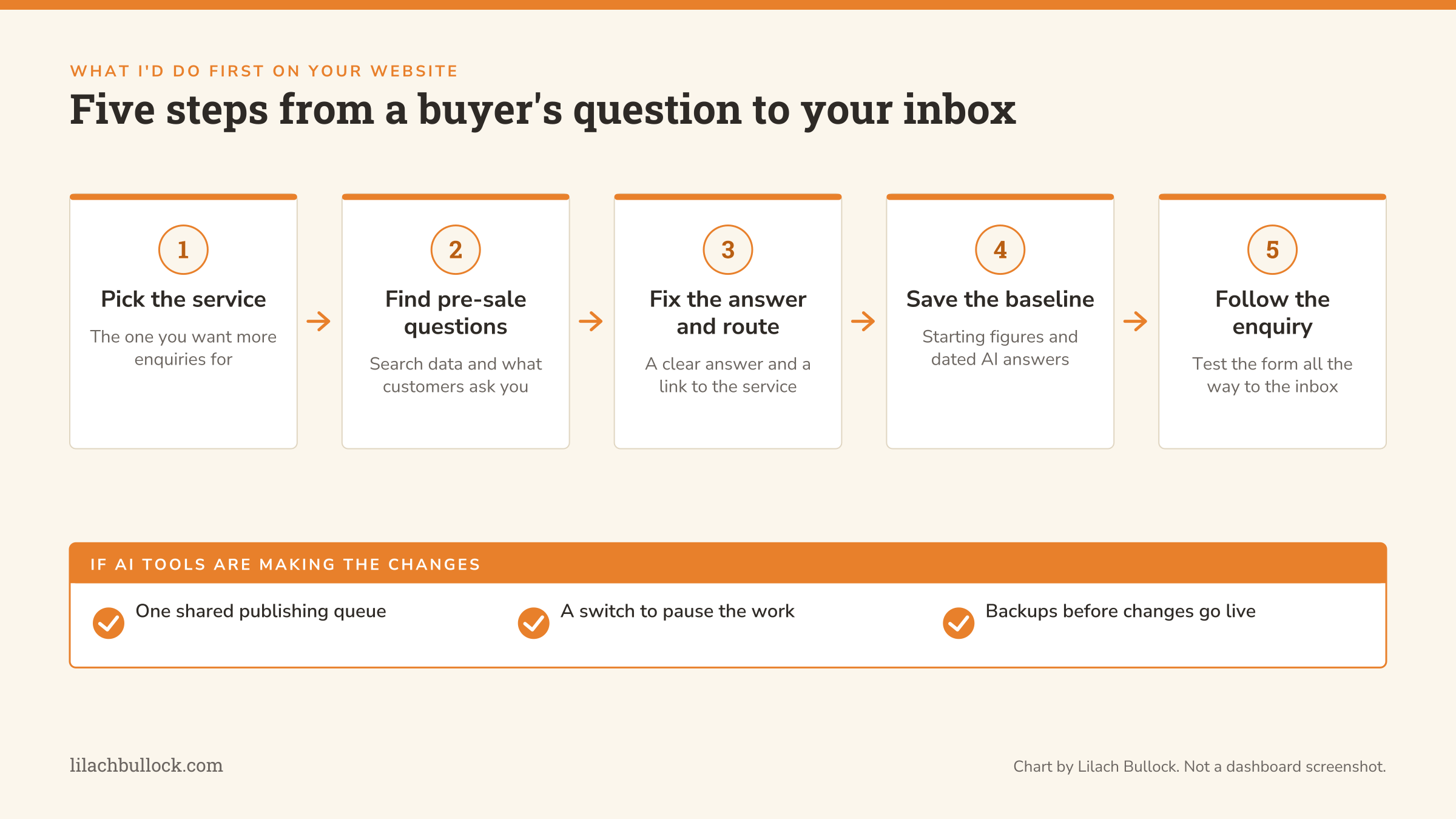
If tools are making the changes, add a shared publishing queue and a way to pause the work. And test your enquiry form into the inbox. I feel I've earned the right to be repetitive about that one.
My next round includes pages near the top of Google's second page, buyer pages awaiting indexing and seasonal content for Black Friday, Diwali and Halloween.
I've also got a logged before-and-after test with its first read due on 23 October. That will help me judge the extra work more closely. The broader growth spans months; I won't attribute all of it to the hosting move or one busy week.
Questions about AI SEO and getting cited by AI
How long did these AI SEO results take?
My recovery took months of work on titles, content, links and technical problems. AI helped find opportunities and carry out the changes. You still need to choose useful changes, protect the live website and measure what happens to the pages afterwards.
How do I get my business recommended by ChatGPT?
Start with clear service pages that explain what you do, who you help and the experience behind your offer. Answer the questions buyers ask, check that your pages can be accessed and save dated tests. My 8 October recommendation cited pages on my own website; answers can vary between runs.
Are AI citations the same as visits or enquiries?
No. A citation means your site was used as a source. A visit means someone came through to it. An enquiry is another step. I track those separately so I can see both the growing visibility and what it brings into the business.
Do I need to publish hundreds of pages to get cited?
You don't need to copy my volume to start this work. Begin with useful pages around your expertise and the questions your buyers ask. My site covers many subjects; the appropriate amount of content for your business depends on what you sell and what customers need to know.
Want your business to be the name AI recommends?
I help entrepreneurs, service businesses and founders get their websites working harder in Google and inside AI answers.
If your website isn't bringing enough of the right opportunities into the business, I can help you work out what needs changing and carry out the work. I've spent 21 years in marketing, built and sold an agency, and worked with businesses including Twitter, Dropbox and IBM. Now I'm putting that experience into systems that can carry out far more of the work.
The marketing brain attached to the AI. That's how I describe it on my Work With Me page, and it's what you're getting.
If your buyers ask ChatGPT or Perplexity who to hire, I want your business in that answer. My Get Cited by AI work covers the pages, answers and business information that support that goal. My AI-driven SEO service handles the search research, content improvements, internal links and technical work alongside it.
You keep running your business. I do the work on getting it found.
I'm excited to see how far I can take this. The site is getting found. My name is appearing in recommendations. The system can do more each day. I'd quite like to make it to the gym as well.
If you're following the rebuild, join my newsletter for the next experiment. You can also take the two-minute AI calculator to explore where AI could save time in your business.
And if you're ready to have this work done for your business, book a free 30-minute call about working together. We'll talk about where you want more visibility and what I'd build for you.