- The numbers I'd want to see if this were somebody else's business
- What the person sending the enquiry saw
- Last time it was the website itself
- Be careful what you wish for. You might have to administer it.
- The invoice job I finally stopped supervising
- Could I keep doing this without hiring anyone?
- A one-hour version you can run in your own business
- The weekly experiments that got me here
- Frequently asked questions
People have been finding me on LinkedIn to let me know their enquiries bounced. Some are trying to pay me. Imagine wanting to give a woman money and having to track her down on a second platform for the privilege.
The emails got to me, by the way. It's the people who sent them who didn't know that. From my side, business was booming. From theirs, Lilach appeared to have left the building.
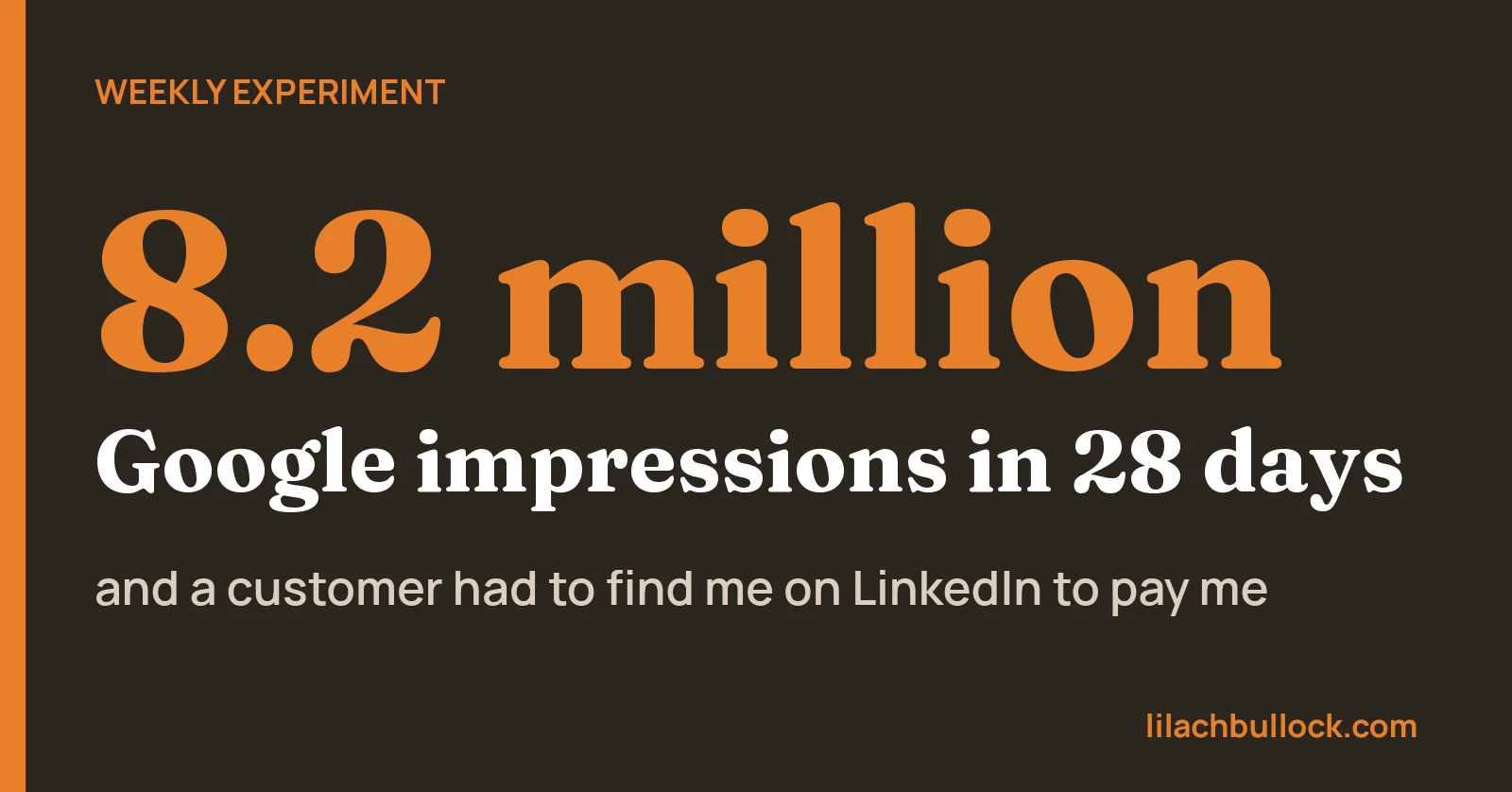
At the beginning of the year, when there was barely any income coming in, I'd have loved to have this week's problems. I meant it then and I mean it now. I'm grateful I get to write 8.2 million Google impressions in 28 days at the top of this article. I'm also learning that nobody passes the good news on to your stomach. It still does the same little drop when somebody says they've been trying to get hold of you.
The website sells sponsored posts, product placements and newsletter sponsorships. That's the media business the income figures below refer to. (I also work with clients on AI consulting and training, SEO and AI visibility, content, lead generation, ads, HubSpot, workflow automation, websites and custom AI agents. I offer fractional CMO support, too. Here are all the ways you can work with me.)
I've got more consulting clients coming in alongside all of this. And for the first time in 23 years in business, I have no staff. There's me, four AI accounts and, as several prospective customers now know, a functioning LinkedIn profile.
The numbers I'd want to see if this were somebody else's business
Start with the orange bar marked November on the enquiries chart. In 14 days, it nearly reaches the October bar, which had 31 days to get there. Now look to the right. That's how busy an ordinary day became. I've used this layout throughout so you can see both the result and the workload behind it.
Enquiries | 124 arriving a day
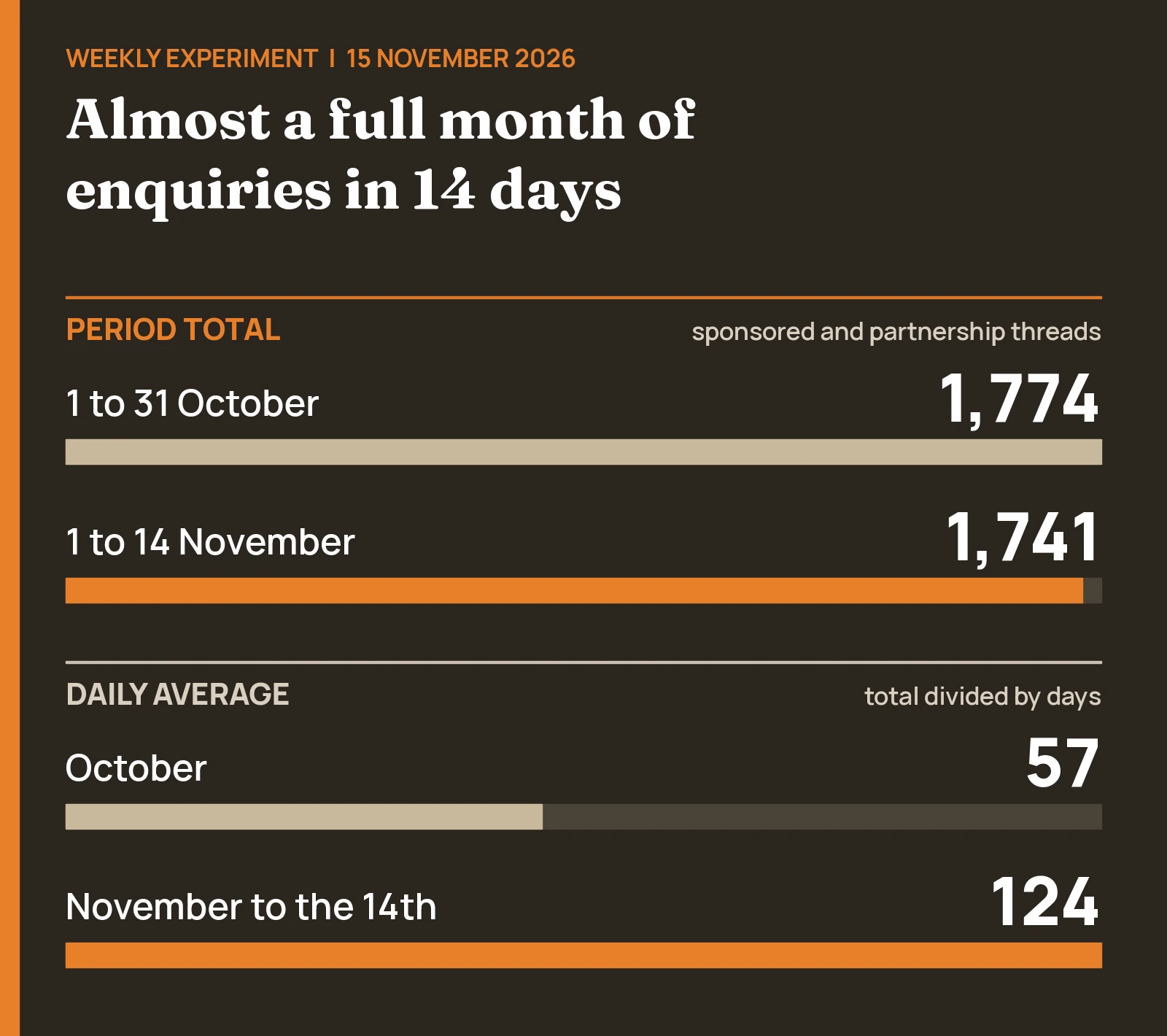
The difference was about 67 more conversations to deal with each day. A conversation might need a first reply, a clarification and a follow-up. So if you want to know whether your inbox can cope with growth, counting unread messages when you wake up only gets you so far.
Try it with your own inbox. Pick a completed enquiry and count the times it came back to you. Which reply could you have written in advance? Which one needed a decision only you could make? Save the first as a template. Put the second somewhere you'll see it before the end of the day. In my business that distinction is the difference between the same pricing question arriving again and somebody waiting on my approval.
Newsletter | 910 new subscribers in the first fortnight
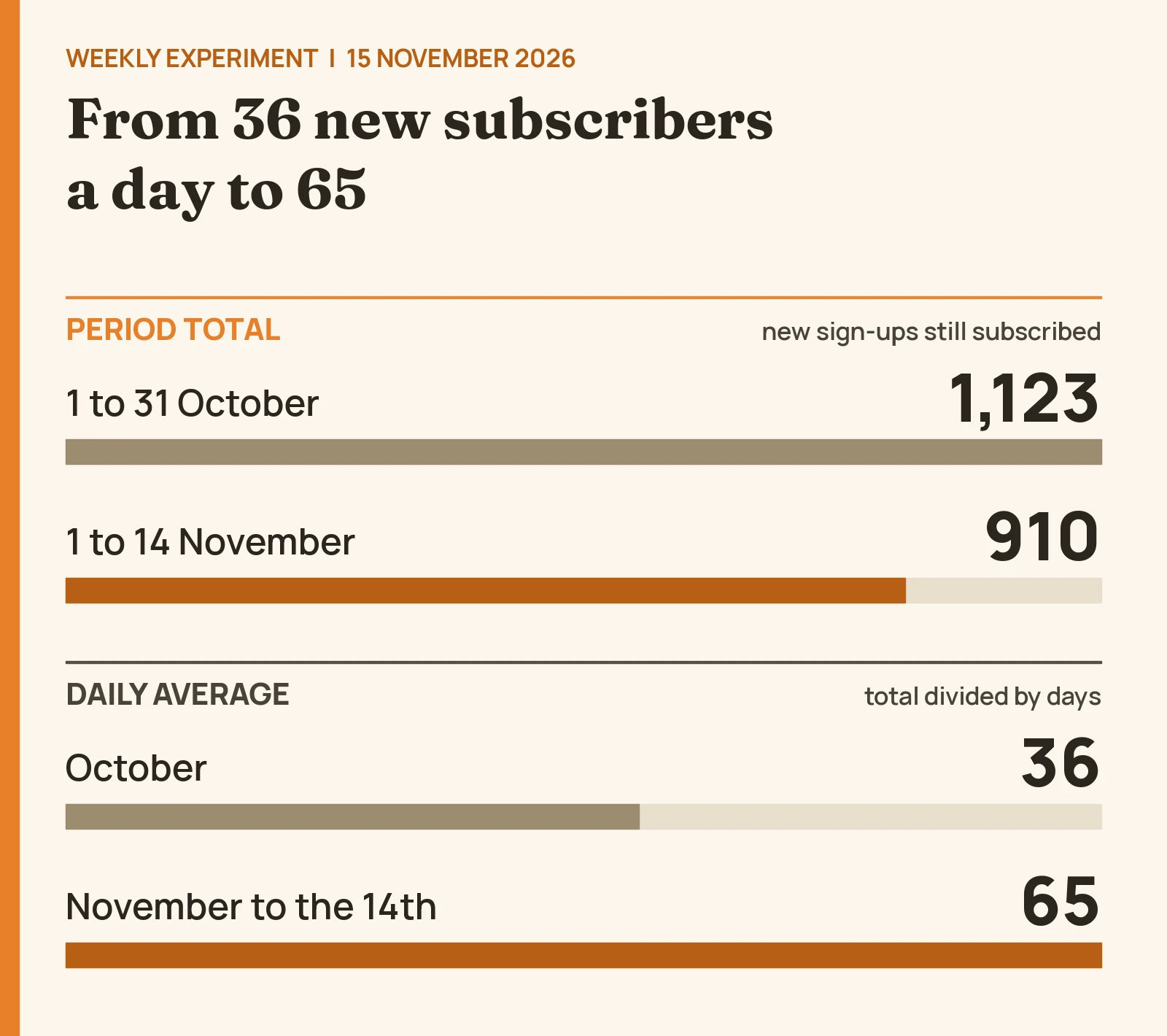
There's another way to see it. Across the last 30 days, 1,637 people joined and were still subscribed at the 15 November check. That includes the November sign-ups in the chart. It's the rolling-month view of the same growth.
Imagine 65 people turning up at your front door today because they'd like to hear what you've got to say next Sunday. Then another 65 tomorrow. Suddenly "Thanks for subscribing" seems a touch underprepared for the occasion.
Two things I'd put beside a signup form. A sentence saying what the reader will get and when. Then one issue they can read before deciding. Below an article about enquiries, I'd offer the experiment that shows what I did when the inbox got busier. The person has already told you what interests them by choosing the article. Use that little piece of information before asking them to hand over an email address.
Read your welcome email on your phone. Does the sender name match the person they just signed up to hear from? Can they tell which day you'll write? Does the first link take them straight to the thing you promised? It's a surprisingly good way to find a lovely old freebie you've long since moved. Here's the Sunday newsletter if you'd like to see what I offer.
Google visibility | 8.2 million impressions in 28 days
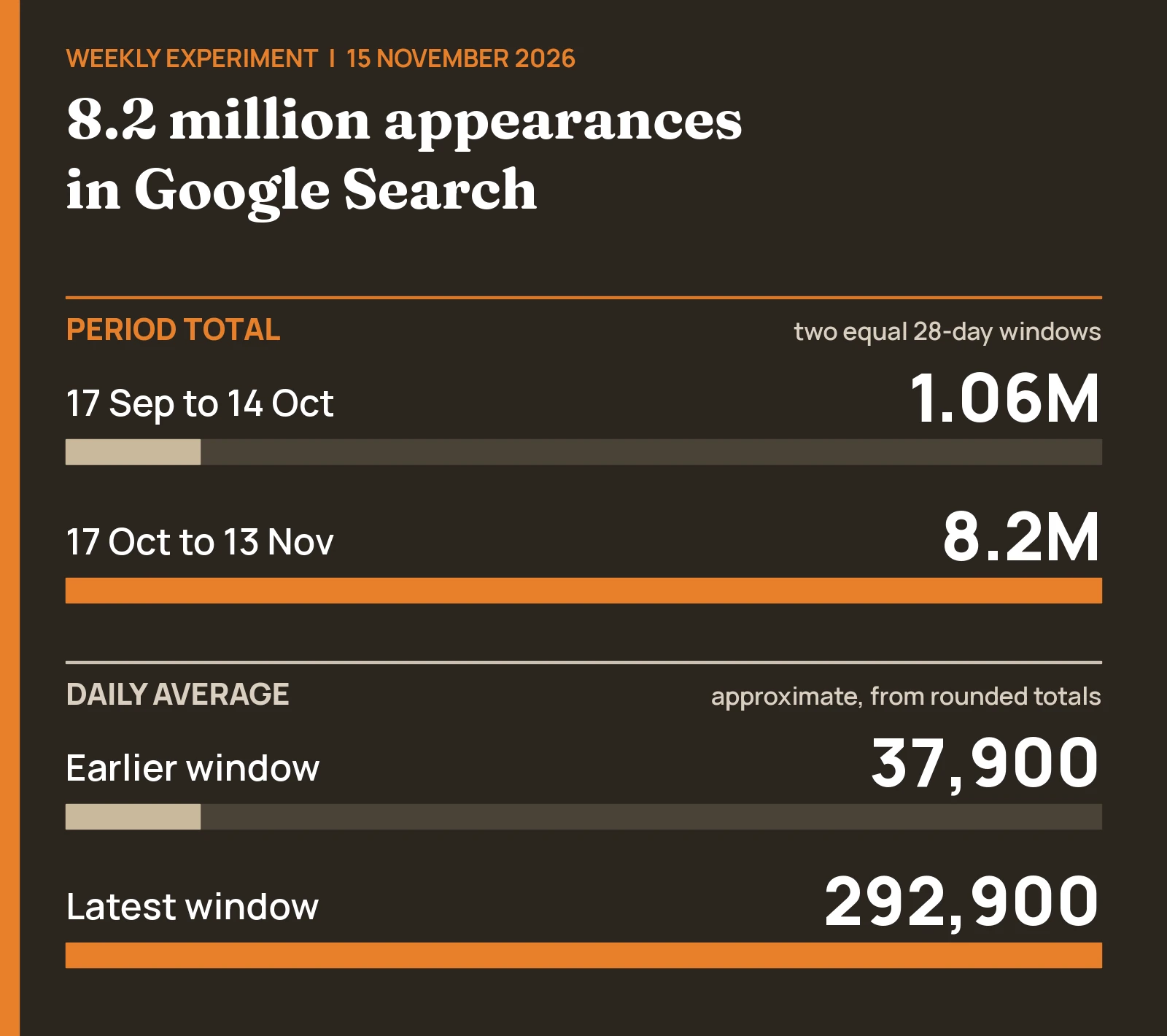
I remember working on pages Google had crawled and still hadn't bothered to put in its index. I'd written them. They existed. We appeared to have a difference of opinion about whether anyone else needed to know. So yes, 8.2 million is the Google number I'm making a fuss about. Here's the earlier experiment, when getting indexed was the job.
Give a high-impression page ten minutes. Open Search Console, choose a page whose impressions have grown, then open its Queries tab. Find the most specific question a customer might ask and read your page on your phone. How far down do you have to go before you get the answer? If it's four swipes, move the useful paragraph up. If the answer needs a condition such as a minimum order or a particular subscription, keep the condition next to it.
Give the headline the same test. If people are searching for a comparison, let the title tell them which options you compare. If the page is a worked example, say what you worked out. Make one edit and date it in a note. When you come back, compare equivalent periods and the same query. Otherwise you'll end up congratulating a headline for something that happened to a completely different page.
AI visibility | About 1.2 million citations in three months
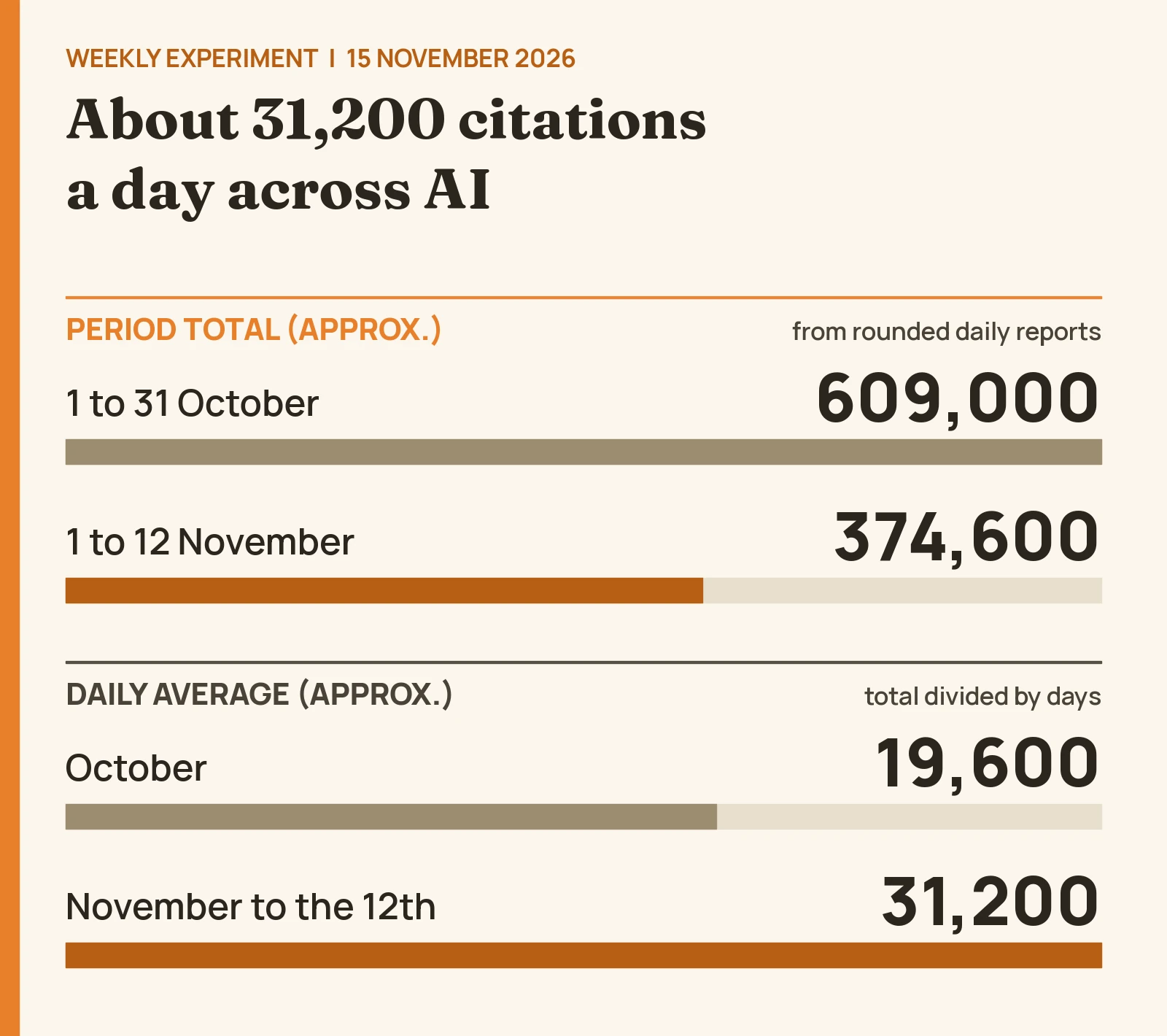
On 12 November alone, my pages were cited about 29,500 times across AI. A citation means an answer used my website as a source. That's a separate way for my work to reach somebody who has a question. I track it alongside search because a person can get a useful answer before they've clicked through to meet me.
Make a paragraph worth quoting. Take one question buyers ask you before they spend money. Give the answer you would give on the phone. Include the inconvenient detail. If delivery takes two days once the artwork is approved, those last five words matter. Now read the paragraph without its heading. Could somebody tell what you were talking about? Give the product or service its name in the answer.
Give the curious reader somewhere to go. Say your comparison gets cited because it explains which plan a freelancer needs. The person who clicks through may want to see a worked example. Put it beside the comparison. A generic "Explore our solutions" sends them off to do the bit you could have done for them. I shared my earlier citation results in the AI search experiment.
Website traffic | What people found after the search result
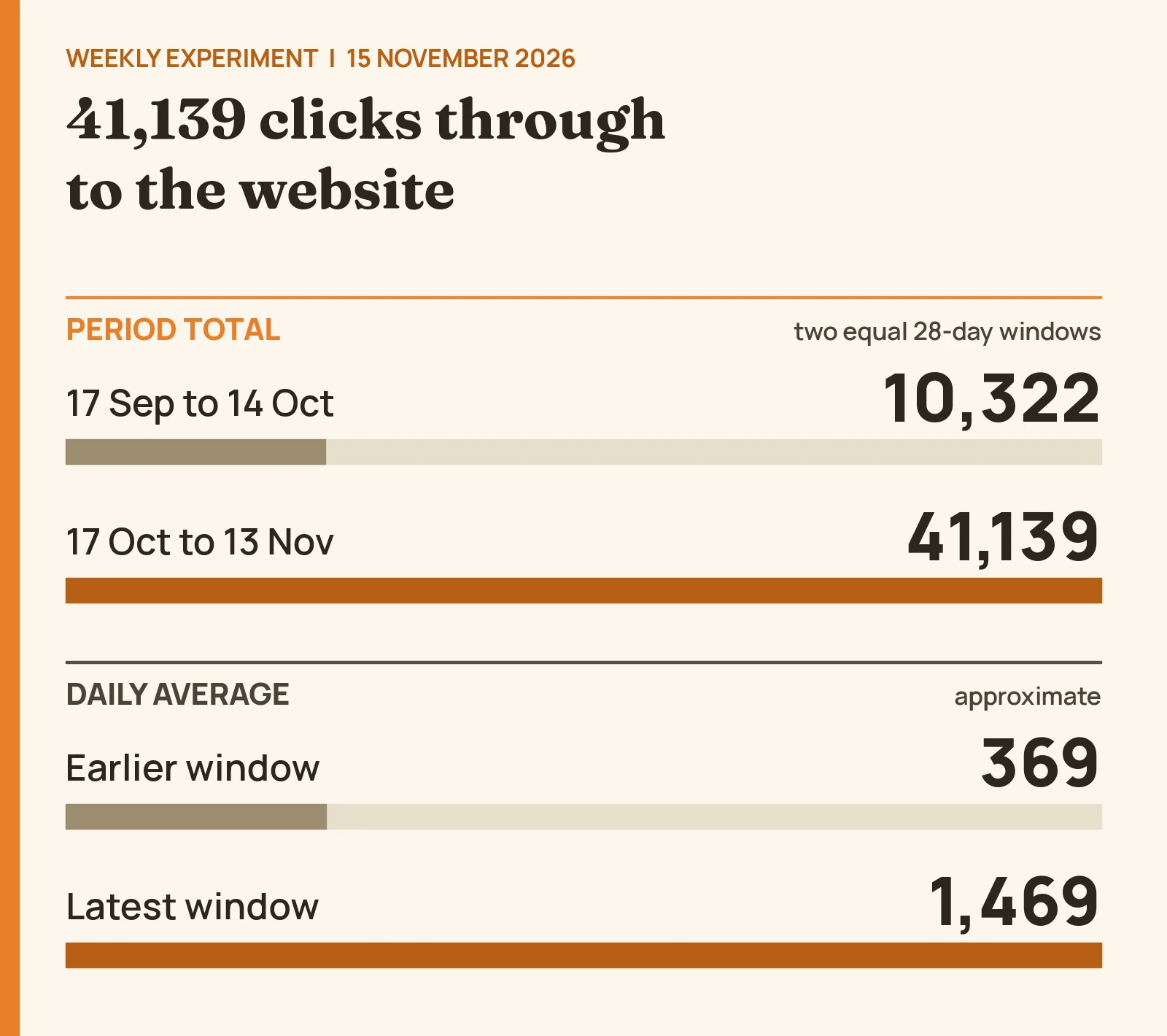
When I wrote the early experiments it was easy to assume you knew what happened last week. With 41,139 clicks coming through from Google in 28 days, that's asking rather a lot of a stranger. I'd like you to get something useful out of the first article of mine you read, even if the entire history of my inbox holds limited appeal.
Test the page with one job in mind. Suppose someone lands on your article after searching for help with a full inbox. Could they try one thing before their next meeting? Give them the reply you saved, the filter you used or the question you asked. If the next step needs another guide, link the words that describe that job. That's why how I organised my inbox and what I let AI do in it are different articles.
Media income | 105% of October in the first 14 days of November
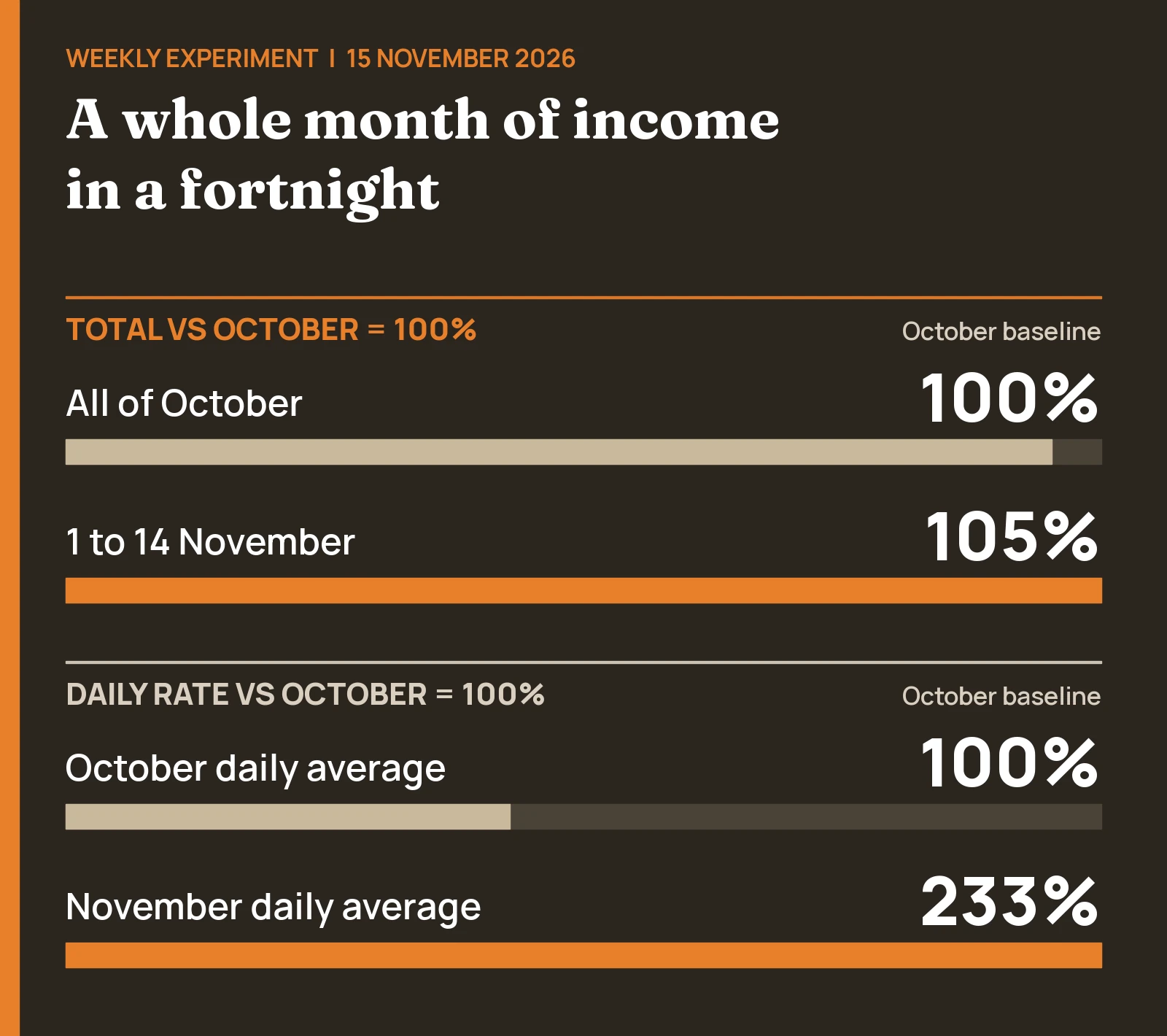
October's media income grew 93% on September. Then, by 14 November, I'd already earned 105% of all October's income. In plain English, the first fortnight had paid me slightly more than the entire previous month. Spread those payments over the days in each period and my daily income was up 133%.
My overall profit margin is about 95% to 96%. PayPal fees rise with sales. I'm paying for the AI accounts, Workspace mailboxes, hosting and plugin licences that keep the business running. I keep an eye on margin because that's what tells me how much of the extra business stays with me. If you're curious about how the placements work, I wrote up the sponsored post experiment here.
Borrow my comparison. Take a complete month, then a fortnight where work felt considerably busier. Write down the income in each and divide each total by its own number of days. Next to that, write what you spent to deliver the work in each period. If a tool renews annually, use the share that belongs to the period you're looking at. It takes the drama out of the month the card gets charged.
Look at the time, too. Pick two jobs that paid the same fee. One went through on the standard terms. The other needed three sets of amendments and a Friday afternoon. What would you quote for the second one now? That's the part a very impressive margin can leave out. You only get the one Friday afternoon.
What the person sending the enquiry saw
A Google Workspace routing rule forwards the messages sent to my business addresses into Gmail. Every email still arrives. Some senders get a bounce notice. You can see how I might have missed the problem by checking my inbox, which is, irritatingly, exactly where a person tends to look when checking their email.
The LinkedIn messages were the bit I couldn't see in my inbox. A potential sponsor had already done the hard part: found the website, decided the placement was worth asking about and sent the enquiry. Now they were doing unpaid technical support for the woman they wanted to buy from. I'm glad they bothered. I'd rather spare the next person the trip.
At 124 new enquiries a day on average from 1 to 14 November, checking whether I had mail would have given me a very reassuring answer to entirely the wrong question. I needed to know what came back to the sender.
I'm fixing the forwarding and moving sending for my business addresses onto Workspace before the old mailboxes close on 16 November. Every sign-in has asked for a security code. A fine moment to discover how much of your working life depends on being able to get into your own email.
Here's the email test I'd keep. Use an address outside your own domain. Send a recognisable message to the address printed on your website. Keep both inboxes open. Does the message arrive once? Does the sender also get a failure notice? Now reply from the business address and look at the name and address the customer sees. Hit reply again. Where does that second message go?
That last step is the one I'd keep even if the first test looks fine. Most sales conversations involve another question, an attachment or an "I've paid, did you get it?" The email address needs to survive the conversation. I've covered how I organised the inbox and which jobs I gave to AI. This week's addition to both is to keep a chair free for the customer when you test the thing.
Last time it was the website itself
The site had short outages on 3, 5 and 8 November. The latest roughly 300 checks recorded no downtime. That's welcome, and I still have a deadline. My developer's plan ends on 20 November. I'm taking the site fully in-house with my own hosting, plugin licences, Cloudflare keys and full-site backup.
If you pay someone else to look after a website, there's a useful question buried in this. Suppose the arrangement ends on Friday and you need to restore the site on Monday. Can you sign in to the hosting yourself? Can you get at the backup without asking the person whose contract just ended? Who owns the licences the site depends on? It's much easier to have that conversation on Tuesday.
On 2 November I held back new page types after a Google safety review. I wrote about that in last week's experiment. It's part of the same decision. With 8.2 million impressions on the board, I'd much rather use an afternoon making sure the pages people are finding will open than use it giving them more pages to find.
I've been wrong about what needed fixing before. The newsletter redesign looked better and got fewer clicks than my plain links. The cold email test used the wrong sender name and photograph. This is why the weekly experiment includes what it looked like from the receiving end. My version of events is often the flattering one.
Be careful what you wish for. You might have to administer it.
Back in January I wanted people to find the site, subscribe, get in touch and buy something. All of that's happening. I feel lucky. Blessed, even. And I want to be honest about something I hadn't understood then: you can get the thing you've worked for and still feel anxious on a Sunday about your email.
Every week something breaks. The hosting. The forwarding. The automation that once managed to send an email with a man's name and photograph on it. In the past, a message from someone who'd tried to pay me and couldn't would have tipped me straight into stress and overwhelm. I'd be worrying about everyone else who might have had the same problem before I'd finished reading what happened to this one person.
Want AI doing the heavy lifting in your marketing?
I build the systems that handle the boring 80 percent, so you get your week back. Done properly, with the human kept in.
The feeling still turns up. What's changed is how much of my working day it gets to run. I'm learning to expect a problem somewhere in the week. That sounds a bit miserable until you try the alternative, which is making a lovely full diary on the assumption that everything you own will behave itself until Friday.
I need time blocked out for growth and time to deal with what growth breaks. If I give every spare hour to attracting new people, the first thing a repair eats into is time I've promised a client. If I spend every spare hour firefighting, social and outreach will still be on my list when the internet retires. Both jobs need an appointment.
Here's what I'd put in the calendar entry for the repair time: What happened to the customer? What do I know worked? What could I test from their side? This week those answers were a bounce notice, a message sitting safely in my inbox, and a test from an outside address. That's a smaller job to sit down to than "there is something wrong with my entire business", which is generally the diagnosis my stomach favours.
The invoice job I finally stopped supervising
This one's especially humbling if, like me, you describe yourself as good at delegation and also happen to be a control freak.
Until recently I told my AI which invoice payments had come in. Then I gave it permission to deal with them. The work was automated, provided a woman with 23 years of business experience was available to point at it and say yes. I was the notification system. Fairly senior hire for the role.
Now my agents pick up the payment and handle the routine work that follows it automatically. I still issue the paper invoice myself. That's the bit left on my desk. There's a way to automate that too, and if enquiries carry on growing I may well hand it over. For now, I know exactly where my part starts and ends. That's progress I can feel on a busy day.
AI makes mistakes. I've had to clean some of them up in public, which I can recommend if you've ever felt your self-esteem was running a little high. Letting go doesn't require me to believe it's suddenly perfect. It means working out what I'd need to see afterwards to know the customer got what they paid for.
If you'd like to hand over a job but you're still hovering, take one example that's already finished. Mine would be a payment I know came in and a placement I know was delivered. Write down what started the job, what the buyer should have at the end and what would make you step in. Then follow the agent's record through that example. Can you match the payment to the right buyer? Can you see what they received? If a second notification for the same payment arrived, would the job run twice?
Those questions are how I'd choose my next handover. A clear start, an end I can check and an exception I can recognise are much more persuasive to me than someone promising a tool will give me my life back. I'd happily start with Tuesday afternoon.
Could I keep doing this without hiring anyone?
I don't know yet. It's an odd question to be asking this far into my career. I've had staff before. Now I'm doing the lot myself with AI, and there are more clients who need my attention as well as more people coming through the website. A sponsorship enquiry can often be answered from terms I've already set. A client asking what I'd do with their marketing budget is paying for my judgement. Both arrive in the same working day.
The measure I'd use for hiring is what keeps landing back on my desk. If I'm forever confirming something the system already knows, that's another invoice job. Fix the handover. If several people need an experienced person at the same time and the work needs judgement each time, another AI account is unlikely to create another afternoon of me. That's when a human hire starts to make sense. I'm curious which point I'll reach first.
That's why I've delayed launching social media and outreach. This growth has been inbound. People finding me on LinkedIn to tell me about an email problem is inbound too, albeit a rather specialised form of audience engagement.
I'm hoping to get social going in the next couple of weeks and bring outreach into the mix once I can manage the extra demand. I'd love to see what happens to newsletter sign-ups and enquiries when I start actively asking people to come and have a look. Before then, I want to finish the mail and hosting work, keep auditing what my agents do and take one more unnecessary job off my desk.
Be careful what you wish for? Yes. Would January me still wish for exactly this? In a heartbeat. She might just pencil in an hour on Thursday for whatever breaks.
A one-hour version you can run in your own business
Ten minutes with the enquiry count. Open two comparable periods and count new conversations. A thread with six replies counts once. Write the dates right beside the figures. If one period is shorter, divide by its number of days. Now count how many people had to chase a reply. More new enquiries tells you demand is growing. More chasers tells you something about the experience of waiting for you. Those need quite different fixes.
Fifteen minutes as a customer. Open the page where a stranger is most likely to meet you. On your phone, find the answer to a buying question, send a message from a different address and read the acknowledgement. Put your phone down. If you don't know when anyone will get back to you, neither does a buyer. Add a reply window you can keep.
Fifteen minutes on tomorrow's replies. Take three recent enquiries about the same thing. Underline the words that repeat in your answers. Save those as the start of a reply and leave a clear space for the bit that depends on the buyer. Try it on the oddest of the three. If the template promises a price, deadline or refund you haven't agreed, shorten it. That's where mine would need me.
Twenty minutes with the next person who'll read your article. Choose a page getting found in search or cited across AI. Put the answer near the question, then put one useful example beside it. Add a link to the next thing a reader might want to do. Write down what you changed and the date. Come back after a comparable reporting period and look at that page again. There's your next experiment, and you've already done the awkward bit of remembering what you changed.
The weekly experiments that got me here
- Week 1: I de-indexed 1,300 pages to save my website
- Week 2: My newsletter stopped getting opened
- Week 3: The unglamorous SEO work nobody talks about
- Week 4: The crawled-but-not-indexed problem
- Week 5: Getting my newsletter opened again
- Week 6: Conquering my inbox instead of my blog posts
- Week 7: The sponsored post experiment that helped rebuild my business
- Week 8: I let Claude loose on my website
- Week 9: The newsletter redesign that backfired
- Week 10: Automating my WordPress publishing
- Week 11: Rescuing the pages I'd de-indexed
- Week 12: Getting AI to help with my inbox
- Week 13: The month my website started paying me again
- Week 14: The rebuild in public numbers
- Week 15: Getting found by AI
- Week 16: Setting up cold email with AI
- Week 17: My hands-free cold email disaster
- The five-month passive income comeback
- Week 19: I asked one AI to audit another
- Building an AI agent to run my newsletter
- My AI SEO results and the ChatGPT recommendation
- My experiment with AI in everyday life
- Week 20: My enquiries hit 83 in a day. My email system had to catch up
- 8 November: How I grew website traffic and what it cost me to keep up
Related: the hair page.
Frequently asked questions
How much did my media income grow?
October was up 93% on September. From 1 to 14 November I'd already earned 105% of October's total. The 133% increase is the change in the average daily rate over that fortnight compared with October.
Why could a sender get a bounce if I received the email?
A Workspace rule forwarded mail to my Gmail. Some senders received a failure notice even though their messages appeared in my inbox. That's why I'm checking both what arrives and what goes back to the sender.
Did I launch outreach or social media to get these results?
No. The sponsored and partnership enquiries in this comparison were inbound. I haven't launched either channel for this phase of the rebuild.
What would make me ready to scale again?
I want a buyer to be able to email me, get a reply and pay without having to look me up anywhere else. Then I want enough time in the week to look after my consulting clients and deal with whatever breaks next. I'm hoping to start social in the next couple of weeks.
How do I compare half a month with a whole month?
Keep the totals, then divide each by the number of days it covers. October brought me 1,774 enquiries in 31 days. The first 14 days of November brought 1,741. On a typical day that meant about 57 conversations in October and 124 in November. That's the comparison I'd use when planning who handles replies.
Why do the subscriber figures say both 910 and 1,637?
They answer two different questions. Of the people who joined from 1 to 14 November, 910 were still subscribed at the check. Widen the window to the last 30 days and the number is 1,637. The first group sits inside the second.
What's the difference between an impression and a citation?
An impression counts an appearance in Google Search. A citation counts an occasion when a tracked AI answer uses a page as a source. Someone could encounter my work both ways, so I keep separate charts. For the page owner, the first useful question in either case is which page earned the appearance.
Which page would I improve first on a small website?
Start with a page already appearing for a question customers ask before buying. Answer the question early, add one specific example and give the reader a sensible next step. One well-chosen page is a manageable experiment. If you change the entire website at once, good luck remembering which bit helped.
Which part of an inbox is worth automating first?
Look for a frequent question whose answer stays the same across customers. Save the answer, test it against a real enquiry and keep the first few replies as drafts to review. Let a person handle approvals, prices that require judgement and exceptions. Most owners can name a good candidate by finishing this sentence: the reply I'm tired of typing is...
Which part of invoicing do I still do myself?
I issue the paper invoice. The agents now recognise the payment coming in and handle the routine follow-through. I used to announce each payment and give permission to proceed. Removing that one interruption has made it easier to stay with client work.
How would I know it was time to hire a person?
I'd look at the decisions that repeatedly wait for me. If it's the same routine check, I can teach the system what to look for. If two clients regularly need experienced judgement at the same time, that points me towards a person. I'm still finding out where that line is in my business.
What's worth tracking if I only have a few enquiries a week?
Start with the date, what the person asked, where they say they found you and what happened next. Read the actual words they used. A handful of people asking the same question can give you a better idea for next week's article than an afternoon staring at a graph.
Lilach