


- 1. Blockbuster - The Company That Laughed at Netflix and Then Ceased to Exist
- 2. Kodak - Invented the Future, Put It in a Drawer, Watched Competitors Find It
- 3. Nokia - Nearly 50% of the Phone Market, Then Essentially Nothing, Then a Footnote
- 4. BlackBerry - When Being Right About the Wrong Things Destroys You
- 5. Toys R Us - They Gave Amazon the Keys and Were Surprised When Amazon Kept the Car
- 6. MySpace - The Original Social Media Giant That Somehow Became a Music Site Nobody Asked For
- 7. Yahoo - The Company That Said No to Google Twice and Then Sold to Verizon for Table Scraps
- 8. Sears - Invented Amazon 100 Years Early, Then Forgot About It, Then Went Bankrupt
- 9. Polaroid - Instant Gratification, Right Up Until There Was Nothing Left to Sell
- 10. Borders - Gave Amazon Their Customer Relationships, Was Then Surprised Amazon Used Them
- 11. Pan Am - The Most Glamorous Brand in the Sky, With No Floor Beneath It
- 12. MapQuest - Owned Navigation, Then Forgot to Move When Navigation Did
- The 5 Patterns Behind the Most Famous Brand Failures in History
- What You Do With All of This And How to Avoid Famous Brand Failures
- FAQs About Famous Brand Failures
- The Screening Test I Run With Clients Before Any Campaign Goes Live
Brand failures happen when companies ignore customer feedback, misjudge cultural context, or chase trends without checking if they fit the core identity. Kodak missed digital photography despite inventing it, Blockbuster dismissed streaming, and New Coke ignored loyal customers who liked the original formula. I've seen smaller businesses make the same errors: rebranding too fast, launching products nobody asked for, or copying a competitor's tone instead of building their own. The lesson is simple: test changes with real customers before you commit budget and reputation to them.
I want to talk about famous brand failures. Not because I enjoy watching empires burn (okay, a little), but because the mistakes that killed these companies are happening right now, in businesses of every size, and most people running those businesses have no idea.
Including, possibly, you.
Sorry. But also, you're welcome.
Here's what got me thinking about this. I spent years building a business I was really proud of. Social media in 2006, back when Twitter was something you explained to people at parties and they looked at you like you'd suggested astrology as a career. Forbes Top 20 influencer. IBM, Twitter, Dropbox on my client list. Stages. Strategy. The whole thing.
Then my health collapsed. Two years in a wheelchair. Not the sporty kind. The kind where surgeons hover around you with the energy of people at an auction who haven't decided what to bid yet.
I lost 54kg. I lost the business. I had to start over.
And rebuilding from scratch teaches you something that success never does, nothing is permanent. Not market position. Not customer loyalty. Not the thing that made you special last year.
Blockbuster knew this. They just decided not to act on it.
So did Kodak. And Nokia. And eleven other companies we're going to walk through today, each one a masterclass in a different way to snatch defeat from the jaws of, well, continued existence. The famous brand failures we're covering today span decades and industries, but the mistakes are surprisingly consistent.
Key takeaways before we dive in (because some of you will skim, and I respect that):
- Every company on this list had the money, the talent, and the time to survive. They chose not to. Mostly by accident, but still.
- The three things that kill businesses over and over, comfort, fear of cannibalising their own revenue, and not listening to customers. Sometimes all three at once, which is impressive in a horrifying way.
- Being first to market is not the same as being safe. Ask MySpace.
- The companies that made it through disruption all did the same thing, they blew up their own model before someone else could. Not fun. Extremely effective.
1. Blockbuster - The Company That Laughed at Netflix and Then Ceased to Exist

Let's start here because it's the story everyone knows and almost nobody knows correctly.
In the year 2000, Netflix showed up at Blockbuster headquarters and offered to sell the company for 50 million dollars.
Blockbuster said no. Allegedly laughed them out of the room.
Netflix is now worth over 300 billion dollars. The last remaining Blockbuster is in Bend, Oregon, and it is a tourist attraction. People visit it on purpose, to feel things.
This is a famous brand failure of almost poetic proportions.
What made Blockbuster a famous brand failure
Late fees.
That's it. That's the villain of this story.
At its peak, Blockbuster made close to 800 million dollars a year from late fees. That is not a small revenue line. That is the business model. And it was built entirely on customers being irritated.
When they finally tried to ditch late fees in 2005, their own franchisees revolted because individual stores were losing money. They couldn't make a clean decision because their entire operation depended on a thing their customers hated.
Netflix, meanwhile, built their model on the premise that you shouldn't feel punished for forgetting to return a DVD. Revolutionary? No. Just not actively annoying.
Blockbuster also had a CEO, John Antioco, who started to turn things around. He understood what was happening. He launched Blockbuster Online. He killed the late fees. He was starting to compete.
Then Carl Icahn, an activist investor, showed up, decided Antioco's turnaround plan was too expensive, got him ousted, and installed a new CEO who reversed most of the changes.
The rest is history. Literally. It's in museums now.
| WHAT YOU DO DIFFERENTLY. Find the thing in your business that makes customers' lives worse and exists purely because it's profitable for you. Get rid of it. Someone else will use that frustration to build a business that takes your customers. Better it be you that fixes it. |
2. Kodak - Invented the Future, Put It in a Drawer, Watched Competitors Find It

Okay. Ready for the most frustrating fact in corporate history?
In 1975, a Kodak engineer named Steve Sasson built the world's first digital camera. It weighed 3.6 kilograms, took 23 seconds to capture a single black-and-white image, and saved it to a cassette tape.
When he showed it to Kodak management, they told him to keep quiet about it.
Their concern, digital photography would eat into the film business.
Which it did. Thirty years later. After Sony, Canon, and Nikon had already won the digital market. And Kodak filed for bankruptcy in 2012.
The company that invented the thing that replaced film was destroyed by the thing it invented and then hid in a cupboard. This is one of the most famous brand failures in history precisely because the irony is so painful it almost wraps back around to funny.
Almost.
The real lesson here
This is what business school calls the innovator's dilemma, and what I call ‘the fear of killing your golden goose before someone else eats it alive.’
Kodak's most profitable thing was film. Transitioning to digital would mean dismantling the thing making them money. So they didn't transition. And someone else dismantled it for them, along with the rest of the company.
Here is the brutal arithmetic, the old thing dies either way. The only choice is whether you profit from what replaces it, or whether you watch someone else do that while you're busy protecting something that's already gone.
| WHAT YOU DO DIFFERENTLY. What is the thing in your business you're quietly protecting because disrupting it feels scary? Name it. Specifically. Then ask, if I don't disrupt this, who will? And when they do, what happens to me? Build the replacement yourself. Yes, it will hurt the existing revenue. Build it anyway. |
3. Nokia - Nearly 50% of the Phone Market, Then Essentially Nothing, Then a Footnote
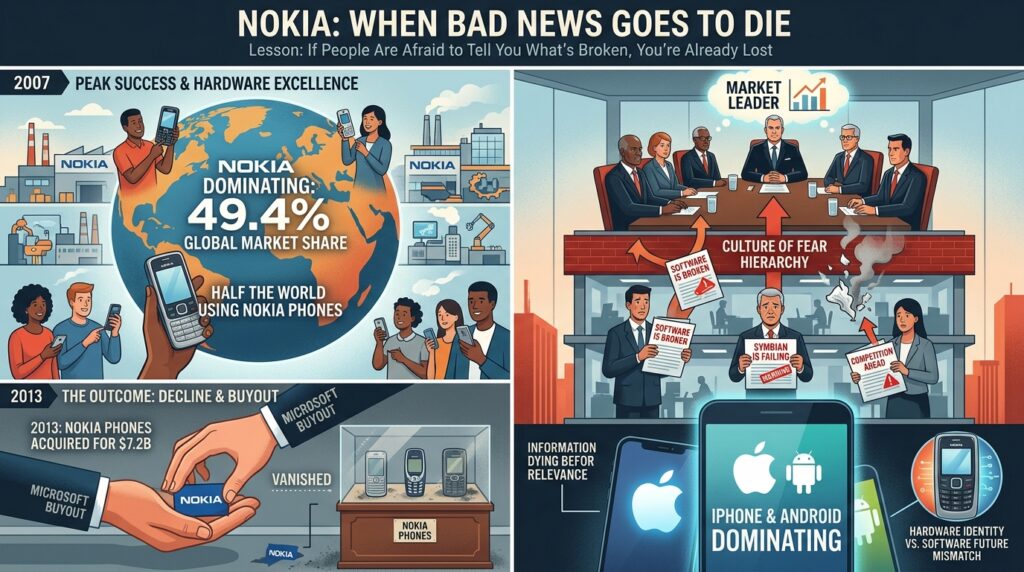
In 2007, Nokia held 49.4% of the global mobile phone market.
Half. Of. Everything.
By 2013, Microsoft bought their phone business for 7.2 billion dollars. By 2014, Nokia phones had basically vanished. It is one of the most dramatic famous brand failures of the smartphone era, and the story people tell about it is wrong.
The story people tell, Apple came out with the iPhone, touchscreens happened, Nokia couldn't adapt.
The actual story is Nokia's middle managers knew for years that their smartphone software was dangerously behind. And nobody told anyone at the top.
A culture where bad news goes to die
INSEAD researchers studied Nokia extensively. What they found was a company so hierarchical, and leadership so intimidating, that people were optimising their reports upward rather than giving accurate ones.
Executives made decisions based on projections that people two levels below them knew were wrong. Nobody said anything. Because saying something felt dangerous.
Nokia also had a fundamental identity problem. They were a hardware company, world-class at making physical phones, durable and reliable and beautifully engineered. But smartphones aren't hardware products. They're software products that need hardware to run.
Nokia never made that mental shift. By the time they admitted how far behind their software was, they needed an entirely new operating system, new app ecosystem, new developer relationships. They tried to build it all while the market was already moving on.
The gap between knowing something is broken and being willing to say it out loud? That gap cost them everything.
| WHAT YOU DO DIFFERENTLY. If people in your business are afraid to tell you when things aren't working, you will always be the last to know. The information that saves your business is almost always uncomfortable to hear. Make it safe to deliver bad news. Reward the people who do it. They are the most valuable people in your company. |
4. BlackBerry - When Being Right About the Wrong Things Destroys You

BlackBerry's co-CEO Mike Lazaridis was not an idiot. He had data. He had focus groups. He had years of enterprise customers who loved physical keyboards.
He genuinely believed consumers didn't want touchscreens.
He was correct that physical keyboards have advantages. He was spectacularly wrong about whether that mattered.
In 2009, BlackBerry held 20% of the global smartphone market and 50% of the US market. By 2016, less than 1%. Seven years. One of the fastest falls in the history of the mobile phone industry and one of the most instructive famous brand failures for anyone running a business right now.
Optimising for people who already love you
Every decision BlackBerry made was filtered through one question, what do our existing enterprise customers want?
Enterprise customers loved the keyboard. Loved the security. Loved the email. BlackBerry was outstanding at serving those people.
But the market was moving somewhere else. Consumers wanted apps. Cameras. A full internet in their pocket. BlackBerry looked at this and concluded it was a phase.
It was not a phase.
Then something even more interesting happened. The enterprise market, BlackBerry's fortress, started following the consumer market. Employees brought iPhones to work. IT departments eventually gave in. The distinction between ‘what people use personally’ and ‘what they demand professionally’ collapsed, and BlackBerry collapsed with it.
| WHAT YOU DO DIFFERENTLY. alk to people who are NOT buying from you. Not just the ones who already are. Your current customers' preferences are not a map of where the market is going. Ask yourself what would someone who'd never heard of me choose right now, and why? |
5. Toys R Us - They Gave Amazon the Keys and Were Surprised When Amazon Kept the Car

In 2000, Toys R Us signed an exclusive deal with Amazon to be the only toy seller on their platform.
At the time, this seemed clever. Amazon had the traffic. Toys R Us had the toys. The deal would handle the internet thing without Toys R Us having to do the internet thing.
Amazon then quietly let other toy sellers onto the platform anyway. In breach of the agreement.
Toys R Us sued. Won. But by the time the lawsuit concluded, Amazon had built out an entire toy category with dozens of suppliers, and the e-commerce window Toys R Us assumed the partnership was handling had long since closed.
They filed for bankruptcy in 2017. Fully liquidated in 2018. Nineteen thousand people lost their jobs.
Partnership as a substitute for strategy
This is one of the most famous brand failures involving a single outsourcing decision, and the lesson is brutal, you cannot delegate your digital future to a partner and assume it's handled.
Toys R Us needed its own e-commerce capability. The Amazon deal felt like a solution. It was actually a way of not solving the real problem.
The stores didn't help either. If you've ever been to a Toys R Us, you know. Vast. Overwhelming. Slightly fluorescent. The experience of being in a giant toy store should be pure magic for a child. It was more like a warehouse that had heard about fun once.
Toys R Us had one massive, genuine advantage, kids love toys. That should have been enough to make the store itself extraordinary. They never did that work.
| WHAT YOU DO DIFFERENTLY. Never outsource the part of your business that is most critical to your future. A partnership solves today's problem. It cannot build tomorrow's capability. If you have a physical space or product, ask honestly, does this experience make people feel something? Because fine is not enough anymore. |
6. MySpace - The Original Social Media Giant That Somehow Became a Music Site Nobody Asked For

MySpace was Facebook before Facebook existed.
In 2008 it had 100 million users and was the most visited website in the United States. News Corp bought it for 580 million dollars in 2005, convinced they'd acquired the future of the internet.
They sold it in 2011 for 35 million dollars. Facebook had 750 million users. MySpace was pivoting to music, which is what you do when you've run out of ideas and are trying to seem intentional about it.
They let users decorate themselves into chaos
MySpace let you customise your profile to an unlimited degree. Font colours. Background images. Embedded music that played automatically and could not be stopped. Animated GIFs that had no business existing. Pages that took a full minute to load and assaulted you when they got there.
People loved the idea of this. They did not, it turned out, love the actual experience of it.
Facebook's bet was simple, people want to connect, not decorate. Clean. Fast. Consistent. MySpace looked at this and concluded their users preferred the chaotic option.
Meanwhile, News Corp was piling advertising onto everything. Pop-ups. Auto-play video ads. Spam. They were extracting maximum value from the platform at exactly the moment they needed to be investing in making it better.
You can't milk a cow and forget to feed it and then be surprised when it stops giving milk. That is not a real farming analogy. But it applies.
| WHAT YOU DO DIFFERENTLY. Being first gives you users. It does not give you loyalty. Ask yourself not ‘do we have customers’ but 'why would they stay if something better appeared tomorrow?' And please, if you are adding revenue mechanisms at the expense of user experience, you are writing a cheque you will eventually have to cash at the worst possible moment. |
7. Yahoo - The Company That Said No to Google Twice and Then Sold to Verizon for Table Scraps

Yahoo's record of declining good opportunities is almost impressive.
1998: offered Google for 1 million dollars. Passed.
2002: could have bought Google again, this time for 3 billion dollars. Negotiated. Walked away. Google is now worth over 2 trillion dollars.
2008: Microsoft offered to buy Yahoo for 44.6 billion dollars. Yahoo said no. They eventually sold to Verizon in 2016 for 4.8 billion dollars.
This is one of the most financially devastating famous brand failures in tech history, and it's fascinating because it wasn't a market problem or a technology problem.
It was an identity problem.
When you don't know what you are, every decision is the wrong one
Yahoo could never decide whether it was a technology company or a media company. This sounds like an abstract question until you realise that every hire, every acquisition, every product decision flows from the answer.
They answered it differently depending on who was in charge. Which changed constantly. Twelve CEOs in roughly a decade. Twelve different answers to the same fundamental question.
Yahoo had a search engine and outsourced search to Google. They had social features before Facebook. They had an app store before Apple. They had streaming before Netflix. They had everything and converted it into nothing because they never committed to any of it long enough to win.
Dabbling is not a strategy. It is what strategy looks like when you're afraid to choose.
| WHAT YOU DO DIFFERENTLY. Know what your business is for. One clear answer. Then make every decision through that lens. Being in seven markets is not the same as winning one of them. If you have an opportunity in front of you right now and you keep thinking about it, that is your answer. Move or let it go. Dithering is its own choice. |
8. Sears - Invented Amazon 100 Years Early, Then Forgot About It, Then Went Bankrupt

Here is a fact that will mildly rearrange your understanding of retail history.
Sears invented the mail-order retail model in the late 1800s. The Sears catalogue was the internet. You could order anything, clothes, watches, furniture, prefabricated houses from anywhere in the country and have it delivered.
Want AI doing the heavy lifting in your marketing?
I build the systems that handle the boring 80 percent, so you get your week back. Done properly, with the human kept in.
They literally invented the concept that built Amazon.
Sears filed for bankruptcy in 2018 with 11.3 billion dollars in debt. Their market cap at peak was 50 billion dollars. At bankruptcy it was approximately nothing.
What happens when financial engineering replaces actual business
In 2005, hedge fund manager Eddie Lampert merged Sears and Kmart, took control, and ran the combined company as a financial instrument rather than a retail operation.
He split the business into internal units that competed against each other. He cut costs aggressively. He reduced investment in stores. He extracted value at every possible point and created a structure where employees described spending more energy on internal politics than on serving customers.
Meanwhile, Amazon was doing exactly what Sears had invented, delivering anything, conveniently, to anyone with the operational obsession that Sears had abandoned.
The lesson isn't to do with retail. It's what happens when a business stops creating value and starts extracting it.
You can extract for a while. You cannot extract forever. Eventually, there's nothing left.
| WHAT YOU DO DIFFERENTLY. Cost-cutting is not a strategy. It is what you do when you've run out of growth ideas. If you have a heritage or an established model that worked, understand why it worked before you optimise it away. The best competitive advantage you can build is being the company that cares most about the customer experience. It is also the hardest for anyone else to copy. |
9. Polaroid - Instant Gratification, Right Up Until There Was Nothing Left to Sell

Polaroid cameras were magical. A photo that developed in your hands, in real time, in front of actual people who had not yet seen it. In the 1970s this was not a novelty. This was a miracle.
The company was worth 3 billion dollars at its peak.
It filed for bankruptcy in 2001 and again in 2008.
(Filing for bankruptcy twice is, I'm sorry to say, a choice.)
And here's the bit that makes Polaroid a particularly interesting famous brand failure, they also had digital photography technology. Patents. Expertise. Early products. They were sitting on the future, again, just like Kodak.
The razor and the blades
Polaroid ran on a razor-and-blades model. Sell the camera cheap, make the money on film. Every photo you took was recurring revenue for Polaroid.
It was a brilliant model, right until digital cameras meant no film, no recurring revenue, and a load of cheap cameras out in the world that now generated nothing.
When digital arrived, Polaroid tried to transition but was so structurally dependent on film income that they couldn't invest meaningfully in competing on digital. They were trying to build a new engine while the car was still running on the old one.
The brand exists today. Someone revived it. It sells retro instant cameras to people who like the aesthetic. That's lovely, genuinely. But that's not recovery. That's a niche nostalgia business wearing the bones of something that could have owned an entire category.
| WHAT YOU DO DIFFERENTLY. What is your business model, really? Not what do you sell, how do you make money from it? Polaroid wasn't in the camera business. It was in the film business. When film went, so did the model. Ask yourself, if the thing that generates my recurring revenue disappeared tomorrow, what happens? And how much runway do I have to build something else? |
10. Borders - Gave Amazon Their Customer Relationships, Was Then Surprised Amazon Used Them

Borders was the second-largest bookseller in America. Over 1,200 stores worldwide. Loyal customers who genuinely loved going there.
In 2001, Borders outsourced its online retail operation to Amazon.
Let me say that again.
They let Amazon run Borders.com. They handed Amazon the customer relationship, the data, the fulfilment, the online experience, everything and then went back to running their physical stores while assuming the internet side was handled.
Amazon used that data, that relationship, and that experience to become the dominant bookseller in the world.
Borders filed for bankruptcy in 2011. Every store closed. 19,500 jobs gone. It is one of the most avoidable famous brand failures in retail history.
The single worst outsourcing decision in the history of books
When Borders eventually tried to build their own e-commerce capability, they were doing it in debt, with no infrastructure, in a market Amazon had completely won. They also over-expanded into music and DVDs right at the moment streaming made both irrelevant.
These things happen in combination. One bad decision creates a constraint. That constraint prevents you from fixing the second problem. Which creates a third. It compounds, and not in the good direction.
| WHAT YOU DO DIFFERENTLY. Your customer relationship is the most valuable thing you have. Never outsource it. Whoever holds the customer data, the customer experience, and the customer contact is the one with the power. Make sure that's you. If you are currently letting a third-party platform own your customer relationship, this is your sign to start building something you control. |
11. Pan Am - The Most Glamorous Brand in the Sky, With No Floor Beneath It

Pan American World Airways was not just an airline. For decades it was a symbol of what travel could be. Glamour. First class. The future, made physical.
Pan Am invented large-scale commercial aviation as we know it. The 747. The concept of hub airports. International mass travel. They were, genuinely, extraordinary.
They ceased operations in December 1991.
Extraordinary at one thing, with nothing underneath
Pan Am's fatal structural problem, no domestic US routes.
In a deregulated market, competitors were building profitable domestic networks that subsidised their international expansion. Pan Am was a prestige international operation with no feeder system and no domestic cushion.
Then everything that could go wrong did, in sequence.
1986: oil crisis. Fuel costs hammered.
1988: the Lockerbie bombing. Reputation for safety, gone.
1991: Gulf War. Transatlantic travel collapsed.
Any one of these might have been survivable. For a structurally sound company. Pan Am was not structurally sound. It was extraordinary and brittle, and brittle things break under pressure.
They sold routes, sold hubs, sold planes, piece by piece, trying to stay alive. Until there was nothing left to sell.
| WHAT YOU DO DIFFERENTLY. A famous brand is not a business strategy. It is the reward for one. What happens to your business if your single biggest advantage disappears tomorrow? Build depth. Multiple revenue streams. Multiple customer types. Multiple reasons someone might choose you. Being brilliant at one thing with no backup plan is an incredibly fragile way to exist. |
12. MapQuest - Owned Navigation, Then Forgot to Move When Navigation Did

In 2000, MapQuest was the dominant online mapping service in the world. AOL paid 1.1 billion dollars for it.
Today MapQuest exists. It is not relevant in a way that requires further discussion.
Google Maps launched in 2005. Within a few years it was the default for basically everyone. MapQuest went from owning a market to being a thing people remember existed in approximately the time it takes to grow out a bad haircut.
Built for the world as it was, not the world as it was becoming
MapQuest was a desktop product. You looked up directions, printed them out, and argued about which lane to be in.
In 2007, the iPhone arrived. Maps moved into your pocket, connected to GPS, updating in real time. Google understood this immediately and built accordingly.
MapQuest was retrofitting a desktop experience for mobile. Google was building mobile from scratch.
The difference between a purpose-built mobile product and a converted desktop product is the difference between MapQuest and Google Maps. One of those is still relevant. You know which one.
This is a famous brand failure that isn't dramatic. No activist investor. No lawsuit. No borrowed billions. Just a company that built something excellent for a moment that passed, and didn't build fast enough for the moment that replaced it.
| WHAT YOU DO DIFFERENTLY. Where does your customer use your product? Not where you think they do, where they actually do. Technology platforms shift. When they shift, products built for the old platform have to rebuild from scratch. If mobile is not central to your product or service experience right now, ask yourself why. And be honest with the answer. |
The 5 Patterns Behind the Most Famous Brand Failures in History

These twelve famous brand failures are not twelve different stories. They're the same five stories, in rotation. These five patterns appear in almost every set of famous brand failures, from Blockbuster to MapQuest.
Pattern 1: Protecting existing revenue instead of building future revenue
Kodak, Polaroid, Blockbuster. All had the resources. All had the information. All decided that protecting today's income was less frightening than building tomorrow's. It always feels rational in the moment. It always looks catastrophic from ten years out.
Pattern 2: Outsourcing a critical capability
Borders and Toys R Us handed their e-commerce future to Amazon. When they tried to reclaim it later, the window was gone and the debt was insurmountable. If something is central to your future, you must build it yourself. Even if it's slower. Even if it's more expensive. It's the only version that works.
Pattern 3: A culture where bad news travels slowly or not at all
Nokia's middle managers knew the software was broken. No one told the top. Yahoo kept changing strategy because no one could hold a consistent diagnosis of what was wrong. Information that doesn't reach people who can act on it is the same as information that doesn't exist.
Pattern 4: Optimising for current customers while ignoring where the market is going
BlackBerry built a better and better product for their existing enterprise customers while consumers moved to smartphones and took the enterprise market with them. MapQuest made an excellent desktop product while the world moved to mobile. The customers who love you today are a lagging indicator. They are not a forecast.
Pattern 5: No clear answer to what are we actually for?
Yahoo tried everything and owned nothing. MySpace was popular and directionless. Sears spent a decade optimising for financial extraction rather than customer value. Every company that survived disruption had a clear, held answer to what it existed to do. The ones that didn't? You're reading about them.
What You Do With All of This And How to Avoid Famous Brand Failures
This isn't history.
History is what it looks like when you're standing far enough away. Up close, it looks like a normal Tuesday and a decision that seems completely reasonable and a competitor who doesn't seem that threatening yet. Every famous brand failure on this list had a moment where a different decision could have changed everything.
The same patterns behind these famous brand failures are playing out right now. In businesses of every size. Including, probably, some you admire. Maybe including yours.
Not because the people running them are fools. But because protecting existing revenue is always more comfortable than building new revenue. Because bad news is hard to hear. Because your current customers are real and your future customers are theoretical.
I rebuilt my business after two years in a wheelchair. Everything I'd spent a decade creating had gone quiet. Not dramatically. Just quietly, the way guests stop coming to a party nobody told you was over.
Coming back taught me something. Nothing is permanent. Not market share. Not the distribution channel that currently works. Not the revenue model that currently holds.
The companies that are still growing made a choice. Specifically, they chose to disrupt themselves before someone else could. Netflix killed the DVD model before Blockbuster could finish laughing. Amazon built its own logistics before it could become dependent on carriers. Apple made the iPhone knowing it would eat the iPod. There is no shortage of famous brand failures that prove ignoring your customers is a slow form of corporate suicide.
That willingness to break your own best thing in service of where your customers are going is the whole difference.
You don't need to be worth billions to do it. You just have to be willing.
Do the audit. Ask the uncomfortable question. Find the thing you're protecting that you know you shouldn't be.
Do it now, while it's still a choice.
Want to see how much time AI could free up in your business? Try my free AI savings calculator and you'll get a simple roadmap.
Many of these brands stopped listening to customers long before the end. A good help desk platform keeps complaints visible, and an AI visibility checker shows what assistants now say about your brand.
FAQs About Famous Brand Failures
What is the Most Famous Brand Failure in Business History?
Blockbuster is the one most people cite, because the Netflix story is vivid and the stakes were clear and the ending involves a tourist attraction in Oregon. But Kodak is arguably more instructive, they invented the technology that replaced film, suppressed it internally, and then watched competitors use it to put them out of business. That level of irony is instructive in a way that sticks. Blockbuster is widely considered the most famous brand failure of the modern era, though Kodak runs it close.
What Do All Famous Brand Failures Have in Common?
Almost all of them share at least one of five traits, protecting existing revenue over building future revenue; outsourcing a critical capability; a culture where problems don't reach decision-makers; optimising for current customers while ignoring where the market is going; and not having a clear identity about what the business exists to do. Most share more than one. The most consistent thread across famous brand failures is the prioritisation of short-term revenue protection over long-term adaptation
Can small businesses learn from the failures of large corporations?
Absolutely and more easily, because small businesses can change faster. The patterns that killed these giants operate at every scale. The advantage a small business has is that one person can make a different decision tomorrow. Large corporations need eighteen meetings and a committee.
Which companies successfully avoided becoming famous brand failures?
Netflix, Amazon, Apple, and Adobe are the most instructive. Each faced a moment where their existing model was genuinely threatened and chose to disrupt themselves rather than defend what they had. Netflix moved from DVDs to streaming. Amazon moved from books to everything. Apple built the iPhone knowing it would kill the iPod. Adobe moved to subscriptions when the market made perpetual licences unviable. All of them are still here.
What should I do if I recognise these patterns in my own business?
Name the specific thing. Not we need to innovate more but we are protecting this particular revenue stream because changing it is scary, and that fear is stopping us from building what our customers need next.
Then move. The businesses on this list all had the information they needed. The difference was whether they were willing to act on it.
If you've read this far and quietly recognised one of these patterns in your own business, that's not a coincidence. That's the thing worth paying attention to.
I work with small businesses, entrepreneurs and marketers to look honestly at what's working, what's not, and what needs to change before it becomes a problem you can't reverse. Not generic advice. An actual look at your business model, your revenue, your positioning, and where the gaps are.
If you want a second pair of eyes on your business before it becomes a case study, let's talk, here's how to work with me.
If you want the full breakdown, here is everything I know about digital marketing.
Related: attraction marketing.
Related reading: Maximizing Brand Impact: How Every Booth Interaction Adds Value.
Related reading: Why Every Plumber Needs Insurance to Secure Their Business.
Related: how much an AI consultant costs
Related reading: for more on what separates the winners from the failures, see these business lessons from the best entrepreneurs and our library of marketing case studies.
Free resource: The Energy-Mapping Time Block Cheat Sheet.
Related reading: Top Tips on How To Learn Affiliate Marketing and PPC Advertising in 2022! and Understand How Online Fraud Works and Learn How to Protect Yourself.
The Screening Test I Run With Clients Before Any Campaign Goes Live
After watching enough of these disasters unfold from the outside, I built a simple screening habit into my own client work: before any campaign, ad, or piece of copy leaves the building, it goes through what I call the five reader test. I hand the concept to five people who had no part in creating it: someone in finance, someone in customer service, someone under 25, someone over 50, and one person outside the company entirely. If two or more of them flinch, pause, or ask "wait, does this mean what I think it means," the campaign does not launch as is. That single rule has stopped three client campaigns in the last four years, including a pun-based tagline for a financial services client that an outside reader immediately read as mocking bankruptcy.
The reason this works where internal review boards often fail is that most brand failures, from the Kenneth Cole 9/11 tweet to Peloton's 2019 holiday ad, were approved by rooms full of marketing professionals who had spent weeks with the material and lost the ability to see it fresh. Groupthink inside a marketing or executive team is not a hypothetical risk, it is the actual mechanism behind most of the failures people write about. The teams were not careless, they were simply too close to their own work, and nobody with a outside perspective saw it before the public did.
My honest opinion, having sat in on brand strategy sessions for over a decade, is that most companies treat crisis prevention as a legal compliance exercise rather than a creative one. They run copy past lawyers for liability but never past a bored 22 year old customer service rep who could tell them in ten seconds that the joke lands wrong. Legal review catches defamation and trademark issues. It does not catch tone-deafness, and tone-deafness is what sinks a brand's reputation, not lawsuits.
- Pull five reviewers from outside the creative team, including at least one customer-facing employee
- Show them the raw concept with no framing or explanation from the creators
- Treat any hesitation as a stop signal, not something to explain away
It costs one afternoon. Every failure in this post cost millions and, in some cases, the CEO's job.



