- The quick result: 28 days, then and now
- October beat January to September combined
- 412,073 impressions in one day
- Cited by AI 1 million times
- Traffic is nice. Enquiries pay the mortgage.
- Newsletter signups, all from my website
- What compounding looks like up close
- What went wrong this fortnight
- How to grow your website traffic: what I'd copy
- The lesson from my worst week
- Every weekly experiment that got me here
- FAQs
- Want the next chapter?
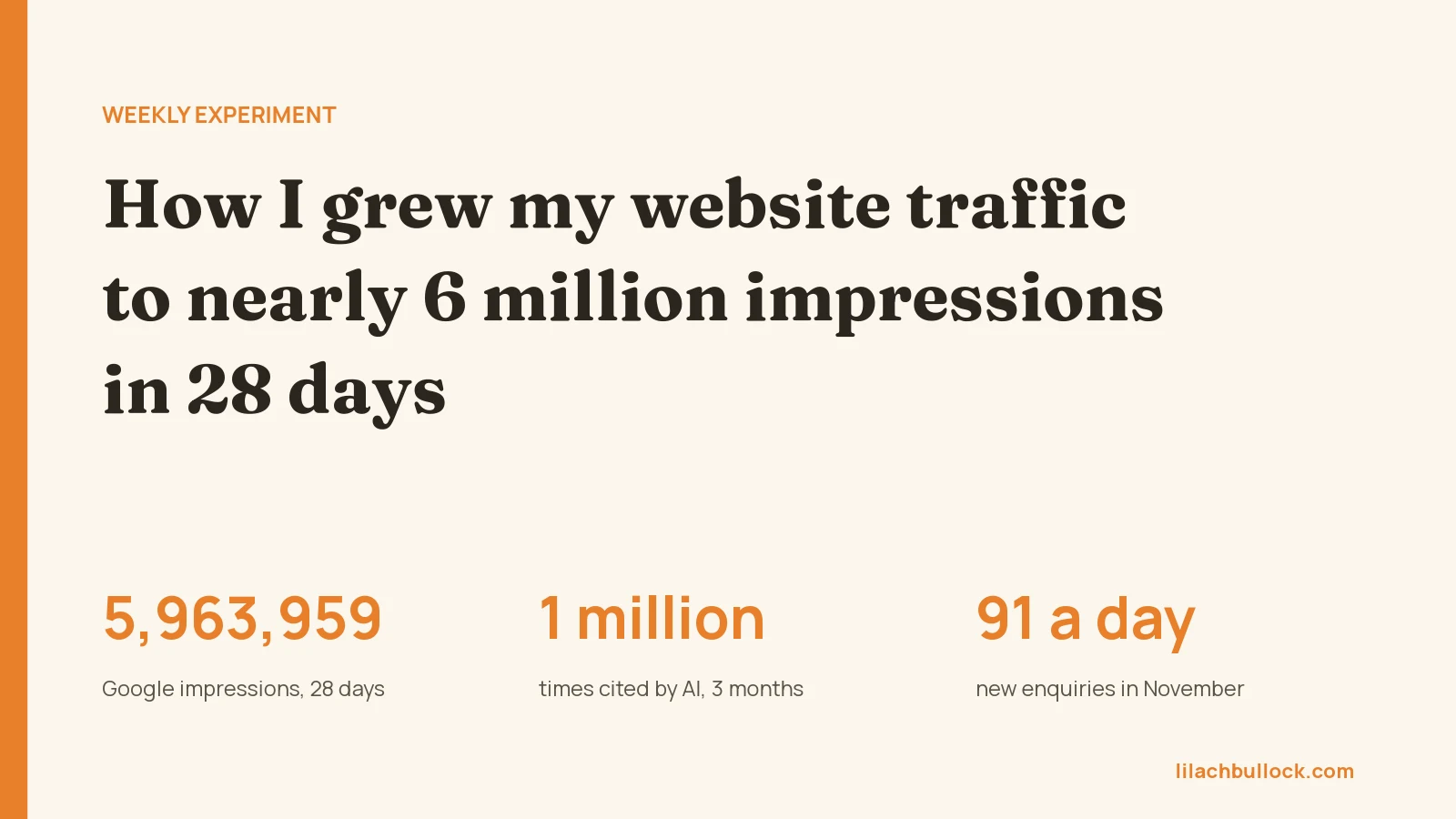
My website just had the best fortnight in its life.
I spent most of it in bed with a flu-like bug, convinced I'd lost my touch.
Which is a funny thing to think while Google is showing your pages 412,073 times in one day. But that's the thing nobody puts on the graph. A week earlier I felt unstoppable. Then I got ill, my confidence went for a long walk without me, and I started doubting every decision I'd made since January.
The numbers didn't notice. They kept climbing. This is the story of why, and what I'd copy if I were you.
The quick result: 28 days, then and now
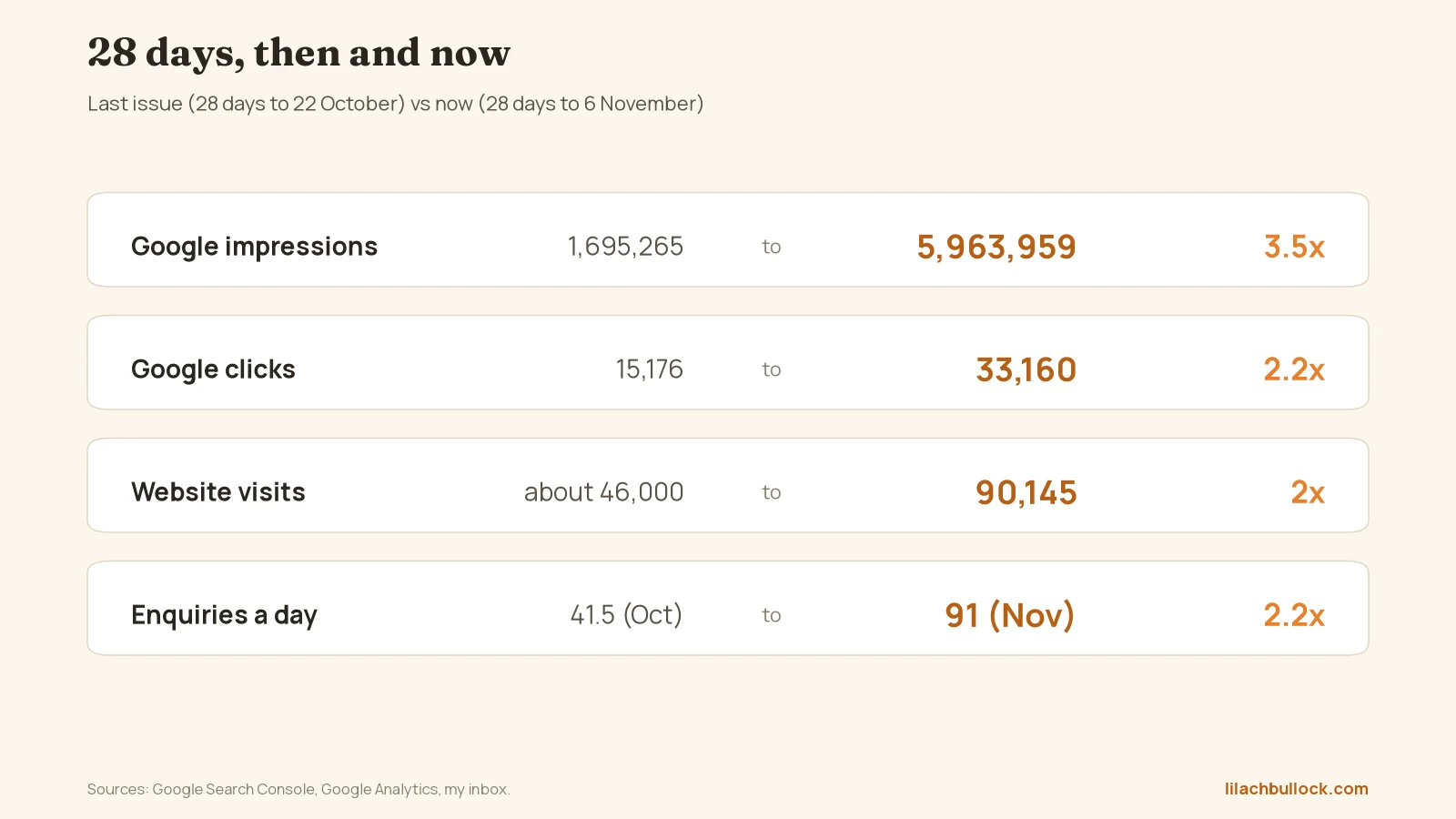
Here's where things stood at my last update, against the 28 days to 6 November 2026.
| 28 days to 22 October | 28 days to 6 November | Change | |
|---|---|---|---|
| Google impressions | 1,695,265 | 5,963,959 | 3.5x |
| Google clicks | 15,176 | 33,160 | 2.2x |
| Website visits | about 46,000 | 90,145 | roughly 2x |
| New enquiries a day | 41.5 (October) | 91 (1 to 6 November) | 2.2x |
And the one that still makes me blink: my website has been cited by AI 1 million times in three months, with nearly 40,000 citations in a single day.
Nine months ago, January brought me 1,322 Google clicks for the whole month. The first six days of November brought 11,186.
October beat January to September combined
If you only look at one chart, make it this one.
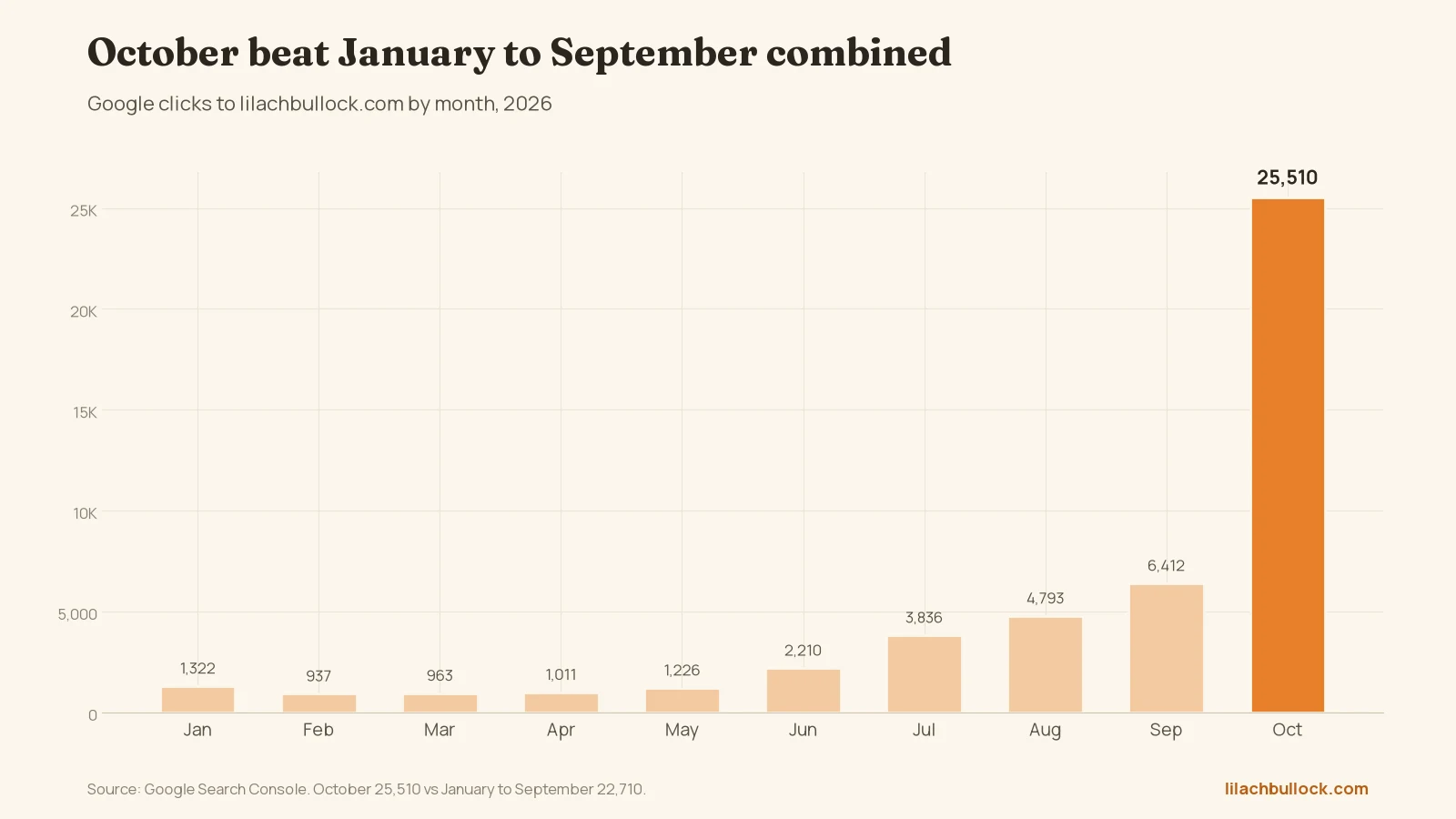
In October my website got 25,510 clicks from Google. January to September added together came to 22,710. One month beat nine.
That didn't happen in October. It happened in all the months before it, when the bars were small and nobody was clapping. February was lower than January. March and April barely moved. If I'd judged the plan on those months, I'd have stopped.
The daily picture is even sharper. In January I averaged 43 clicks a day from Google. Every single day of November so far has been over 1,600, with an average of 1,864.
412,073 impressions in one day
An impression is one time one of my pages appears in someone's Google results. It's not a visit. It's a chance to be chosen.
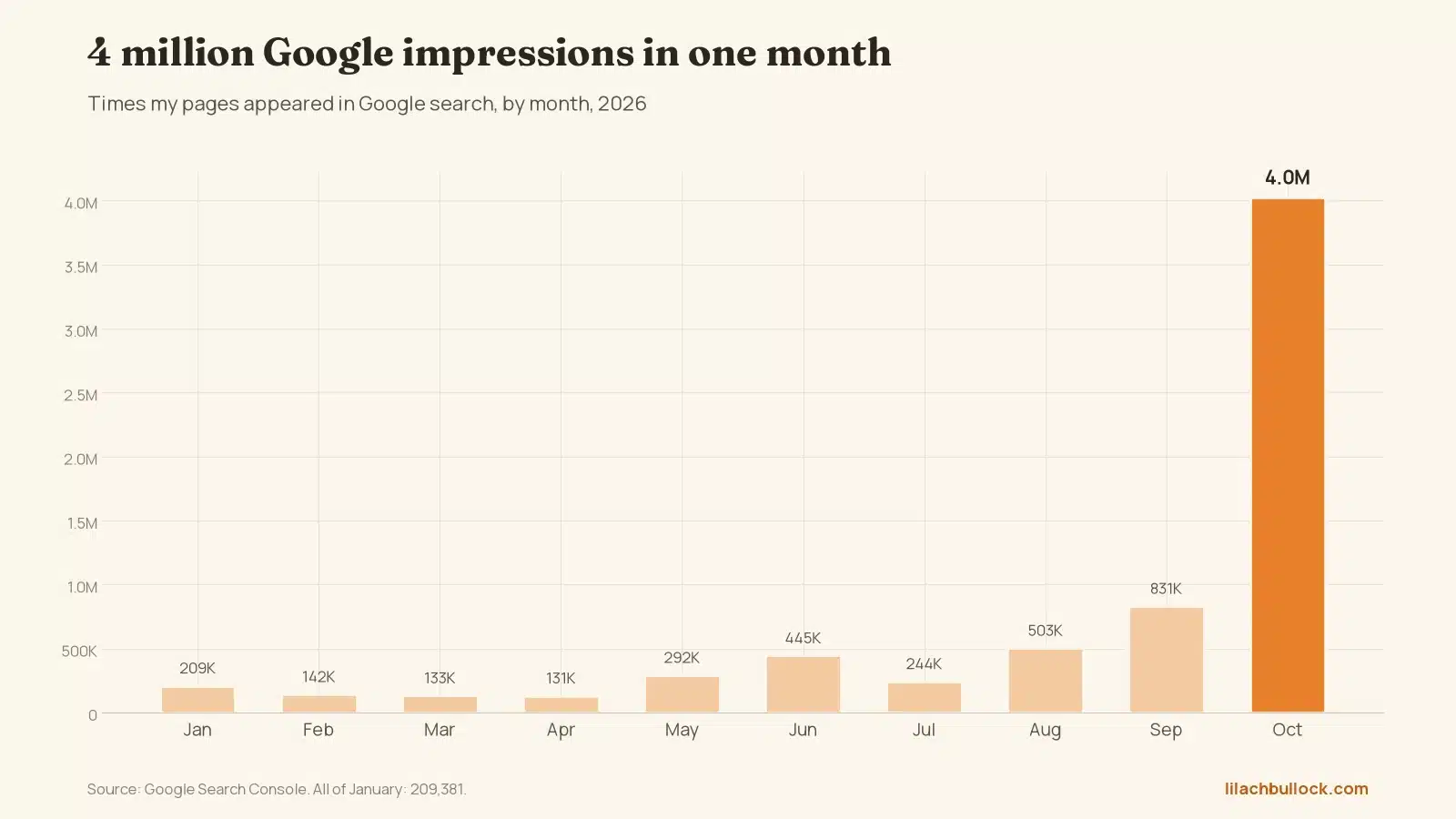
On 4 November my pages appeared 412,073 times. The whole of January was 209,381. So one ordinary-looking day in November did nearly double the work of an entire month at the start of the year.
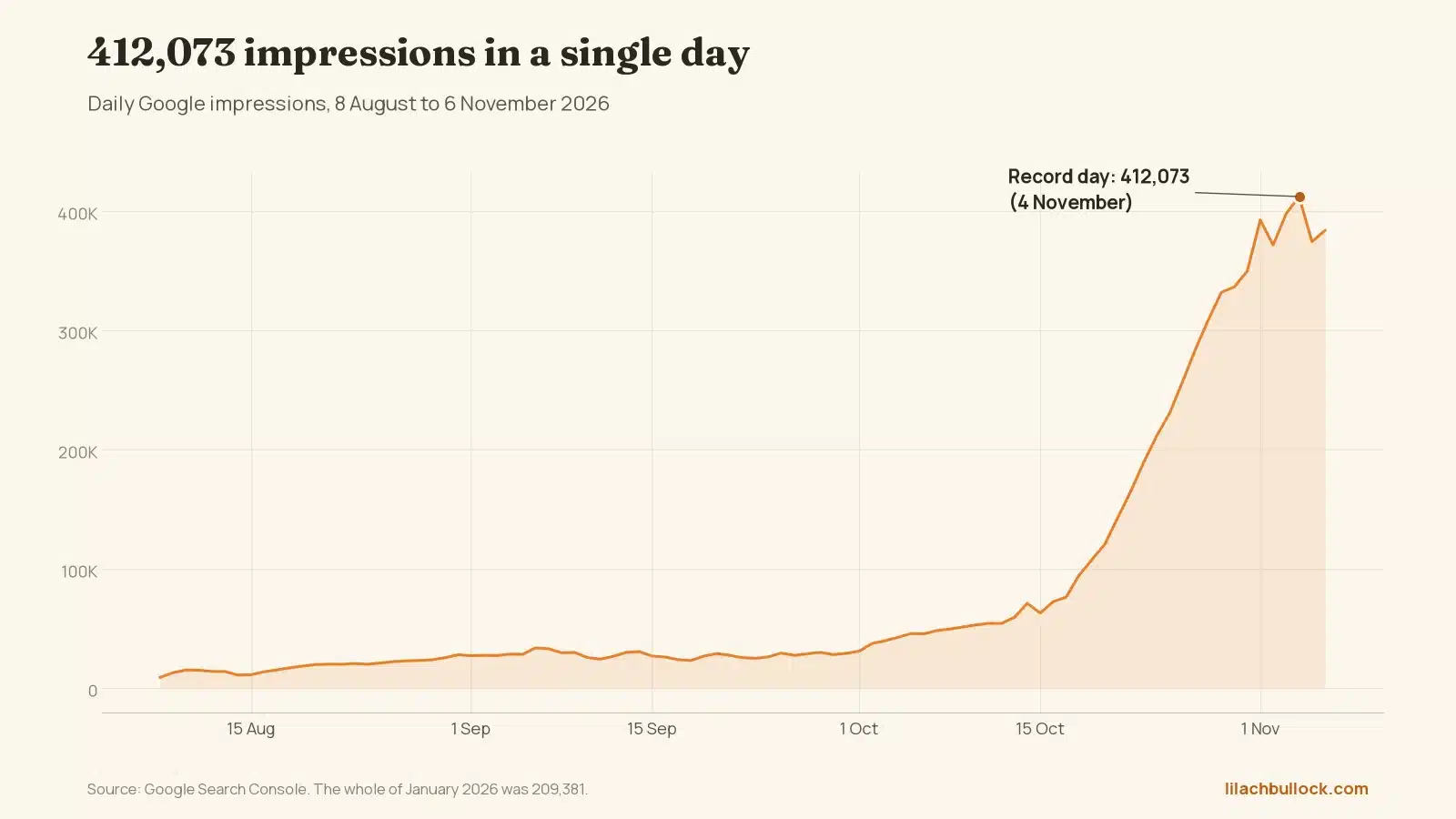
Why does that matter for a small business? Because impressions are the top of everything. More people see your name, a slice of them click, a slice of those enquire, and a slice of those buy. You can't win the bottom of that if nobody sees the top.
Cited by AI 1 million times
This is the bit I'm proudest of, because a year ago I couldn't have told you whether AI tools had ever heard of me.
Over the last three months, AI assistants have cited my website as a source 1 million times. On the busiest day it was nearly 40,000. That's people asking an AI a question and the answer pointing at my work.
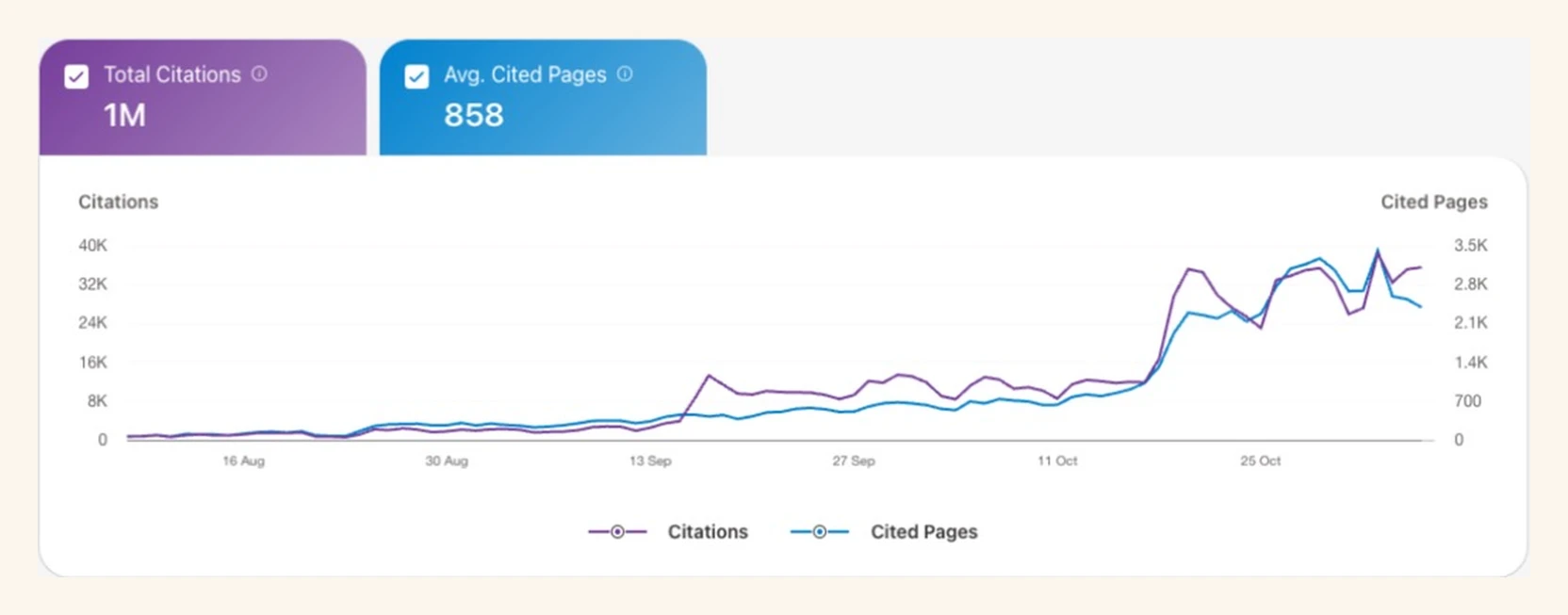
It's the new word of mouth, and most small businesses have no idea whether they're in the conversation or not. If you want to find out where you stand, my free AI visibility checker shows whether AI tools already mention your business. I wrote up how I got here in getting found by AI.
Traffic is nice. Enquiries pay the mortgage.
I'll be honest: I don't care about traffic for its own sake. I care about what it turns into.
In October I counted 1,288 new sponsorship and partnership enquiries, about 41.5 a day. In the first six days of November, 547. That's about 91 a day, more than double, counted the same way for both periods.
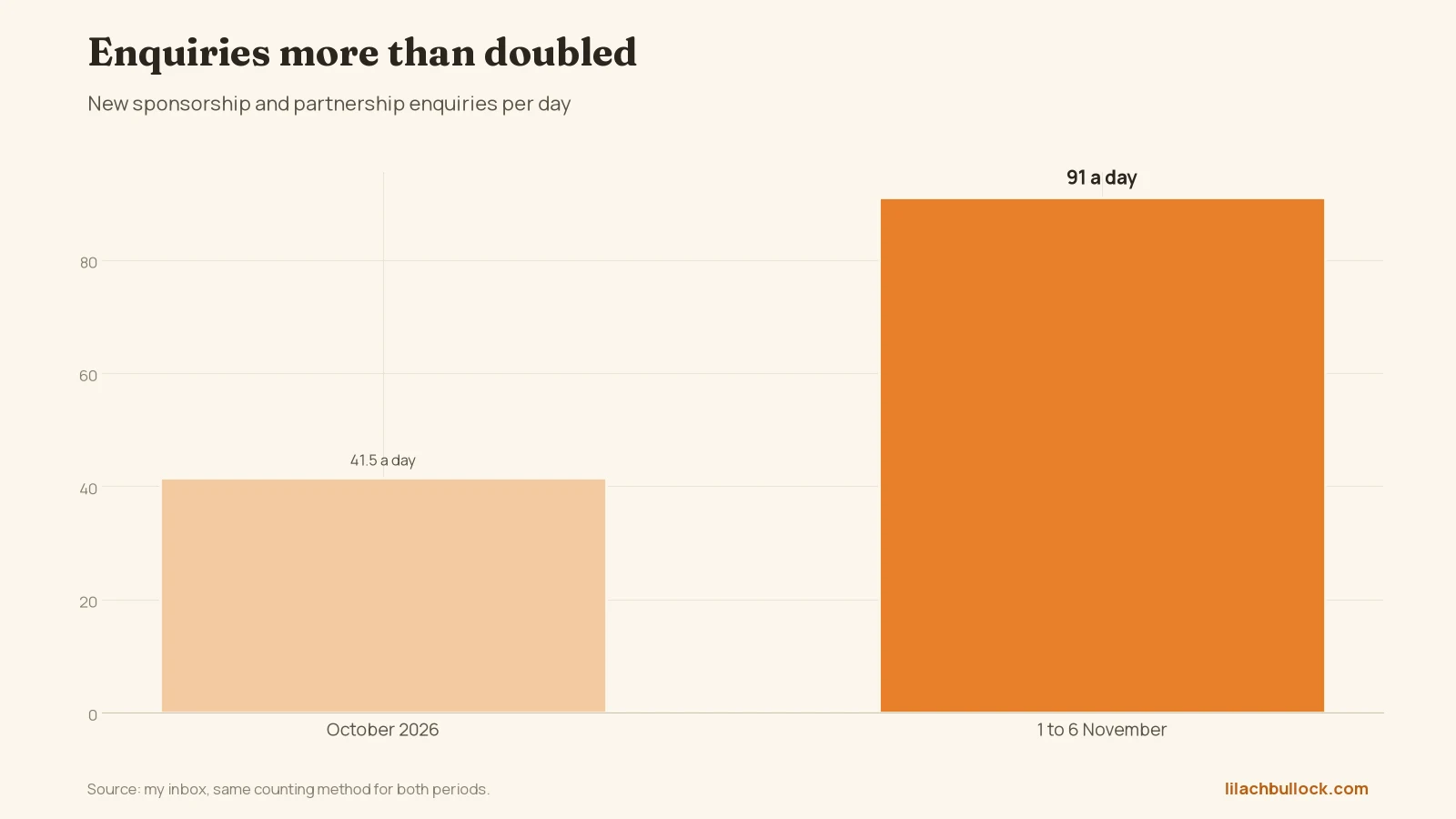
Enquiries for product placements, my highest-value service, went from 122 in the whole of October to 86 in the first six days of November.
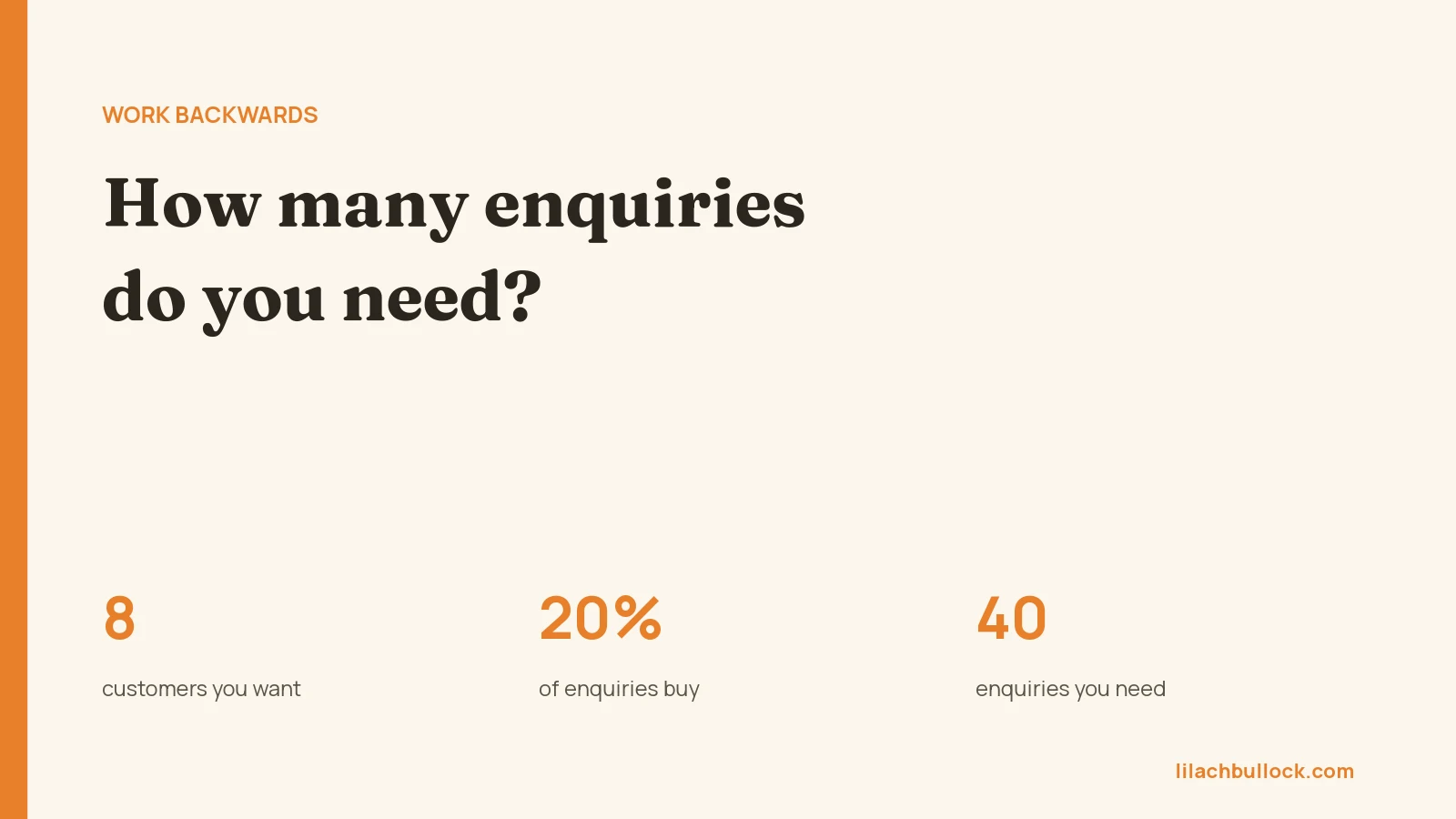
If you're wondering how many enquiries your own business needs, I've written a step-by-step guide: how many enquiries do you need? It works backwards from the customers you want, which is a lot more useful than "more leads, please".
Newsletter signups, all from my website
People asked me to share this one, so here it is. Every new newsletter subscriber this year came from my website. I haven't started on social media yet.
In January, 21 people signed up. In October, 1,159 did. In the first seven days of November, 468 more.
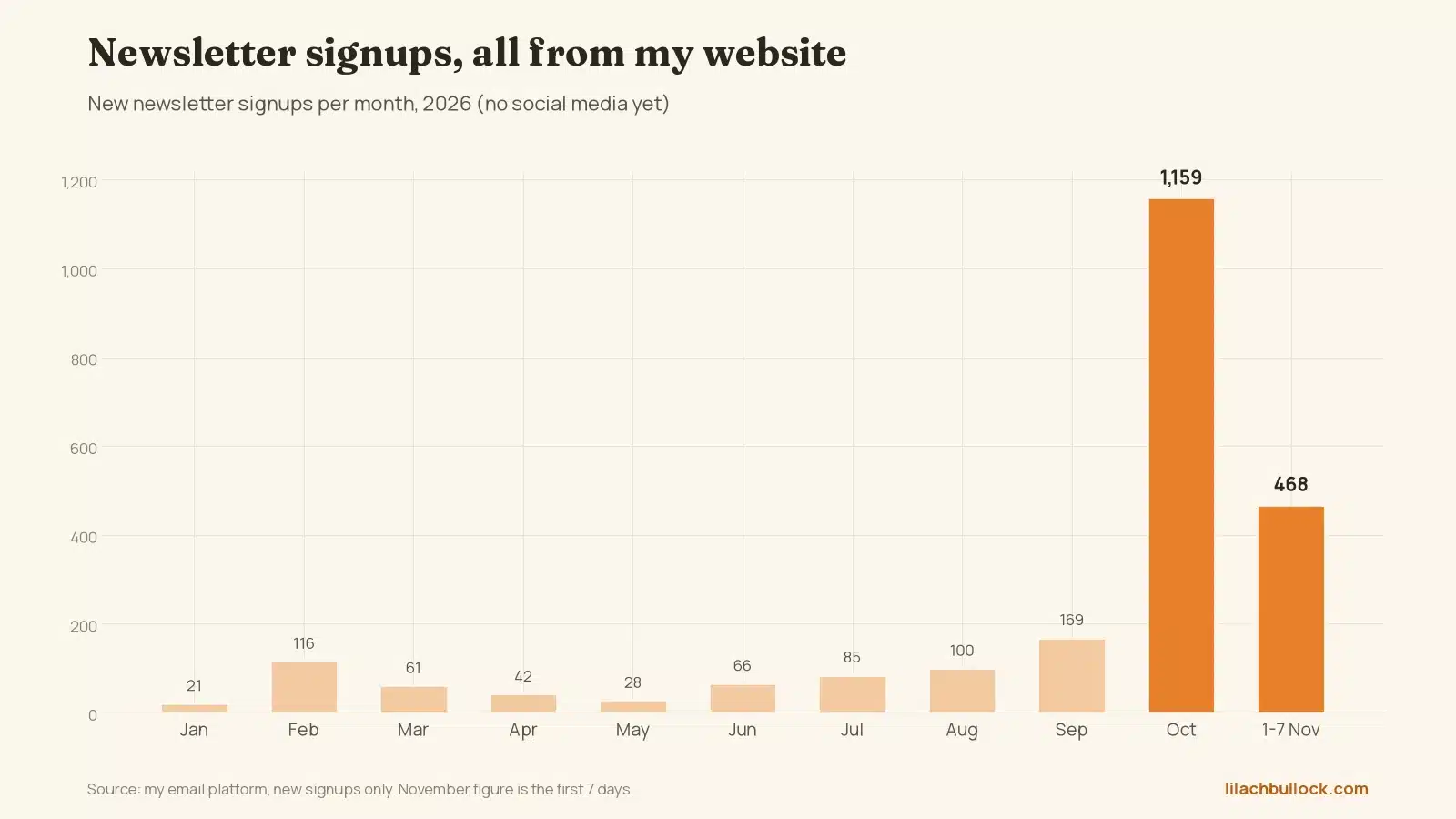
That's the compounding effect in one line: the same website, the same newsletter, a lot more people finding both.
Want AI doing the heavy lifting in your marketing?
I build the systems that handle the boring 80 percent, so you get your week back. Done properly, with the human kept in.
What compounding looks like up close
Compounding sounds clever. Up close, it's boring.
It's publishing pages that answer the questions my readers type into Google. It's linking those pages to each other so Google understands what my site is about. It's going back to old posts and fixing them. It's citing good sources. Every day.
In the seven days to 7 November, my AI team and I made 20,255 updates to my website: new pages, new internal links and new sources. My standard is 3,500 updates a day, and that standard doesn't change because I'm feeling rubbish.
That's the whole point. If your growth depends on how you feel, it'll be as moody as you are. If it depends on a system, it carries on while you're under a duvet with a box of tissues.
What went wrong this fortnight
You don't get numbers like this without things breaking. Here's what broke, and what I did about each one.
My inbox is still the bottleneck. About 91 new enquiries a day sounds like a dream until you're the one answering them. AI sorts them and drafts the routine replies, but invoices, approvals and anything unusual still need me. I've rebuilt how my inbox works twice in a month, and it's getting there.
AI made mistakes. In one case an apology email went to the same newsletter partner twice, because a resend didn't check whether the first had already gone. Mildly mortifying. Now every send gets checked before it goes. AI is brilliant, but it isn't 100% reliable, and it still needs a human who knows what good looks like.
The website outgrew its hosting. More visitors meant more strain, and the site wobbled a few times. I upgraded the hosting.
I slowed down on purpose. On 2 November I deliberately cut how many new pages we publish while I ran a safety review against Google's guidelines. I'd rather grow a bit slower and keep everything I've built than chase a bigger number and lose it. That's a decision I'd make again.
How to grow your website traffic: what I'd copy
You don't need a team of AI agents to use what worked for me. Here's what I'd do with a small site.
- Answer the questions your customers ask. My pages that win are the ones that answer a specific question in plain English. Tool names and buzzwords lose. Questions win.
- Publish steadily, not in bursts. A little every week beats a flurry every quarter. Google rewards a site that keeps getting better.
- Link your own pages together. Every new page should point to two or three related ones, and they should point back. It's free and most people skip it.
- Fix what you already have. Old posts with a few impressions are your cheapest wins. Update them, sharpen the title, add a clear answer near the top.
- Check whether AI knows you exist. AI answers are where a lot of buying research starts now. Run the AI visibility checker and see.
- Track enquiries, not just visits. Traffic is the top of the funnel. Count what comes out of the bottom.
If you'd like a simple way to see which of your own jobs could run without you, my free automation audit checklist walks you through it.
The lesson from my worst week
Here's what I'll take from this fortnight.
Judge yourself on the trend, never on the day. The day you feel your worst might be the day your graph hits a record. The week you feel unstoppable might be a flat one. Neither tells you much.
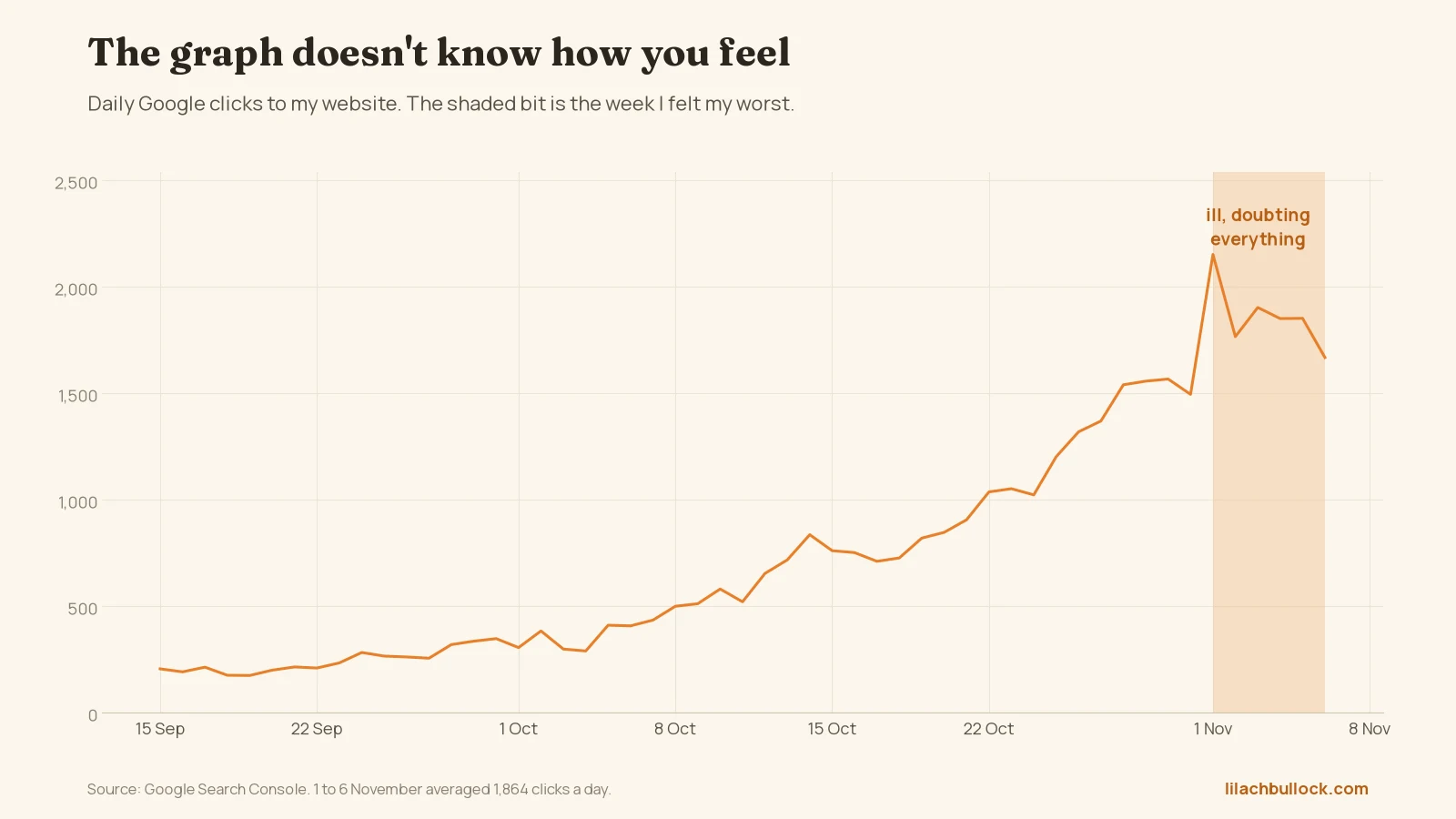
What tells you everything is whether you kept showing up, and whether you built something that shows up when you can't. I wrote more about that side of it in mindset for entrepreneurs, because I suspect I'm not the only one who's had a wobble this year.
Every weekly experiment that got me here
This is the latest chapter of my rebuild in public. Every earlier chapter is below, so you can see the bits before the nice graph.
- Week 1: I de-indexed 1,300 pages to save my website
- Week 2: My newsletter stopped getting opened
- Week 3: The unglamorous SEO work nobody talks about
- Week 4: The crawled-but-not-indexed problem
- Week 5: Getting my newsletter opened again
- Week 6: Conquering my inbox instead of my blog posts
- Week 7: The sponsored post experiment that helped rebuild my business
- Week 8: I let Claude loose on my website
- Week 9: The newsletter redesign that backfired
- Week 10: Automating my WordPress publishing
- Week 11: Rescuing the pages I'd de-indexed
- Week 12: Getting AI to help with my inbox
- Week 13: The month my website started paying me again
- Week 14: The rebuild in public numbers
- Week 15: Getting found by AI
- Week 16: Setting up cold email with AI
- Week 17: My hands-free cold email disaster
- The five-month passive income comeback
- Week 19: I asked one AI to audit another
- Week 20: The AI email workflow behind 3.7x more enquiries
- Building an AI agent to run my newsletter
- My AI SEO results and the ChatGPT recommendation
- My experiment with AI in everyday life
- I Built My Career on Luck and Timing. I Don't Have Either Anymore. Here's What I'm Doing Instead.
- How to Keep Your Business Running When Your Brain Has Officially Left the Building
FAQs
How long does it take to grow website traffic?
Longer than you'd like, then faster than you'd expect. My clicks barely moved from February to May, then roughly doubled every couple of months, and October beat the previous nine months combined. Most of the growth arrived long after most of the work.
Are impressions or clicks more important?
Clicks pay the bills, because a click is a visit. Impressions matter because they're the chances you get to be clicked, and they usually rise first. I watch both, and I judge a page on whether people choose it once they see it.
How do I know if AI tools mention my business?
Ask them, and keep a note of what they say. For a quicker check, my free AI visibility checker shows whether AI tools already mention your business and what to fix first.
Can a small business grow traffic without social media?
Yes. Every new newsletter subscriber I've had this year came from my website, before I'd started on social media. Search and AI answers bring people who are already looking for what you do, which is the best kind of visitor.
Want the next chapter?
I share the numbers, the mess and what I'd do differently every week in my newsletter, along with my weekly AI news for small business round-up.
And if you'd like this kind of growth for your own business, here's how to work with me.