I get two New Years.
There is the one on 1 January, when the whole world seems to pause, review and decide what the next twelve months should become.
Then there is Rosh Hashanah, the Jewish New Year, which begins at sundown on 11 September this year.
I love this time of year because it gives me another honest stopping point.
Not another chance to write an ambitious list and forget it by February. We already know why so many New Year's resolutions disappear. This is a chance to ask whether the goals I set still belong to the life and business I am living now.
That feels especially important after three weeks of work travel and a fresh lesson in how to keep a business running when life changes location.
I am flying from Orlando to the UK, then back to Israel. It has been long, intense and full of meetings, conversations and movement. The business continued. Clients were served. AI agents and systems carried repeatable work in the background. One sponsored-post income stream had its strongest month yet.
I am proud of what worked.
I can also see more clearly what felt heavy, what still depends too much on me, and what I do not want to drag unchanged into another year.
That is the gift of a second New Year.
January lets me imagine.
Rosh Hashanah asks me to account.
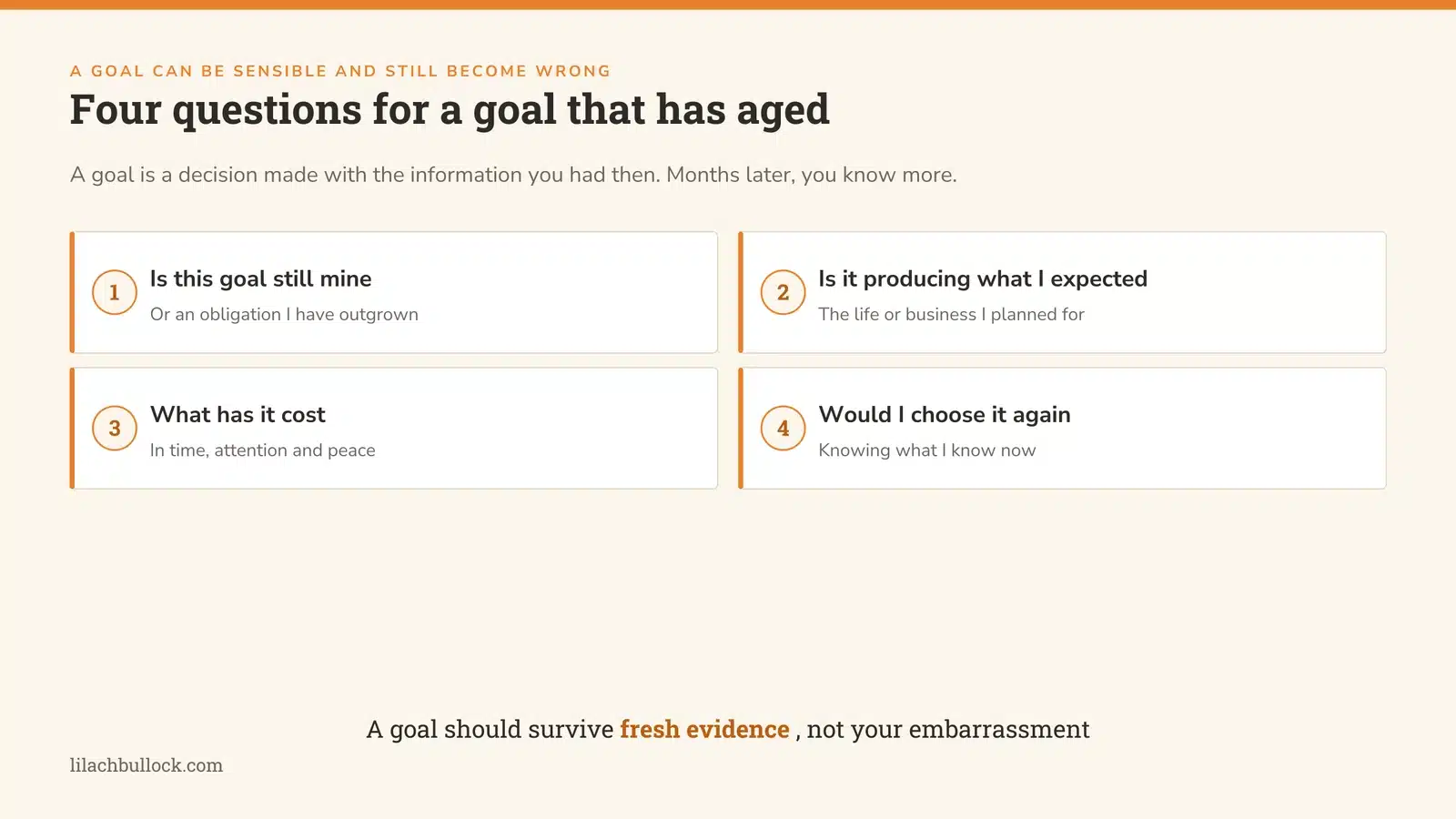
A goal can be sensible and still become wrong
We treat changing a goal as weakness because we confuse consistency with integrity. That is why goal setting needs a blueprint and a review date.
But a goal is a decision made with the information, energy and priorities you had at the time. Months later, you know more. Self-discovery and reflection reveal when those inputs have changed. The market may have changed. Your family may need something different. The work may be succeeding in a way you did not predict or costing you more than the result deserves.
Keeping the goal simply because you announced it is not discipline. Sometimes it is avoidance.
A second review point gives you permission to ask:
- Is this goal still mine?
- Is it producing the life or business I expected?
- What has it cost in time, attention and peace?
- Would I choose it again with what I know now?
My verdict
A goal should survive fresh evidence, not your embarrassment about changing course. A positive business mindset is strong enough to change its mind.
Use it in your business
Take the three goals that have consumed the most attention since January. For each, write continue, change or close. Add one sentence of evidence. Do not use how much work you have already invested as the evidence.
Keep this human
Numbers tell you what happened. They do not tell you what is worth wanting.
Reflection is not a performance review
Business reflection can become another way to punish yourself.
You open the plan, find the targets you missed and begin building a case for why you should have worked harder.
That is not useful reflection. It is prosecution.
The point is to see accurately.
What worked because you designed it well, rather than because you relied on motivation every day?
What worked only because you repeatedly rescued it?
What looked successful from the outside and felt unsustainable from the inside?
What did not hit the number but created a relationship, capability or piece of evidence that matters next?
I can look at this trip and see both the result and the cost. The systems gave me freedom. The schedule was still intense. AI carried work. It did not carry jet lag, emotion or the human effort of being present in every meeting.
Both things are true.
My verdict
Honest reflection includes the result, the method and the cost. Remove any one of the three and you can learn the wrong lesson.
Use it in your business
Review one recent win using three columns: result, what produced it, and what it cost. This is more useful than collecting inspirational quotes and hoping your energy changes. Keep the mechanisms that produced value. Redesign the parts that required unnecessary strain.
Keep this human
Do not ask AI to decide whether the cost was worth it. That answer belongs to the person who lived it.
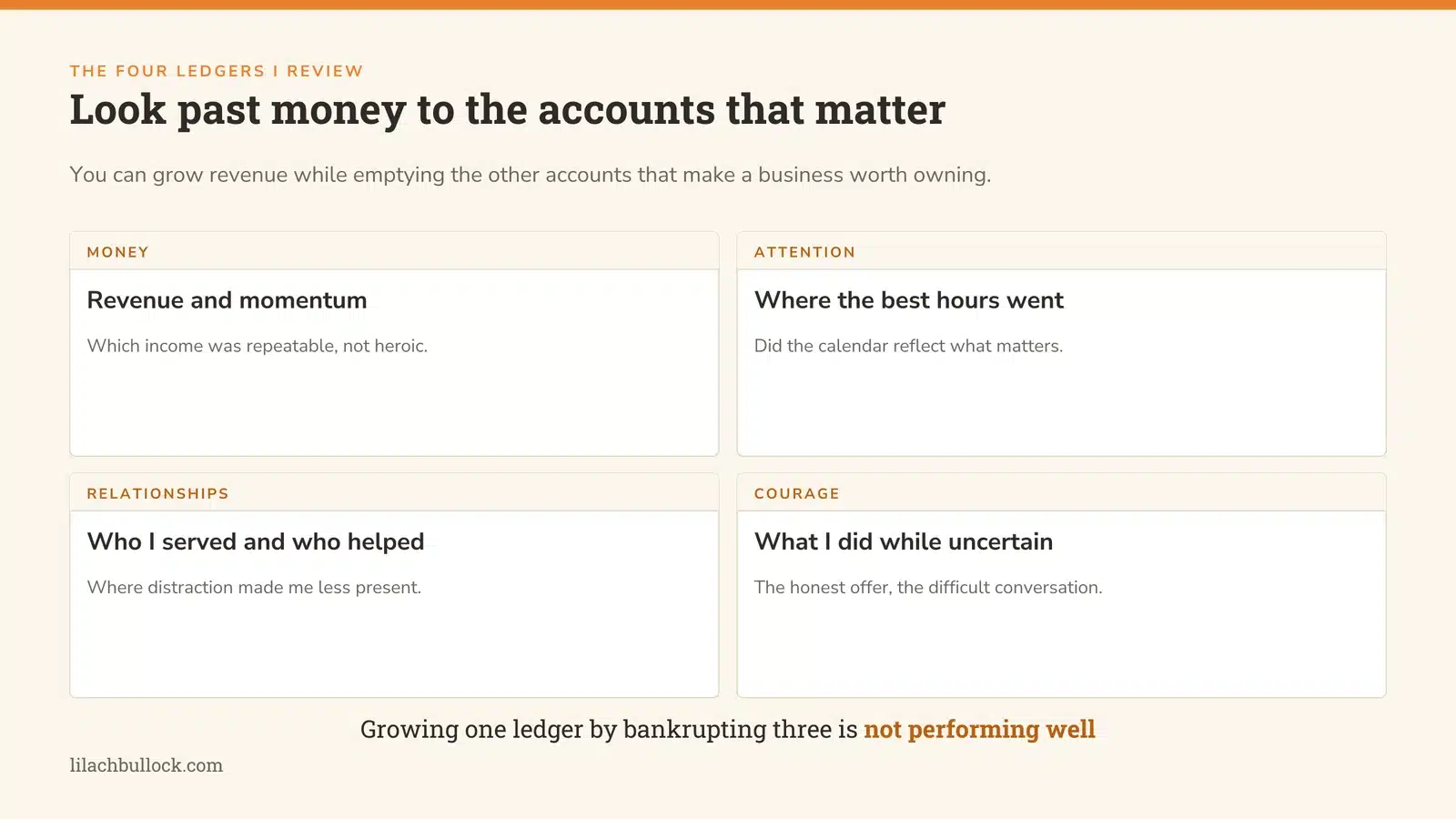
The four ledgers I review
Most business reviews look only at money, even though productivity and success are never measured by one number.
Money matters. It is also possible to grow revenue while emptying the other accounts that make a business worth owning.
I prefer four ledgers.
1. Money
What created revenue, profit and useful commercial momentum?
Which income was repeatable? Which required a heroic amount of attention? Which customers or offers produced healthy work rather than merely busy work? Which helped me earn more without adding more stress?
2. Attention
Where did my best hours go?
Did my calendar reflect what I say matters? What repeatedly pulled me into low-value decisions? Which productivity habits protected my best hours? Which projects kept returning to my mind after work should have ended?
3. Relationships
Who did I serve well? Who helped me? Which conversations changed the direction of the business? Where did speed or distraction make me less present than I wanted to be?
4. Courage
What did I do while still uncertain?
Where did I have the difficult conversation, make the clear offer, publish the honest idea, take the trip or stop pretending that a broken process would fix itself?
My verdict
A business that grows one ledger by bankrupting the other three is not performing well.
Use it in your business
Give each ledger a score from 1 to 10. Then write one thing to protect and one thing to change before January. The lowest score is not automatically the priority. Look for the change that improves more than one ledger.
Keep this human
Resist turning every meaningful part of life into a metric. The score starts the conversation. It is not the truth.
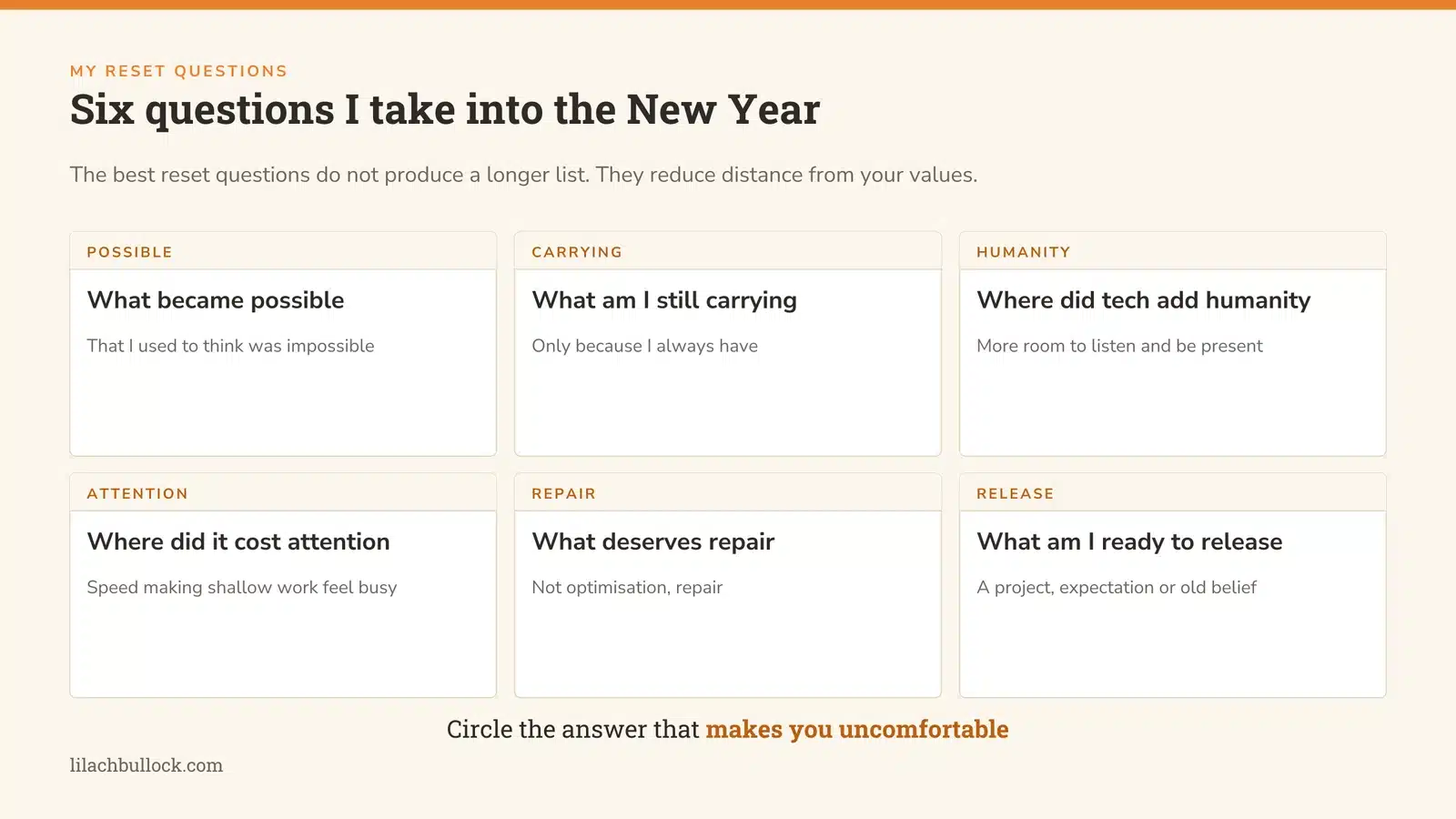
My reset questions
These are the questions I am taking into the Jewish New Year.
What became possible that I used to think was impossible?
Three weeks of work travel while keeping the business moving would once have felt impossible without constant stress and dropped work. The systems changed what was possible. That evidence should change what I plan next.
What am I still carrying because I have always carried it?
Founders become attached to tasks through habit. We keep doing something long after it has stopped requiring our judgment, even when we know what should be outsourced. The task feels easier than the handoff, until years have passed.
Where did technology give me more humanity?
The right automation should create more space to listen, think, rest or be present. That is the point of using AI for personal productivity. If it only creates capacity for more admin, it has not improved the life around the work.
Where did technology make me less attentive?
Speed can make shallow work feel productive. More drafts, more updates and more outputs can crowd out the thinking that gives them value.
What deserves repair?
Not optimisation. Repair. A neglected relationship, an unclear promise, a process that keeps failing, a boundary that exists only after it has been crossed.
Want AI doing the heavy lifting in your marketing?
I build the systems that handle the boring 80 percent, so you get your week back. Done properly, with the human kept in.
What am I ready to release?
A project, an expectation, a version of the business, or the belief that needing support means I am less capable.
My verdict
The best reset questions do not produce a longer task list. They reduce the distance between what you say matters and how you are living.
Use it in your business
Answer all six in one sitting without editing. Circle the answer that makes you uncomfortable. That is usually where the useful work begins.
Keep this human
Keep the first pass private. Reflection becomes performance the moment you start writing what will sound impressive to an audience.
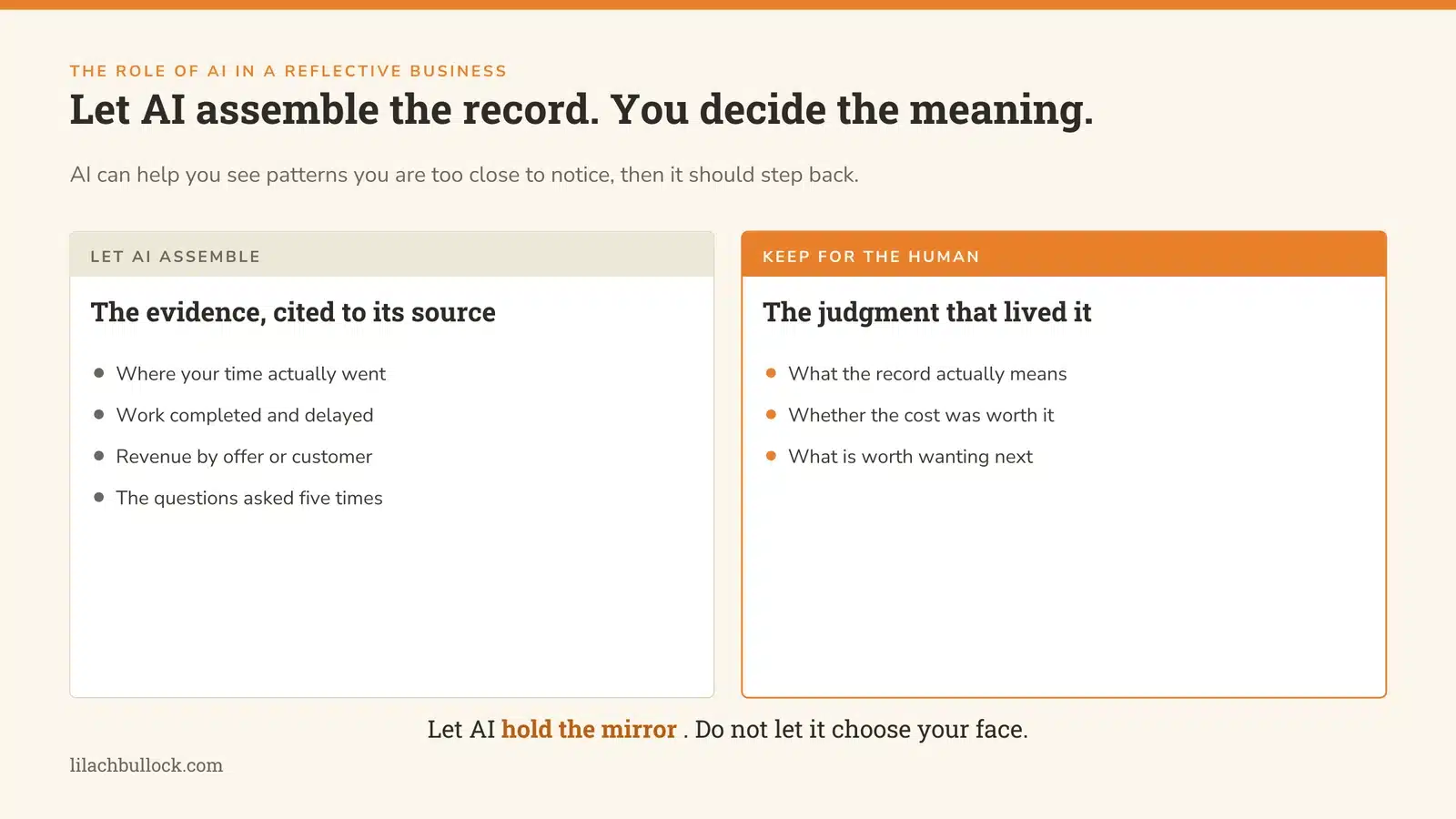
The role of AI in a reflective business
AI can help you see patterns you are too close to notice.
It can analyse a calendar, group a task list, compare goals with completed work, summarise customer feedback and surface where the same problem has appeared five times under different names. My AI newsletter agent uses the same principle: assemble the evidence before asking for judgment.
That is useful evidence.
It can also give you a beautifully structured answer that sounds wise and means nothing to you.
The line matters.
Use AI to assemble the record:
- meetings and where your time went;
- work completed and delayed;
- revenue by offer or customer type;
- repeated client questions;
- tasks you postponed more than once;
- decisions that created results;
- processes that required rescue.
Then step away from the screen and decide what the record means.
My verdict
Let AI hold the mirror. Do not let it choose the face you should make.
Use it in your business
Give AI a clean, limited set of business data and ask for patterns, contradictions and unanswered questions. Require it to cite the source item behind every observation. Use the questions for reflection, not the conclusions as instructions.
Keep this human
Do not upload private personal, client or financial information without checking the account, retention and training settings first.
A two-New-Year operating rhythm
You do not need to be Jewish to benefit from more than one meaningful review point.
Annual goals are too slow for a business changing at AI speed. Weekly reviews are often too close to the work to challenge the direction, even when you use the best productivity tools for entrepreneurs. Two larger resets create a useful rhythm.
January: Choose the direction
- What do I want to build?
- What would make this year meaningful?
- Which capabilities, relationships and revenue streams deserve investment?
- What will I deliberately not pursue?
September: Test the truth
- What does the evidence say?
- Which goals still deserve the remaining months?
- What has become easier because of systems or skill?
- What is costing more than it returns?
- What needs repair before it needs scale?
Every week: Keep the promise
- What moved?
- What is stuck?
- What needs a human decision?
- What is the single next action?
This creates a simple loop: direction, truth, action.
My verdict
Goals fail less from lack of motivation than from long periods without honest evidence. The entrepreneurial mindset needs feedback, not endless positivity.
Use it in your business
Put two 90-minute resets and a 20-minute weekly review into the calendar. Use the same questions every time so patterns become visible.
Keep this human
Leave space for what cannot be planned. A good operating rhythm supports life when it changes. It does not punish life for changing.
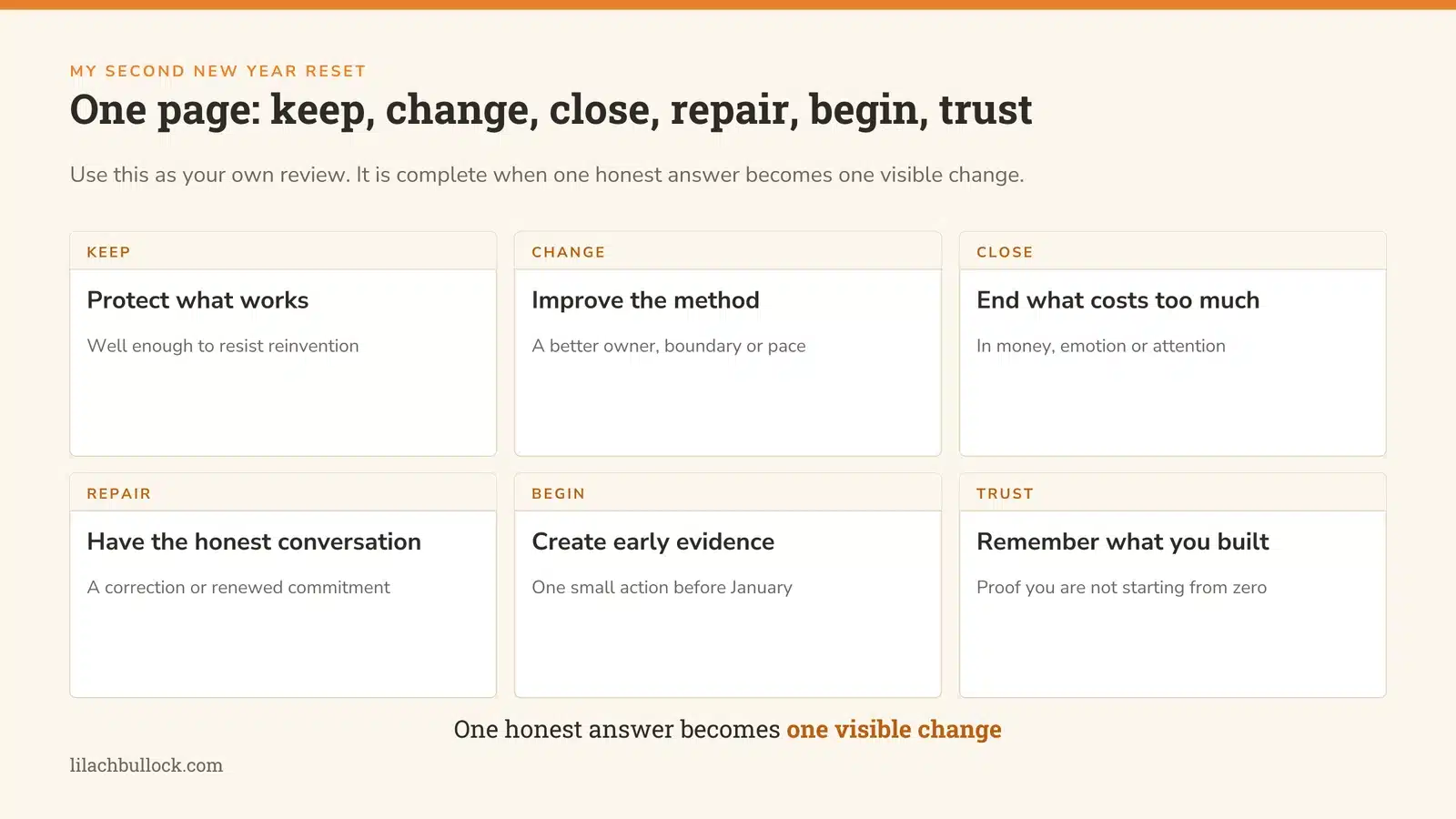
My Second New Year reset
Use this as your own one-page review.
Keep
What is working well enough to protect from unnecessary reinvention?
Change
What produces value but needs a better method, owner, boundary or pace?
Close
What is no longer worth its financial, emotional or attention cost?
Repair
What needs an honest conversation, correction or renewed commitment?
Begin
What small action would create evidence before January?
Trust
What have you already built, learned or survived that proves you are not starting from zero?
If your reset exposes something bigger
Reflection is useful only when it changes what happens next.
If the review shows that stress has become normal, start with these practical ideas for working when you feel stressed and choose one pressure you can remove this month.
If your health has disappeared from the plan, my experience of running a business through menopause and the reality of menopause burnout for entrepreneurs may help you name what is happening without blaming yourself.
If the business consumes every hour you release, revisit these work-life balance ideas for entrepreneurs and decide what the extra capacity is for before you create it.
If the goal still matters but your energy has dropped, use one of these ways to stay motivated and build momentum from a small piece of evidence.
If the reset shows that the business relies on you for too much, look at marketing automation for solo operators and how to prepare a small business for AI automation before buying another tool.
If you need a reminder that personal change and business change are connected, my conversations about rebuilding health, moving countries and changing direction and losing 52 kilos after years of self-sabotage are the least polished and most honest places to start.
My verdict
The reset is not complete when the page is full. It is complete when one honest answer becomes one visible change.
Use it in your business
Choose one link between the four ledgers. For example, remove one low-value task to improve attention, then spend the released time on a relationship or your health.
Keep this human
Do not turn your life into a turnaround project. Some seasons need patience before they need optimisation.
Final takeaway
I feel lucky to get two New Years.
One lets me look forward with ambition.
The other asks me to look back with honesty, make repairs and choose again.
After three intense weeks away, I am returning home with evidence that the business can carry more through systems and AI than it once could. I am also returning with a clearer view of what only I can do, what still needs redesigning and what I want the work to make room for.
That is the reset I want.
Not a new list for the sake of a new list.
A more honest agreement between the business I am building and the life I want to live inside it.
Shana Tova to everyone celebrating. May the year ahead be sweet, healthy, peaceful and full of meaningful work.
Lilach