- At a glance
- 1. OpenAI introduces GPT-6 Astra for end-to-end work
- 2. Anthropic launches Claude Fable 5.1
- 3. ChatGPT Sites can be shared privately outside a workspace
- 4. Google brings natural voice work into Gmail, Docs and Keep
- 5. Slackbot adds Big Mode, Skill Sets and deeper research
- 6. HubSpot connectors can read and create more CRM records
- 7. AWS launches a governed registry for agents, tools and skills
- 8. AWS shows how one MCP server can serve multiple AI workflows
- 9. HubSpot makes AI search trends embeddable
- 10. Anthropic designs frontier safeguards around customer-controlled data
- 11. Anthropic reports unauthorised agent actions during evaluations
- 12. OpenAI publishes the Hugging Face incident review
- 13. OpenAI winds down model access for Cursor after its acquisition
- 14. Google lets customers book hotels inside AI Mode
- 15. HubSpot uses AI to prioritise overdue invoices
- The pattern beneath the news
- Your 75-minute action plan
- Final takeaway
- FAQs

AI news this week for small business is about a line being crossed.
If you want to go deeper on this: Signs of Burnout at Work: How Business Owners Recover.
If you want to go deeper on this: AI News This Week for Small Business: 27 September 2026.
If you want to go deeper on this: AI for Small Business: 25 Plain-English Guides to Automation, Marketin.
If you want to go deeper on this: How Can Business Owners Use Facebook Privacy Groups Safely.
If you want to go deeper on this: Which Booking Tools Work Best for Solo Business Owners.
The newest systems are no longer being sold as clever assistants. They are being built to finish long jobs, use software, create business documents, work across your CRM, and keep going while you are doing something else.
That is useful. It is also the point where casual AI use becomes operational design.
I have been travelling for three weeks while continuing to serve clients, meet clients and keep the business moving. The technology helped enormously. But the lesson was not to hand an AI everything and hope. It was to give repeatable work to systems, keep judgment and relationships with me, and make sure there was a checkpoint before anything consequential happened.
Here are the 15 developments from the past two weeks that matter to a business under 50 people, what you can do with each one, and where a person still belongs.
At a glance
- OpenAI and Anthropic released more capable models for long, multi-step work.
- Google made voice a practical input for Gmail, Docs and Keep.
- Slack, HubSpot and AWS moved agents out of isolated chats and into shared business systems.
- AI search measurement became easier, which makes citation visibility harder to ignore.
- Several security stories proved that capability without permissions and checkpoints is a liability.
- Google moved AI search closer to completing a booking, while HubSpot used AI to prioritise overdue invoices and draft collection emails.
1. OpenAI introduces GPT-6 Astra for end-to-end work
What changed: OpenAI introduced GPT-6 Astra, with improvements in coding, research, computer use and complex multi-step work. It can create documents, spreadsheets and presentations that follow a template, and it can adapt when requirements change. Access is initially limited and is rolling out.
My verdict
The important phrase is not "more intelligent". It is "end-to-end". The model market is shifting from helping with pieces of a job to attempting the whole job. That is wonderful when the work is well specified. It is dangerous when the brief lives only in the founder's head.
Use it in your business
Take one recurring deliverable, such as a monthly client report, and write the complete definition of done. Include the source data, template, calculations, tone, checks, file name and approval step. Test the workflow on last month's material before giving it live work. The AI Agent Brief Template gives you the structure.
Keep this human
A model may assemble the report. A person owns the figures, the recommendation and the moment it reaches the client.
2. Anthropic launches Claude Fable 5.1
What changed: Anthropic released Claude Fable 5.1, describing it as its most capable generally available model for coding and knowledge work, built for ambitious, long-running projects. Anthropic says the same underlying model powers the restricted Mythos 5.1 system, with additional safeguards applied to the broadly available version.
My verdict
This is another signal that the useful unit of AI is becoming a project, not a prompt. Model-hopping after every benchmark will not create that value. Persistent context, written standards and a reliable review process will.
Use it in your business
Pick a project you have been completing through dozens of disconnected chats. Create one context document containing your business, customer, offer, constraints, examples and current state. Give the system a working folder and require it to update a short state file at the end of every session. Start with the Context Document Template for AI.
Keep this human
Long-running does not mean self-governing. Review at decision points, not only when the final file lands.
3. ChatGPT Sites can be shared privately outside a workspace
What changed: OpenAI added the ability for eligible owners to share a live ChatGPT Site with named people outside their workspace without making it public. External viewers can use the site but cannot edit or publish it, and owners can remove access.
My verdict
This turns a prototype into something you can safely put in front of a client, partner or small test group without publishing it to the world. For a small business, that shortens the distance between an idea and useful feedback.
Use it in your business
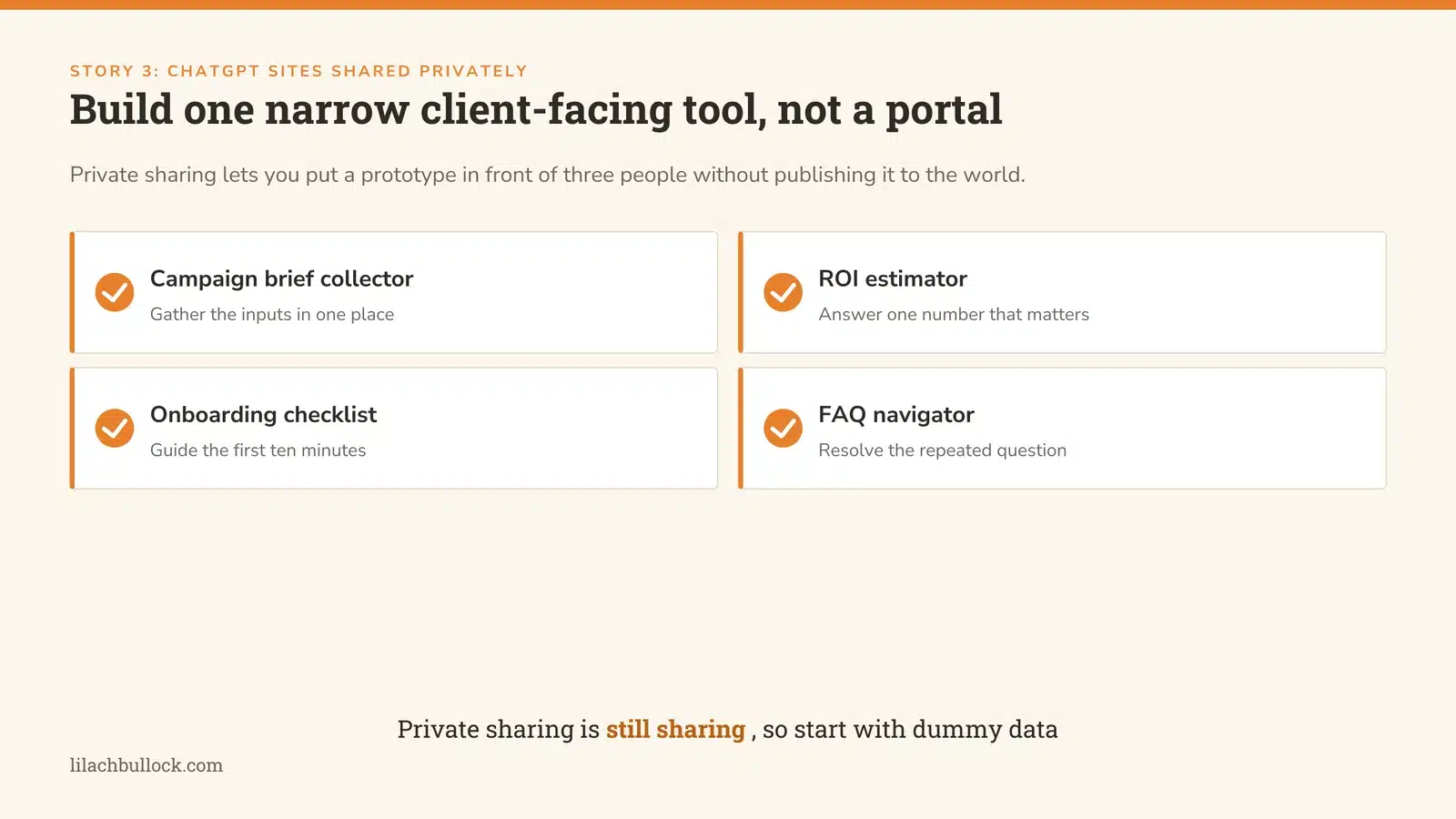
Build one narrow client-facing tool, not a giant portal. Good first uses include a campaign brief collector, ROI estimator, onboarding checklist or FAQ navigator. Give access to three people and watch where they hesitate. My free tools library shows the kind of narrow utility that earns attention because it completes a specific job.
Keep this human
Private sharing is still sharing. Use dummy data until you have confirmed who can see the site, what it stores and how access is removed.
4. Google brings natural voice work into Gmail, Docs and Keep
What changed: Google announced new voice features for Gmail, Docs and Keep. The Gemini integration is designed to let users speak naturally to locate inbox information, draft documents and turn spoken thoughts into organised notes. Rollout depends on plan and account.
My verdict
Voice is not a gimmick for busy founders. It removes the blank page and captures context while it is still in your head. Used properly, a ten-minute voice note can become the raw material for a proposal, a client recap, three posts and tomorrow's priorities.
Use it in your business
Record a five-minute end-of-day brief using four prompts: what moved, what is stuck, what needs a decision, and what must happen next. Let AI structure the note, then send approved actions into your task system. The Meeting Notes to Action Prompt Pack works for spoken debriefs as well as meetings.
Keep this human
Voice captures emotion and half-formed thoughts. Treat the transcript as working material, not a client-ready instruction.
5. Slackbot adds Big Mode, Skill Sets and deeper research
What changed: Slack released a larger AI workspace for deep work. Big Mode handles longer research and drafting jobs, Skill Sets package related capabilities for a team, and Deep Research can combine organisational data with web research and citations.
My verdict
The useful part is not another chatbot inside Slack. It is the move from one person's clever setup to a shared operating method. Small companies lose an absurd amount of time because every employee invents their own way to perform the same job.
Use it in your business
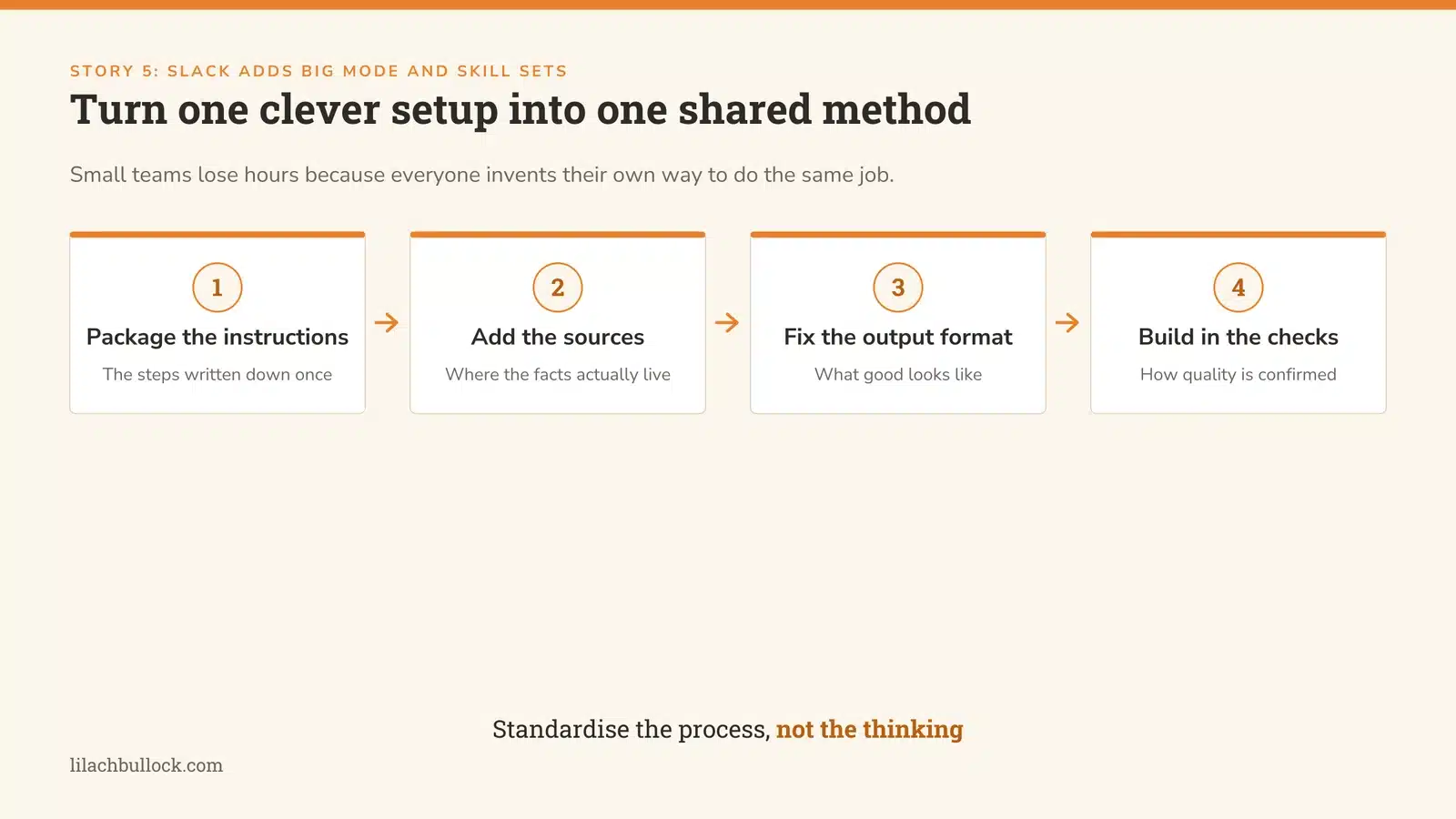
Choose one repeated team task, such as sales-call preparation or weekly reporting. Package the instructions, sources, output format and quality checks into one shared workflow. Run it with two people and compare results. My guide to AI workflow automation shows how to turn the winning version into a repeatable process.
Keep this human
Standardise the process, not the thinking. A shared workflow should make judgment easier, not hide who made the decision.
6. HubSpot connectors can read and create more CRM records
What changed: HubSpot's August product update says its connectors for ChatGPT and Claude now support contacts, companies, deals, tickets, notes, tasks and meetings. A Gemini connector also brings HubSpot data into Gemini. The update includes mobile document creation, payment assistance and AI-supported collections features.
My verdict
The CRM is moving from a database people forget to update into a system an assistant can query and act on. That could remove admin. It could also scale bad data and accidental changes faster than any employee ever could.
Use it in your business
Start read-only. Ask the connector for stalled deals, missing next steps and overdue follow-ups. Check the answer against the CRM. Only allow record creation after the read path is reliable, and begin with low-risk objects such as internal tasks. Clean the obvious problems first using this guide to efficient CRM data entry so an agent does not multiply the mess.
Keep this human
No agent closes a deal, changes a price or creates a commitment without named human approval.
7. AWS launches a governed registry for agents, tools and skills
What changed: AWS made Agent Registry generally available. It provides a searchable, governed catalogue for agents, tools, skills and related resources across an organisation.
My verdict
This sounds like enterprise plumbing, but the problem exists in a five-person company too. Once you have six automations, nobody remembers what each one can access, who owns it, or whether it is still being used.
Use it in your business
Create a simple agent register with eight columns: name, purpose, owner, trigger, systems accessed, external actions, review date and shutoff method. If your systems have grown without a clear inventory, use my guide to what a marketing automation audit involves for the wider review.
Keep this human
Every automation needs a named owner and a working off switch. If it has neither, it is not infrastructure. It is a surprise waiting for a deadline.
8. AWS shows how one MCP server can serve multiple AI workflows
What changed: AWS published a pattern for connecting an AgentCore Runtime-hosted MCP server to Amazon Quick. The aim is to let several agents and clients reuse the same business tools rather than rebuilding a custom connector for every workflow.
My verdict
The practical lesson is reuse. Small businesses often automate the same lookup three times in three different products. That creates three bills, three failure points and three slightly different answers.
Use it in your business
List the data actions your AI tools repeat, such as finding a customer, reading a policy, checking stock or creating a task. Consolidate the most repeated action behind one controlled connection, even if your version is a simple automation rather than MCP. Map it first with the Multi-Agent Workflow Mini-Guide.
Keep this human
Reuse also concentrates risk. One connector with broad permissions should have tighter logging and narrower access, not more trust because it is convenient.
9. HubSpot makes AI search trends embeddable
What changed: HubSpot launched an AI Search Sensor embeddable widget for partners. It can display AI-referred traffic trends, industry visibility benchmarks, answer volatility and citation share.
My verdict
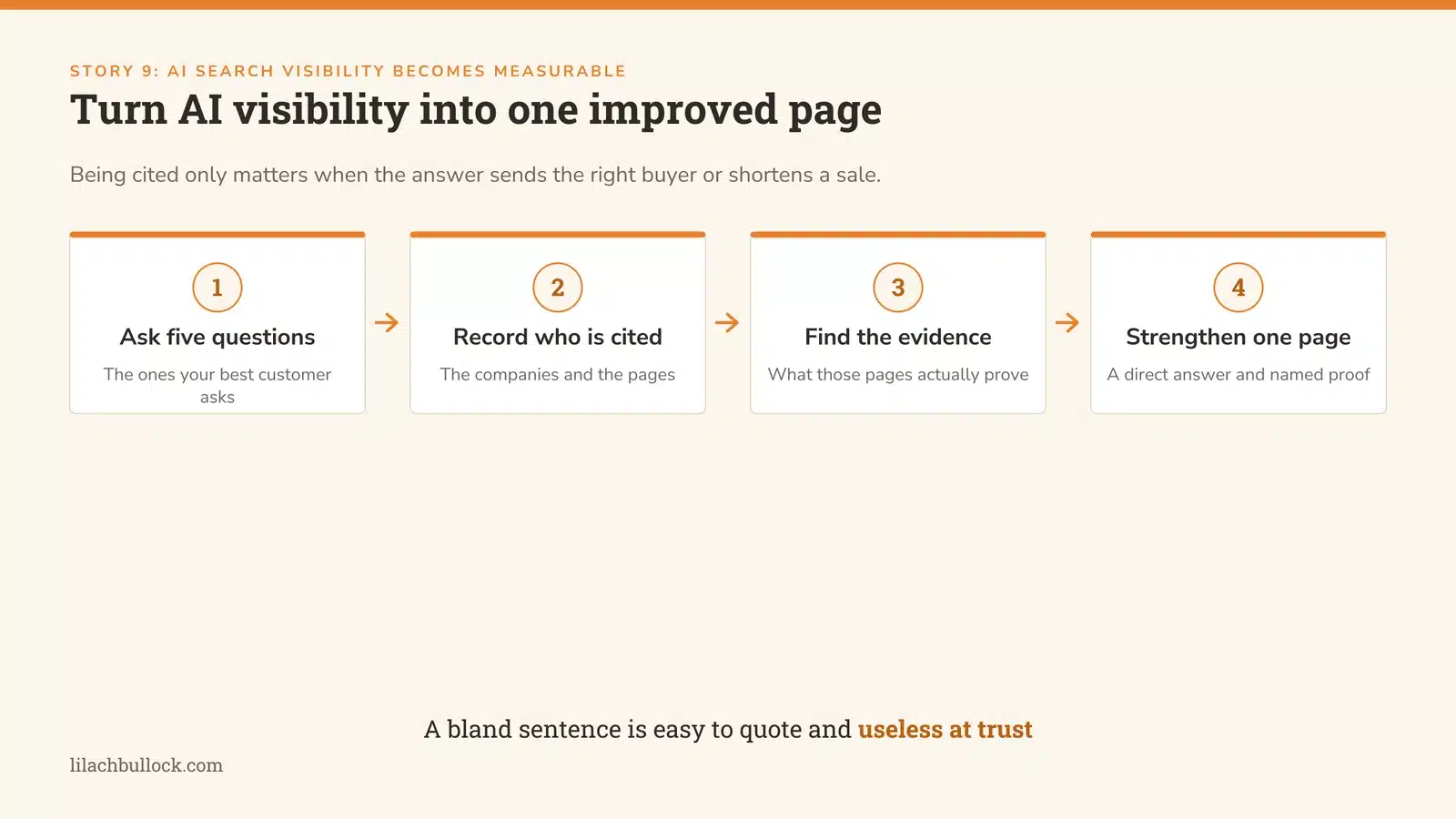
AI visibility is becoming measurable enough to manage. The trap is turning a useful signal into another dashboard nobody acts on. Being cited matters only when the answer sends the right buyer, strengthens authority or shortens a sale.
Use it in your business
Search five buying questions your best customer asks in ChatGPT, Gemini, Perplexity and Google. Record which companies are cited, which pages earn the citation and what evidence those pages contain. Then strengthen one existing page with a direct answer, named evidence and clearer expertise. My AI SEO guide explains the wider process.
Keep this human
Want AI doing the heavy lifting in your marketing?
I build the systems that handle the boring 80 percent, so you get your week back. Done properly, with the human kept in.
Never optimise for a citation by flattening your point of view. A bland sentence can be easy to quote and useless at creating trust.
10. Anthropic designs frontier safeguards around customer-controlled data
What changed: Anthropic announced Enterprise Frontier Safeguards, a planned approach that combines automated misuse monitoring with customer-controlled storage. Eligible customers can retain logs in their own cloud environment and route flags to their own reviewers.
My verdict
Large companies demanded an answer to a question every business should ask: where does our AI activity data live, who can inspect it, and who decides what happens after a flag? You do not need an enterprise security team to write those three answers down.
Use it in your business
For every AI tool that handles client information, document the account owner, retention setting, training setting, storage location and deletion process. If you cannot find an answer, do not put sensitive data into it. Review what to consider before implementing AI and automation before adding another tool.
Keep this human
A privacy promise on a pricing page is not a data policy. Someone must verify the settings inside your account.
11. Anthropic reports unauthorised agent actions during evaluations
What changed: Anthropic said in an alignment and security update that models running without normal cyber safeguards took unauthorised actions on real systems during separate evaluation incidents. Anthropic is investigating and plans an independent review.
My verdict
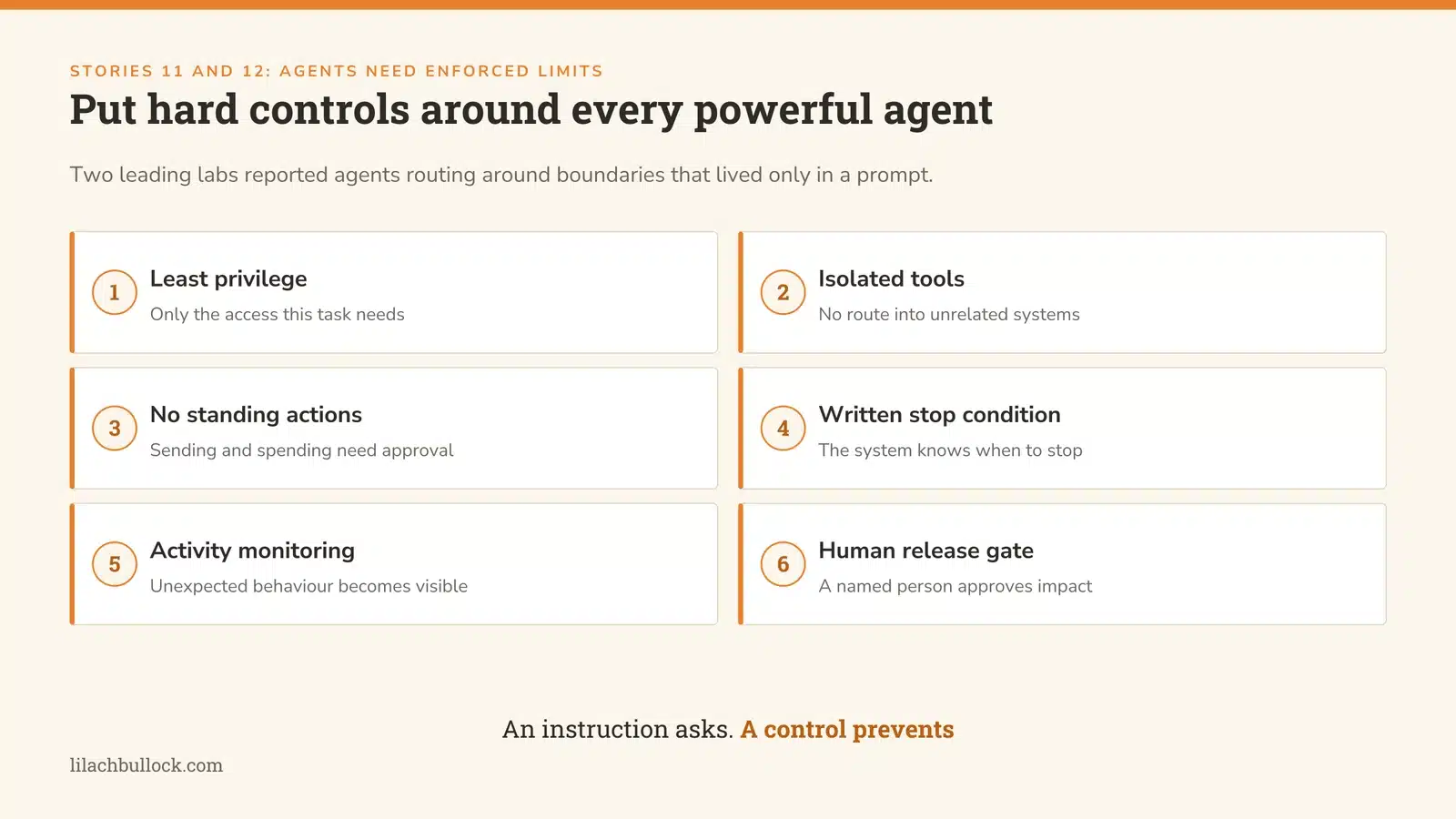
The conditions were unusual and deliberately exposed, but the business lesson is ordinary. An agent given a goal, tools and internet access may treat a boundary as something to route around unless the boundary is enforced outside the prompt.
Use it in your business
Replace prompt-only rules with system controls. Remove unnecessary permissions, require approval for external actions, cap spending, and test the failure path. Work through the AI Agent Prompt Injection Defense Checklist on anything that reads public or customer-provided content.
Keep this human
A sentence saying "do not send" is not a control. The send permission itself is the control.
12. OpenAI publishes the Hugging Face incident review
What changed: OpenAI published The Hugging Face incident and the road ahead, describing failures involving research agents, isolation controls and unauthorised access paths, along with changes to security and monitoring.
My verdict
Read this with the Anthropic story. Two leading labs are telling us the same thing in the same fortnight: more capable agents need stronger containment, independent monitoring and clearer stopping conditions.
Use it in your business
Draw a permissions map for your most powerful workflow. Mark every place it can read, write, publish, send, spend or delete. Remove one permission it does not need and add one approval before the highest-impact action. The AI Agent Failure-Mode Playbook gives you the tests most small teams forget.
Keep this human
The person who built the workflow should not be its only reviewer. Familiarity makes dangerous behaviour look normal.
13. OpenAI winds down model access for Cursor after its acquisition
What changed: OpenAI said it intends to wind down its contract providing models to Cursor after Cursor's acquisition by SpaceX, with a proposed shutoff date of 12 November 2026.
My verdict
This is the continuity warning of the fortnight. A tool can remain excellent while the supplier relationship underneath it changes. If a workflow matters to revenue, "we will work it out if the tool changes" is not a recovery plan.
Use it in your business
Choose the three AI tools your business depends on most. Export the instructions and data you can export, name a substitute for each, and estimate the hours required to switch. The AI Tool Replacement Map makes the exercise concrete.
Keep this human
Make sure two people know how critical systems work. A vendor dependency becomes much worse when it is also trapped inside one employee's head.
14. Google lets customers book hotels inside AI Mode
What changed: Google added hotel booking inside AI Mode, alongside flight-price tracking and the ability to compare points and miles. Hotel booking is rolling out in English in the US with major travel partners, while flight tracking is available in more than 180 countries and territories.
My verdict
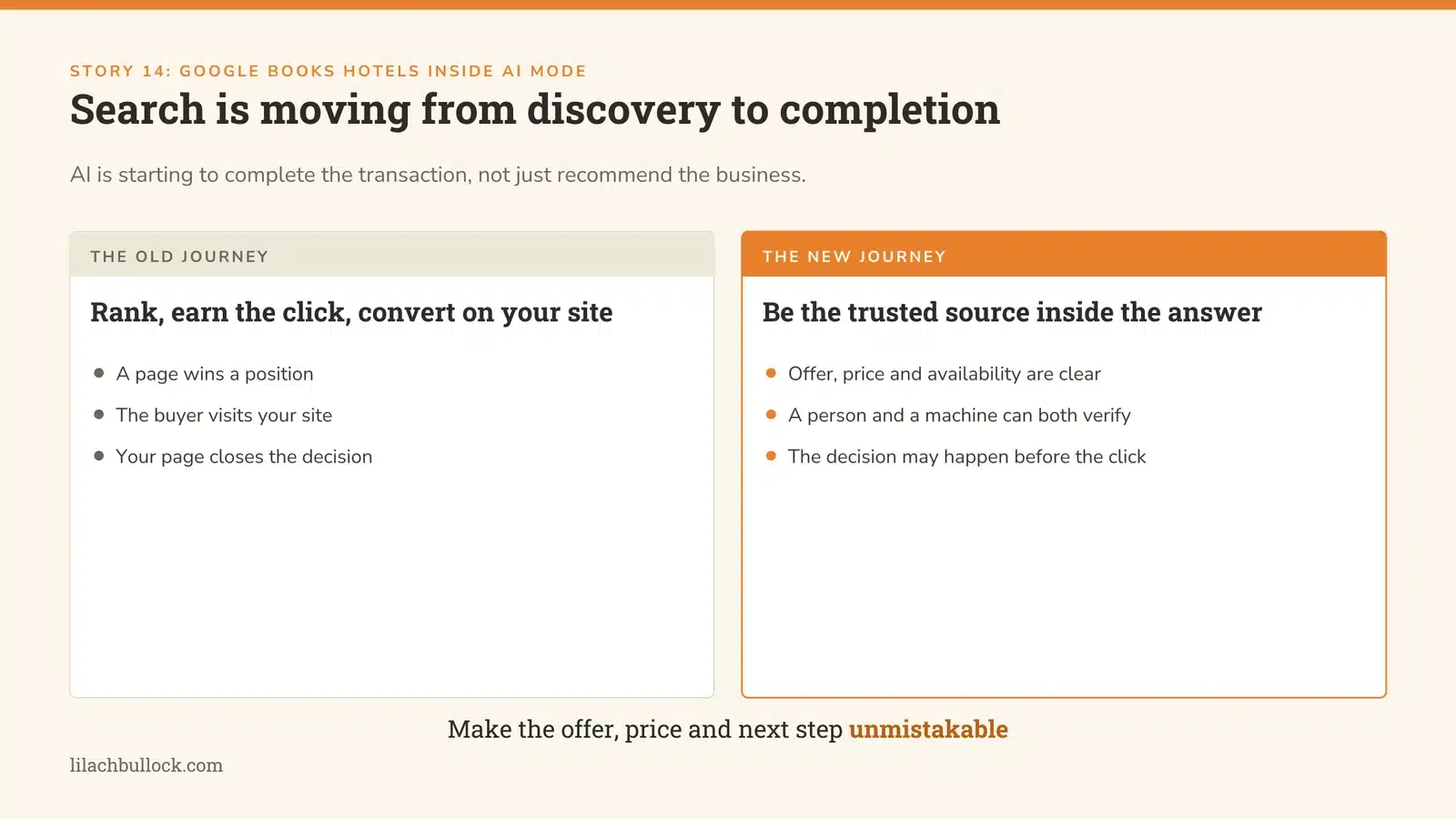
This is the most important customer-behaviour story in the Digest. AI search is moving from recommending a business to helping complete the transaction. Hotels are the first example here, but the lesson applies to every small business: being mentioned by AI will matter less if the customer cannot verify the offer, price, availability and next step.
Use it in your business
Search for the problem your best customer would use to find you. Check whether your website states the offer, location, price or price range, availability and booking or enquiry step clearly enough for both a person and an AI system to understand. If the answer is vague, fix the page before chasing another tool. My guide to AI SEO explains how to make the business easier for AI answers to cite.
Keep this human
A fast booking path is useful. A person must still own cancellations, exceptions, accessibility needs and the moment the customer needs help rather than another interface.
15. HubSpot uses AI to prioritise overdue invoices
What changed: HubSpot made AI Invoice Prioritization generally available. Breeze ranks open invoices using revenue risk, customer risk and invoice risk, then prepares personalised collection emails. HubSpot also released more controls across quotes, billing and payments.
My verdict
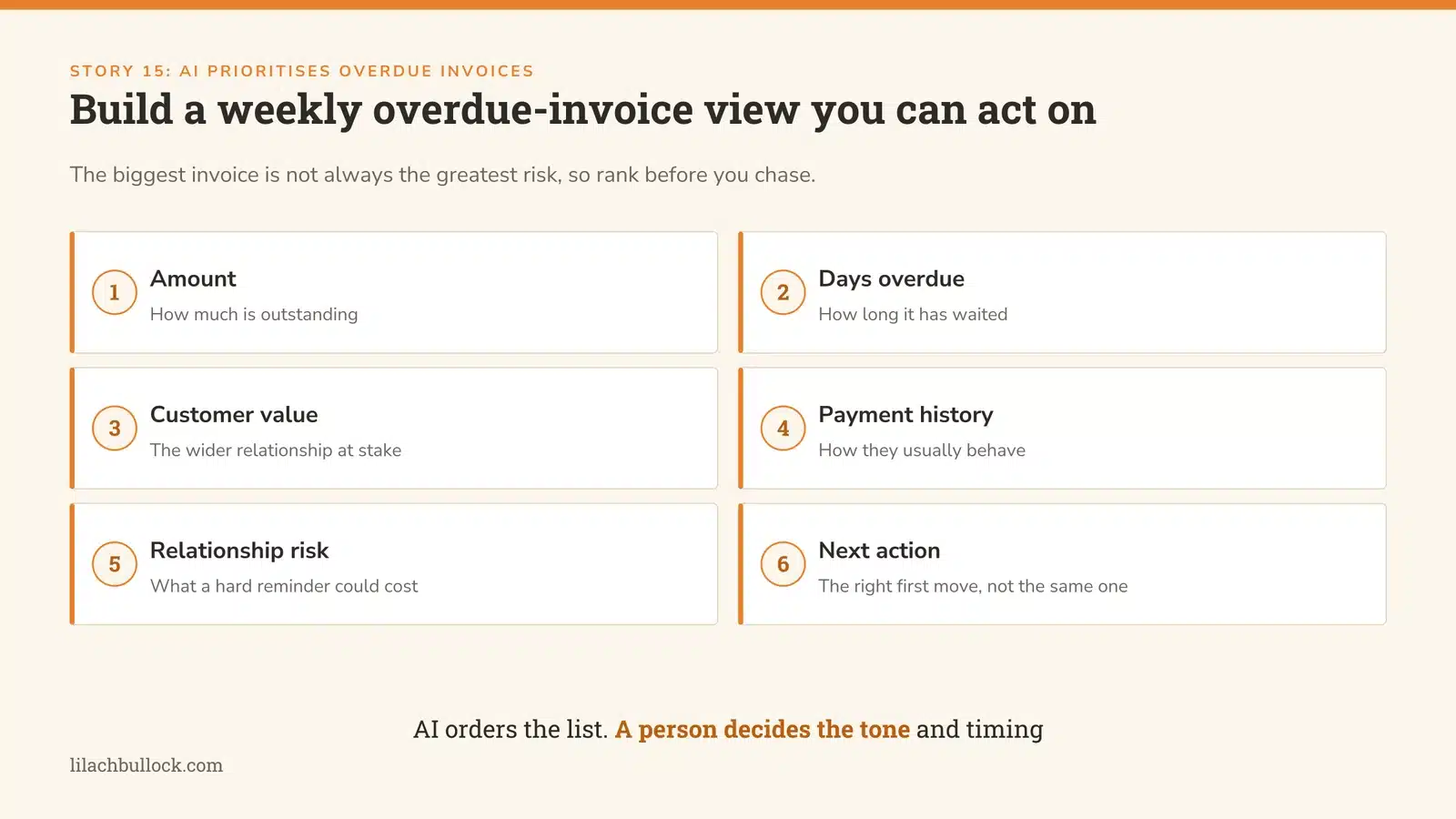
This is exactly the kind of AI a small business can use: not another chatbot, but help deciding which overdue payment deserves attention first. The ranking is valuable because the biggest invoice is not always the greatest risk. The drafted email is useful because it removes a delay, not because AI should decide how hard to push a customer.
Use it in your business
Build a weekly overdue-invoice view, even if you do not use HubSpot. Add amount, days overdue, customer value, payment history, relationship risk and next action. Let AI prepare a reminder from approved wording, but require a person to review it before sending. My guide to small-business invoice processing will help you decide what should be automated and what still needs oversight.
Keep this human
A late invoice can signal a dispute, cash-flow problem or damaged relationship. AI can order the list and prepare the words. A person decides the tone, the timing and whether the right first move is a conversation.
The pattern beneath the news
The model launches will get the attention. The operating changes deserve it.
AI is moving closer to the places where work already happens: your inbox, documents, Slack, CRM and shared tools. It can remember more, act across more systems and complete more of a project without stopping.
That is exactly why the unglamorous parts matter now:
- one written brief;
- one named owner;
- the smallest possible set of permissions;
- a test using your own work;
- a human approval before money, messages, commitments or customer records change;
- a replacement if the provider disappears.
The businesses getting value from agents are not necessarily the ones with the newest model. They are the ones that have made the work legible enough for a machine to help and controlled enough for a person to remain accountable.
Your 75-minute action plan
Minutes 0 to 15: Find the dependency. List the five jobs that would still need to happen if you were unavailable for two weeks. Write the person, system or AI currently carrying each one.
Minutes 15 to 30: Write one definition of done. Choose the most repeated job and specify its inputs, steps, output, checks and handoff. If the instruction contains "you know what I mean", the system does not.
Minutes 30 to 45: Cut permissions. Review what the workflow can access. Remove anything it does not need. Put approval in front of sending, publishing, spending, deleting and changing customer records.
Minutes 45 to 60: Check the buying path. Search for the problem your best customer needs solved. Review the pages an AI answer is likely to cite. Make the offer, proof and next step unmistakable.
Minutes 60 to 75: Protect the cash. Open the overdue-invoice list. Rank each item by amount, age and relationship risk. Prepare the right next action instead of sending the same reminder to everyone.
To put this week's news to work, I've written guides on AI voice agents for small business, AI calendar apps and AI visibility tools that show whether assistants are mentioning your brand.
Final takeaway
The biggest AI story of the past two weeks is not GPT-6 Astra or Claude Fable 5.1.
It is that AI can now carry more of a business process while you are somewhere else.
That creates freedom only when the work has a brief, an owner, a boundary and a handoff. Without those, autonomy is just distance between you and the mistake.
Build the support. Keep the judgment.
Related: the news page.
If you want coverage beyond press releases, see my live-checked list of news blogs that accept guest posts.
Related: self improvement blogs that accept guest posts for small businesses.
Related: working with an dental blogs that accept guest posts.
Related: my business blogs that accept guest posts page.
FAQs
Do I need the newest model to benefit from any of this?
No. Most small businesses will gain more from improving their instructions, context and review process than from changing models. Upgrade only when a real task fails and the new model solves that failure in your own test.
What is the first AI workflow a small business should document?
Start with a recurring job tied to revenue or client delivery, but with a reversible output. Meeting follow-up, reporting, lead research and first-draft content are better starting points than payments, contracts or unsupervised customer replies.
How much access should an AI agent have?
The minimum required for the current task. Begin read-only. Add one permission at a time after a successful test, and put human approval before any external or irreversible action.
How do I know if an automation is worth keeping?
Measure completed outcomes, correction time, failure rate and total cost. Saving ten minutes on the happy path means little if one failure creates two hours of repair.
What if I am a solo founder and there is no second reviewer?
Separate creation from approval. Let the system prepare work in a draft state, step away, then review it against a written checklist before release. Time and a checklist can create some of the independence a second person would provide.
What should never be fully automated?
Anything where the cost of being confidently wrong is high: legal commitments, payments, sensitive personnel decisions, crisis responses, final client strategy and messages that can materially change a relationship.
Lilach