- What counts as a qualified enquiry?
- How many enquiries do you need at your current conversion rate?
- What if your numbers are small or your sales take months?
- Can you deliver the customers you're aiming for?
- Find the constraint before choosing the channel
- Build a 30-day plan you can review
- Frequently asked questions
- Give your ambition a number
In this blog post I'm going to help you work out how many enquiries you need to reach your customer target. You'll need a few records and a calculator. Your horoscope can sit this one out.
"More leads" sounds like a plan until you have to decide what to do on Monday morning.
More than last month? Enough to fill next month? Enough to keep someone busy answering questions from people who were never going to buy?
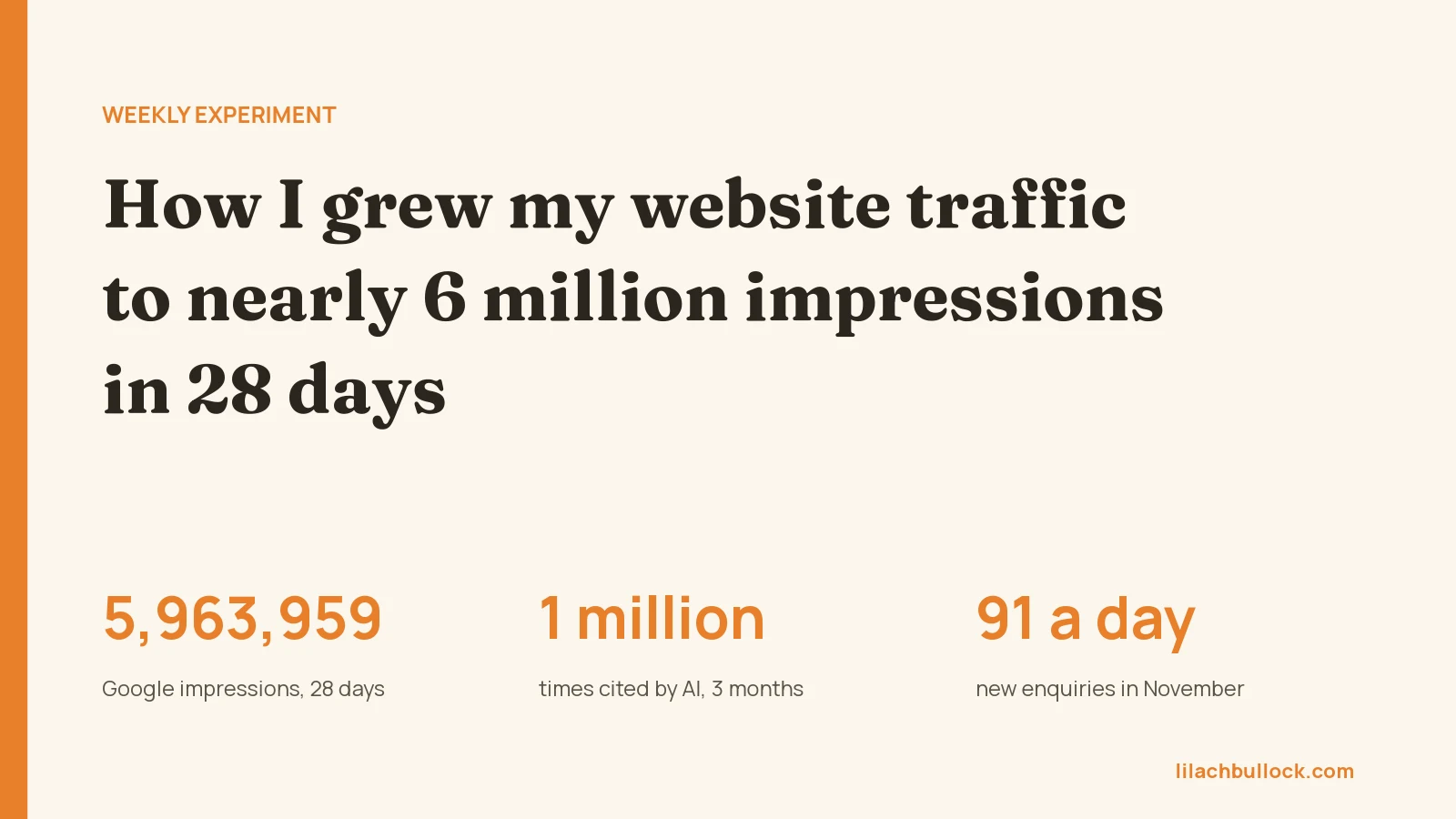
I've watched my own enquiries more than double, from about 41.5 a day in October to about 91 a day in the first six days of November. I wrote up what drove that in how I grew my website traffic. Those are enquiries, rather than a customer conversion rate. I'm sharing the distinction because a busy inbox can make you feel successful while leaving the important question unanswered.
How much of that interest becomes work you want to deliver?
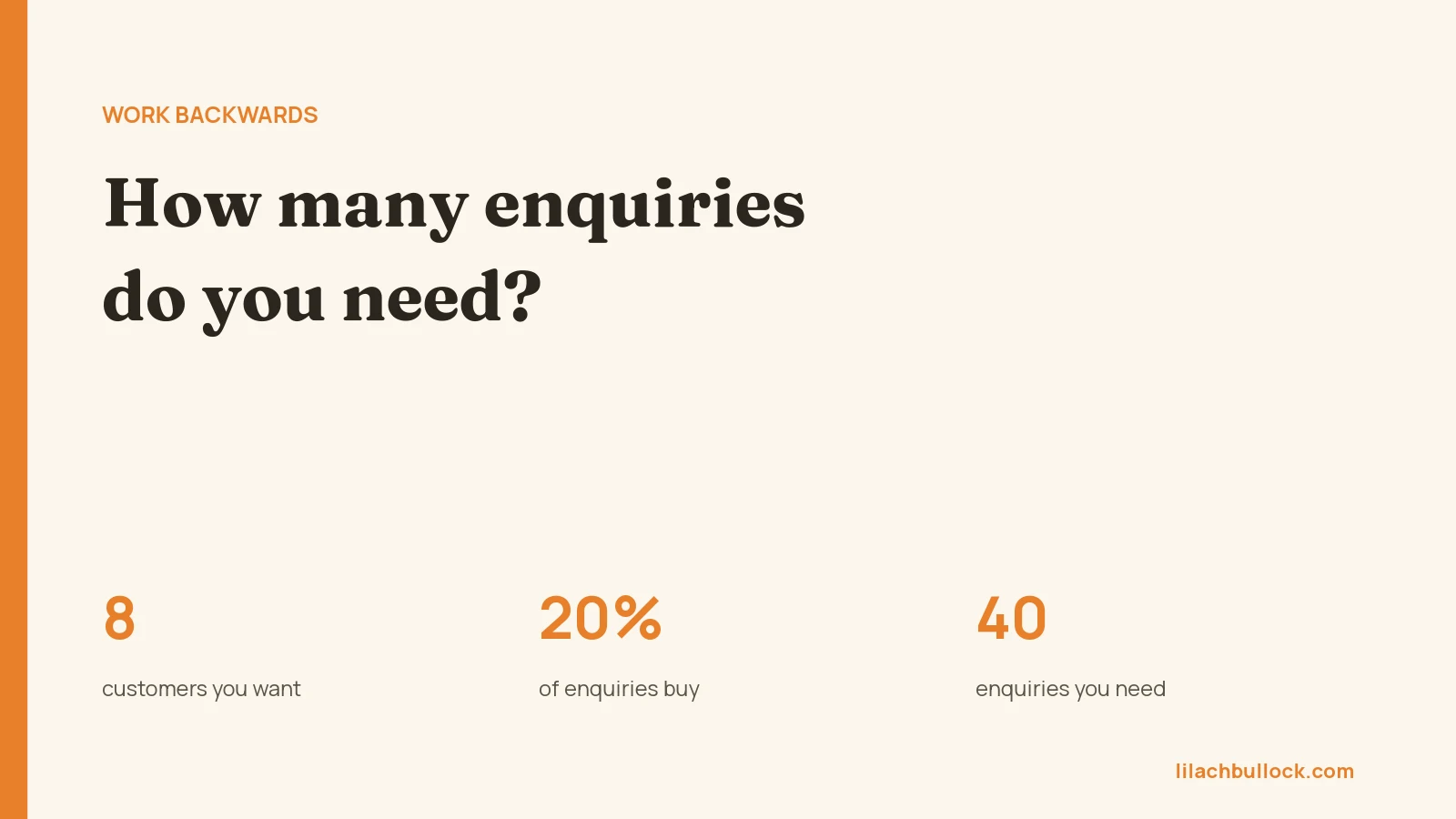
Quick answer: Divide your target number of new customers by the proportion of qualified enquiries that become customers. If four out of 20 enquiries buy, that's 20%. Eight customers would require 40 comparable enquiries at the same rate. Treat the result as a planning estimate, then check capacity and sales timing.
What counts as a qualified enquiry?
A qualified enquiry is a conversation about a service you sell, from someone whose need fits that service and who could plausibly buy it.
A newsletter reply saying "Loved this" is lovely. It isn't automatically a sales opportunity. Neither is someone asking for a link exchange when you're selling a paid service.
Write a short definition for your business before you count anything. For example, an owner asks about your bookkeeping service, needs work you provide and expects to start within the next three months. Budget may still need discussing. Qualification doesn't require clairvoyance.
Keep the definition consistent across channels. Otherwise, your website enquiries will look excellent because you excluded the poor ones, while your social enquiries include everyone who waved.
Use a simple record with an enquiry date, source, service requested, qualification decision and outcome. Count each buying opportunity once. Five emails from one prospective customer aren't five leads.
If an existing customer asks for another project, track that separately from new customer acquisition. Both matter, but combining them can disguise how dependent you are on repeat business.
How many enquiries do you need at your current conversion rate?
Your enquiry requirement depends on your observed buying rate. Calculate that rate using a group of enquiries whose outcomes have had time to develop.
Suppose 20 qualified enquiries arrived in September. By the end of October, four had bought, 12 had declined and four were still deciding.
The observed conversion so far is four divided by 20, or 20%. Keep the four undecided enquiries visible. The rate could rise later, so don't describe it as a final result while decisions remain open.
Now suppose you want eight new customers from your next comparable group:
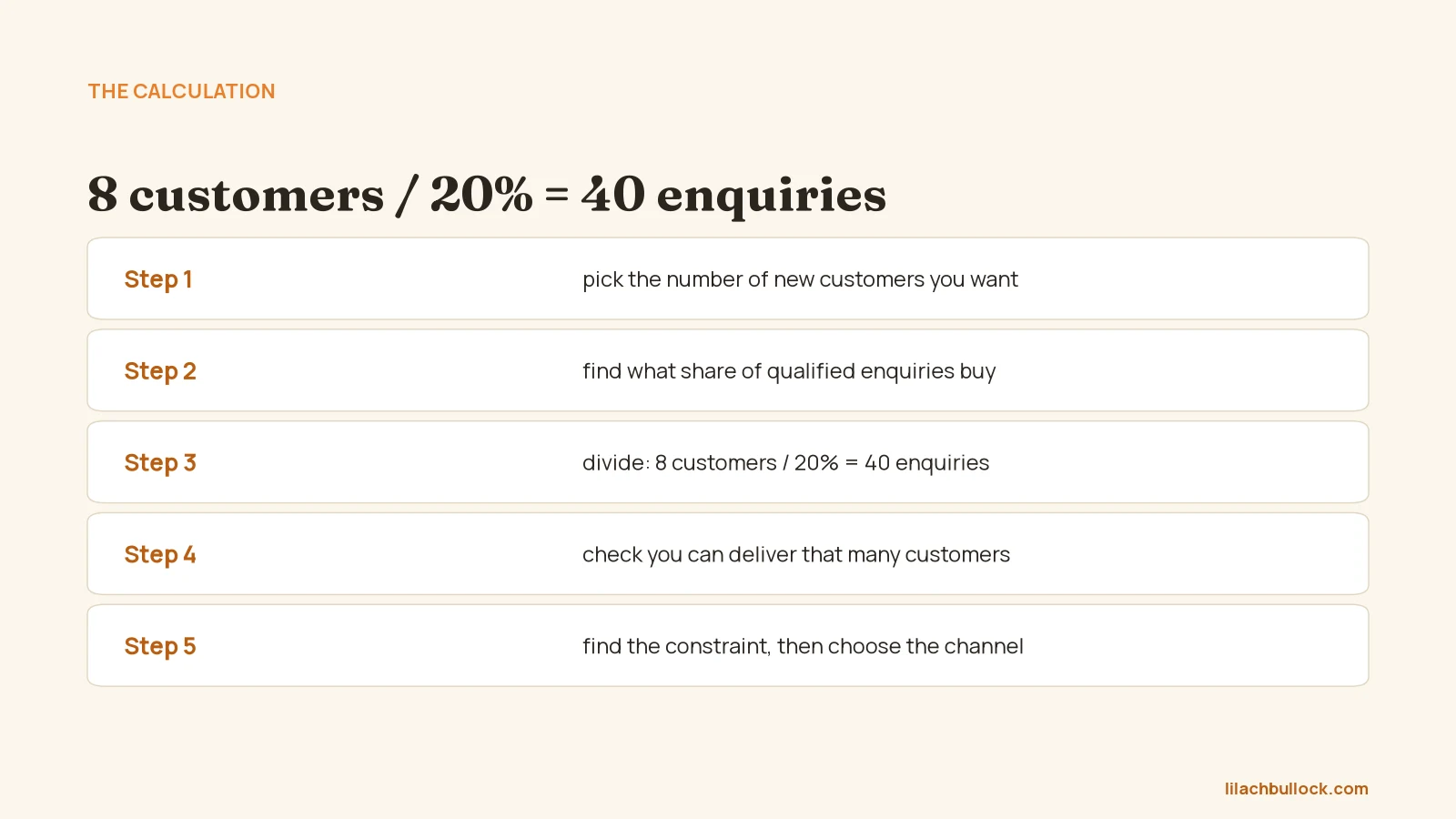
Eight customers / 0.20 = 40 qualified enquiries.
This is a hypothetical example. It gives you a starting point, rather than a promise that 40 enquiries will produce eight customers.
Don't divide this month's sales by this month's enquiries unless those sales came from those enquiries. A customer who first contacted you in July belongs to July's group, even if they finally bought in October.
Your spreadsheet may prefer the easy calculation. Your bank account would prefer the useful one.
What if your numbers are small or your sales take months?
Small samples produce jumpy rates. One extra customer in a group of ten changes the result by ten percentage points. That isn't evidence that your latest headline has transformed the business.
If you only receive a handful of enquiries each month, combine several comparable months. Keep a note of any major change in your offer or audience that makes the older enquiries less relevant.
For long sales cycles, look at an older group with enough time to buy. Track recent enquiries as pipeline, with their current stage and next step. Don't count a warm conversation as a confirmed sale because the person used an exclamation mark.
You can also plan a range. At 10%, eight customers would need 80 enquiries. At 20%, they'd need 40. At 25%, they'd need 32.
Those scenarios tell you how sensitive the plan is to conversion. They don't tell you which rate you'll achieve.
When the range is wide, start by improving your records. You can still take action while collecting better information. You just need to resist decorating uncertainty with a decimal point.
Can you deliver the customers you're aiming for?
Before you set an enquiry target, work out the number of new customers your business can serve well.
Want AI doing the heavy lifting in your marketing?
I build the systems that handle the boring 80 percent, so you get your week back. Done properly, with the human kept in.
Suppose each new project needs ten hours and you have 60 delivery hours available next month. Six projects would use all 60. Eight would require 80 hours, before anything goes wrong.
Include your current commitments. Allow time for sales, preparation and the admin that keeps turning up without an invitation.
Then look at the fee and direct costs of the service. Six demanding projects at a weak fee may leave you busier without giving you the breathing room you wanted.
The answer might be a better-defined service, a different mix of work or a revised fee. It might be additional capacity. Attracting more enquiries won't repair an offer that exhausts you every time someone buys it.
Also distinguish bookings from starts. You may be able to book eight projects over several months while starting only four next month. State the delivery dates clearly before accepting the work.
A bigger ambition needs a delivery plan. Otherwise, you've designed an impressive way to disappoint people.
Find the constraint before choosing the channel
Compare the target with what happens now. If you already receive enough qualified enquiries but few buy, inspect the sales process before increasing volume.
Look for unanswered enquiries, vague next steps and proposals that arrive after the buyer's interest has cooled. My Lead Leak Calculator gives you a way to investigate where opportunities could be slipping away. If the problem is replies that take too long, here's the AI email workflow I built to keep up with mine.
If buyers convert well and you have capacity, acquisition may be the next job. Choose a channel where you already have some reason to expect relevant conversations. If you need ideas, start with these 25 unconventional lead generation ideas, and check whether AI tools already recommend you with my free AI visibility checker.
That could mean reconnecting with previous customers, making your website's service page clearer or participating where buyers discuss the problem you solve. My AI lead generation guide can help you consider where AI fits into that work.
Pick one main change for the first test. Launching six activities together gives you six places to look when you can't explain the result.
Build a 30-day plan you can review
Give the plan a customer target, an enquiry estimate and one acquisition activity you can repeat.
For example: you want four customers, your planning rate is 20%, and you therefore aim for 20 qualified enquiries. You have checked that four projects fit your available delivery hours.
Set aside time each week for the activity. Record the conversations it creates and use the same qualification definition throughout.
Review weekly, but judge results according to your sales cycle. During the month, check whether enquiries are relevant and receive timely replies. Once buying decisions have developed, review conversion for that group.
Keep a separate note of time spent. A channel that brings five enquiries after 30 hours of work deserves a different conversation from one that brings five after two hours.
At the end, decide what to repeat, change or stop. A target is useful because it helps you make that decision. Missing it isn't a character assessment.
Frequently asked questions
How many enquiries does a small business need each month?
There isn't one useful number for every business. Start with the customers you want, divide by your observed qualified-enquiry conversion rate, then check delivery capacity. A business selling a few substantial projects needs a different enquiry volume from one selling many smaller services. Use your own records wherever possible.
What conversion rate should I use if I've never tracked enquiries?
Start recording enquiries now and mark your first estimate as provisional. Reconstruct recent opportunities from records if you can do so accurately. Use several scenarios until you have enough comparable outcomes. Don't borrow another business's rate and treat it as something your marketing owes you.
Should I count people who haven't decided yet?
Keep them in the original enquiry group and label them as open. Report the conversion observed so far alongside the number still deciding. Excluding them can inflate your rate. Treating them as definite losses can also mislead you, especially when buyers normally take several months to commit.
What should I change if I have enquiries but too few customers?
Check fit, response times, the clarity of your offer and what happens after you send information. Look at specific lost opportunities before changing everything. If buyers repeatedly need work you don't sell, acquisition targeting may be the issue. If suitable buyers disappear after the proposal, inspect that stage first.
Give your ambition a number
"More enquiries" can sit on a to-do list forever. A customer target and an honest calculation give you something to act on.
If your marketing keeps you guessing about where the next customer will come from, work with me on the strategy and implementation.
You don't need an inbox that looks impressive. You need enough of the right conversations to build the business you want.