By Paul Gordon
Clients still ask me when they're going to be number one. After eighteen years in SEO, I understand why. It's something they can search for themselves, see on a screen and compare with a competitor.
And sometimes it's a perfectly sensible target. If that keyword brings in the right customers, of course I want the client ranking well for it. But when the conversation stops at the position, we're missing quite a lot.
What does the search result actually look like? Is there an AI answer above the organic listings? Is the business mentioned in it? And when people reach the website, are they enquiring or buying? Those are the things I now put alongside the rankings when I talk clients through performance.
When the reports tell you different things
One e-commerce account is a good example. These were the year-on-year figures I was looking at, across the reporting windows shown:
- Google Search Console clicks over 90 days: 4,309, down 54.6% from 9,493.
- GA4 organic sessions over 90 days, excluding the blog: 20,492, up 1%.
- Rankings across a 735-keyword desktop comparison set: 621 on page one, down from 701. The top-three count was unchanged at 548.
- Direct sessions over 28 days: 7,931, up from 3,817.
- Organic revenue: down 22% over 90 days, but up 12% over 28 days and 90% over seven days.
If I only showed the top-three rankings, I could make that account look fairly settled. If I only showed the Search Console clicks, the client would quite rightly be concerned. The revenue picture changes depending on how far back we look.
There are also differences in what those reports include. The Search Console figure covers the whole site; the GA4 figure excludes the blog. Clicks and sessions measure different things anyway. So I need to check the definitions and periods before explaining why the numbers have moved.
AI may be part of that explanation, but I can't point at the increase in direct traffic and say it all came from ChatGPT. Someone might discover the business in an AI answer and return later. We won't always see that first interaction. That gives me something to investigate with the client, rather than a conclusion I can put in a report as fact.
What does number one actually look like
When a client asks about a keyword, I want to look at the results page with them. The organic position still matters, but so does everything around it.
In an early October 2026 scan of one UK account, AI Overviews appeared for 827 of 953 tracked keywords. That's 87%. In another account, in a different niche, the figure was 44%. Those are two client keyword sets, so I wouldn't use them to describe Google as a whole.
The first client was cited in 524 of the 827 Overviews where one appeared, or 63%. That tells us something useful about its visibility. It doesn't tell us how many customers saw the answer, clicked through or bought anything.
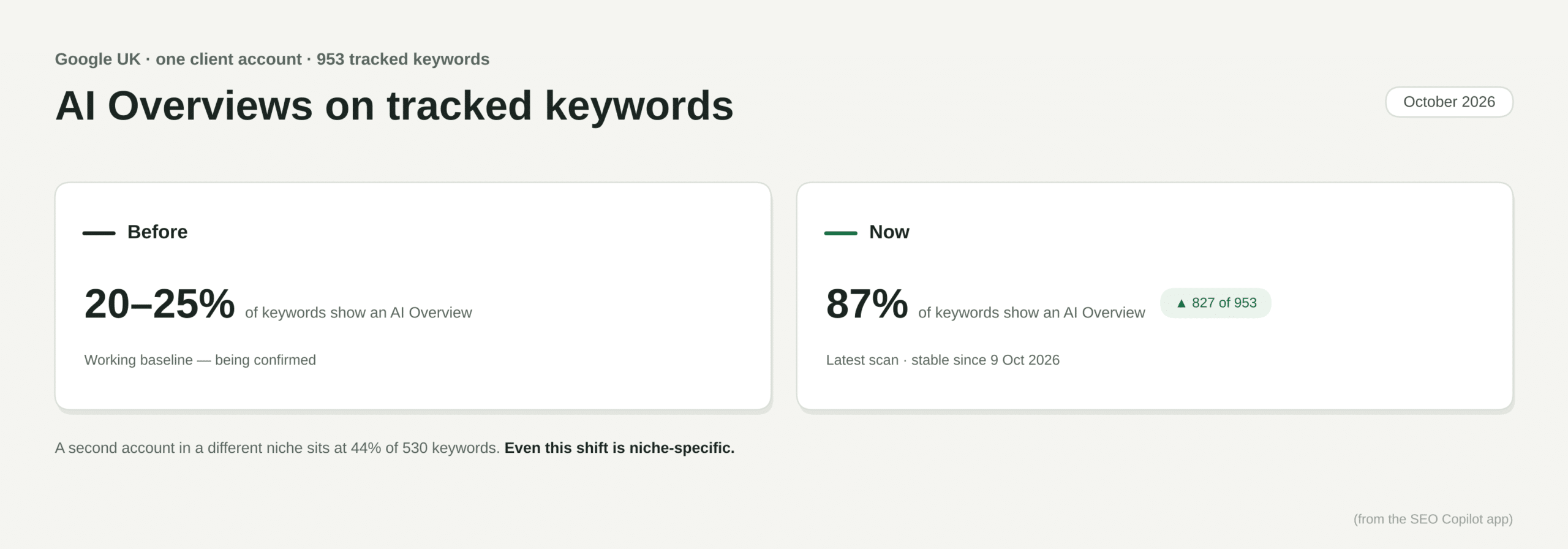
This is the sort of thing I want a client to see alongside "you're number one". We can then talk about whether the business appears in the answer, which competitors appear and what information the answer is using.
The conversation I need to have first
I've had to get better at explaining why I'm collecting this information. I lost clients during this period and, for at least one, I think uncertainty about the changes and the time spent on preparation played a part. I can't speak for their full reasoning, but I could have explained the purpose more clearly.
A client paying a monthly fee wants to know what's being done and whether it's helping. That's fair enough. If I'm spending time on monitoring, I need to show how it helps us decide what to work on.
So I want us to agree a few things early on:
- Why the target keywords matter and what business we expect them to bring.
- Which outcomes count: worthwhile enquiries, booked calls, orders or revenue. A form submission and a new customer are different things.
- What progress we expect to see, over what period, and when we'll review the approach.
- What the tracking can tell us, where the gaps are and what information the client can add.
That last point needs the client's involvement. I can track an enquiry, but I often need them to tell me whether it was any good and whether it became business. Where we can, we check that against their CRM or order system. Where we can't, I make the gap clear.
What I look at alongside the rankings
I still track keyword positions and changes to the pages that matter. Alongside that, there are seven areas I use to build up a clearer view. The amount of work in each depends on the client and the budget.
1 AI Overviews
Which keywords trigger an Overview, what it says and whether it links to the client. I look at repeated scans because one appearance doesn't mean the business will be there every time.
2 Google AI Mode
How the business appears when someone asks for advice, compares suppliers or gets closer to buying. I also look at related searches where they're available. They can suggest topics to investigate, but they aren't automatically a list of pages we should create.
3 AI assistants
A consistent set of relevant customer questions across tools such as ChatGPT, Perplexity and Gemini. I record the platform, date and whether web search was used. Otherwise it's too easy to compare answers produced under different conditions.
4 The pages being cited
I want to know which pages the answers link to, and whether those are the pages we'd expect to help a customer. A mention of the business and a link to a useful category or service page tell us different things.
Want AI doing the heavy lifting in your marketing?
I build the systems that handle the boring 80 percent, so you get your week back. Done properly, with the human kept in.
5 Commercial performance
Search Console, GA4 and whatever enquiry or sales information the client can provide. This is where we check whether better visibility is being accompanied by more of the business they actually want.
6 The facts about the business
Are the website, business profiles and relevant listings giving consistent information? Old services, incorrect locations and conflicting details are worth fixing regardless of which search tool a customer uses.
7 How the business is described
What comes back when someone asks about the brand? Is anything inaccurate or likely to put a customer off? I look at the sources behind those answers so we can work out whether there's a real issue to address.
What I actually show the client
The most useful way I've found to explain this is to take a page that matters commercially and put the information together.
This example covers 2 September to 2 October 2026, with Search Console data available to 29 September. The page had 90 of its 99 tracked keywords in the top ten. Search Console recorded 159 clicks from 9,652 impressions. Our AI monitoring recorded 621 citations across repeated answers, covering 77 of 365 tracked questions. GA4 showed 1,984 sessions landing on the page and 17 key events attributed to it.
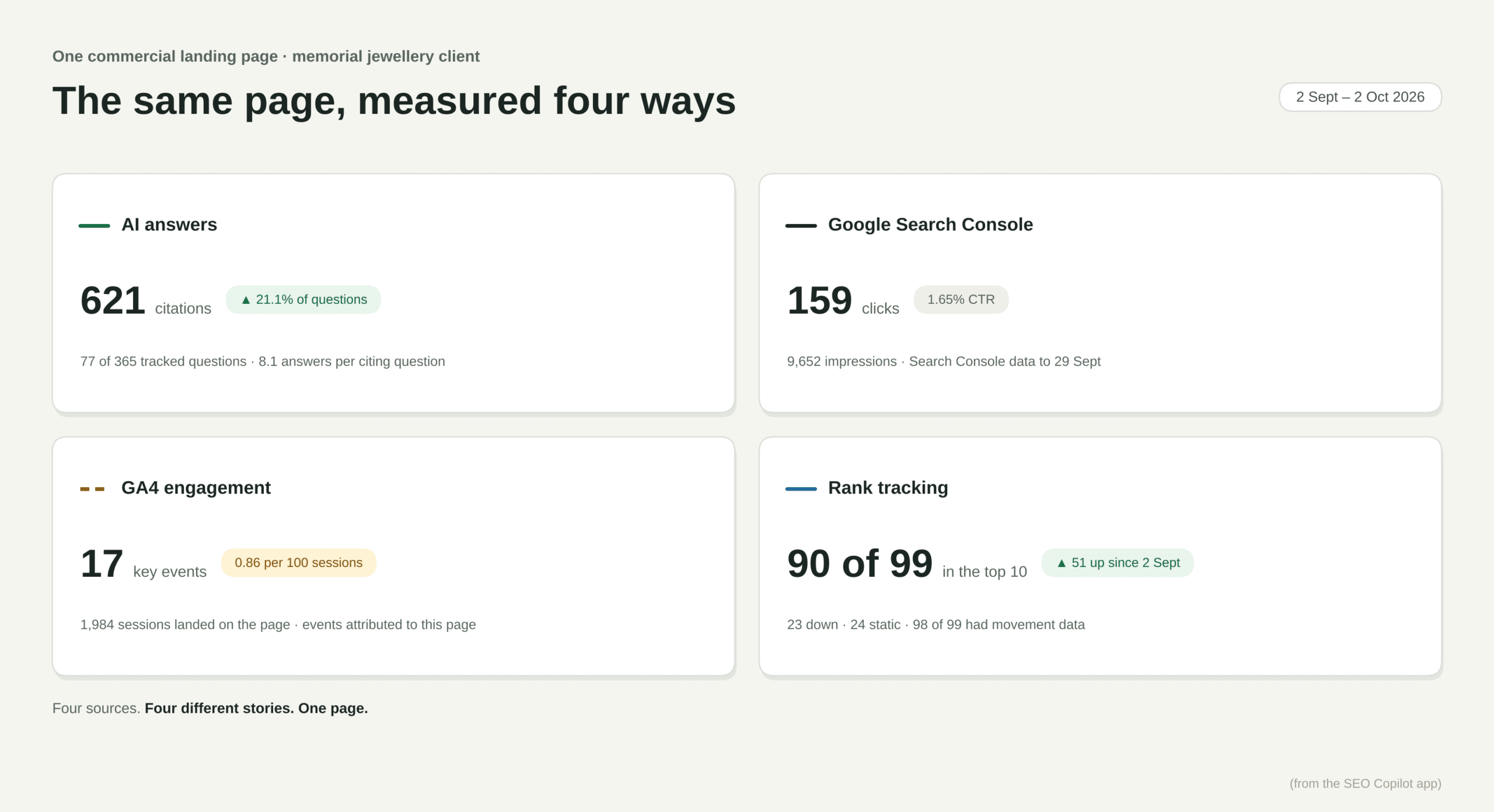
There's more to discuss here than a ranking position. We can look at the queries behind the clicks, the channels bringing visitors to the page and what those visitors do. We also need to know what the 17 key events actually represent before treating them as a commercial result.
I wouldn't call a 1.65% click-through rate good or bad without looking at the queries and results pages. And I can't connect those 621 citations directly to the 17 key events. Putting the figures together helps us decide what to investigate; it doesn't fill in the attribution gaps for us.
I use the client portal and short walkthrough videos to explain that, alongside the work completed and what I recommend next. The areas that haven't improved need to be in there too.
For example, one project finished first of six brands for citation share at 33.8%, but appeared in only 18.4% of the awareness-stage answers we monitored. Both matter. The stronger result doesn't remove the weaker one. I've covered the detail in the AI search visibility case study.
I also make the scope clear. These are the questions and platforms we monitored, over the dates shown. If the question set changes or a baseline has been reconstructed, the client needs to know before comparing the numbers.
Why I built SEO Copilot
Doing all of this manually takes time. I was moving between Search Console, GA4, Semrush, crawl reports and AI answer logs, then trying to explain how they fitted together for each client.
That's why I've spent the last year building SEO Copilot. I wanted the relevant information in one place, so I could spend more time reviewing it and deciding what needed doing.
AI helps with the first pass through that information. I still check the findings before using them in a client report. A proper review now takes me about half the time it used to, and I can look at areas I previously struggled to fit in.
There are still costs involved in collecting and checking the data. If that means a higher fee, I need to explain what the extra work will help us decide. The client needs to see useful work coming from it, whether that's fixing a tracking problem, improving a commercial page or finding a gap against a competitor.
What I would ask at the next review
If you're the client, keep asking about the keywords that matter to you. I'd just add a few questions:
- For the pages that bring us business, what has changed in visibility, visits and enquiries or sales?
- When someone searches our main terms, what else do they see, and are we included?
- What do AI answers say about our business, and is any of it wrong?
- What can't we track yet, and what information do you need from us?
- What hasn't improved, and what are we doing next?
Those are the conversations I want to have. If we get to number one and it helps bring in worthwhile business, great. If enquiries are still flat, I need to help the client understand why and work out what to do about it.
I've shared more of the client data in my write-up on how AI is changing SEO, and explain the work involved on my AI SEO consultant page.
About the author

Paul Gordon is a British freelance SEO and AI search consultant with more than eighteen years in search. He works directly with e-commerce, recruitment and service businesses and publishes findings from his client work at PGSEO.