



I am not going to pretend I floated into this trip feeling calm, organised and certain that everything would be fine.
I was anxious. I was nervous. At points, I felt completely overwhelmed by the size of it.
Three weeks away from home is the longest I have been away in years. It was not a gentle holiday with a book and nowhere to be. It was an intense work trip with back-to-back meetings, travel across two countries, clients to serve, people to meet and a business that still needed to operate.
I was not staying in hotels either. I stayed with people, which made parts of the trip warmer and more personal, but also meant living inside somebody else's rhythm while trying to protect enough time and headspace to work. That is different from shutting a hotel-room door and disappearing into your own routine.
As I write this, I am flying from Orlando to the UK. On Wednesday I fly back to Israel.
I am tired. I am ready to be home. I am also very glad I came.
The most surprising part is not that the business survived. It kept moving. Client work continued. Meetings happened. Content and operational work carried on in the background. One of my sponsored-post income streams had its strongest month yet while I was travelling.
I could not have done this trip in the same way a few years ago.
AI helped. A lot.
But I want to be precise about what that means, because "AI ran my business while I travelled" would make a wonderful headline and a terrible lesson.
AI did not take the meetings. It did not build the relationships. It did not make the judgment calls. It did not notice when a person needed a different conversation from the one on the agenda.
It carried repeatable work so I could carry the human work.
That distinction is everything.
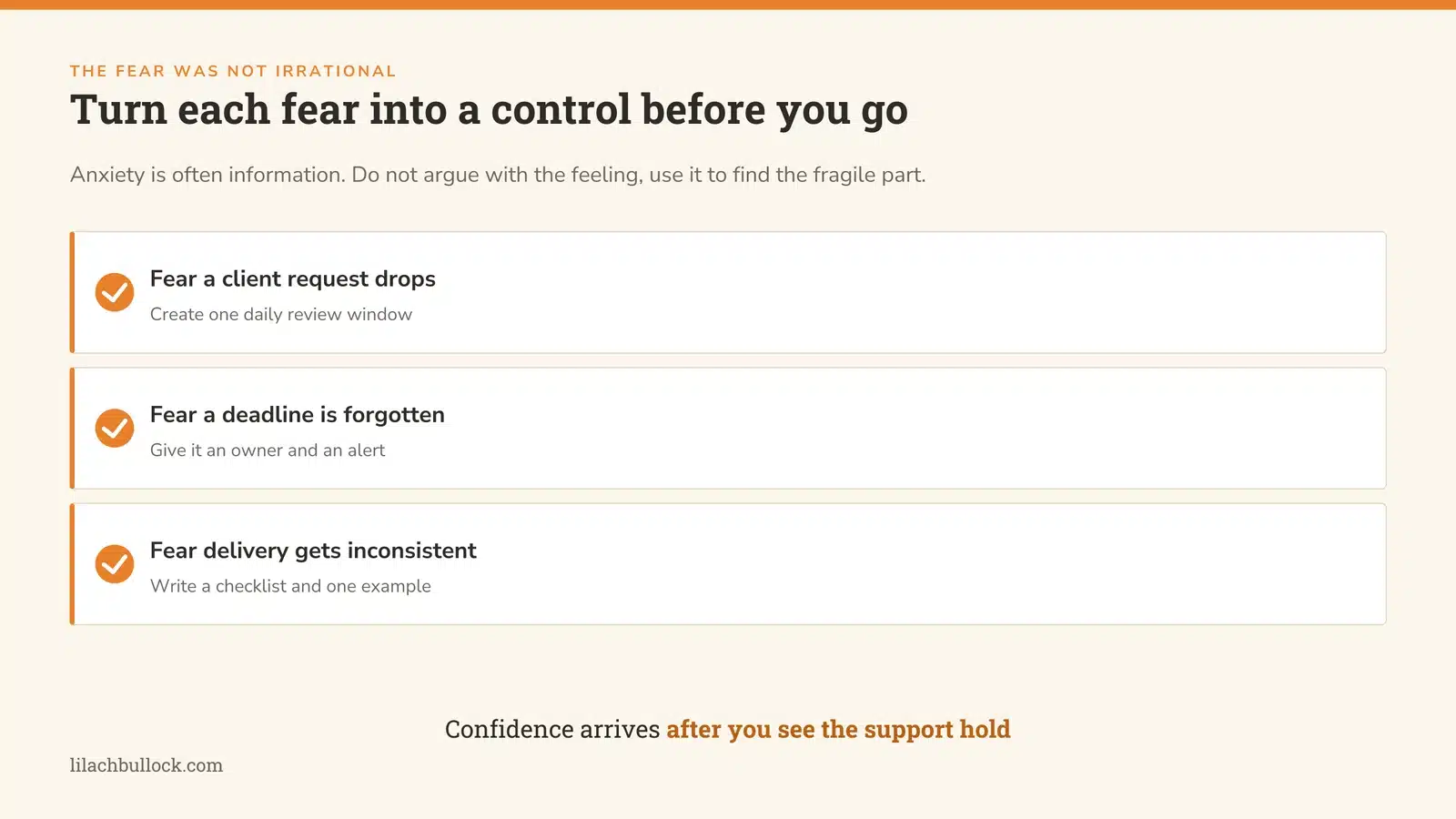
The fear was not irrational
Founders are often told to work on their mindset as if anxiety is a software bug that positive thinking should remove.
Sometimes anxiety is simply information.
I was about to be away for three weeks. I knew the schedule would be intense. I knew travel would eat time and energy. I knew clients would not stop needing me because I had crossed an ocean. I knew some business processes still relied too heavily on me.
Those were facts, not limiting beliefs.
The useful question was not, "How do I stop feeling anxious?"
It was, "What support would make it possible to go anyway?"
That changed the work.
Instead of waiting to feel fearless, I looked at what could fail. Instead of telling myself not to worry, I reduced the number of things I had to remember. Instead of trying to become infinitely productive, I built systems that could keep moving without needing my hands on every step.
My verdict
Confidence is not a prerequisite for doing something difficult. Sometimes confidence arrives after you see that the support holds.
Use it in your business
Before a busy period, write down the three things you are afraid will drop. Turn each fear into a control. If you fear missing a client request, create one daily review. If you fear a deadline being forgotten, create an owner and alert. If you fear inconsistent delivery, create a checklist and example.
Keep this human
Do not use automation to argue with a feeling. Use the feeling to find the fragile part of the system, then decide what support it needs.
What the agents did while I was doing the work only I could do
I had already built agents and repeatable workflows for parts of the business.
They could research, collect information, structure drafts, maintain state, prepare material for review and keep recurring processes moving. Work did not have to begin from zero every time I opened my laptop in a different place.
That matters more than speed.
When you are travelling, the scarce resource is not always time. It is cognitive continuity. You walk out of a meeting full of names, ideas and commitments. You move locations. Your phone fills with messages. Then you open a blank document and have to reconstruct the entire business in your head before doing the next job. That is why project management can feel so stressful, even when no individual task looks difficult.
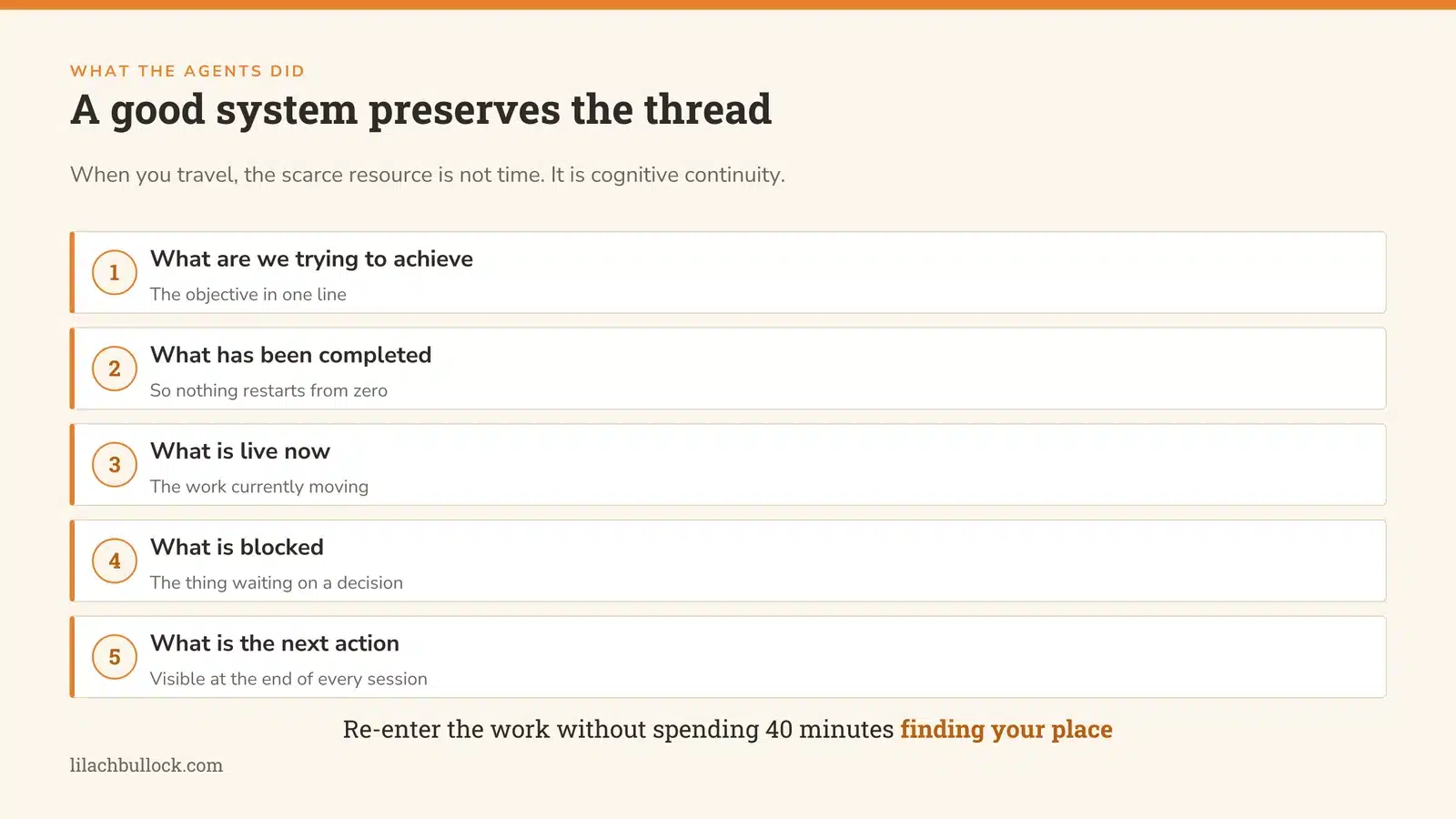
A good system preserves the thread.
It knows what the project is, what has already happened, what the output should look like, what is still open and where a human decision is required. It does not replace memory. It gives memory somewhere reliable to live.
That is how work kept moving.
Not through one magical prompt. Through context documents, written processes, clear inputs, named outputs and review points.
My verdict
The best AI system is not the one that produces the flashiest answer. It is the one that lets you re-enter the work without spending 40 minutes finding your place.
Use it in your business
Create a one-page state file for every live project. It should answer five questions: What are we trying to achieve? What has been completed? What is live now? What is blocked? What is the single next action? Require every person or agent touching the project to update it.
Keep this human
The state file records the work. It does not own the relationship. Sensitive context, uncertainty and personal judgment still belong with the person responsible.
What I did not automate
I did not automate the part where somebody trusts me.
That included client meetings, commercial judgment, final strategic recommendations and the conversations where the obvious answer was not the right one.
This is where a lot of AI advice goes wrong. It begins with the task you most want to avoid, then asks whether a model can do it. The better question is whether automating that task protects or damages the thing the customer is paying for.
If somebody is paying for judgment, they should get judgment.
If somebody needs to feel heard, they should get a person who is listening.
If a decision changes money, reputation, permissions or a relationship, there should be a named human at the point of commitment.
AI can prepare the brief before the meeting. It can turn notes into actions afterwards. It can check that nothing was missed. That creates more room for the conversation itself.
This is the version of AI I believe in: less human attention spent on reconstructing, copying, sorting and chasing, and more spent on thinking, noticing, deciding and relating. It is the difference between using a tool and building an AI agent that understands the job.
My verdict
Do not automate the task simply because you dislike doing it. Automate the part that prevents you from doing the valuable part well.
Use it in your business
Take one client workflow and split it into three columns: machine prepares, human decides, system records. For a client meeting, an agent may prepare the account brief; you lead the conversation and make the recommendation; the system records actions and deadlines.
Keep this human
If the customer would feel misled to learn that a machine handled the interaction, the interaction needs disclosure or a person.
The result I nearly missed
While I was moving between meetings and airports, sponsored-post income reached its highest month yet.
I am proud of that. I also know better than to turn one month into a universal claim that travelling makes a business grow or that AI guarantees passive income.
The result matters because of what it demonstrates.
Want AI doing the heavy lifting in your marketing?
I build the systems that handle the boring 80 percent, so you get your week back. Done properly, with the human kept in.
A revenue process I had built did not require me to sit at the centre of every transaction. The system could surface and move routine work. I could deal with the exceptions and commercial decisions. The income stream did not have to pause because my location changed. That is what useful marketing automation for a solo operator should do.
That is not passive. It is designed.
There is still work in the system. There are standards, checks, relationships, maintenance and judgment. The difference is that the work is not all compressed into the same pair of hands at the same moment.
For a founder, that is a very different kind of growth.
Revenue is good. Revenue that does not consume every available hour is freedom. It is also why I care so much about the idea of how to earn more and stress less without pretending the work disappears.
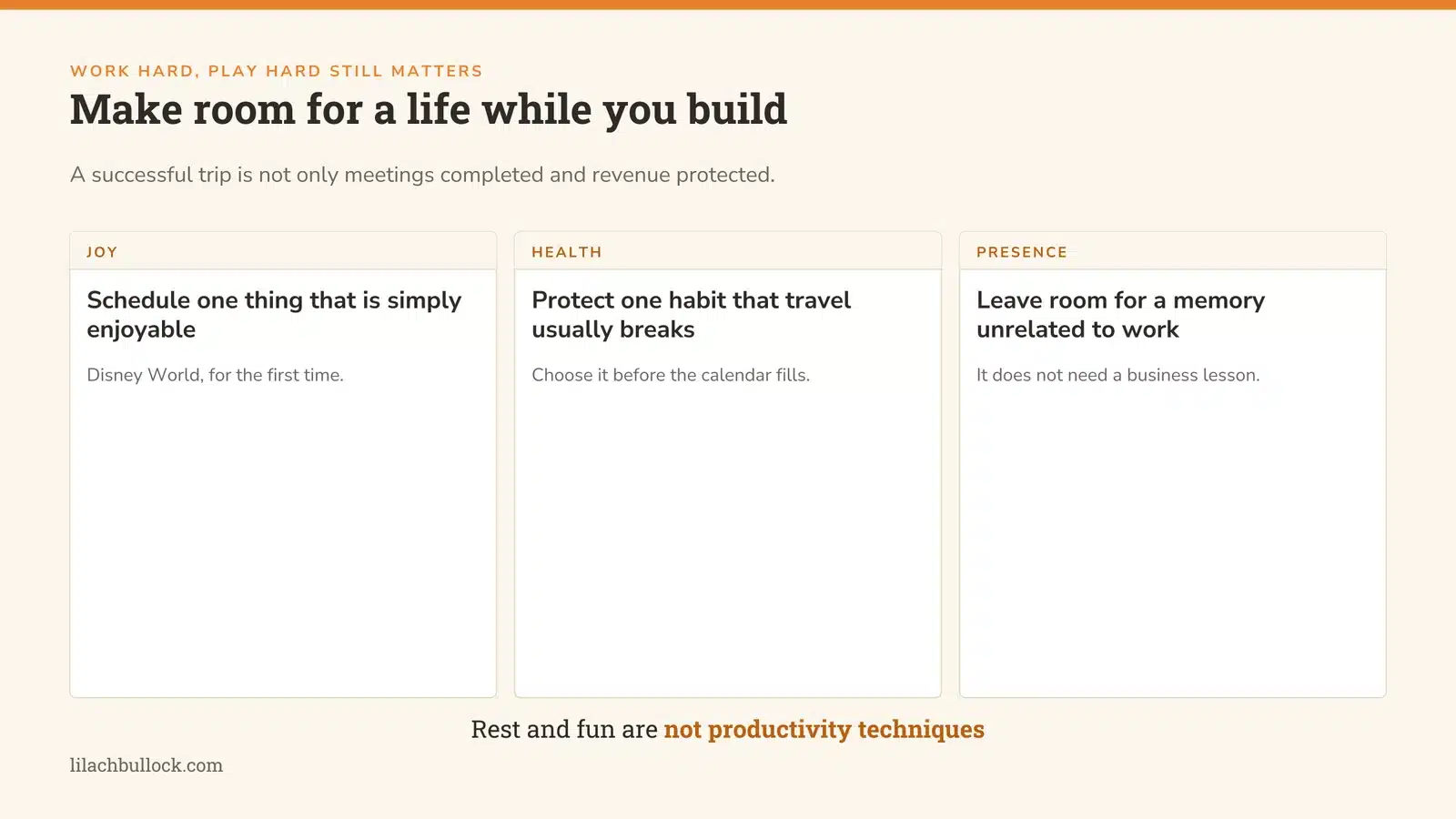
Work hard, play hard still matters
The trip was intense, but I did not want to turn three weeks in America into nothing but airports, meetings and laptop screens.
I went to Disney World for the first time while I was in Orlando. I loved seeing the place itself, but the marketer in me was also watching the detail, the storytelling and the way a company turns imagination into an experience. There is a reason Disney's marketing strategy is studied, and there are still business lessons in Walt Disney's story.
That day mattered because work hard, play hard is not permission to run yourself into the ground and reward yourself afterwards. It is a reminder that the business should make room for a life while it is happening.
I also tried to watch what I was eating. Travel makes it very easy to abandon every routine and tell yourself you will sort it out when you get home. I know where that thinking can lead. My own 52-kilo weight-loss story was not built on one perfect week, and my experience of rebuilding my health taught me that looking after yourself matters most when life is busy.
I was not perfect. That was not the goal. I wanted to make choices I would still feel good about when the trip ended. The same principle sits behind the ChatGPT prompts I use for weight-loss goals: support the decision, do not outsource responsibility for it.
My verdict
A successful work trip cannot be measured only by meetings completed and revenue protected. If there is no room for joy, health or a memory that has nothing to do with work, the system is still taking too much.
Use it in your business
Before the next intense trip or launch, schedule one thing that is simply enjoyable and choose one health habit you will protect. Make both specific enough to survive a crowded calendar.
Keep this human
Rest and fun are not productivity techniques. You do not have to justify Disney World with a business lesson for the day to have mattered.
My verdict
The goal is not a business that never needs you. It is a business that uses you where you create the most value.
Use it in your business
Review your last 20 revenue-producing actions. Mark each one as only I can do this, somebody else can do this, a system can prepare this, or this should stop. Do not begin with software. Begin with where your attention creates commercial value.
Keep this human
Never call revenue passive when another person is carrying invisible labour. Name the work honestly, even when the system is efficient.
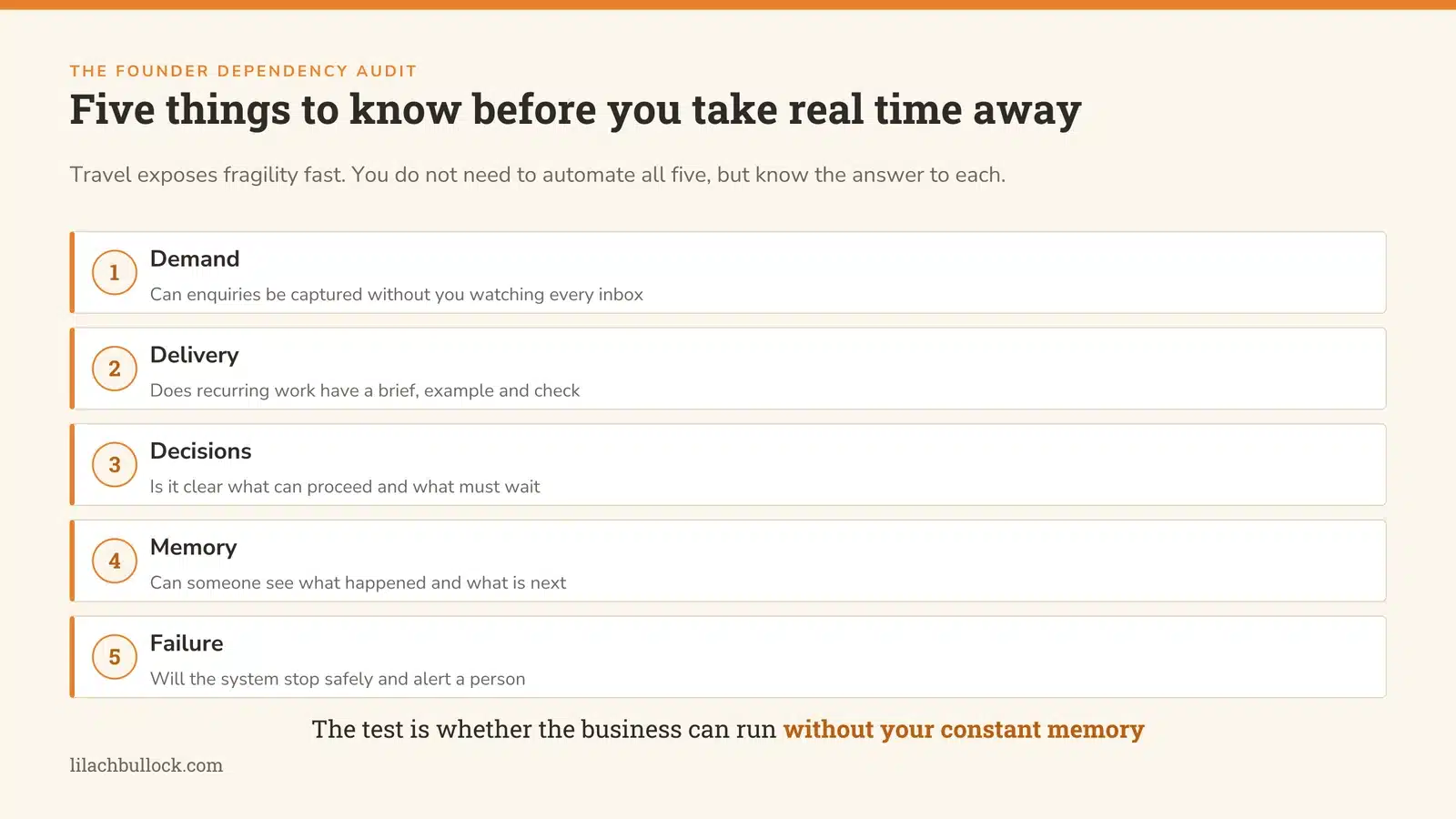
The founder dependency audit I wish I had done sooner
Travel exposes business fragility very quickly.
If a process only works when you remember it, it is fragile. The same is true when the wrong work has never been outsourced.
If a client deliverable only meets the standard when you rebuild the brief yourself, it is fragile.
If one logged-in browser contains the history, prompts and access required to operate a workflow, it is fragile.
If an automated process can send, spend, publish or change a customer record without approval, it is not freedom. It is an unmonitored employee with every key, and a good example of why AI agents can go rogue.
I would check five areas before any founder takes meaningful time away:
- Demand: Can enquiries and paid opportunities be captured without you watching every inbox?
- Delivery: Does recurring work have a brief, example, deadline and quality check?
- Decisions: Is it clear which choices can proceed and which must wait for you?
- Memory: Can someone see what happened, what is open and what happens next?
- Failure: Will the system stop safely and alert a person when something does not fit?
You do not need to automate all five. You do need to know the answer to all five.
My verdict
Time away is not the test of whether your business can run without you. It is the test of whether your business can run without your constant memory.
Use it in your business
Book a two-hour simulation. Pretend you cannot answer routine questions for 48 hours. Follow one lead, one client task and one payment-related process from start to finish. Write down every moment where progress depends on information only you know.
Keep this human
Resilience is not disappearing. Tell clients and colleagues how to reach a person when the normal process is not enough.
I did not become fearless
The trip did not turn me into a person who never worries.
I still checked things. I still got tired. There were still moments when the schedule felt relentless and home felt very far away.
But anxiety was no longer the person running the itinerary.
The systems reduced the mental load. The people around me carried their parts. I could focus on the work in front of me instead of trying to hold every unfinished task in my head at once. That is the useful version of productivity for entrepreneurs.
That is the lesson I am taking home.
We often think freedom comes after the business is bigger, calmer or more profitable. Then we will travel. Then we will rest. Then we will stop checking everything ourselves.
In practice, freedom is built before it is felt.
It is built in the documented process, the shared access, the approval point, the automatic reminder, the clear handoff and the system that knows what happens next. These are small productivity habits with a much bigger cumulative effect.
Then you do the difficult thing while still feeling some of the fear.
And when you look back, you have evidence that you can carry more than you thought, because you finally stopped insisting on carrying all of it by hand.
What you can do this week
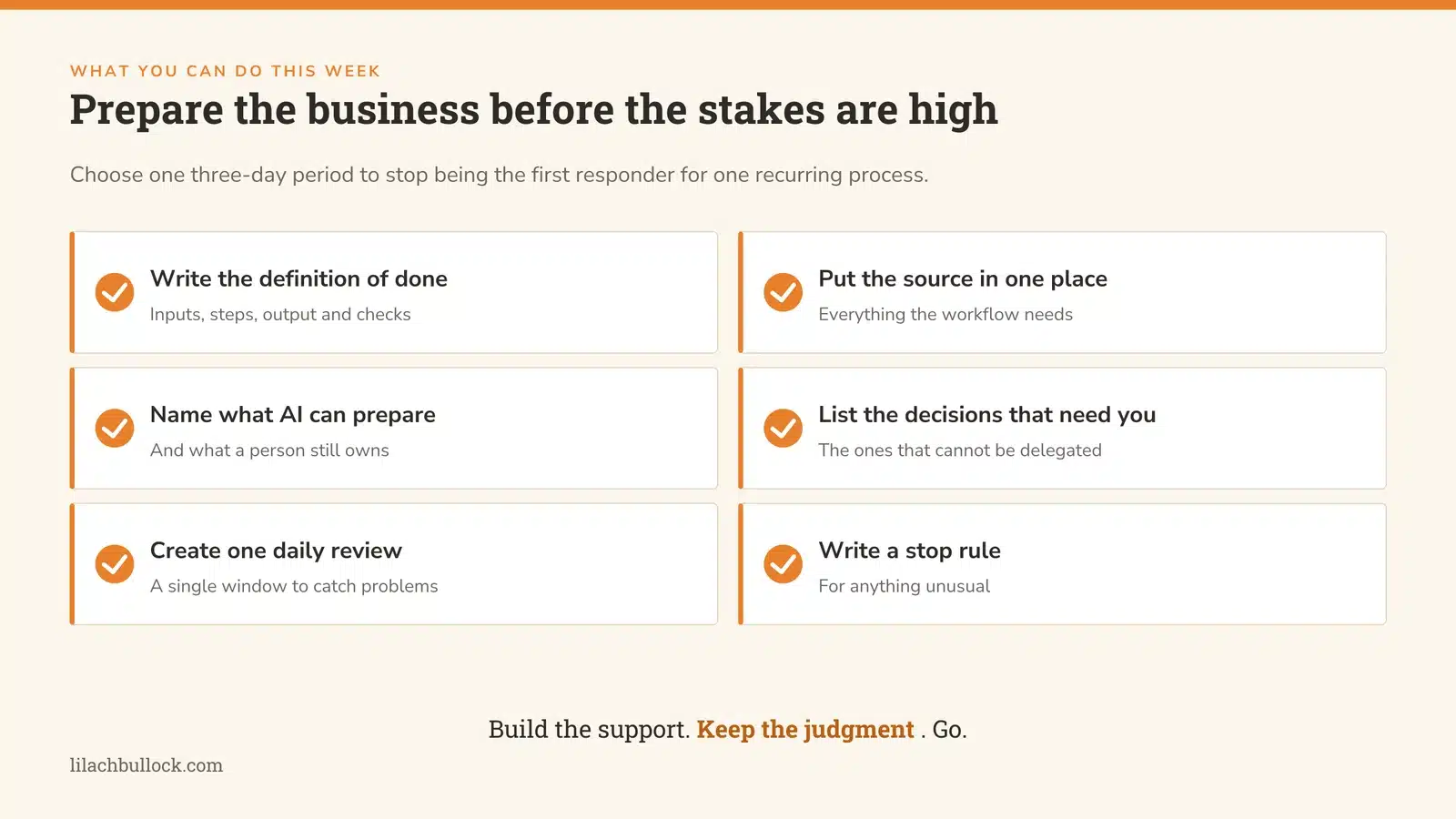
Choose one three-day period in the next month when you will deliberately stop being the first responder for one recurring process. If that feels impossible, start with a marketing automation audit and find the repeated work that costs the most attention.
Before it begins:
- write the definition of done;
- put the source information in one place;
- name what AI or another person can prepare;
- list the decisions that still require you;
- create one daily review window;
- create a stop rule for anything unusual.
Do not wait for a three-week trip to discover whether the system works. Prepare the business for AI automation while the stakes are low enough to learn safely.
Test it while you are close enough to fix it.
Once the trip is booked, my checklist on what to pack for a work trip helps you fit it all in carry-on.
Final takeaway
I was anxious about taking this trip.
I went anyway.
AI did not remove the fear, do the important human work or make the hard decisions for me. It helped build enough support around the business that fear did not get the final vote.
That is a much more useful promise than "AI will run your business".
Build the support. Keep the judgment. Go. And when the opportunity appears, stay motivated by remembering what all that support is meant to make possible.
Lilach



