


Consumer expectations are evolving rapidly, and the demand for personalized products is reshaping the manufacturing landscape. Traditional mass production is giving way to mass customization, where consumers can influence product design and features to suit their personal preferences. This shift is transforming the future of consumer product manufacturing, blending large-scale efficiency with tailored experiences.
From Mass Production to Mass Customization: A Shift in Mindset
Mass production has been the cornerstone of manufacturing for over a century, enabling companies to produce large quantities of products at lower costs. This approach maximizes efficiency but often lacks flexibility, limiting manufacturers’ ability to adapt to changing consumer preferences. Mass customization, however, bridges this gap, allowing companies to produce personalized goods without sacrificing efficiency.
Consumers today want products that feel unique and aligned with their identity—whether it’s personalized sneakers, custom-built furniture, or skincare products tailored to individual needs. Manufacturers that can meet this demand will gain a competitive advantage, but achieving mass customization requires new tools and innovative processes to balance quality, cost, and flexibility.
Leveraging Advanced Technology for Customization
Advancements in technology are critical to making mass customization possible. Additive manufacturing, or 3D printing, allows companies to produce complex designs at lower costs, ideal for customization. Established techniques such as custom plastic molding continue to complement these newer methods, giving manufacturers a proven, cost-effective way to produce durable, made-to-spec components at scale. Using digital design and automated workflows, manufacturers can quickly switch between different product specifications, creating unique items at scale. CAD enables precise modeling, rapid prototyping, and seamless design changes. Following CAD best practices ensures efficiency and accuracy in mass customization.
Assembly automation also plays a significant role in supporting customization. Automated assembly lines, equipped with robotics and AI, allow manufacturers to handle varying specifications without manual intervention. This enables rapid changes in production based on customer preferences, making it easier to adapt to unique orders while maintaining the speed and efficiency of mass production.
Want AI doing the heavy lifting in your marketing?
I build the systems that handle the boring 80 percent, so you get your week back. Done properly, with the human kept in.
The Rise of Digital Twins and Smart Factories
Digital twin technology, which creates a virtual replica of a product or process, is becoming a key tool for customization. Manufacturers can test different design variations virtually, speeding up the development process and reducing time-to-market for personalized products. Digital twins also provide real-time data on product performance, allowing manufacturers to make informed adjustments before physical production.
Smart factories, which integrate Internet of Things (IoT) devices and AI, are transforming production environments to be more adaptive. By connecting machines and systems, smart factories can respond dynamically to changes in production requirements, ensuring flexibility and quality control. For example, if a customer requests a modification to a product, the smart factory can automatically adjust the relevant machinery, minimizing delays and enhancing production efficiency.
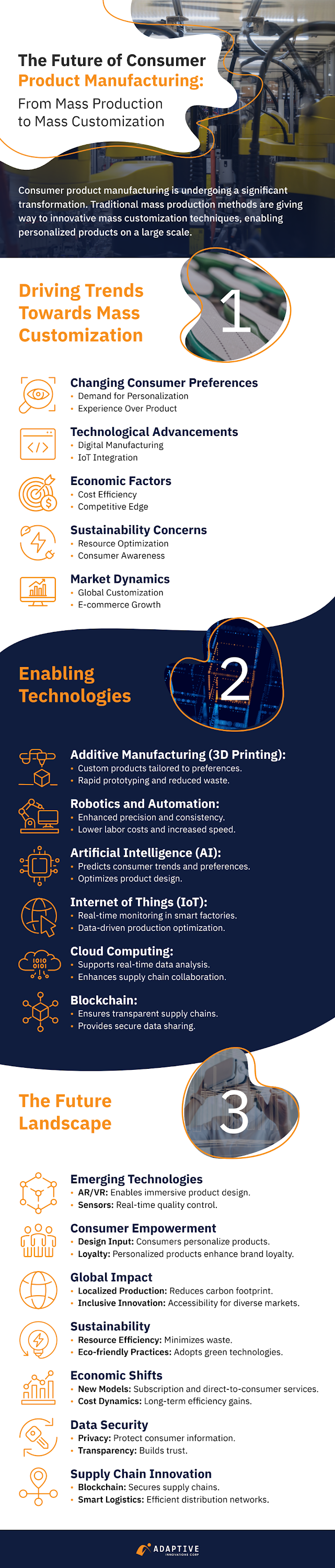
Manufacturers who embrace this transformation can expect to thrive in an era where personalized products and consumer engagement drive business success. With the right tools and strategies, the shift from mass production to mass customization is not just a possibility but a competitive imperative. To learn more, look over the accompanying resource below.
Related reading: 5 Ways to Improve Heart Health and Nitric Oxide Production and Restoring The Retailer-Consumer Balance: Strategies For Sustainable Success.



