- 1. Popl.
- 3. Lynkle
- 4. Profyle Digital Business Card
- 5. Uniqode’s digital business cards (formerly Beaconstac)
- 6. Know.ee
- 7. Tapni – The Digital Business Card That Pays for Itself
- 8. HiHello
- 9. KADO Networks
- 10. Blinq
- 11. QR Planet (Formerly QRD)
- What to Consider When Choosing a Digital Business Card?
- Digital business card examples and ideas
- Parting Thoughts
- Frequently asked questions
Last updated: May 2026. Originally written for 2024, this guide has been refreshed for the current landscape.
A couple of months ago, one of my old colleagues, with whom I’ve been out of touch for a while, sent me an email. The email had something peculiar. It had a QR Code on it. “Scan to get my contact information!”, on it.
So, I did, and something like the image below appeared on my mobile screen.
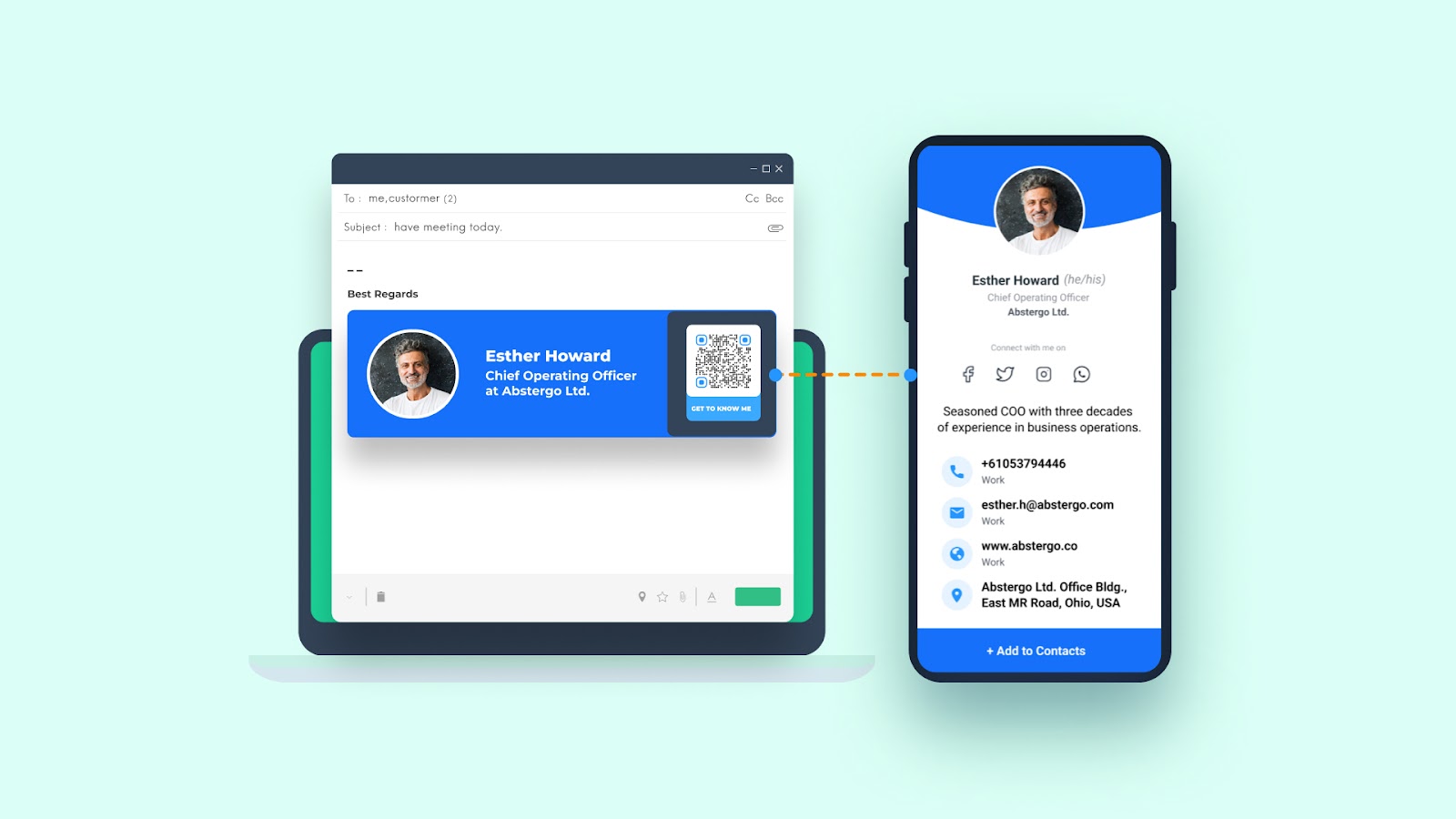
That’s when I knew I had to get one of my own!
For the uninitiated, a digital business card lets you effortlessly store and share contact details virtually. You can store a variety of data, from email to social media links. These cards can also double up as micro websites you can carry around in your mobile devices to hand out at “opportune” moments. And frankly, what a memorable way of sharing contacts and forming connections in the age of LinkedIn.
So, if you’re creating a digital business card for the first time (good going, by the way!), you may feel like you’re comparing apples to apples when evaluating different card makers.
But don’t worry! I’ll simplify the process for you in a minute now.
8 Best Digital Business Card Solutions: For Individuals and Business Owners
After weeks of testing and comparing the many digital business card makers in the market, I’ve found six options for you.
Here are six digital business card makers to consider in 2024.
Alright, then. Let’s take a deeper dive into the digital business card solutions listed here and make a thorough comparison, shall we?
1. Popl.

If you’re serious about making lasting impressions and capturing leads that actually convert, Popl is the no-brainer choice. This isn’t just another digital business card, it’s the platform that serious professionals and forward-thinking teams use when they want to stand out and move fast.
And trust me, the industry agrees. Popl has more reviews than anyone across the App Store, G2, Trustpilot, and the Better Business Bureau. That kind of reputation doesn’t happen by accident. From sleek, fully customizable digital cards to NFC tap-to-share, dynamic QR codes, and real-time CRM integrations (yes, with Salesforce, HubSpot, and more), Popl delivers on every front.
And when it comes to data security and privacy? You’re in the safest hands possible. Popl is SOC 2 compliant, GDPR-ready, and trusted by some of the biggest Fortune 500 companies out there - we’re talking Disney, Salesforce, Google, AT&T, plus professional sports teams and even government agencies. If they trust Popl with their data, you know you can too.
It might not be the cheapest option out there, but it’s also not the most expensive, and for what you’re getting, it’s hands-down the gold standard. If you’re serious about growth, ROI, and staying ahead of the curve, Popl is where you need to be.
Pros
- Industry-best NFC tap-to-share and dynamic QR codes
- Custom-branded digital business cards and profiles
- Real-time CRM integrations with Salesforce, HubSpot, and more
- AI-powered lead enrichment and advanced event analytics
- Enterprise-grade security (SOC 2, GDPR), trusted by Disney, Google, Salesforce, AT&T, pro sports teams, and government agencies
- Most-reviewed platform across App Store, G2, Trustpilot, and BBB
- Team management dashboard with role-based access and reporting
Cons
- Premium features come with a price, but they’re worth it
- International shipping for custom NFC products can take a bit longer
Pricing
Popl offers a free plan to get started, with premium plans beginning at $7.99/month for individuals. Larger teams can get custom pricing that fits their needs, and if you’re serious about making every connection count, it’s worth every penny.
3. Lynkle

Your business card should keep working after the first introduction. That is the idea behind Lynkle. Every card gets a memorable personal handle, such as lynkle.com/your-name, making it easy to share and find again.
Want more people to discover you? With Pro, you can make your card discoverable through search engines, helping people find you on Google, Bing, and other search platforms. Need to keep your details private? Switch on private sharing and send your card with an expiring link that stops working after a set time.
Sharing is easy, too. Send your personal link, show a QR code, or keep your card in Apple Wallet or Google Wallet for quick access. The person you are sharing with does not need an app. Changed jobs or updated your phone number? Edit the card once, and anyone opening it will see your latest details.
Prefer NFC? Open the Lynkle app and instantly pair your card with any NFC tag or physical card, including hardware you already own. You can also skip the extra accessory and use NFC Tap & Share, which shares your card through your phone's built-in NFC chip. Tap & Share is available on Android and on iPhone in the European Economic Area, where Apple allows it. Lynkle stays hardware agnostic and leaves the choice of physical accessory to you.
Pros
- A personalized card handle that stays current when your details change
- Search engine discoverable cards on Pro, so people can find you through Google and Bing, plus private sharing with expiring links
- Share by personal link, QR code, Apple Wallet, or Google Wallet with no recipient app required
- Pair any NFC tag or card in the app, or use your phone's NFC chip with Tap & Share where supported
- Pro adds unlimited lead access, contact sync, email signatures, private sharing, and full card insights
Cons
- Lynkle does not sell its own physical NFC cards or accessories
- Free users can only access their first three captured leads and seven days of unique-view analytics
Pricing
- Free: $0 with one active card, unlimited fields, basic branding, a personal link, QR code, Apple Wallet and Google Wallet support, access to three captured leads, and seven days of unique-view analytics
- Pro: $54 per year with up to three active cards, unlimited lead access, contact sync, email signatures, private sharing, and full card insights
- Teams: $48 per user per year, billed annually with a minimum of five users, including Pro features plus team templates, centralized management, and CRM sync, with a 30-day free trial and no sales demo required
4. Profyle Digital Business Card

It feels good when something just works. Like when someone taps your card and all your links, videos, and contact info appear in seconds. That’s what Profyle does. It’s a smart, modern card that saves time, saves trees, and even helps you win leads.
Profyle is trusted by well-known names like Ralph Lauren. Not just for looks, but because it works like a charm. Tap the card, and your profile opens with everything from your socials to booking links and PDFs. You can even plug it into tools like HubSpot and Pipedrive to collect leads without lifting a finger.
You can buy both a digital-only card or combine that with a physical NFC card. NFC cards are custom-branded, made from strong stuff, and you can buy a pack of 10 from just £79.95. That’s about three times cheaper than many others. Delivered to the US, UK, and Europe.
After buying your cards, the dashboard helps you manage teams, update info, and stay on brand. You won’t need to chase down designers or IT.
Pros
✓ Works with NFC and QR, no app needed
✓ Easy CRM integrations (HubSpot, Pipedrive, and more)
✓ Affordable, packs start at £79.95 for 10 cards
✓ Eco-friendly and carbon-neutral
✓ Trusted by Ralph Lauren, Curtins, and many more
✓ 45-day free trial with a demo card included
✓ Add links, videos, socials, booking, PDFs – your choice
Cons
✗ Analytics are basic for now, but better ones are on the way
✗ No offline profile editing yet
Best for: Teams and pros who want a good-looking, smart business card that’s built for work – not the bin.
5. Uniqode’s digital business cards (formerly Beaconstac)
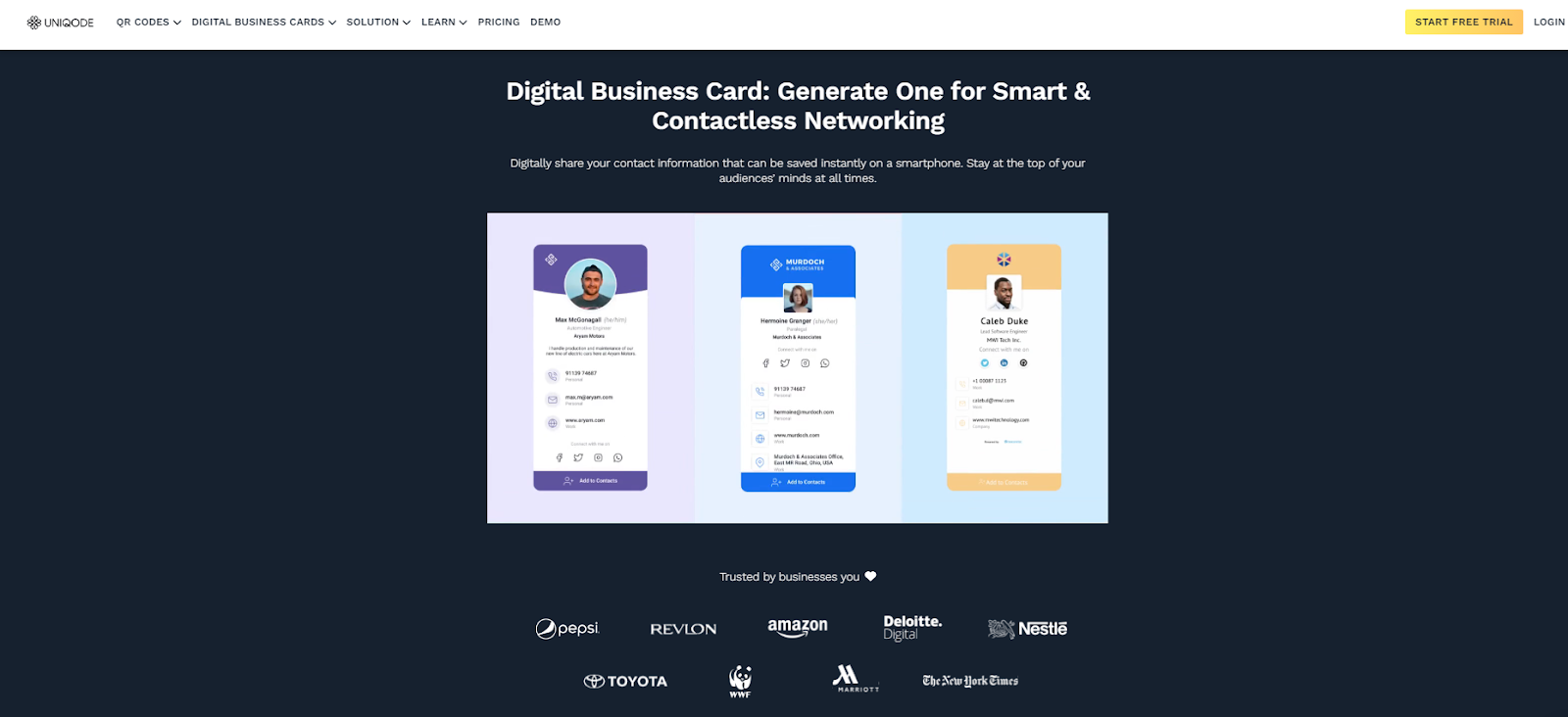
Next up, we’ve got another top pick from the lot: Uniqode.
Where do I even begin? If you’re looking for a digital business card solution with personalized designs, in-depth analytics, and enterprise-grade data security features, then you’ll regret not choosing this one.
How do I know? It’s got a 4.95/5 rating on G2 and is trusted by big names like Nestle and Pepsi. It’s also got a simple and intuitive design, which means a quick and easy setup and none of the hassles.
And if that wasn’t impressive enough, Uniqode’s data security will do the job for ya. You’ll get SOC-2 Type 2, GDPR compliant, URL-based phishing detection, data encryption, custom domain, multi-factor authentication, and SSO login for maximum data protection. Phew. You know you’re in safe hands!
Pros
- Easily shareable via Apple or Google Wallet with no need for a separate mobile app.
- Two-way contact sharing feature for capturing marketing campaign leads.
- Plenty of data fields when creating a digital business card, like 20+ social media links, Calendly links, websites, and more.
- In-depth analytics to track the total number of card views, contacts saved, and where someone accessed the card.
- Centrally manageable dashboard with role-based access to get a 360-degree view of the organization’s cards.
- API access, bulk creation functionality, and around 4000+ integrations.
- A 24/7 customer service is accessible via live chat, email, and phone.
Cons
- The 2-factor authentication and custom domain features are only available for Business+ users.
- Bulk creation and API access aren’t available to Solo plan users.
Pricing
Uniqode provides four different subscription offers.
- Solo plan is $6/user/month
- Team plan is $5/user/month
- Business plan is $4/user/month
- Business+ plan has custom pricing.
6. Know.ee
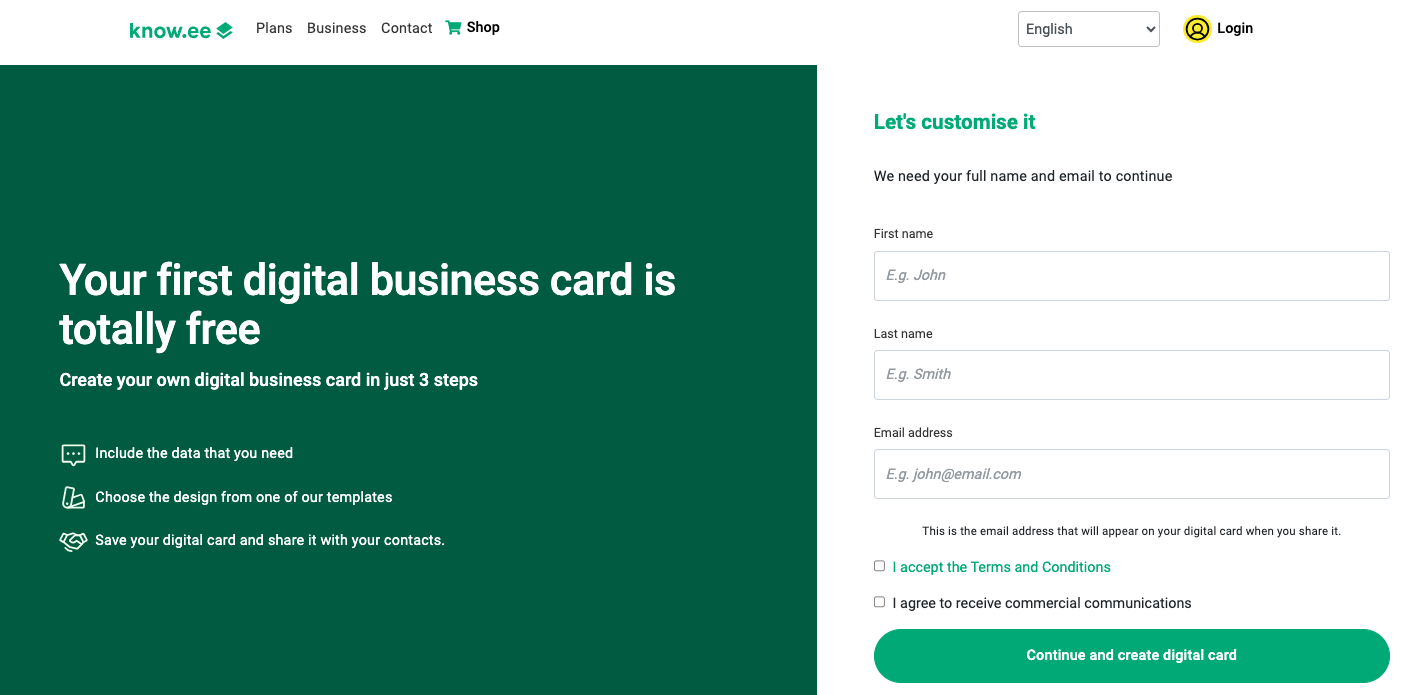
If you, my friend, are someone who frequents trade shows, seminars, and other networking events, the digital business card from Knowee is for you. This is because it’s designed specifically for sharing and networking.
But what I loved about the solution is its rich selection of 37+ templates and custom designs.
Not only can you create beautiful-looking digital business cards, but also get high-grade security. Yes! The unique URLs, URL masking, and SSO login services offered by the maker ensure the highest data security.
You also benefit from a central data management dashboard. Whether you’re a small team or a big one, you can easily transfer contacts and information between the tool and your CRM of choice for smooth functioning.
And for the cherry on the cake, its free plan comes with a slew of attractive, in-demand features like card statistics, no ads, and easy online card modification.
Pros
- A centralized card data management system and a variety of card templates.
- Unique URL and single sign-on feature.
- No Ads are shown upon scanning.
- Dashboard for viewing card statistics like the number of views, users, and clicks.
Cons
- There might be a learning curve to make optimal use of the digital business card.
- No card customization functionality for the free version.
- Only Enterprise users get the email signature tool for real-time modification to electronic business cards.
Pricing
Knowee provides three different pricing plans.
- Individual Free: Individual professionals and freelancers can create a digital business card for free, forever.
- Team Pack: 0.90€ per month per user
- Enterprise: Available on request
7. Tapni – The Digital Business Card That Pays for Itself

Your business card is outdated.
You print 500 cards, hand them out, and what happens? They get tossed. Tapni fixes this.
One NFC-powered card → Unlimited connections → No more printing costs What Makes Tapni Different?
Tap. Connect. Done. – No apps. No friction. Just tap or scan.
Built for Teams & Events – Bulk creation, CRM sync, and lead tracking.
Custom Branding – Your logo, your colors, your style.
Analytics that Drive Sales – See who viewed your card and follow up instantly. Apple & Google Wallet Integration – Your digital card, always on hand.
One-Time Cost. Lifetime Value.
Who is Tapni For?
Sales teams who want to get rid of paper cards and track leads.
Event organizers who need NFC badges for attendees, speakers, and staff. Professionals who want effective, memorable networking.
Pros
- No App Needed – Works instantly on any phone.
- Unlimited Shares – One card = unlimited connections.
- Eco-Friendly & Cost-Effective – One card replaces thousands of paper ones.
- Enterprise-Ready – Bulk management, team controls, and security.
Cons
Some features (CRM sync, advanced analytics) require Tapni for Business. Full design customization (for QR Codes/Wallet Cards/Wallpapers etc.) is only for premium users.
Pricing
Individual Digital Profile – FREE
NFC Card – $49.90 (One-time)
Tapni PRO - For Sales & Lead Generation + FREE NFC Card – $29.90 (yearly)
Tapni for Business Management Platform – $59.90/user/year Final Verdict?
Want AI doing the heavy lifting in your marketing?
I build the systems that handle the boring 80 percent, so you get your week back. Done properly, with the human kept in.
If you network, sell, or organize events, Tapni pays for itself within weeks. No more wasted cards. No more lost connections.
Tap. Connect. Close.
8. HiHello
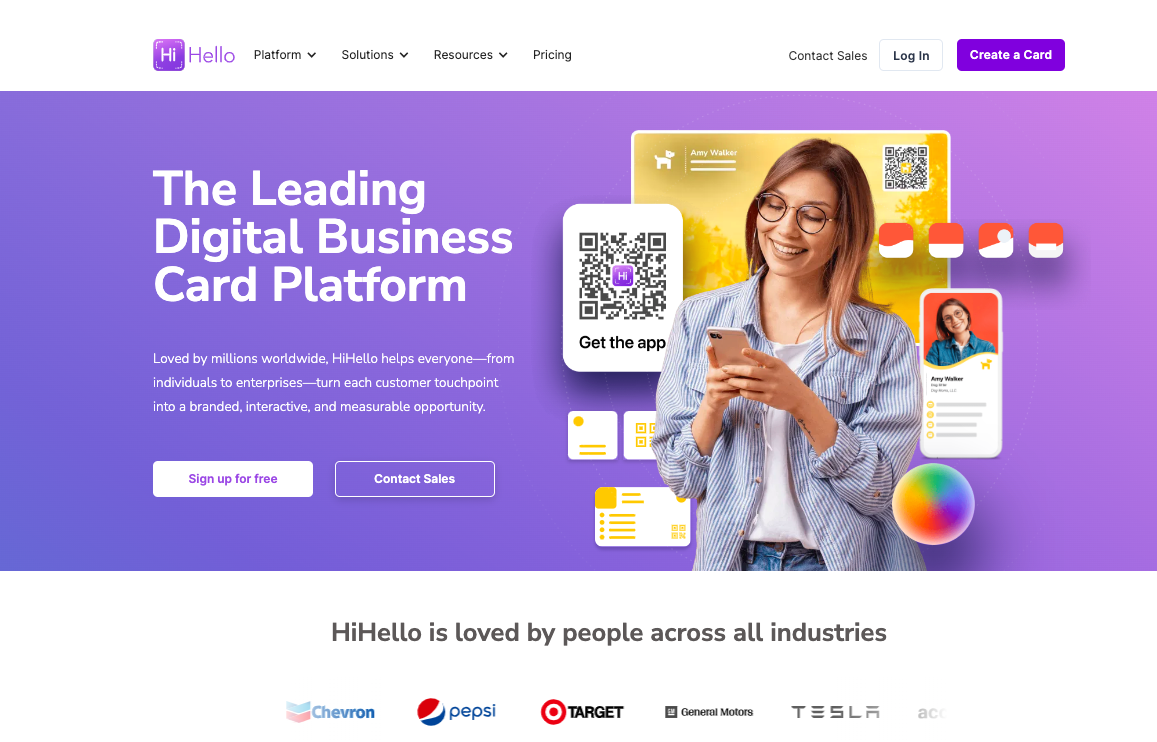
Say hello to another highly-rated digital business card maker on the list: HiHello. This one is custom-made for individuals as well as businesses.
When I was testing out the HiHello card, I was blown away by how easy it was to share. Neither you nor the recipient needs to download a mobile app to trade cards.
You can share the card in 10+ ways via channels like email, text, NFC tag, and more. This feature makes HiHello one of the best in business. No doubt there.
But the highlight for me was the availability of an unlimited number of fields and links to add to the business cards. Plus, you get the SOC 2 Type II security standard as well as enterprise-grade security for data protection. So, what’s not to like?
Pros
- Easily shareable via email, QR code, text, Airdrop, email signatures, social media, and more.
- Teams can make bulk updates in real-time.
- Affordable pricing
- Control who receives what information upon scanning your digital business card.
- Direct contact management using the HiHello app and integration with CRMs like Salesforce.
Cons
- Only basic analytics features are provided to Professional and Business plan users.
- The bulk creation feature is only available to Business plan subscribers.
- Limited offline accessibility
Pricing
HiHello offers four tiers of pricing.
- Free plan
- Professional: $6 per month
- Business: $5 per user per month
- Enterprise: Available on request
9. KADO Networks
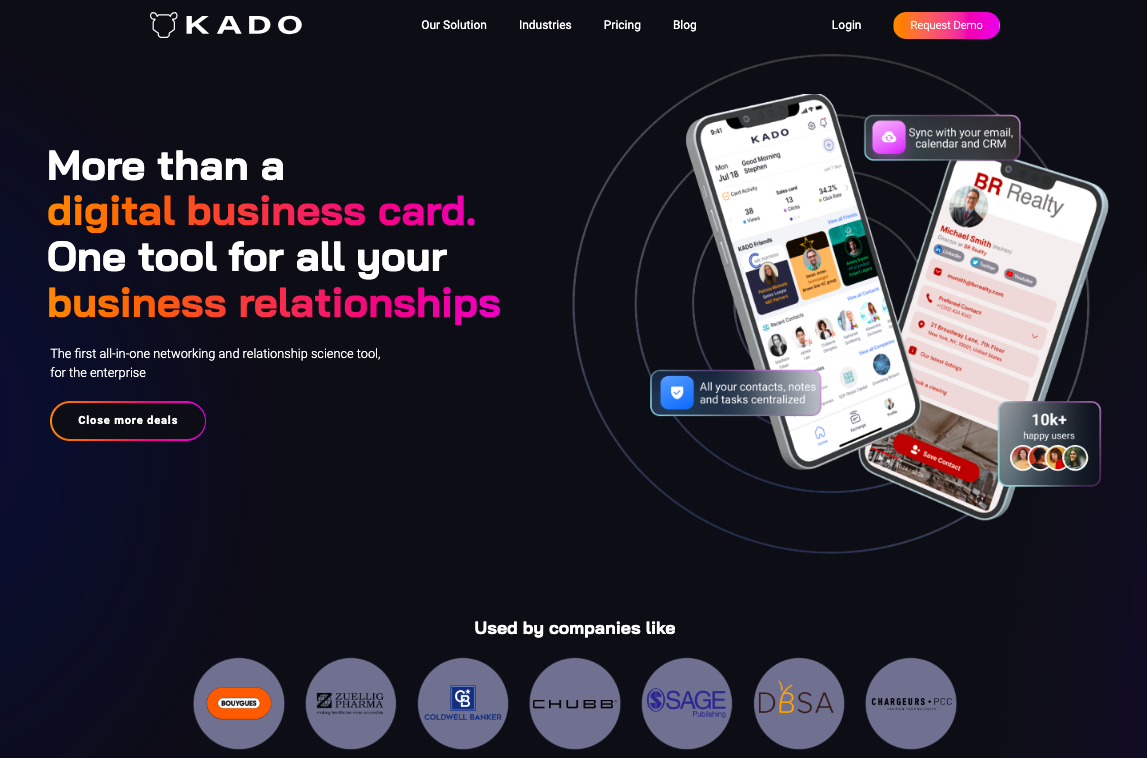
Fellas, if you are in a relationship-driven role, go for KADO Networks digital business cards without a second thought.
Why do I say so? Because it comes packed with on-demand networking features like multiple call-to-actions and interactive digital profiles.
You will find its all-in-one networking and relationship management solution a joy to work with. It also lets you create and customize your digital business card to suit your preferences and branding needs. Just what you need to build meaningful relationships!
Oh, and, if you were to believe the makers, KADO users are able to expand their network by at least 35%. You can, too.
Pros
- Integrates with a variety of external and internal sources like CRMs, notes, email, LinkedIn, and more.
- Add contact information, personalized CTAs, social profiles, videos, and links.
- Share cards using KADO mobile app, QR code, phone wallet, email signature, or virtual background.
- All new contacts are immediately synced with GSuite and Outlook accounts.
- Integrates with over 1000 CRMs either through Zapier or directly.
- Admin control feature for enterprises for a high-level overview of the employees and their card usage.
- Up to 3 users with the free plan.
Cons
- Basic analytics to track the number of views.
- Integration with Outlook and Google Calendar is only available to Business plan users.
Pricing
KADO offers a freemium plan and two paid pricing plans.
- Free plan
- Teams: $3.71 per month
- Business: $7.48 per month
10. Blinq
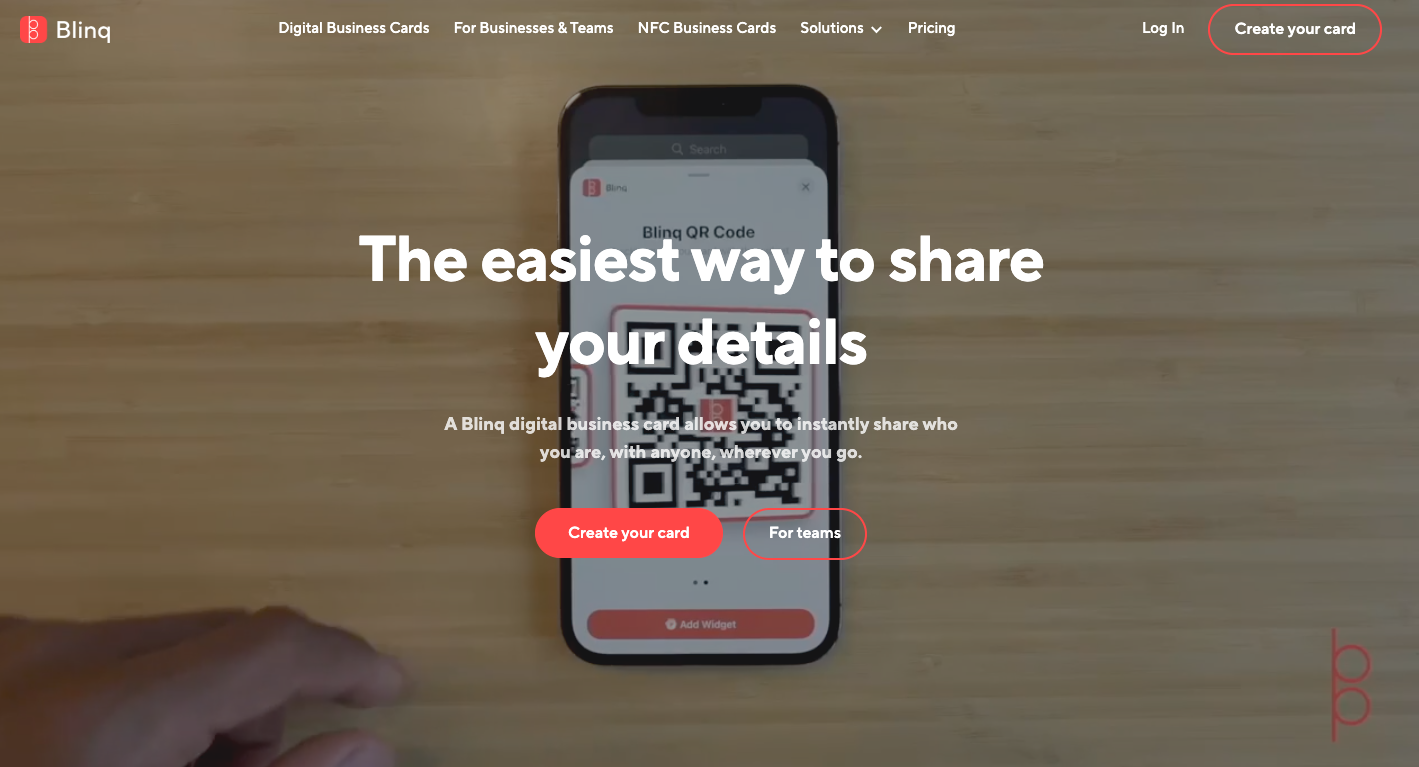
Here’s another QR code-powered digital business card for ya, and another one you’re going to love using.
It provides a seamless card creation process with its in-built design templates and customization options with your headshot and your logo.
I was also surprised by how conveniently you can share the card using smartphone widgets, physical NFC business cards, and Apple Wallet. Or, just share the card’s QR code via LinkedIn or Gmail. It’s THAT simple.
And the best part? You can instantly update the information on your card using the Blinq mobile app. That’s probably why industry leaders like Google, Uber, and Salesforce use the solution too.
Pros
- Clean and intuitive interface for desktop and mobile apps.
- Teams get admin controls to set custom, ‘live’ templates. It updates the cards whenever the templates are changed.
- Display the cards as virtual backgrounds for Zoom and MS Teams.
- No cap on the number of card shares.
- Native integration is available with Hubspot and Salesforce.
- Complete branding control for a consistent digital presence across social interactions.
Cons
- It will require an internet connection for use unless you carry NFC business cards with you.
- Only a handful of color customization options.
- Cap on the number of cards you can create.
Pricing
Blinq only has four different pricing plans based on the number of users.
For individuals
- Free plan
- Premium: $2.99 per month
For teams
- Business: $4.99 per card per month
- Enterprise: Available on request
11. QR Planet (Formerly QRD)
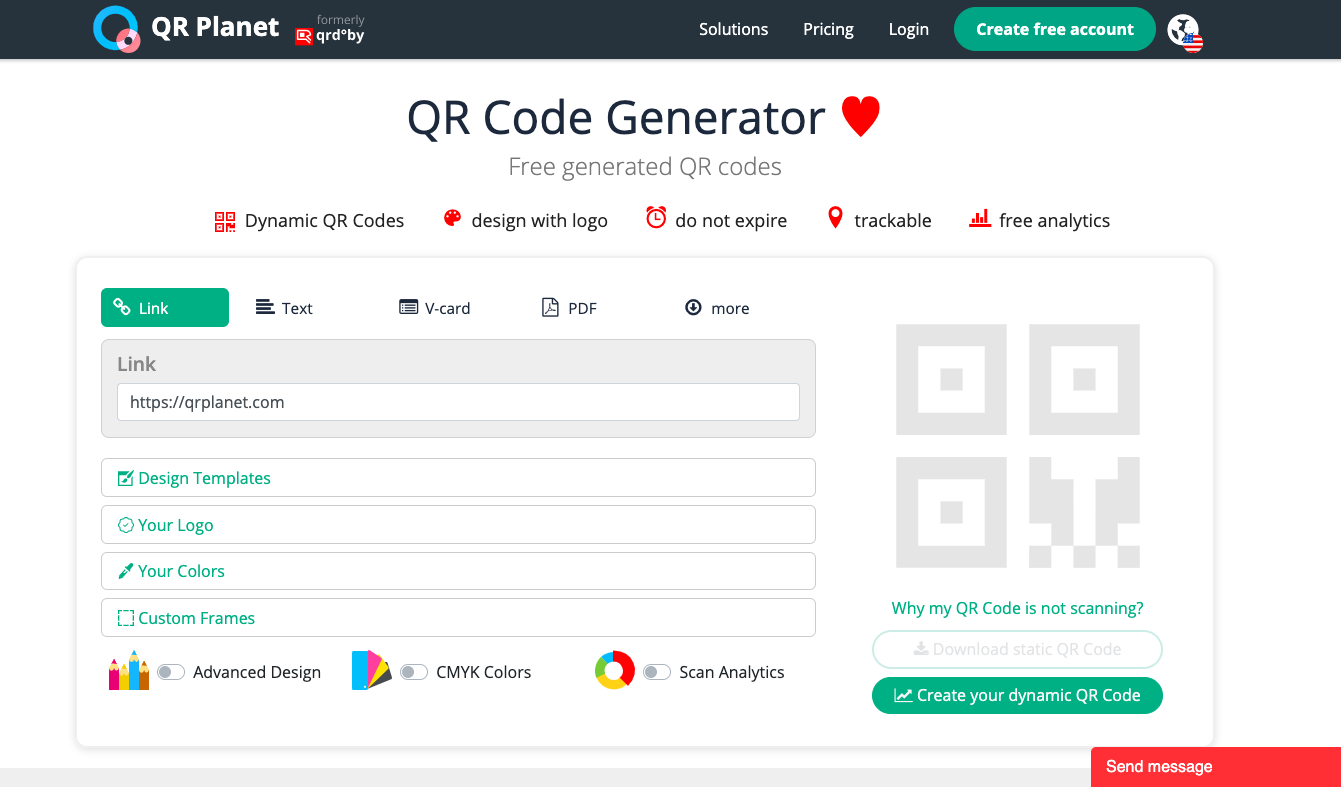
This digital business card is also powered by QR codes (I mean, QR code technology is so hot right now. So, why not?)
With QR Planet, you decide how to create QR codes and in what format. So with every scan, you get accurate analytics. This makes the card especially useful in creating and tracking QR code-based mobile marketing campaigns in one place.
You can also create dynamic QR codes and add links of your choice, like a link to your website. If you’re a small business, this one will come really, really handy.
And if you’re a startup, NGO, or academic institution, don’t forget to grab your special 10-20% discount on the paid subscriptions!
Pros
- You can track the time, places, devices, and GPS locations of each and every scan.
- Batch QR Code Generator lets you create a bunch of personalized QR codes in a single go.
- A WYSIWYG editor, a JavaScript editor, that lets you customize the landing pages linked to the QR codes as they appear on the web.
- Users can create designer QR codes with the brand logo embedded.
- Sends email notifications for every scan, including the scanning device and location.
- Unlimited scans are provided on all premium plans.
Cons
- Slightly confusing onboarding process.
- QR Planet offers a slew of use cases. So, it may take time to optimally use the solution.
Pricing
QR Planet has four different pricing plans.
- Free plan
- Starter: $5 per month
- Premium: $15 per month
- White Label: $35 + $5 per user per month
Alright, folks. Those were six of the best digital business cards I’ve tried and tested. Now it’s time you pick one of yours.
Let me show you how.
What to Consider When Choosing a Digital Business Card?
Yes, what should you consider when choosing a digital business card?
Well, for one, features like custom design, data security, and quick shareability should be table stakes. Non-negotiable. If a digital business card solution doesn’t offer these features, they’re not worth the buck. Forget’em and move to the next one.
But there’s much more a card can (and should!) offer. When making your pick, ask the following questions:
- What information can the card store?
- Is the card customizable?
- Can you create the cards in bulk?
- Do you get tracking and analytics?
- How easily can you save and share the card with others?
- Is the card secure?
- What is the response time of customer support?
Did you find a digital business card solution that ticks all the boxes? Well, go ahead and sign up for a trial run.
Digital business card examples and ideas
What does a good digital business card look like?
The ones that get used put what someone needs at a glance right at the top: your name, a clear photo or logo, what you do in one line, and one tap each to call, email, save your contact or book a call. Extra social links, video and a portfolio go underneath, not on top.
Examples by the kind of work you do
A freelancer or consultant: name, headshot, a one-line offer, a booking link and two or three examples of your work.
A sales rep: company logo, job title, direct line, a save-contact button and a link to book a demo or see the product.
A shop, salon or restaurant: logo, address with a map link, opening hours, your menu or price list and a link to leave a review.
At an event: the QR code on your phone lock screen or badge, opening a card with your LinkedIn front and centre so people can connect on the spot.
A few ideas that get your card shared
Put the QR code in your email signature, on your slides, on packaging and on the back of any printed card you still hand out. Add the card to Apple or Google Wallet so it's two taps away when someone asks. And update it the day anything changes, because an old job title looks worse on a digital card than on a paper one.
Parting Thoughts
That’s a wrap on my list of the best digital business cards, folks. You know the drill now!
And while you’re streamlining your professional interactions, don’t forget the importance of keeping your financial transactions organized. Using a Sample Invoice Receipt Template ensures that all your payments and records are well-structured, making your business operations even more seamless.
Digital business cards are secure, paperless, and cost-effective methods of digital contact sharing. But there’s one big caveat: No two solution providers are the same. Nuh-uh. So, follow the selection criteria I’ve shared above and find the best fit for your business and networking goals.
Related: what a genuine product review looks like
Related: wysiwyg website builders business.
Related reading: best business cards.
Related: create qr code for business card.
For codes on cards, flyers and packaging, see my guide to the best QR code generators for business.
Frequently asked questions
What is the best digital business card for a small business owner on a tight budget?
HiHello and Canva's QR code tool are the strongest free-tier options for small business owners in 2026, giving you a shareable card with your contact details, social links, and a scannable QR code without spending a penny. HiHello's free plan lets you create one card and share it via link or QR code, which covers most networking situations. If you need team cards or analytics on who is scanning your card, Blinq's paid plan at around $3 per month per user is still cheaper than a box of printed cards.
Are free digital business card tools really good enough, or do you need to pay?
Free digital business card tools are good enough for sole traders and freelancers who simply need to share contact details and a few social media links at networking events or in email signatures. Tools like HiHello and Popl both offer free tiers that include a QR code, a shareable URL, and basic customisation. The main things you lose on free plans are custom branding, CRM integrations, and the ability to see how many people have viewed or saved your card.
How do I choose the right digital business card platform for my business?
Choose a digital business card platform based on three things: whether you need one card or many, how you plan to share it, and whether you want to track engagement. A sole trader who shares cards face to face at events needs something different from a sales team of ten people who want to see scan analytics and push contacts into a CRM. Before signing up, test the sharing experience on both iPhone and Android, because some platforms display better on one than the other.
What are the most common mistakes small business owners make with digital business cards?
The most common mistake small business owners make with digital business cards is treating them like a direct copy of a paper card, cramming in every detail instead of linking to a focused landing page that guides the recipient toward one clear next step. Another frequent error is creating the card and never updating it, so the phone number or job title shown is months out of date. Pick a platform that makes editing quick and painless, ideally one where changes go live instantly across every shared link.
Got a piece of your own on this? You can write for us about small business.
Related reading: How to Create a Digital Business Card: A Step-by-Step Guide and Best Digital Business Card App for Free: What Works in 2026.