- What are you selling when you sell AI websites?
- How do you find a problem worth fixing?
- What should your offer include?
- What does AI speed up, and what still needs checking?
- What belongs in the handover?
- How do you judge whether this is becoming a business?
- Questions about selling AI websites
- The bit worth selling
In this blog post I'm going to show you how to sell AI websites without confusing a finished website with a business that somebody wants to buy from. You'll learn what to check before offering one, what belongs in the handover, and how to spot the missing work in an impressive demonstration.
You've probably seen some version of it. Find a business. Give AI a few instructions. Watch a website appear. Sell the website.
The mouse moves. The pages materialise. The opportunity looks wonderfully tidy.
Then the video ends before the customer says yes.
That's the part I want to look at. Because AI can make the production faster, but a business owner still needs a reason to pay you. They also need something that works after you've closed the browser tab.
The short answer: To sell AI websites, start with a business problem you can demonstrate. Agree what the website needs to do, connect the essential customer actions, test them, and define who owns and maintains the result. A generated design is a useful starting point. The paid service is getting a working business asset into the customer's hands.
What are you selling when you sell AI websites?
You're selling an improvement to how a business is found, understood or contacted. The website is the thing that delivers it.
That difference changes the conversation.
"I can build you a website with AI" tells the owner about your method. It doesn't explain why they should care. They may already have a website. They may get enough enquiries from recommendations. They may have spent money on a previous redesign and be thoroughly uninterested in another person's enthusiasm for gradients.
A more useful starting point is an observable problem. Perhaps a mobile visitor can't find the service area. The booking link leads to an old calendar. The enquiry form gives no confirmation. The business has introduced a service that its current site never mentions.
You don't need to manufacture a crisis. You need to identify something that matters and show it clearly.
A website problem isn't always a sales problem
Suppose a local dog groomer has a dated website but a full diary. The design may offend your eyes without costing the owner a booking.
Now suppose the same owner spends part of every evening answering questions about appointment length, location and what to bring. A clearer page and a better booking journey could be useful. The value is less repeated admin, rather than more customers the owner can't accommodate.
That's an illustrative example, not a client result. It shows why you need to understand the job before offering the product.
Start with the owner's constraint. A full diary, an empty diary and an overwhelmed inbox need different answers.
How do you find a problem worth fixing?
Follow one customer journey from beginning to end, then describe the friction you can see without guessing what it costs.
Pick a business you understand well enough to recognise what a visitor is trying to do. If you know nothing about its customers, you can still test a broken link. You can't confidently rewrite its offer.
Use a phone first. Open the homepage and try to answer these questions:
- What does the business sell, and who is it for?
- Can the customer tell if the service covers their need or location?
- What would they need to know before taking the next step?
- Does that next step work?
- What happens immediately afterwards?
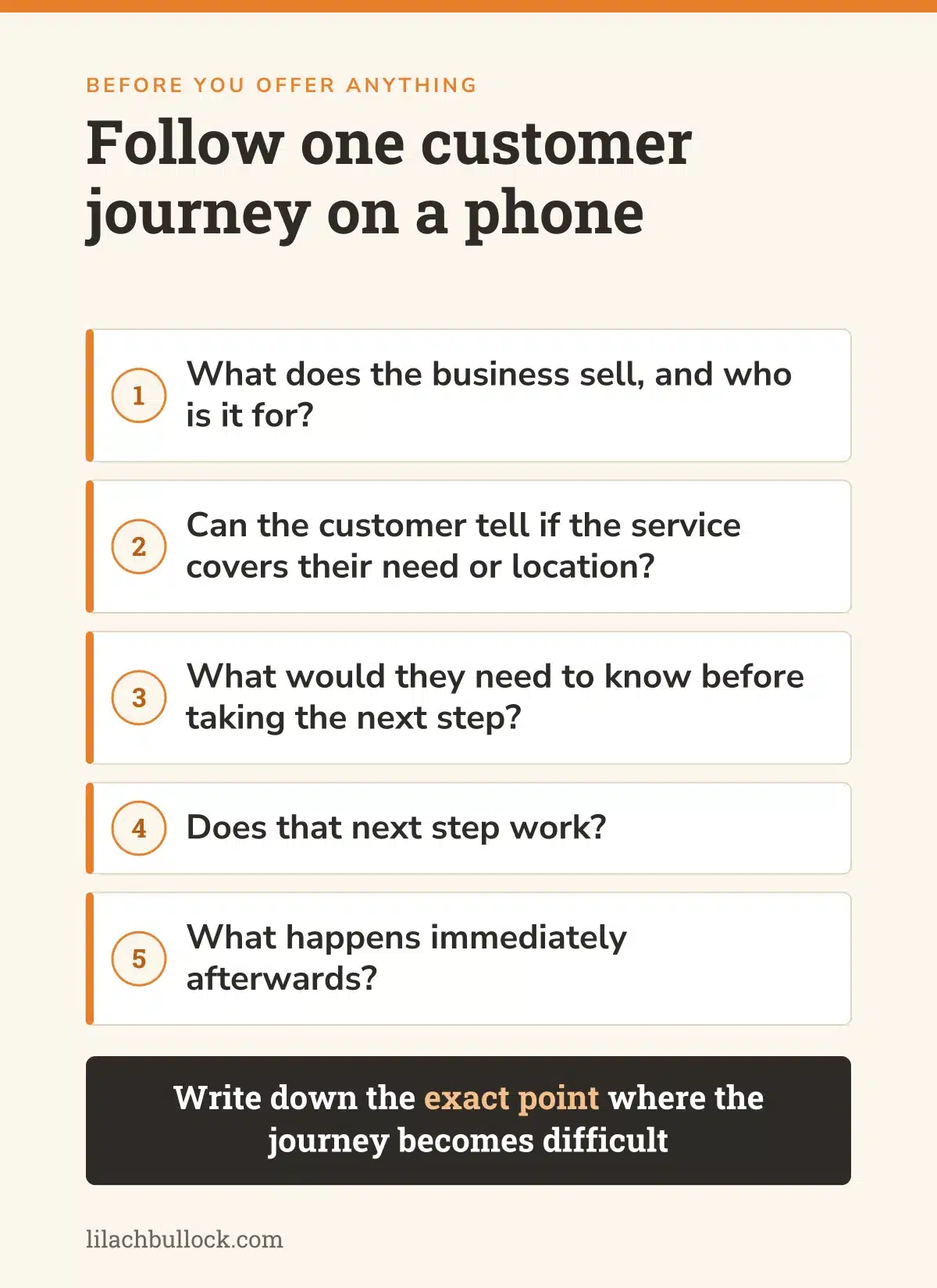
Write down the exact point where the journey becomes difficult. "The booking page returns an error" is evidence. "You're losing thousands every month" is a claim you can't support without their records.
If you're checking a form, don't submit a pretend sales enquiry. Ask the owner to authorise a labelled test when there's an agreed reason to do it.
Bring one relevant observation
A useful observation gives the owner something specific to assess. It doesn't bury them under a list of everything your software thinks is wrong.
For example: "Your new service appears on Instagram, but I couldn't find it on the website or book it through the current booking link."
That leaves room for an answer. Perhaps the service isn't ready. Perhaps they're deliberately handling it by phone. Perhaps you've found the problem they keep meaning to fix.
You won't know until you listen.
AI can help organise your observations. It mustn't turn them into invented revenue losses or a personalisation script that pretends you know the business better than you do. My guide to checking AI business advice explains why a confident answer still needs checking against the situation in front of you.
What should your offer include?
Your offer should name the business job, the deliverable and the boundary. The owner needs to understand what they'll receive and what happens after delivery.
"A five-page website" describes quantity. It says little about usefulness.
Compare that with an illustrative scope for a local service business: a mobile website that explains three services, shows the service area, answers booking questions and sends enquiries to the agreed inbox. It includes testing the enquiry route and handing over ownership. Photography, paid advertising and ongoing content are separate.
Now both sides can see the job.
| Part of the offer | What needs to be clear |
|---|---|
| Purpose | The customer action or admin problem the site will address |
| Content | Which pages, services and existing materials are included |
| Connections | Forms, booking, payment or other agreed systems |
| Ownership | Who controls the domain, hosting and accounts |
| Testing | What must work before the owner accepts delivery |
| Support | What is covered afterwards and how further work is agreed |
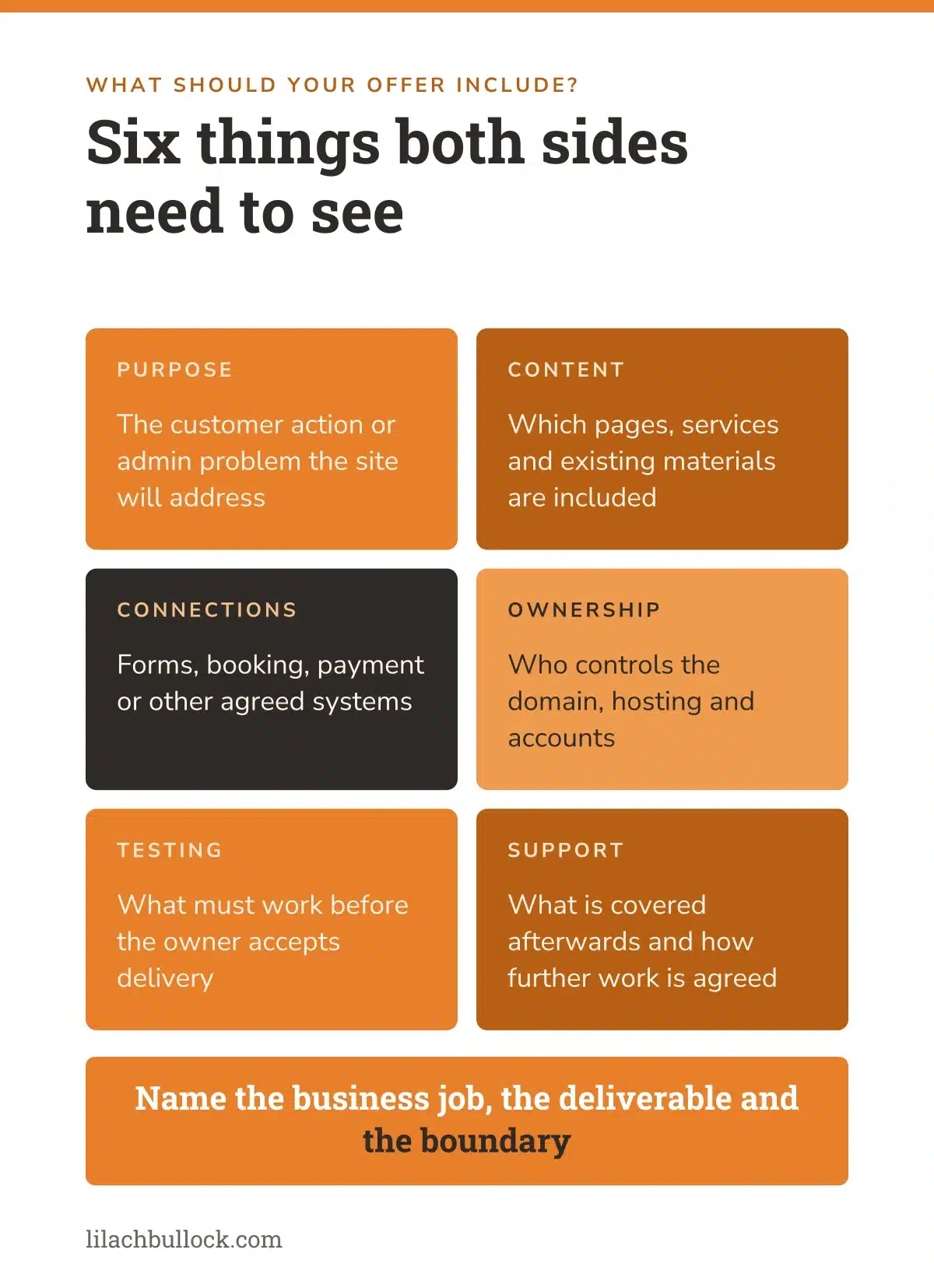
You can package that service without promising unlimited changes forever. You can also explain AI's role without making speed the entire sales argument.
If you're designing a repeatable offer, read how to productise a service with AI. The useful question is what the customer receives consistently, rather than how many prompts you can fit into an afternoon.
Don't promise a result the website can't control
A working enquiry form is something you can deliver and test. A guaranteed number of new customers depends on demand, traffic, the offer, response times and more.
Want AI doing the heavy lifting in your marketing?
I build the systems that handle the boring 80 percent, so you get your week back. Done properly, with the human kept in.
You can agree how the business will measure enquiries. You can improve the route to them. You can discuss assumptions openly.
You can't make a responsible sales promise by taking the time needed to generate a homepage and multiplying it by an imagined price.
What does AI speed up, and what still needs checking?
AI can help with page structures, code, content drafts, variations and routine checks. Someone still has to decide whether the output is correct for this business.
A polished service page can contain a service the owner doesn't provide. A generated testimonial can look convincing while being entirely invented. A contact form can display a success message while delivering nothing.
These aren't cosmetic details. They're the difference between a demonstration and something a customer can rely on.
Use approved source material for factual content. Check business names, locations, services, credentials, prices and promises against that material. Keep anything uncertain out of the public page until it's resolved.
For the customer journey, write simple acceptance checks. "An enquiry arrives at the agreed address with the selected service and contact details" is a check. "The site looks professional" is a preference, and preferences need a different conversation.
Test the awkward version
Try a long name. Leave a required field empty. Open the page on a narrow screen. Check the confirmation email and the destination inbox. Follow the booking link when no appointments are available.
The easy path will often look fine. The awkward path is where the owner starts doing unpaid troubleshooting on your behalf.
You don't need to buy another subscription to make these checks. A short written test list and access to the agreed destination are a useful beginning. Choose tools around the job, as I explain in my AI marketing tools guide.
What belongs in the handover?
A handover should leave the owner able to use the website and get help without depending on information that exists only in your head.
Give them a clear account of what they own, where it runs, how enquiries arrive and how to request changes. Keep passwords out of casual documents and use the agreed secure access method.
Make recurring charges explicit before the work begins. Hosting, domains, email delivery, integrations and maintenance can continue after the build. AI generating the first version doesn't make those responsibilities disappear.
Also agree what happens if the owner stops working with you. Can the site be moved? Can the data be exported? Who transfers access? Which parts depend on a particular service?
You don't have to turn the handover into a technical textbook. The owner should be able to answer a few ordinary questions: where do the enquiries go, who fixes a problem, what am I paying for, and what happens if I leave?
Those answers are part of the service they bought.
How do you judge whether this is becoming a business?
Look beyond the number of sites you can generate. Track the work from first relevant conversation to accepted delivery.
For each opportunity, record the problem discussed, whether a proposal was appropriate, whether the customer bought, and the total time spent selling and delivering. Include revisions, testing and support. They're part of the job even if they don't look exciting on a time-lapse.
If you get interest but no sales, examine the offer and the buyer's priority. If you sell but lose money delivering, examine scope and the work you omitted from your estimate. If delivery goes smoothly but support never ends, examine the handover and support agreement.
You don't need to conclude that the entire market is broken because one owner doesn't want a website. Nor should you conclude you've found a business because one generated page looks impressive.
Get specific about what happened. That gives you something to improve.
Questions about selling AI websites
Can I sell a website that AI helped me build?
You can offer a service that uses AI, subject to the terms of the tools, assets and services involved. Check those terms and any requirements that apply to your work. Your responsibility to the customer still includes delivering the agreed result, using permitted material and explaining ownership and ongoing costs.
Do I need to learn anything technical?
You need enough understanding to check and support what you sell, or a delivery partner who can. Being able to generate a page doesn't establish that you can handle its forms, security, access or failures. Start with a scope you can deliver responsibly rather than discovering the limits after taking payment.
Should I build a complete site before speaking to a buyer?
A small illustrative concept can help explain an idea, but a full speculative build can solve the wrong problem. Start by checking whether the business needs the improvement and what success would mean. Don't publish a speculative site under its identity or imply an existing client relationship.
Is faster production a reason to charge less?
Speed alone doesn't determine the value or cost of the service. Consider the agreed outcome, selling time, testing, revisions, support and responsibility. Define the offer clearly and assess its economics. A short generation step doesn't represent the whole delivery cost.
The bit worth selling
I'd be pleased to see more small businesses get websites they can use. Better tools make that easier. They also make it easier to produce something attractive before anybody has thought about what happens next.
That's where you can do valuable work.
Understand the customer action. Build around it. Test it. Leave the owner with something they can operate and a clear agreement about support.
The website appearing on screen is a good moment. The owner understanding what they've bought, and seeing it work, is a better one.
For more practical ways to use AI in a business, join my newsletter. If you want help connecting your marketing, enquiries and delivery into a system you can run, here's how to work with me.