- What are LinkedIn Advice Sessions?
- What would someone be paying to leave with?
- How do you describe the offer clearly?
- Why would a stranger trust you with that decision?
- Should you put every useful conversation behind a payment button?
- How will you know whether the feature helps?
- What can you do if hosting isn't available to you?
- Questions about LinkedIn Advice Sessions
- A better reason to press the button
In this blog post I'm going to explain LinkedIn Advice Sessions, who can use them, and what your offer needs before a stranger is likely to pay for your expertise. You'll leave with a way to assess a paid session, write a clearer description and judge whether it brings worthwhile business.
LinkedIn is giving experts another way to get paid.
Lovely. A button.
Unfortunately, the button doesn't tell a potential customer why they should want an hour with you. It doesn't decide what you'll cover. It doesn't turn a vague invitation to talk into something worth buying.
And some early users are already describing that gap.
If you sell advice, consulting or another expert service, this is worth understanding. Even if the feature isn't available to you, the buying problem will be familiar.
The short answer: LinkedIn Advice Sessions lets eligible verified experts offer paid consultations through LinkedIn. As announced in October 2026, hosting is available in the US, with wider access planned. The feature helps organise the transaction. Your offer still needs a specific buyer, a useful outcome, clear boundaries and a reason to trust you.
What are LinkedIn Advice Sessions?
LinkedIn Advice Sessions is a way for eligible experts to offer consultations from their profiles, with booking, payment and video calls handled within LinkedIn's offering.
LinkedIn's 15 October 2026 announcement describes access through Premium Business and Premium All-In-One. A related announcement from Ora Levit says hosts must be verified and that hosting is available in the US, with global access to follow.
Don't assume every Premium account can host a session. Check the current options in your own account before planning around it.
The same product announcement includes other earning and creator features. Those have different access rules. In-stream ads are an early test, and Creator Marketplace is invite-only. They aren't interchangeable routes to income.
For this article, I'm interested in the simplest question: if someone sees a way to pay you for advice, what makes them want to do it?
The early feedback is more useful than the launch excitement
Under Ora Levit's announcement, beta user Kevin D. Turner reports that people had missed the session button or hadn't understood it represented a paid opportunity. Beth Granger describes using sessions to serve people whose needs were smaller than her usual programmes, rather than relying on discovery through the feature.
Those are individual experiences. They don't establish the feature's overall performance. But they raise a useful question about what happens between seeing your profile and deciding to buy.
That's the part you can work on.
What would someone be paying to leave with?
A paid session needs a useful endpoint. The buyer should be able to picture what they'll understand, decide or have in their hands afterwards.
"Book an hour with me" sells your availability. "Ask me anything" makes the buyer work out the agenda, the value and whether you're the right person.
Try completing this sentence instead: "This session helps [specific buyer] make [specific decision] using [relevant material], so they can [next useful action]."
That isn't your final sales copy. It's a check on whether you have an offer.
For an illustrative example, imagine a business owner choosing between two email platforms. A useful session might help them compare their requirements, identify migration risks and leave with a written decision. A vague "email marketing chat" promises very little while inviting almost anything.
The narrower session can still require considerable expertise. Specificity makes that expertise easier to buy.
Pick a decision you can responsibly help with
Some questions need more than a conversation. A complex technical audit, regulated advice or a decision requiring extensive research may not fit a short session.
Don't squeeze the work into a slot because the platform has made the slot easy to sell.
Choose something you can assess with the information available. Name the preparation required, what you'll review, and what remains outside the session. If a buyer needs implementation afterwards, make that a separate, clearly described service.
My guide to productising a service with AI explores how to make the deliverable consistent without treating every customer's situation as identical.
How do you describe the offer clearly?
Write the offer around the customer's decision, then explain the scope in ordinary language.
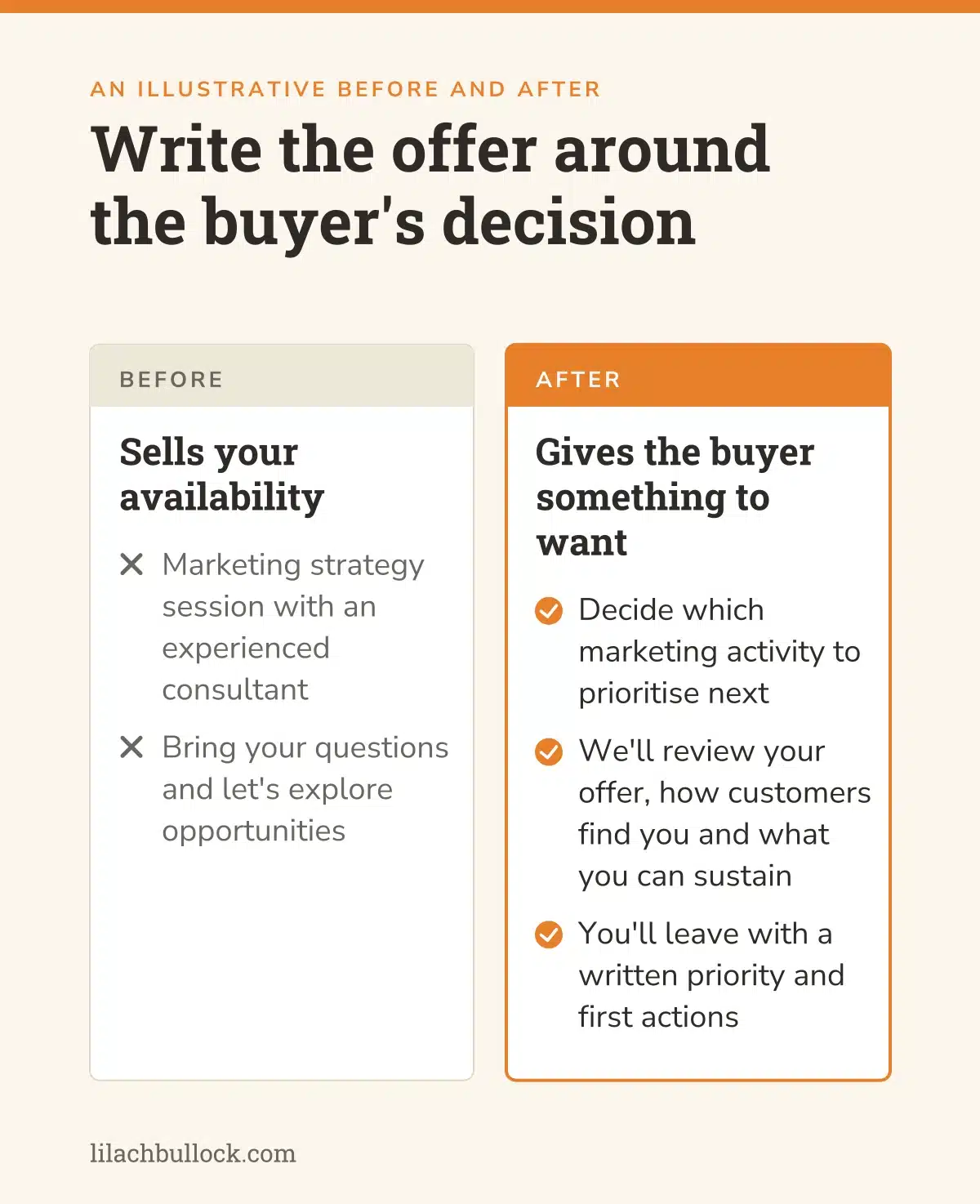
Here's an illustrative before and after.
Before: "Marketing strategy session with an experienced consultant. Bring your questions and let's explore opportunities."
After: "Decide which marketing activity to prioritise next. We'll review your current offer, how customers find you and the activity you can sustain. You'll leave with a written priority and the first actions to put it into practice."
The second version still needs details about length, preparation, price and boundaries. But it gives the buyer something to want.
It also helps them recognise when it isn't the right service. Someone who needs a campaign built has a different need from someone deciding what to build.
Answer the practical questions before they become messages
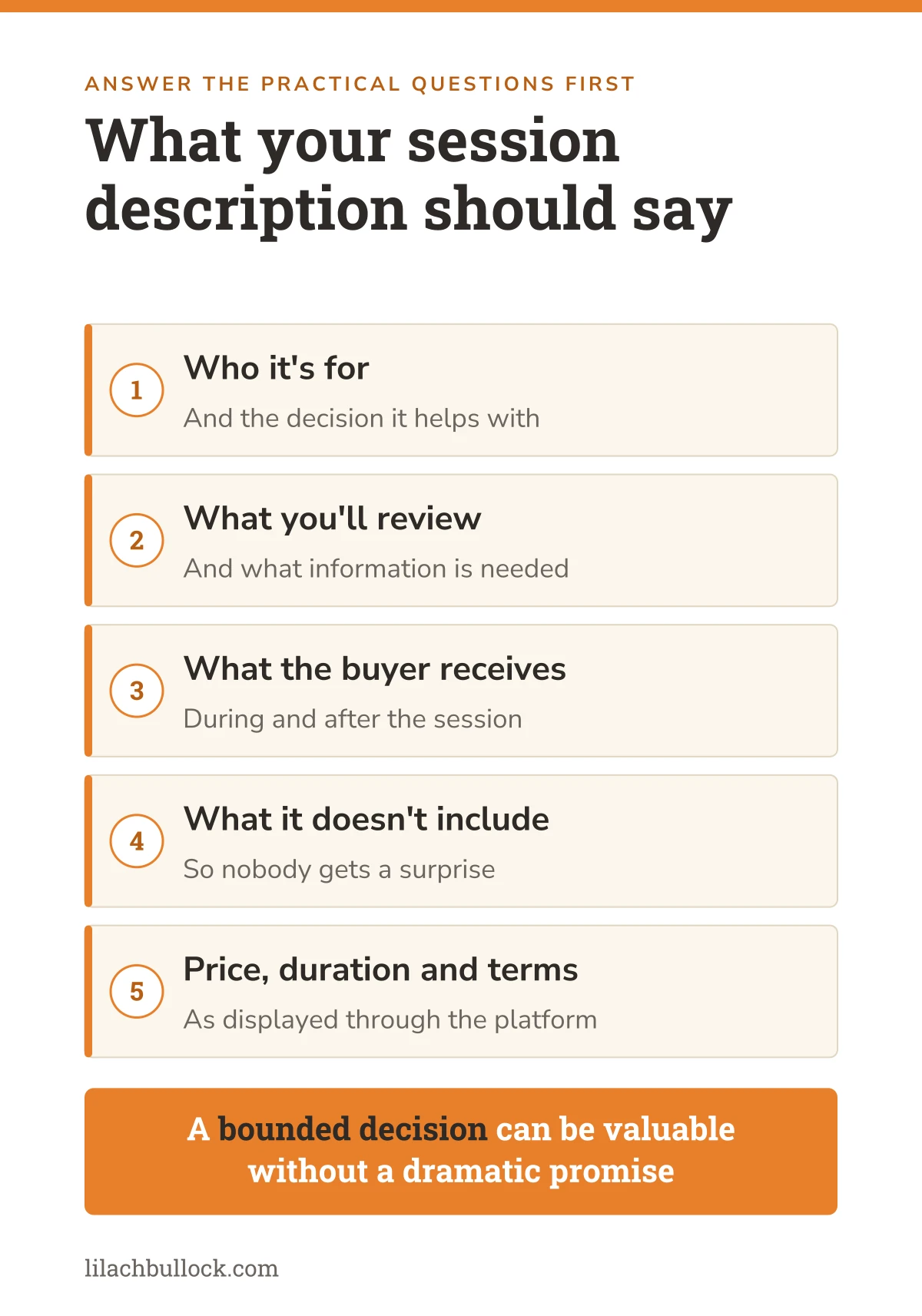
Your description should make these points clear:
- Who the session is for and the decision it helps with.
- What you'll review and what information is needed.
- What the buyer receives during and after the session.
- What the session doesn't include.
- The price, duration and booking terms displayed through the platform.
Be especially clear about any written follow-up. "You'll leave with a plan" could mean a detailed document, a short note or whatever the buyer manages to write down. Agree what it means before they pay.
There's no need for a dramatic promise. A bounded decision can be valuable without claiming it will transform the entire business before the call ends.
Why would a stranger trust you with that decision?
They need evidence that matches the problem they're paying you to address.
Want AI doing the heavy lifting in your marketing?
I build the systems that handle the boring 80 percent, so you get your week back. Done properly, with the human kept in.
A long biography may establish experience while leaving the relevant question unanswered. What have you done that helps this buyer decide whether you're suitable for this job?
Use a relevant, permissioned example. Explain the kind of problem you worked on and the judgement involved. If you have a suitable customer testimonial, preserve its wording and context. If you use a result, make sure the evidence supports it.
You can also show a clearly labelled sample deliverable. A blank decision template or an illustrative completed example helps the buyer understand the output. Keep it separate from any suggestion that a fictional client achieved fictional results.
Make your content lead somewhere recognisable
Suppose you want to sell a session helping an owner choose a marketing priority. Your posts can show how you think about that decision: the trade-offs, the information that changes the answer, and the mistakes that make a plan impossible to maintain.
Then the paid offer is a natural next step for a reader who wants that judgement applied to their situation.
That doesn't mean every post needs a pitch. It means your expertise and your offer should belong to the same conversation.
If you're using AI to help shape that content, check the advice it gives you before accepting a positioning statement that could describe almost anyone with a laptop.
Should you put every useful conversation behind a payment button?
You need a clear boundary between talking about a service and delivering it.
An enquiry about whether your service fits isn't necessarily the service itself. A scoped consultation that applies your expertise to a customer's decision can be.
Make that distinction visible in the offer. Otherwise the customer may expect the paid session to be an introductory sales call, while you expect to deliver paid advice. Neither side enjoys that surprise.
For a service business, paid advisory work can also sit alongside implementation. The customer might need a decision first, delivery first, or both. Explain the route that fits the work rather than forcing everyone through the same small purchase.
You don't have to create a new low-cost offer to use a new platform feature. Start with what you want to sell and what you can deliver well.
Include your preparation and follow-up time
A session's cost is larger than the time spent on camera. Include preparation, review, notes, administration and any promised follow-up when assessing whether the offer works for you.
Also account for what happens when a buyer arrives without the required information or asks for a different job. Have a process for rescheduling, declining unsuitable work or agreeing additional scope under the applicable terms.
Clear boundaries protect the customer as well as your diary. They make the purchase less ambiguous.
How will you know whether the feature helps?
Track the path from interest to paid work. Profile activity alone can't tell you whether the offer is producing suitable customers.
Record how buyers found the session, which description they saw, whether they booked, whether the work matched the scope and how much time delivery required. Ask for feedback about the usefulness of the outcome, rather than only whether the call felt pleasant.
If nobody notices the offer, examine visibility. If people view it but don't buy, examine the match between buyer, promise and price. If people buy but arrive expecting something else, examine the description.
Change one thing you can learn from. Rewriting the offer, moving its location and changing the deliverable together makes it difficult to understand what happened.
A tiny number of visits won't support a sweeping conclusion. Keep the numbers alongside the percentages and resist announcing that a feature is brilliant or useless after a handful of views.
What can you do if hosting isn't available to you?
You can still improve the offer and the path to your existing paid service. You don't need to wait for a rollout to describe your work clearly.
Use your existing enquiry and payment process. Make the outcome, suitability and next step easy to understand. Keep your contact and customer records in the systems you already use.
There's no reason to add another subscription just to feel ready. My AI marketing tools guide starts with the job a tool needs to do. The same thinking applies here.
LinkedIn can become one place people discover or buy your work. Your offer should still make sense when you explain it somewhere else.
Questions about LinkedIn Advice Sessions
Can everyone sell Advice Sessions on LinkedIn?
No. The October 2026 announcements describe verified experts, relevant Premium access and availability for US hosts, with broader access planned. Check the current eligibility and terms in your account. Other creator products in the announcement have separate access rules.
Will LinkedIn find customers for me?
The product gives eligible hosts a route to offer and manage sessions. That doesn't establish that it will generate bookings for your particular service. You still need a relevant audience, a clear offer and a useful outcome. Track your own results rather than treating availability as demand.
Do I need to become an influencer first?
The article doesn't establish a follower threshold for Advice Sessions. Your commercial question is whether suitable buyers can find and trust the offer. A relevant professional audience can be more useful to a specialist service than broad attention that has little connection to the decision you help with.
Should I promise a written plan?
Only if you're prepared to deliver one within the agreed scope. State what it contains, when it arrives and whether it includes follow-up. A concise, useful decision note can be better than an elaborate document that neither side expected. The promise needs to match the work.
A better reason to press the button
I like the idea of making expertise easier to buy. There's value in removing awkward booking and payment steps.
But a customer needs to understand the purchase before the convenience matters. They need to recognise their problem, see why you're equipped to help and know what happens after they pay.
Write that down first. Then decide where to sell it.
If you'd like more practical marketing ideas, join my newsletter. If your business needs a clearer offer and marketing that supports it, here's how I work with clients.