- What does the new TikTok Shop research say?
- Does the buying page match the video?
- Which customer reviews help a buyer decide?
- How do you collect useful reviews without scripting the answer?
- What should you do with a critical review?
- How do you know whether the campaign produces sales?
- What can a service business borrow from this?
- Questions about reviews and creator campaigns
- Make the introduction worth paying for
In this blog post I'm going to show you how customer reviews can support the sale after a creator has brought someone to your product. You'll learn how to connect the video with the buying page, identify unanswered questions and measure the journey without pretending every view represents a customer.
Someone watches a creator use your product. They like what they see. They tap through.
You've paid for the introduction. Now they're looking at a product page with a beautiful description, three vague reviews and no answer to the question they came with.
Will it work for someone like me?
That's a different job from making them stop scrolling. It's also a job your campaign needs to do.
Fresh TikTok Shop research makes the distinction useful to examine. Creators can introduce a product while ordinary customers provide the reassurance a buyer wants before paying.
The short answer: Match the creator's promise with the product page, then use relevant customer reviews, clear product information and purchase details to answer the buyer's doubts. Track the journey from visit to order. Reviews can help someone assess a purchase, but a survey about trust isn't proof of a conversion lift for your business.
What does the new TikTok Shop research say?
Bazaarvoice's 13 October 2026 release reports that 96% of TikTok Shop buyers surveyed said verified customer reviews made them more likely to purchase. It also reports that 68% were more likely to trust an everyday consumer than an influencer they follow.
The survey covered more than 1,600 adult TikTok users in the US and UK in September 2026. Bazaarvoice sells review-related services, so keep the source's commercial interest in view.
The figures describe reported attitudes. They don't mean 96% of people who read a review buy something, and they don't establish how much adding reviews will improve your sales.
What they do give us is a sensible question to ask about a creator campaign: after you've generated interest, have you provided enough useful information for someone to decide?
Interest and reassurance can come from different people
A creator can demonstrate the product, make its use easy to understand and introduce it to an audience. A customer review can describe what living with it was like afterwards.
Those experiences aren't interchangeable.
A video might show how a bag looks when packed for a journey. A customer might explain whether it fitted under their particular seat, how the zip held up or what they struggled to carry. Those details help the next buyer assess fit.
You still need to check factual product information. A review is one person's experience, rather than permission to make a universal claim.
Does the buying page match the video?
The page should continue the promise that earned the visit. If the creator shows one product or use, the destination should make that item and its relevant details easy to find.
Before a campaign runs, open the destination on your phone. Imagine arriving without any knowledge of the brand beyond the video.
Can you identify the product? Is the version shown available? Can you understand the price, size, contents and delivery information? If the video mentions a particular offer, does the page explain the same offer?
A generic homepage can make the visitor restart the search. A product page can still create confusion if it defaults to a different size or leaves out the accessory shown in the demonstration.
You don't need an elaborate redesign to fix a mismatch. You need the correct destination and enough information to help the buyer continue.
Make a promise-to-page check
Write down the video's central claim and find its support on the page.
| What the video creates interest in | What the destination needs |
|---|---|
| A particular product or version | The same item and clearly labelled options |
| A specific use | Accurate details about suitability and limits |
| A result or benefit | Supported explanation and relevant customer experience |
| A bundle | Exactly what is included and what costs extra |
| An offer | Matching terms, price and availability |
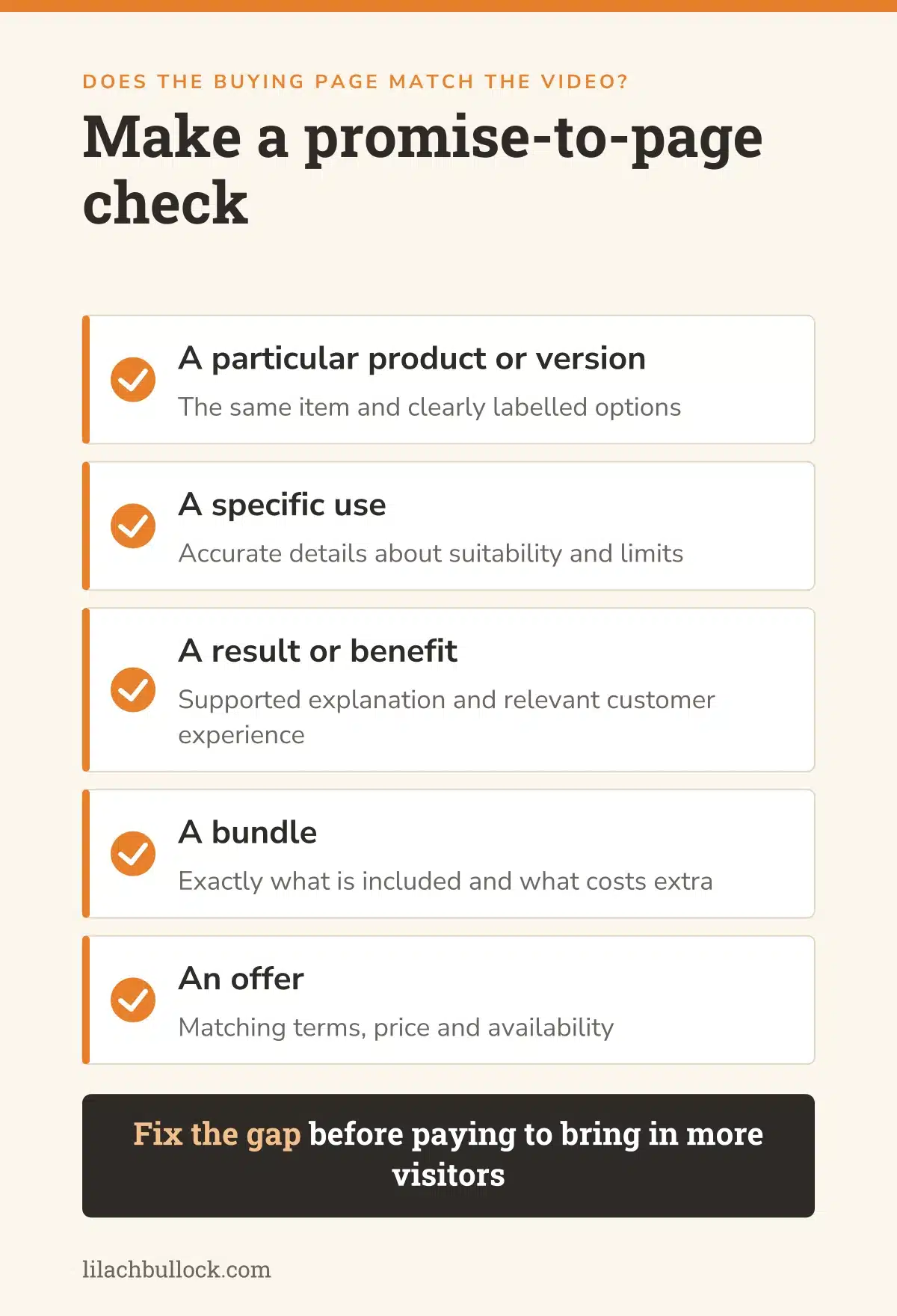
If the support is missing, fix the campaign or the page before paying to bring more visitors into the gap.
That same thinking applies when you package a service. The introduction and the thing someone can buy need to describe the same job.
Which customer reviews help a buyer decide?
The most useful review is one that addresses something the buyer needs to know. A high rating with "Love it!" can convey satisfaction while leaving the purchase question unanswered.
Look for detail about use, suitability, expectations and limitations. For an illustrative example, a desk chair buyer may want to know about assembly, adjustability and comfort during the kind of work they do. A photograph of the chair in a room answers a different question from a comment about using it for several weeks.
Build a list of the uncertainties that come up in customer questions. Group them by product or use, then assess whether the buying page addresses them through accurate specifications, customer experience or a helpful explanation.
Don't ask reviews to do the work of product information
If customers repeatedly ask whether an item fits a particular model, publish accurate compatibility information. Don't leave them to assemble an answer from comments that may refer to different versions.
Likewise, shipping dates, return terms, included parts and material details should be clear in the product information. Reviews can add experience. They shouldn't be the only place the buyer can find essential facts.
When you're uncertain about what a review establishes, preserve the distinction. "This customer found it comfortable" is different from "It will be comfortable for everyone."
That care is part of good marketing. It keeps the promise connected to what you're selling.
How do you collect useful reviews without scripting the answer?
Ask customers for an honest account of their experience, using a consistent process that fits the platform's rules. Give them room to describe what helped and what didn't.
You can make the request easier to answer with neutral questions: what did you use the product for, what did you need to know before buying, and what would you tell someone considering it?
Don't write the praise for them. Don't label a review verified unless the relevant platform or process supports that label. Check current platform and local requirements before offering any review incentive; some prohibit or restrict them.
Want AI doing the heavy lifting in your marketing?
I build the systems that handle the boring 80 percent, so you get your week back. Done properly, with the human kept in.
If you want to reuse a review or customer photograph outside its original setting, check permission and the applicable terms. The fact that something is visible doesn't settle every reuse question.
Leave the customer's meaning intact
An edit that fixes a typo is different from removing the qualification that made the review honest. "Useful for short journeys, but too small for my weekly shop" isn't the same endorsement after you've deleted everything after the comma.
Keep the product version and relevant context attached. A strong review of the old version may not answer questions about the new one.
AI can help group themes and find recurring questions. It shouldn't generate customer experiences or fill missing reviews with plausible stories. The same need to check AI-generated advice applies when the output looks convenient enough to publish immediately.
What should you do with a critical review?
Use it to understand the customer's experience and determine whether there's a product, expectation or service problem to address.
Some criticism identifies a mismatch. Perhaps a product is too large for a particular use. Clearer information could help the next buyer decide before ordering.
Other criticism identifies a fault or failure. A recurring broken part isn't solved by moving the review lower on the page. Fix the problem, explain the remedy where appropriate and let customer service follow its process.
Avoid turning an individual response into a public argument. Answer the point accurately, protect personal information and give a useful route to resolution.
Repeated objections belong in the campaign brief
Suppose customers keep misunderstanding how much assembly a product needs. Your next creator brief should address the setup honestly. Showing the step may make the demonstration more useful than another polished reveal.
The review process then improves the next campaign as well as the current page.
You don't need to make the creator deliver a list of disclaimers. Give them accurate information about the product, its intended use and the questions customers are asking. Let them show the experience within the agreed brief.
How do you know whether the campaign produces sales?
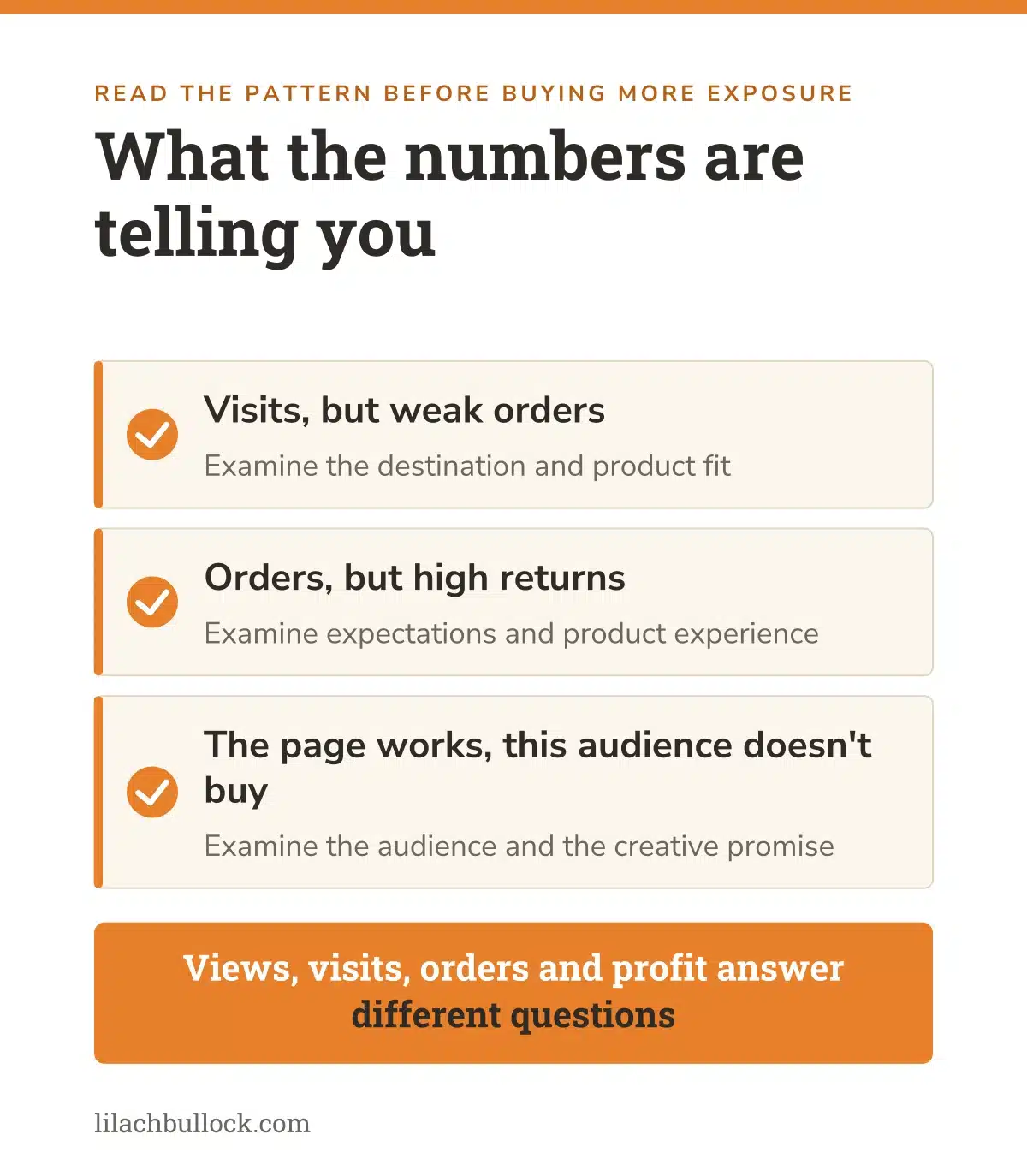
Track the stages separately and keep the measurement method visible. Views, visits, orders and profit answer different questions.
Use the tracking options supported by your selling platform and campaign agreement. Keep creator, destination and offer records consistent so you can compare like with like.
Start with actual counts. How many visits reached the buying page? How many orders followed under the chosen attribution method? What were the campaign costs, product costs, refunds and returns?
A platform's attributed sales are useful within its stated method. They aren't automatically a complete account of every sale caused by the campaign. A customer may watch on one device and buy later through another route.
Read the pattern before buying more exposure
If the content attracts visits but orders are weak, examine the destination and product fit. Check availability, price clarity, delivery information and whether the product shown matches what people can buy.
If orders arrive but returns are high, examine expectations and product experience. A campaign can persuade someone to buy the wrong item very efficiently.
If the page works for other visitors but this audience doesn't buy, examine the audience and the creative promise. More exposure to the same mismatch may reproduce the problem.
You can use AI to organise these observations or summarise a consistent report. Choose it around the questions you need answered, rather than collecting another dashboard. My guide to AI marketing tools takes that approach.
What can a service business borrow from this?
A service buyer also needs reassurance after an introduction, though a testimonial won't work exactly like a product review on TikTok Shop.
Translate the principle with care. Show a relevant example of the work, explain the scope and describe what the customer receives. Use permissioned testimonials that address the kind of decision the buyer is making.
For an illustrative website service, "Great to work with" conveys warmth. A specific account of what was delivered and how the handover worked can answer additional questions about reliability.
Don't turn that into an invented customer story. If you don't have a suitable testimonial, use an accurately labelled sample and a clear process. You can demonstrate competence without pretending a fictional customer has already bought it.
Questions about reviews and creator campaigns
Do reviews matter more than influencers?
They can serve different parts of the journey. A creator may introduce the product, while reviews help a buyer assess it. The Bazaarvoice survey gives evidence about reported trust and purchase attitudes among its sample. It doesn't establish a universal ranking for every product, audience or campaign.
Does the 96% figure mean a 96% conversion rate?
No. It describes surveyed TikTok Shop buyers saying verified reviews made them more likely to purchase. It isn't a count of purchases after reading reviews and doesn't measure a conversion increase. Your business needs its own visit, order and cost data.
Can AI write customer reviews for me?
Don't use AI to invent customer experiences. It can help organise authentic feedback or identify repeated questions, with human checking and appropriate data handling. The published review should preserve the customer's meaning, relevant context and any required permission.
Should I remove every negative review?
Follow the platform's moderation rules and distinguish prohibited content from criticism. An unfavourable but valid experience can reveal a product or expectation problem. Address the underlying issue and respond appropriately. A page that hides useful context can leave the next buyer with the same misunderstanding.
Make the introduction worth paying for
A good creator can make somebody curious enough to visit. When they arrive, give them a fair chance to decide.
Show the right product. Answer the questions. Let relevant customer experience help them understand the fit. Then measure what happened with enough care to learn from it.
The campaign doesn't finish when someone taps the link. That's when your product page gets its turn.
For more practical ideas about marketing that leads somewhere useful, join my newsletter. If your business needs help connecting campaigns, buying pages and follow-up, here's how to work with me.