- What business differentiation means in practice
- Start with buying decisions, not your favourite adjectives
- Choose the customer situation before choosing the difference
- Compare the alternatives a buyer would realistically use
- Turn a promising difference into an operating decision
- Build proof that answers the buyer's hesitation
- Write the service page around the decision
- Test understanding, buying response and delivery separately
- What to change when the first version doesn't work
- Questions about differentiating a small business
- Review your differentiation strategy before changing the page
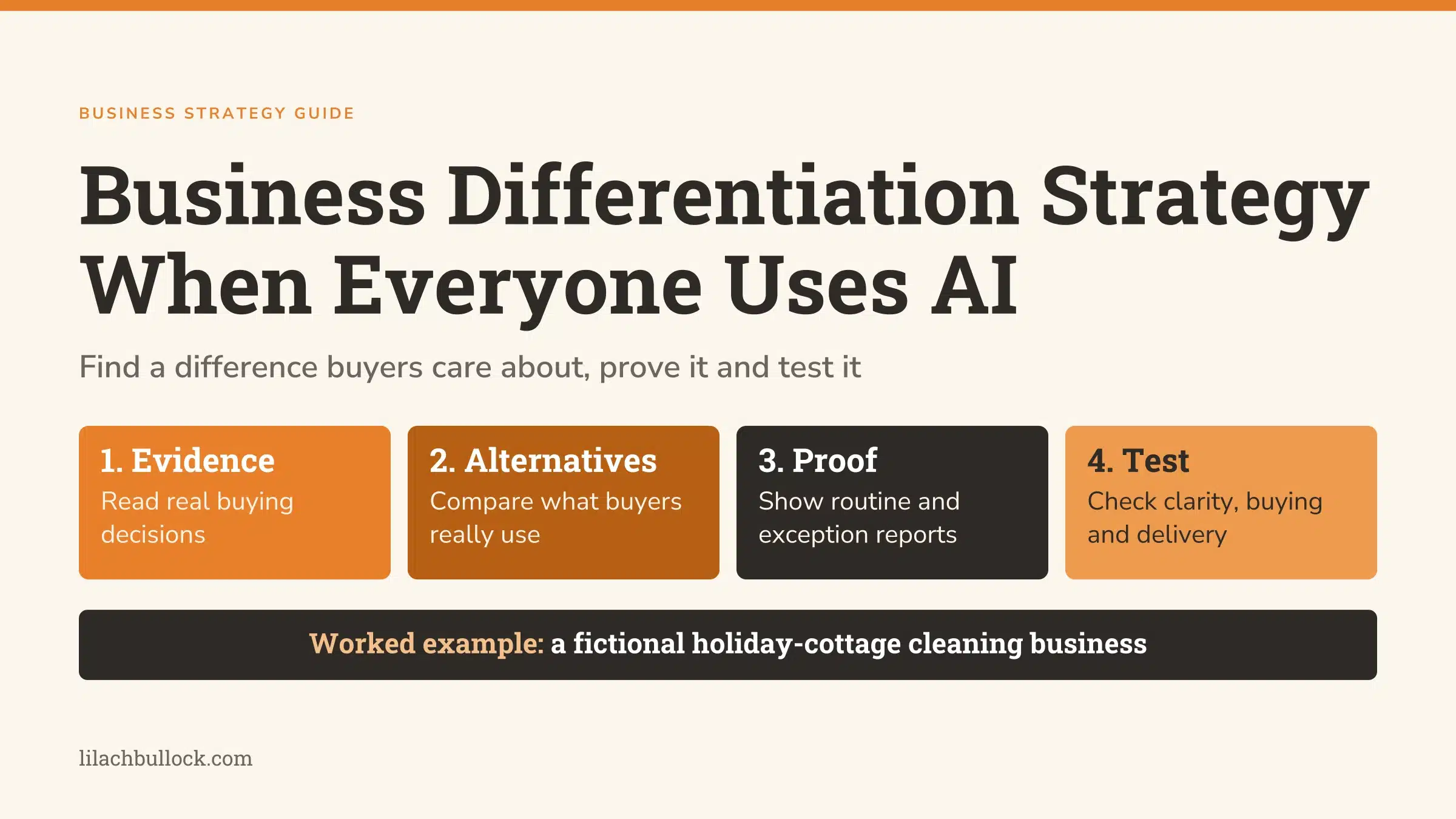
In this blog post, I'll explain how to build a business differentiation strategy when your competitors can use the same AI tools you can. It's for small business owners, consultants and service providers who need a clearer answer to why someone should choose them. You'll learn how to find a difference customers care about, check it against the alternatives, build convincing proof and turn it into a service page you can test. I'll work through a complete example so you can do the same with your own business.
Useful alongside this: Best AI Voice Agents for Small Business (2026): 9 Compared.
AI can help you write a proposal, produce a design or organise a mountain of notes. Your competitor can open an account too. That doesn't make your work worthless. It does mean that owning the tool is a rather flimsy reason to buy from you. The customer still needs to understand what will be better about the job, the experience or the result if they put it in your hands.
I'd start there, before spending a weekend asking a chatbot for a more exciting version of "tailored solutions". There are already enough of those to upholster a conference centre.
What business differentiation means in practice
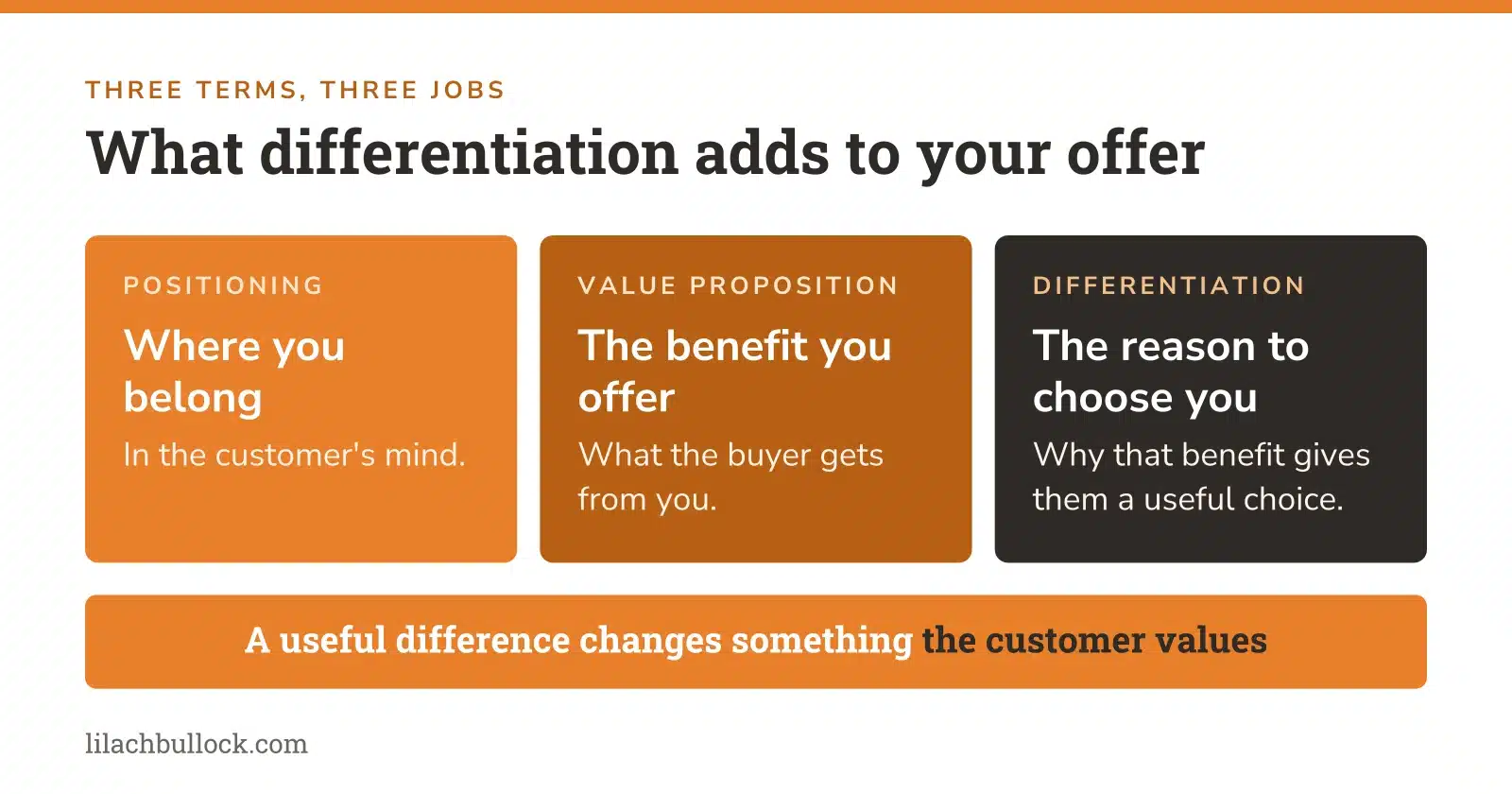
Business differentiation gives a particular buyer a relevant reason to prefer your offer over the alternatives. That reason might be specialist knowledge, a better process, easier handover, more dependable communication or a feature of the service that removes a recurring problem. It needs to be something you can deliver and explain, with evidence that makes the explanation credible.
Your positioning describes where you belong in the customer's mind. Your value proposition states the benefit you're offering. Differentiation is the reason that benefit gives them a useful choice. If you're still untangling the promise itself, my guide to refining your company's value proposition is a useful starting point. Here, we're going further: deciding what deserves to be promised and how a stranger can judge it.
A useful difference changes something the customer values. It could help them make a decision, reduce the work left after delivery, avoid a familiar mistake or know what's happening without chasing. You don't have to prove that nobody on earth offers it. You do have to explain what you offer accurately, and understand whether the buyer can already get the same benefit elsewhere.
Start with buying decisions, not your favourite adjectives
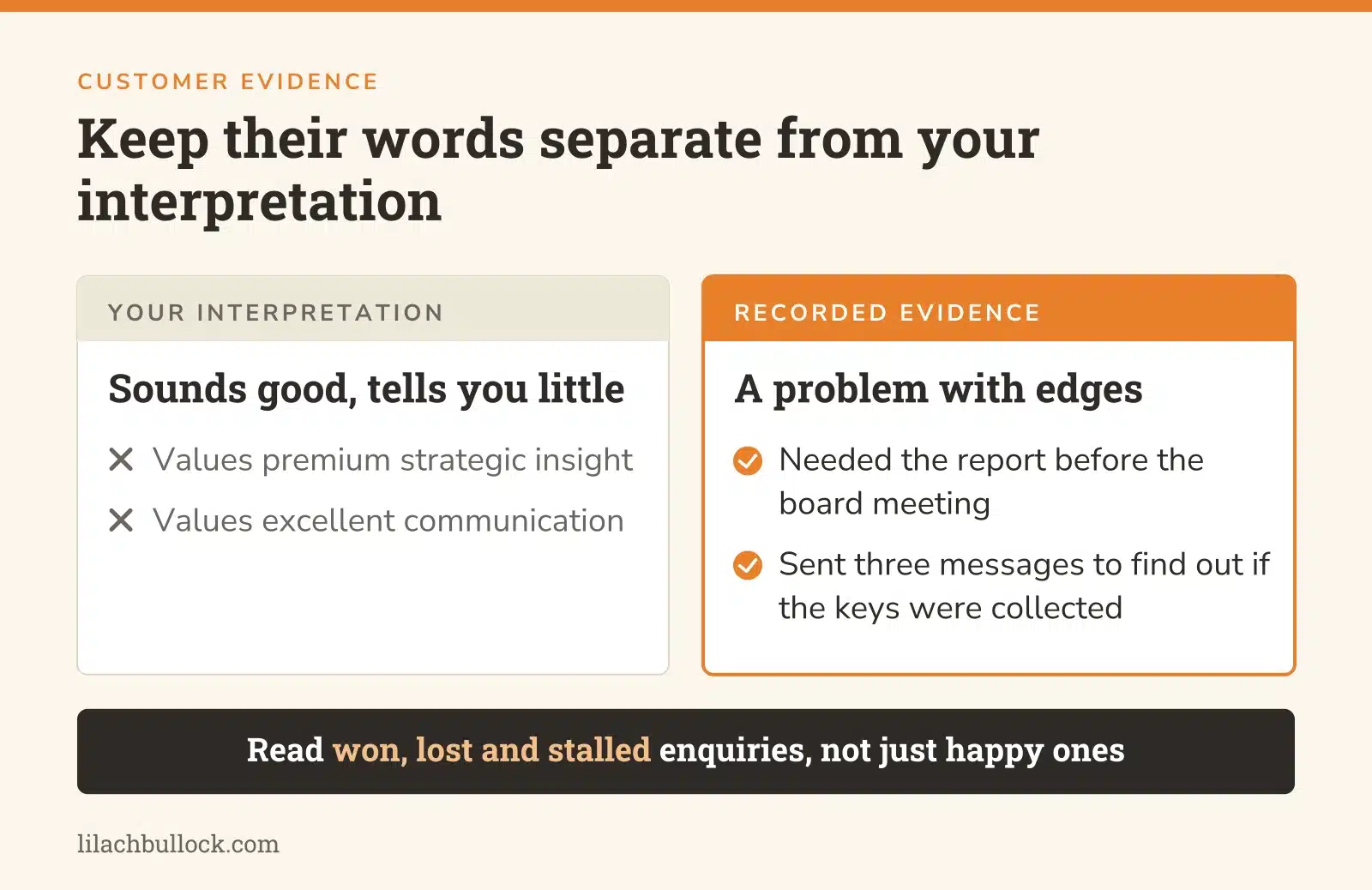
Open recent enquiries, proposals, delivery notes and feedback. Include work you won, work you lost and enquiries that went nowhere. If you only read the happy customers, you'll learn why some people liked you and miss why others never got far enough to find out.
For each buying decision, record the event that created the need, what the person wanted to change, what they worried about, which alternatives they considered and the reason for the decision if they gave one. Keep their recorded words separate from your interpretation. "Needed the report before the board meeting" is evidence of a deadline. "Values premium strategic insight" may be something you added while feeling pleased with the proposal.
The voice-of-customer mining sheet helps organise those fragments. Use it to preserve the words and their context, rather than turning every complaint into a marketing claim. Remove personal or confidential information before putting the records into an AI tool, and check each extracted statement against the original.
When a record is incomplete, a short conversation is more useful than a completed-looking spreadsheet. Ask what was happening when they started looking, what they had tried, what worried them about choosing and what nearly stopped them. My customer interview prompts give you a starting structure. Adapt them to the decision you need to understand; don't make someone sit through a research questionnaire because you downloaded one.
The distinction between a recent event and a general opinion matters. Someone saying they value excellent communication tells you very little about what to build. Someone describing the three messages they sent to find out whether the cleaner had collected the keys gives you a problem with edges.
A worked example: changeover cleaning for holiday cottages
Consider a fictional business, Harbour Clean, which cleans holiday cottages between guests. Everything in this example, including the records and proposed service, is invented to show the process. These are not results from my business or a client.
Harbour Clean's owner reviews six recent buying conversations. The records contain the following concerns:
| Recorded concern in this example | What it might mean | What still needs checking |
|---|---|---|
| Two owners repeatedly chased confirmation that a cottage was ready | Visibility between the clean and guest arrival matters | Was the clean late, or was the update missing? |
| One owner found a missing key only when the next guest arrived | Access checks may be part of a dependable handover | Who held responsibility for the key? |
| One owner wanted the lowest available quote | Price was important in that decision | Were the compared services equivalent? |
| One needed coverage outside the current service area | Availability was the immediate issue | Could the route support that location? |
| One wanted someone who noticed low supplies | An agreed stock check might remove another task | Which supplies, and who replenishes them? |
The tempting conclusion is "owners want peace of mind". It sounds plausible, but you can't build or inspect peace of mind. You can build an agreed readiness check and a completion update. That is a specific response to some of the concerns in these records, while price and coverage remain separate reasons other buyers may choose differently.
Six conversations don't establish market demand. They give the owner a sensible next question: would a dependable handover make enough difference to the owners she can already serve? She can investigate that without redesigning the logo or becoming a national holiday-letting platform.
Choose the customer situation before choosing the difference
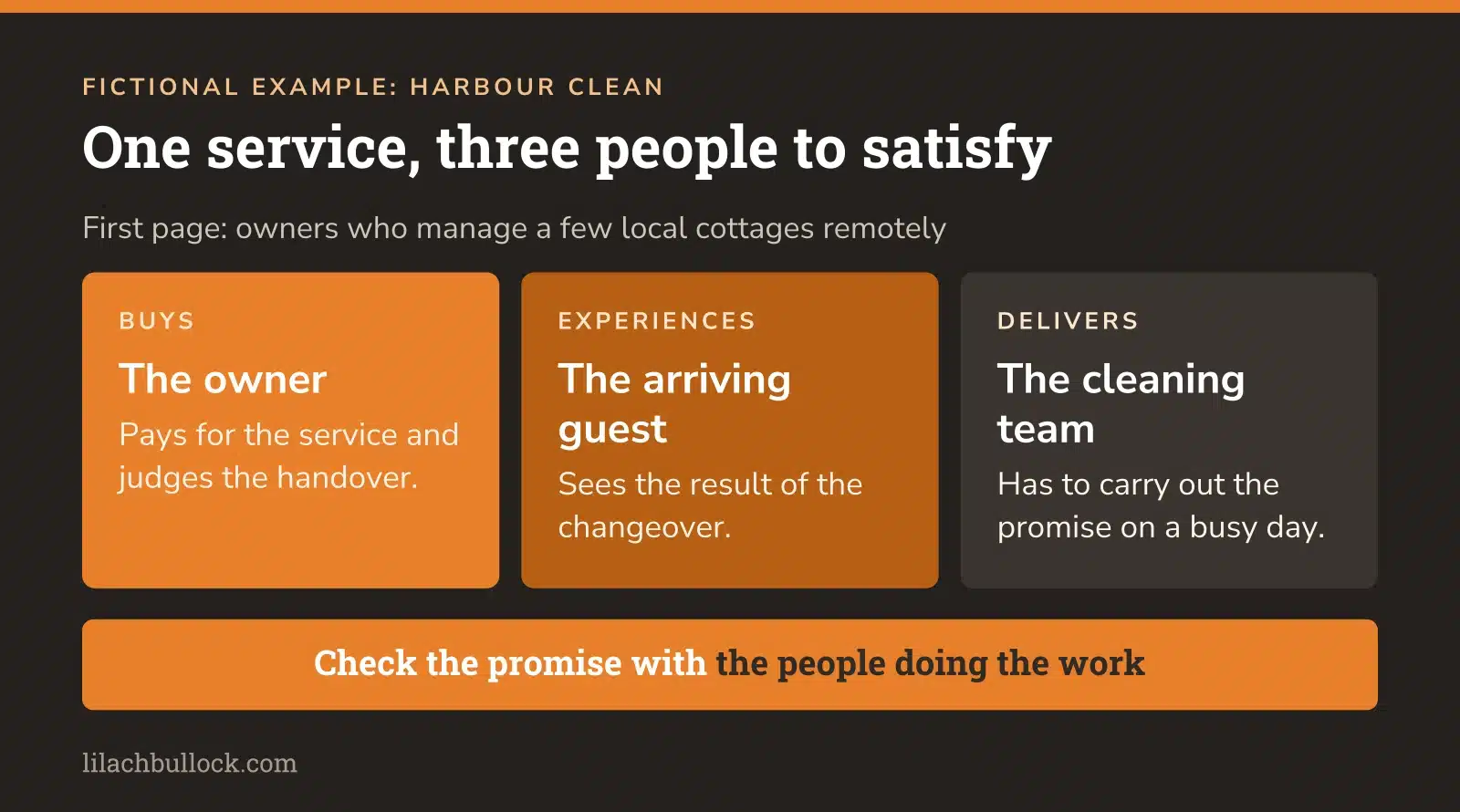
The same cleaning service could serve an owner who lives next door, an owner several hours away or a manager responsible for a group of properties. They may all want a clean cottage, but they don't necessarily need the same support around it. The nearby owner might inspect the property personally. The distant owner needs a reliable way to know whether someone should intervene before guests arrive.
For this first offer, Harbour Clean chooses owners who manage a small number of local cottages remotely. This is a testable buying situation, not a declaration that every other customer is banned. The owner can still take other work; she is giving one service page a clear job.
A buyer persona grounded in buying behaviour is useful here if it describes decisions and constraints. It is less useful if it describes a fictional person's preferred coffee. Use the persona builder to record the buyer's role, situation and trigger. Add who uses the service and who approves the decision to your own notes. Those roles sometimes belong to different people.
For Harbour Clean, the owner buys and the arriving guest experiences the result. The cleaning team has to carry out the promise. A difference that delights the buyer but makes the team's route impossible will eventually disappoint both. Before putting it on a page, speak to the people doing the work and examine what happens on a busy changeover day.
Compare the alternatives a buyer would realistically use
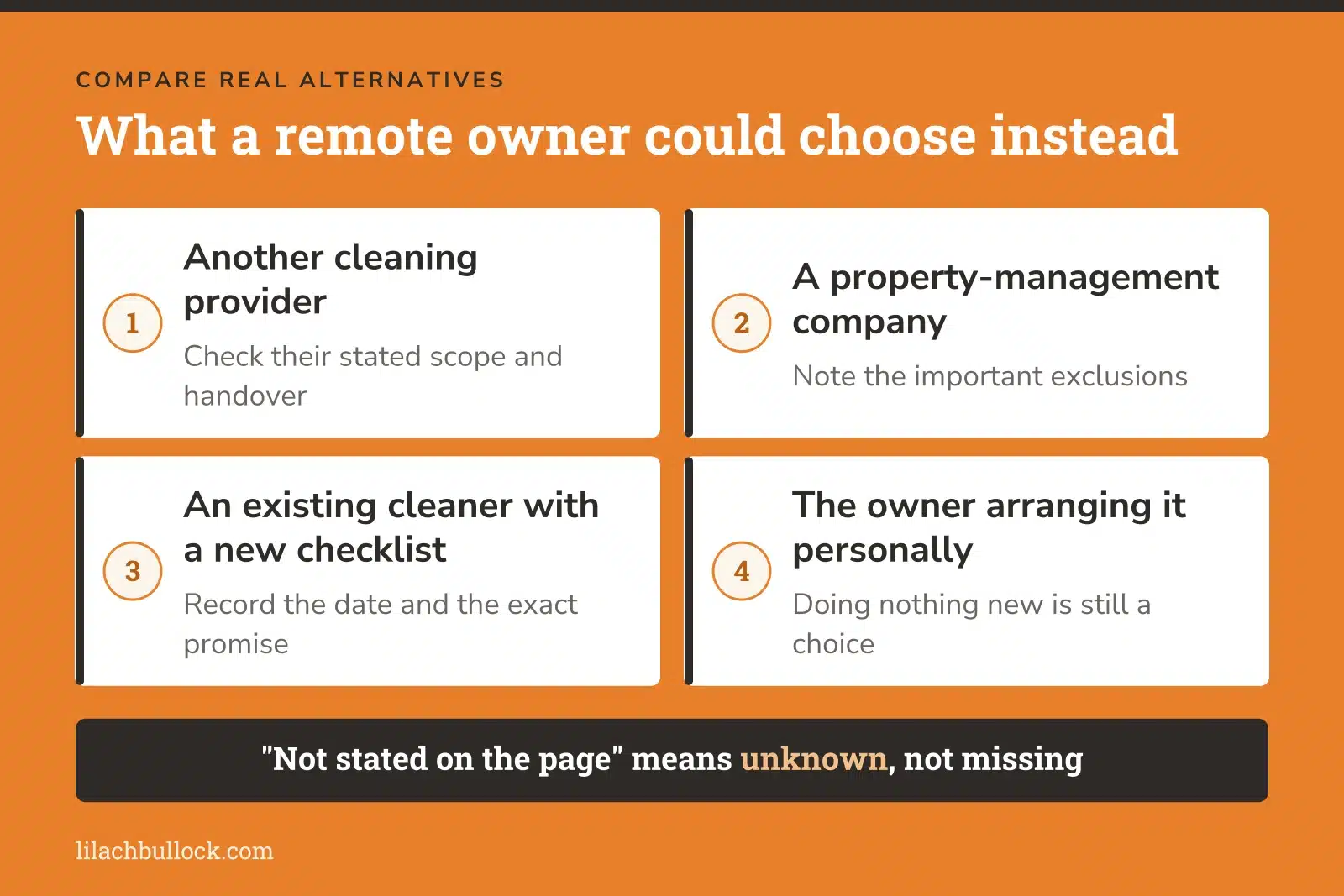
Look at the options in the actual buying area: other cleaning providers, a property-management company, an existing cleaner with a new checklist, or the owner continuing to arrange everything personally. AI may help one of those providers work more efficiently, but it isn't automatically the alternative the customer is choosing between.
Use public service pages, published terms and information a provider openly supplies. Record the date and the exact promise. If you cannot find a completion-update policy, write "not stated on the page reviewed". Don't turn that into "they never tell owners anything". Missing website copy proves a gap in the copy, not a failure in the service.
The competitor teardown prompts can structure this comparison, provided you make the model show the source beside each finding. I'd keep the table small enough to read: the alternatives a customer is likely to consider, their stated scope, the handover they describe, the important exclusions and what remains unknown.
Suppose Harbour Clean finds that a nearby provider already offers completion photographs. That doesn't kill the idea. It does kill a claim that photographs make Harbour Clean unique. The owner needs to understand whether buyers still struggle with the completeness, timing or usefulness of the handover, and whether she can improve it. If every credible alternative already solves the problem well, the next job is to examine another concern, not find a more dramatic adjective.
Turn a promising difference into an operating decision
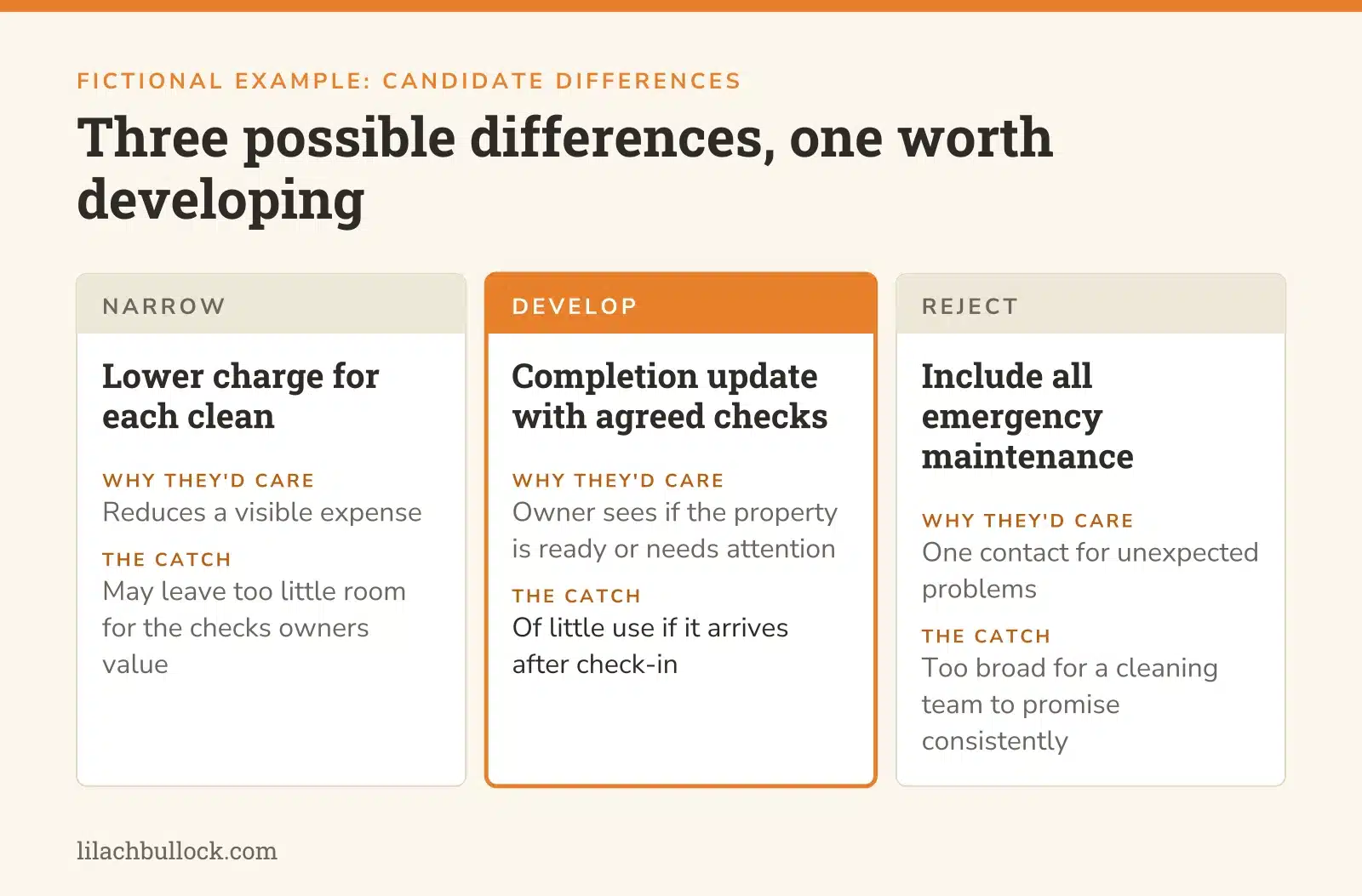
Harbour Clean considers three possibilities. The point of comparing them is to make the trade-offs visible before enthusiasm becomes a promise.
| Possible difference | Why a remote owner might care | Delivery requirement | Reason to narrow or reject it |
|---|---|---|---|
| Lower charge for each clean | Reduces a visible expense | Costs and route must support it | It may leave too little room for the checks the owner values |
| A completion update with agreed checks | Owner can see whether the property is ready or needs attention | Named checks, responsible cleaner, communication method and exception route | An update that arrives after check-in is of little use |
| Include all emergency maintenance | One contact for unexpected problems | Suitable contractors, availability and clear authority | Too broad for a cleaning team to promise consistently |
The owner chooses to develop the second. She specifies a check for access, the agreed cleaning tasks, essential supplies and visible damage within the team's remit. The completion message records when the clean finished, which agreed checks passed and any issue requiring action. It avoids guest details, personal possessions and unnecessary photographs. The owner also decides where the message goes and who receives an urgent exception if the usual contact is unavailable.
Notice how much work sits behind a sentence that might eventually say "know your cottage is ready before the next arrival". The promise depends on access, scheduling, a usable checklist and someone taking responsibility when the property isn't ready. My AI inbox management experiment is relevant to that last part: arranging information and preparing a response is different from resolving the underlying job. An update saying "problem detected" is not a completed handover.
If AI helps draft the update from a checked form, it must not fill missing fields with reassuring guesses. A blank access check means the check is missing. My experiment in having one AI audit another shows why a confident explanation still needs evidence outside the model. Here, the evidence is the completed property check, not the elegance of the message. When a difference like this depends on a fixed scope, schedule and price, my guide to productising a service with AI shows how to turn it into a defined service package.
Build proof that answers the buyer's hesitation
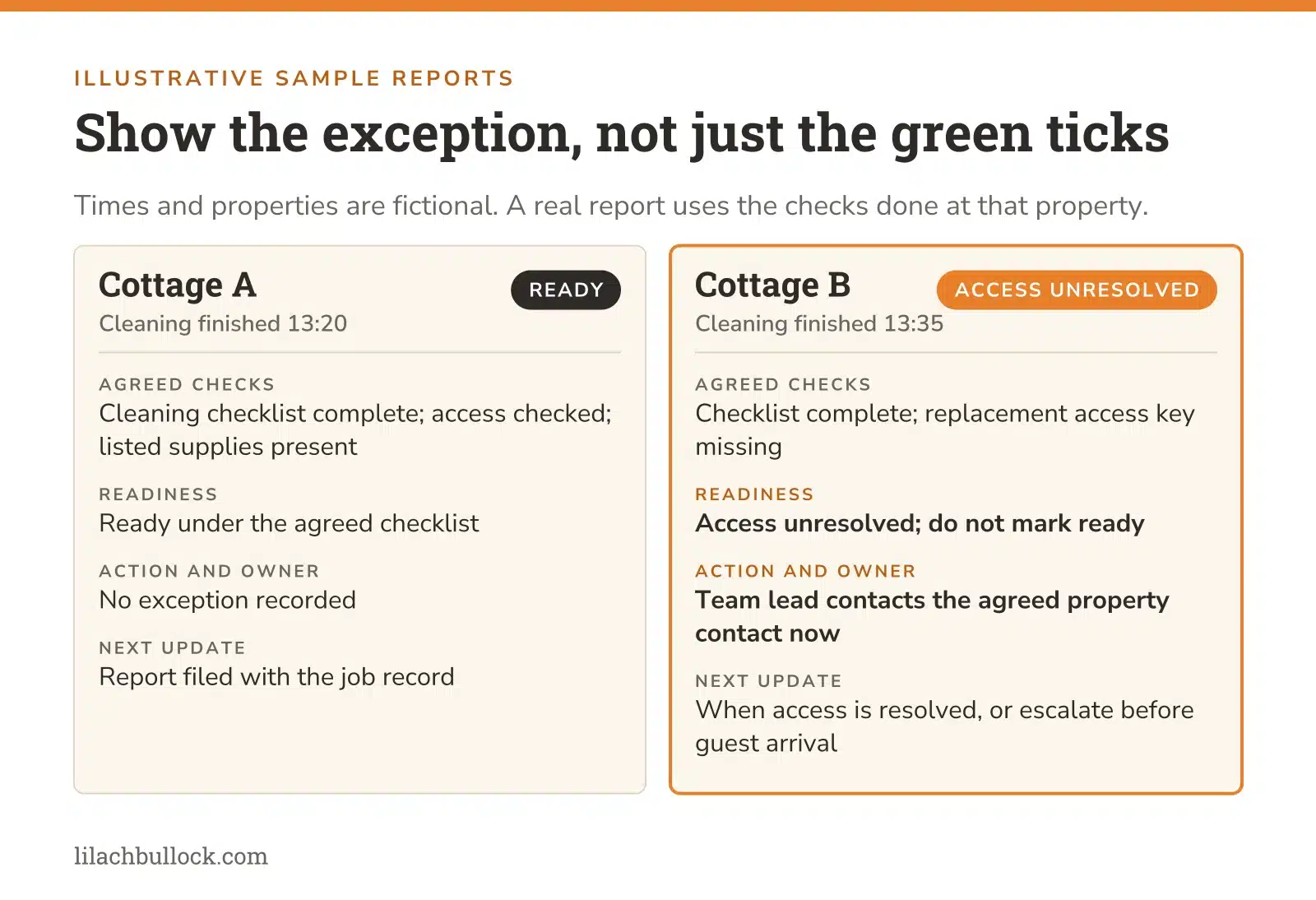
Before Harbour Clean has a customer result for the new handover, it can show a labelled sample. The sample needs to represent the service honestly, including what happens when something goes wrong. A spotless property and a row of green ticks don't show how the owner will hear about a missing key.
I would create two example reports. In the first, the checks are complete. In the second, a supply is missing or access needs attention. Show the difference in the message, who takes the next action and what remains unresolved. Then run the process on suitable existing work with permission, measuring the extra time and whether the report arrives when it is useful. Keep a record of occasions when it doesn't.
Want AI doing the heavy lifting in your marketing?
I build the systems that handle the boring 80 percent, so you get your week back. Done properly, with the human kept in.
A sample could look like this. The times and property details below are fictional; a real report must use the checks performed at that property.
| Report field | Routine handover example | Exception example |
|---|---|---|
| Property and completion | Cottage A, cleaning finished at 13:20 | Cottage B, cleaning finished at 13:35 |
| Agreed checks | Cleaning checklist complete; access checked; listed supplies present | Cleaning checklist complete; replacement access key missing |
| Readiness | Ready under the agreed checklist | Access unresolved; do not mark ready |
| Action and owner | No exception recorded | Team lead contacts the agreed property contact now and records who will provide the key |
| Next update | Report filed with the job record | Update when access is resolved, or escalate before the agreed guest-arrival deadline |
The report gives the owner a decision, not just a photograph. If nobody has accepted responsibility for the missing key, the exception stays open. Harbour Clean also needs to agree in advance what happens if the property contact cannot be reached; a delivery receipt on a message isn't evidence that the problem is being handled.
Ask a prospective buyer to read the sample without a running explanation. Can they tell whether the property is ready, what needs doing and who is handling it? If they have to call to translate the update, you have added a document, not removed a chase.
As evidence develops, keep the categories clear. A demonstration shows how a process is intended to work. A testimonial records someone's experience. A case study explains what changed in a particular situation. The testimonial request examples can help you obtain specific feedback after delivery. Use the customer's permitted words, including any limits, rather than editing a modest observation into a sweeping endorsement.
For a fuller account, the case study writing template gives you somewhere to record the starting situation, what changed and the result. If an owner says they chased less, explain how that was measured and over what period. Don't turn it into a claim about every owner, or imply the cleaning service alone caused an increase in bookings.
Write the service page around the decision

Now Harbour Clean has enough to draft a page. The headline names the service and customer. The next paragraph explains the useful difference. The sample report appears beside the explanation, followed by what is included, the conditions and a clear next step. A visitor should not have to make an enquiry simply to discover whether their property is in the service area.
Here is illustrative copy for that page:
Illustrative page copy
Changeover cleaning for remotely managed holiday cottages in [service area]. We clean to an agreed property checklist and send a completion update covering access, the agreed tasks and any issue that needs attention before the next arrival. You can see a sample update below, including an example where a problem needs action. Availability depends on your changeover dates, property requirements and access arrangements. Maintenance and replenishment are agreed separately. Send the property location and usual changeover pattern so we can confirm coverage and discuss the right checklist.
The bracket is deliberate. Until the actual service area is decided, it stays a decision to make. The copy also avoids promising that a property will always be ready, whatever happens. It describes a process the business can be held to, with room to explain the conditions on the page.
Use the landing page conversion checklist to check whether the promise, evidence and next step are visible together. The sales page copy prompts can help reorganise an untidy first draft, but give them the operating decisions and evidence first. Otherwise they will confidently advertise the business you wish you had built.
Then carry the same promise into the proposal, enquiry response and onboarding. A page that sells a careful handover followed by an onboarding email that never mentions the checklist is already starting to contradict itself. The client onboarding template is a useful place to record the property requirements, contacts and agreed responsibilities before the first job.
For a consultant or other person-led service, the personal positioning prompts can help translate the same evidence into an introduction. If LinkedIn is where people check you, my positioning statement guide covers that particular setting. Consistency matters more than repeating the exact same sentence on every surface.
Test understanding, buying response and delivery separately
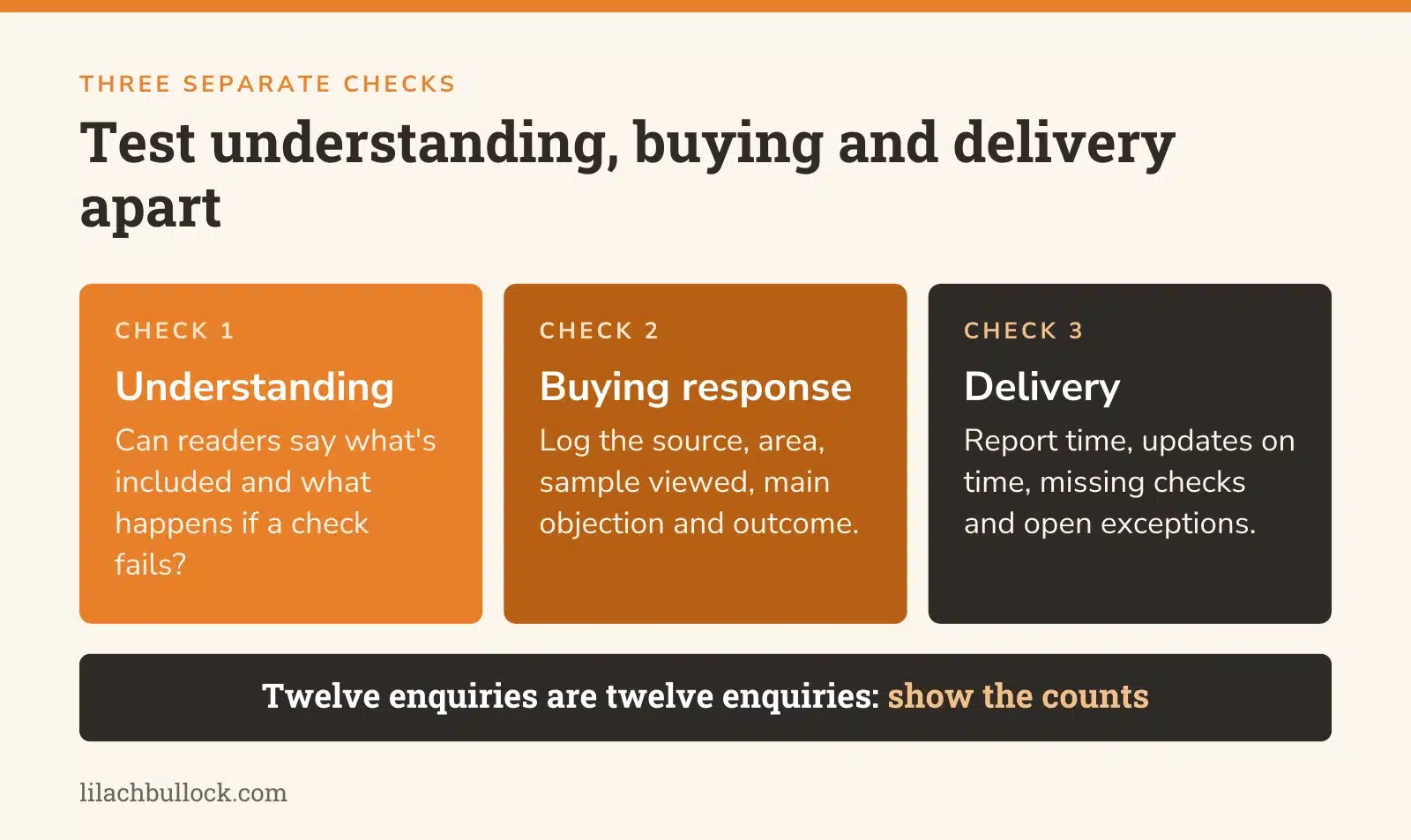
A clear page can explain an offer nobody wants. An attractive offer can be impossible to deliver. A successful sale can leave you with work that costs more to complete than you expected. Check those questions separately so you know which part to change.
Start with understanding. Let a few people who resemble the intended buyer read the page and sample. Ask what they think is included, what would happen if a check failed and what they still need to know before enquiring. Avoid "Do you like it?" because politeness is widely available and doesn't tell you much. The sales discovery question sheet can help you keep the conversation on the buyer's situation rather than defend your wording.
Then watch comparable enquiries over a stated period. Record where they came from, whether the person was in the service area, whether they mentioned the handover, whether they inspected the sample, their main objection and what happened next. Twelve enquiries are twelve enquiries; show the counts beside any percentage. If the source of enquiries changes halfway through, don't combine everything and announce that the new positioning increased conversion.
Finally, check delivery. For Harbour Clean, useful measures include time spent completing the report, the proportion sent within the agreed window, missing checks, owner follow-up questions and exceptions that weren't resolved before arrival. These are measures of the promised experience. They won't prove that a holiday let became more profitable, and they don't need to.
My newsletter design experiment is a reminder that an improvement in appearance can produce a worse result. Keep the old page and a record of what changed. Make one meaningful revision at a time where possible, and give yourself enough comparable observations to learn something before rewriting it again.
What to change when the first version doesn't work
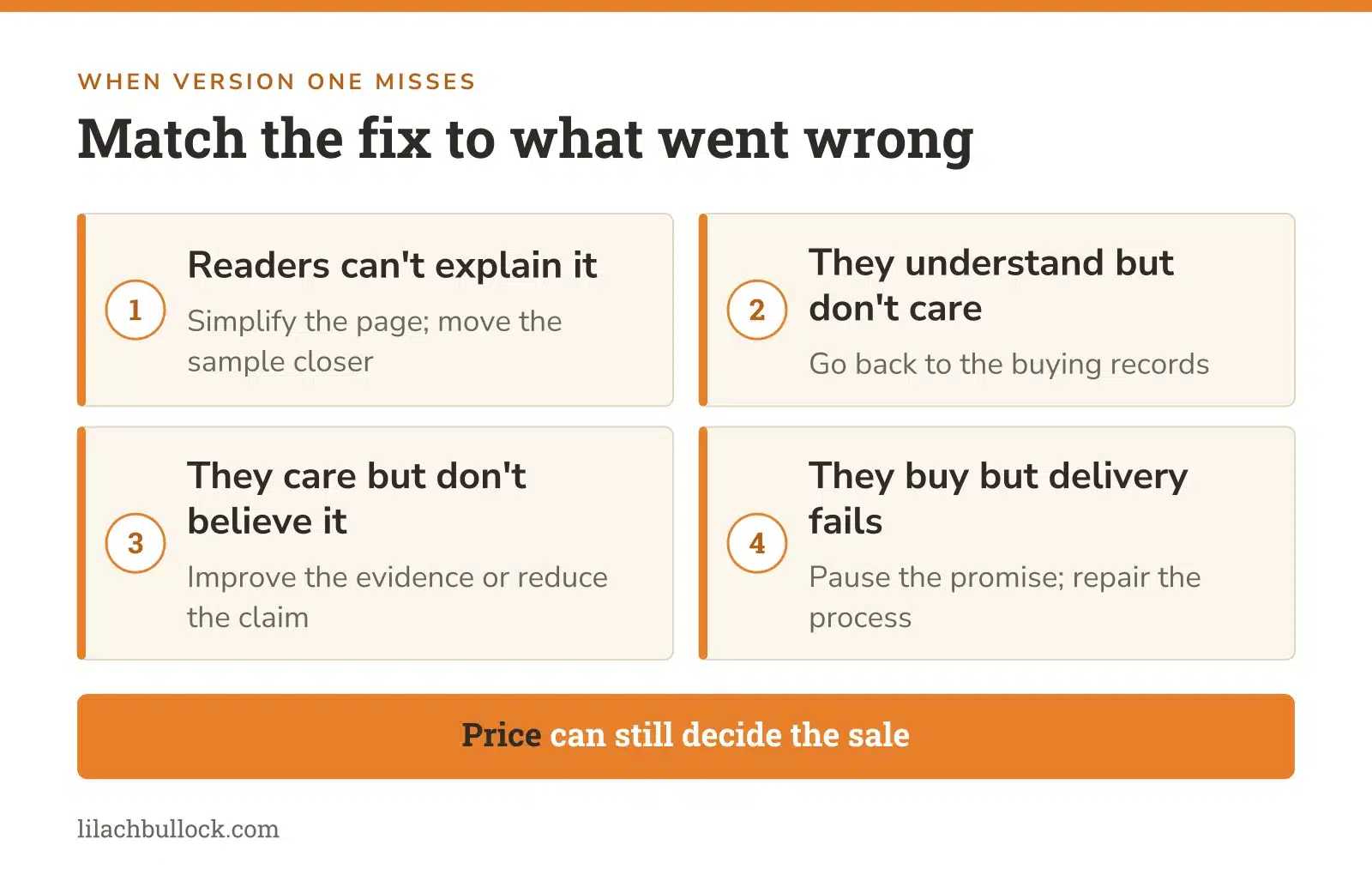
If readers cannot explain the service, simplify the page and move the sample closer to the promise. If they understand it but don't care, return to the buying records. You may have solved an annoyance that wasn't important enough to influence the decision. If they care but don't believe you, improve the evidence or reduce the claim to what the evidence supports.
If people buy and delivery fails, pause the promise while you repair the process. In Harbour Clean's example, late updates might come from poor signal at a property, an overfull route or a checklist that takes too long to complete. Each cause needs a different repair. Asking AI for punchier copy would be a peculiar response to any of them.
Price can still decide the purchase. Strong differentiation makes a choice easier to understand; it doesn't remove the buyer's spending limit. Record price objections alongside scope and alternatives, so you can distinguish "I don't value this" from "I value it, but can't afford it now". Those are different situations and deserve different decisions.
Questions about differentiating a small business

Can a new business differentiate without testimonials?
Yes. You can show a clearly labelled sample, explain the process and demonstrate a relevant task. That helps a buyer inspect your work without pretending you have customer results. As you complete paid projects, ask permission to use specific feedback and replace assumptions with delivery evidence.
Does choosing one customer situation make the business too narrow?
It makes the message specific, which is useful when a broad description hides the benefit. You can keep other services available and test one page for one situation. Before building the whole business around it, check the size and accessibility of the audience, the buying response and whether delivery is sustainable.
What if a competitor copies the promise?
A sentence is easy to copy. Keep improving the service and its evidence: the records, samples, useful handover and consistent delivery behind the words. If the competing offer becomes equally credible and relevant, reassess the difference honestly. You don't acquire permanent ownership of a customer problem by naming it first.
Review your differentiation strategy before changing the page
Copy this prompt
Review this proposed business difference using only the attached records. Separate customer statements, my interpretations and unknowns. Check whether the difference addresses a recorded buying concern, whether the delivery process supports the promise and whether each public claim has relevant evidence. Treat missing competitor information as unknown. Do not invent results, uniqueness or demand. Identify the strongest reason a buyer might still choose an alternative. Suggest a narrower claim if needed, then list the next checks in order. Records, comparison notes, proposed promise and proof: [paste anonymised material].
Check the response against the records. The model may help you notice a contradiction, but it hasn't watched a cleaner finish a property or heard the owner's explanation for choosing someone else.
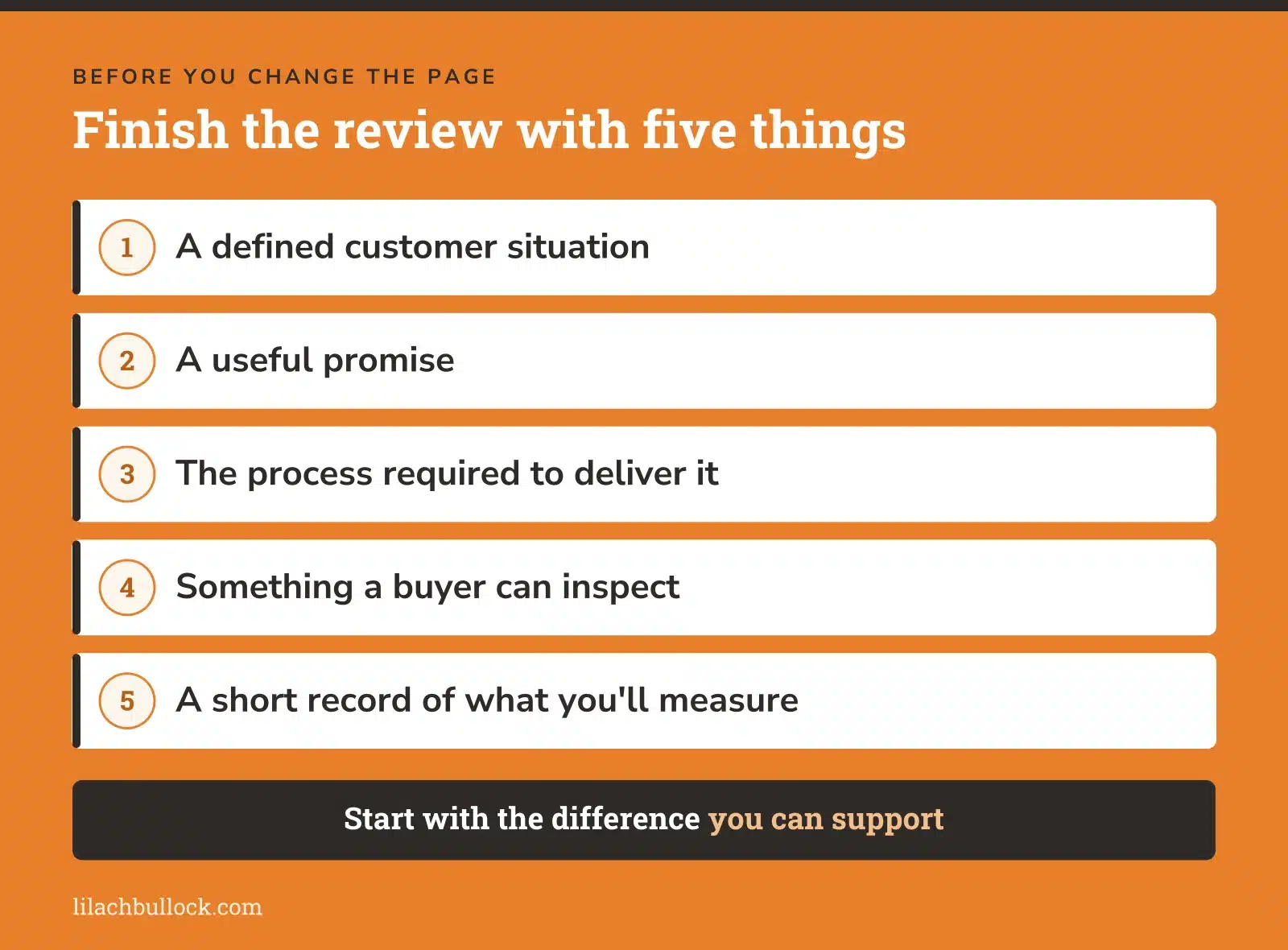
You should finish this exercise with a defined customer situation, a useful promise, the process required to deliver it, something a buyer can inspect and a short record of what you'll measure. The companion worksheet holds those decisions in one place. It doesn't make them for you.
That's enough to improve one service page and learn from the next buying decisions. Start with the difference you can support. Give people a clear way to judge it. Then make sure the business they hire is the one the page described.