I run a one-maker studio. Every piece I sell passes through my own hands, and no two come out alike. That is the whole business, and it is also the whole pricing problem.
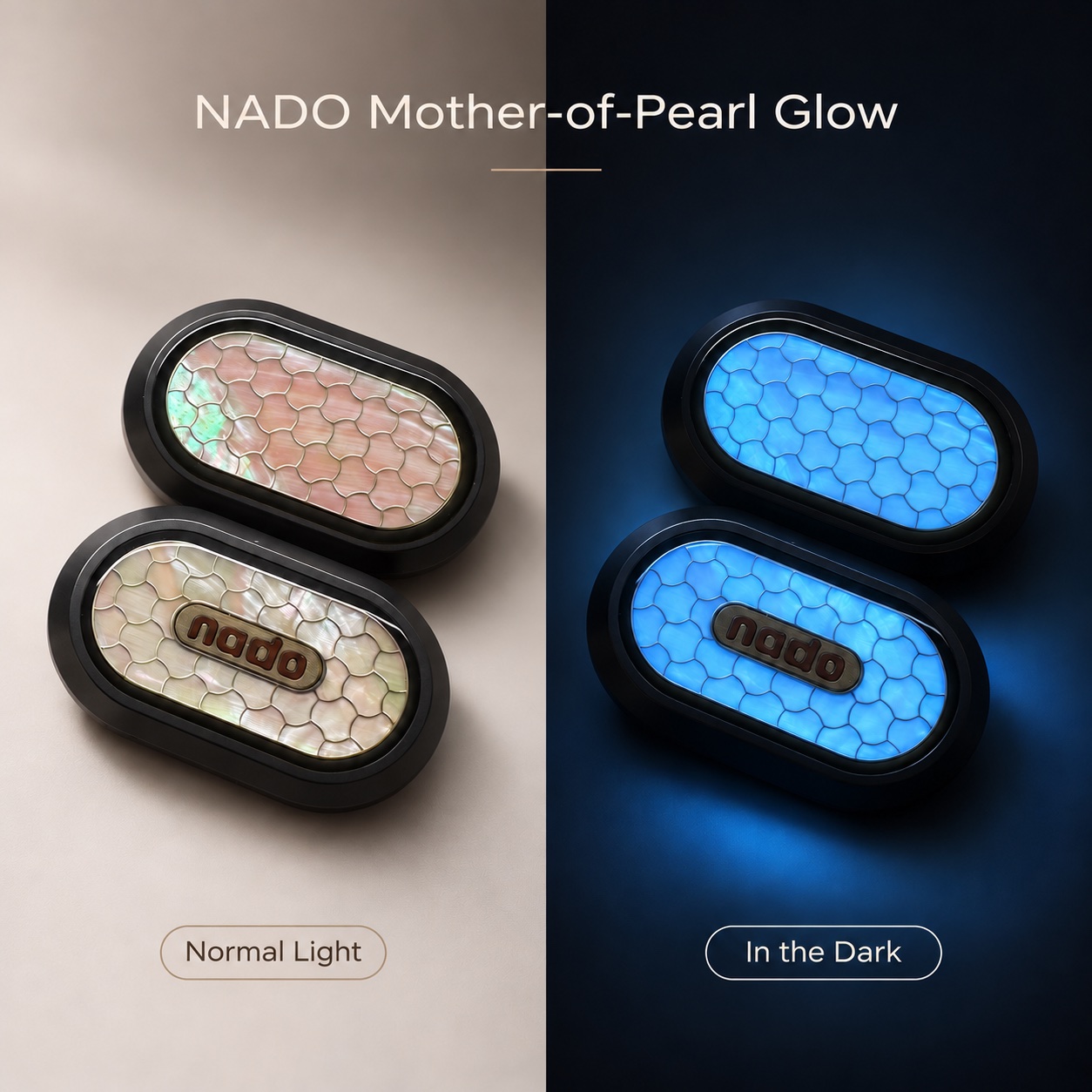
Two pieces taught me how pricing actually works. The first is our NADO Custom MOD Edition, a slider built on natural mother-of-pearl: luminous material mixed in so the pearl itself glows, brass sheet cut into shapes and inlaid onto the pearl surface by hand, and a UV glue seal over the top. It comes in two glow versions, Luminous Glow and Honeycomb Glow, and because the pearl is natural, no two pieces ever look the same; the product photos show a single example, and the pattern, colors and inlay vary with every handmade order. It sells for $99, made to order in about 15 days.
The second is our hand-finished crystal-sealed LAUTIE Choc, a pocket fidget sealed under crystal by hand, also made to order in about 15 days, also never twice the same. It sells for $159.

Same studio, same fifteen days, two different prices. Here is what pricing those two pieces taught me.
The cost is the time, not the object
When I first worked out prices, I made the mistake almost every maker makes: I priced the object. Materials, a bit of margin, done. On paper it looked reasonable. In practice it was wrong, because the object is not what takes the time. The making does.
Mother-of-pearl does not forgive rushing. The brass inlay has to be cut to shape and set onto the pearl surface piece by piece. The luminous layer has to be laid so the glow is even. The Choc is sealed by hand, layer by layer, and then it cures. Nothing about either piece can be hurried without ruining the finish. Fifteen days is not a marketing line; it is the calendar. Once I wrote down the hours honestly, the cutting, the inlay, the sealing, the curing waits, the inspection, the packing, the "reasonable" prices I had in mind stopped covering the work. It was not a pricing decision anymore. It was a question of whether the business could keep existing.
That is the first lesson: if you sell handmade work, your price has to carry your calendar, not just your materials. A buyer is not paying for a slider or a pocket toy. They are paying for fifteen days of somebody's attention.
Cheap prices attract the wrong conversation
My first instinct was to keep prices low so more people would buy. It is a natural instinct, and for both pieces it was wrong in a specific way.
At a low price, the questions I got were all about the price. Is it worth it? Why does it cost that much for something so small? Can you do a discount? At $99 and $159, the questions changed. People asked about the pearl, about the glow, about the crystal finish, whether two pieces could ever look the same. The price stopped being the subject and the work became the subject.
I do not mean that a higher price magically makes a product better. I mean that a price is a message, and the message of a low price on handmade work is "this was quick to make." For pieces that take fifteen days, that message is false. It also pulls in buyers who are shopping for a bargain rather than for something made by hand, and those buyers are the hardest to satisfy, because no bargain is ever quite cheap enough.
Two prices, two sentences
The $60 gap between the two pieces is not a ranking. The NADO is not a cheaper Choc, and the Choc is not a fancier NADO. They are different work: pearl, glow and brass inlay on one side; crystal sealing on the other. Different materials, different hours, different prices.
Want AI doing the heavy lifting in your marketing?
I build the systems that handle the boring 80 percent, so you get your week back. Done properly, with the human kept in.
That is what the two pieces taught me most clearly: a price does not have to be justified against your other products. Each one only has to be justified against its own making. I can defend $99 in one sentence, natural mother-of-pearl that glows, brass inlaid by hand, sealed under UV glue, no two alike. And I can defend $159 in one sentence, fifteen days of handwork, sealed under crystal, no two alike. If a buyer does not want that, they are not my buyer, and that is fine.
If you cannot say a price out loud without apologizing for it, the price is wrong, not necessarily too high, just undefended. I have watched makers, myself included, knock money off a price before anyone even asked, just to avoid an awkward moment. Every time you do that, you are telling the buyer the work was not worth what you asked.
What I would tell another maker
Three things, all learned the slow way:
First, count the hours before you count the materials. Materials are the small number. Your time is the price.
Second, let the price filter for you. A price that scares off bargain hunters is doing its job. You want the buyer who reads the description, not the one who reads only the number.
Third, write the sentence that defends your price, and then price to match it. If you sell more than one handmade piece, write one sentence for each. When every price has its own sentence, the prices stop arguing with each other, and you stop apologizing for any of them.
The NADO and the Choc are the two pieces that taught me this. They sell the making, not just the object. Once I understood the difference, pricing stopped being a guess.
Mu runs M-EDC, a one-maker studio hand-finishing crystal-sealed everyday-carry pieces. The handcrafted crystal-sealed NADO slider ($99) and the hand-finished crystal LAUTIE Choc ($159) are both made to order in about 15 days, no two alike.