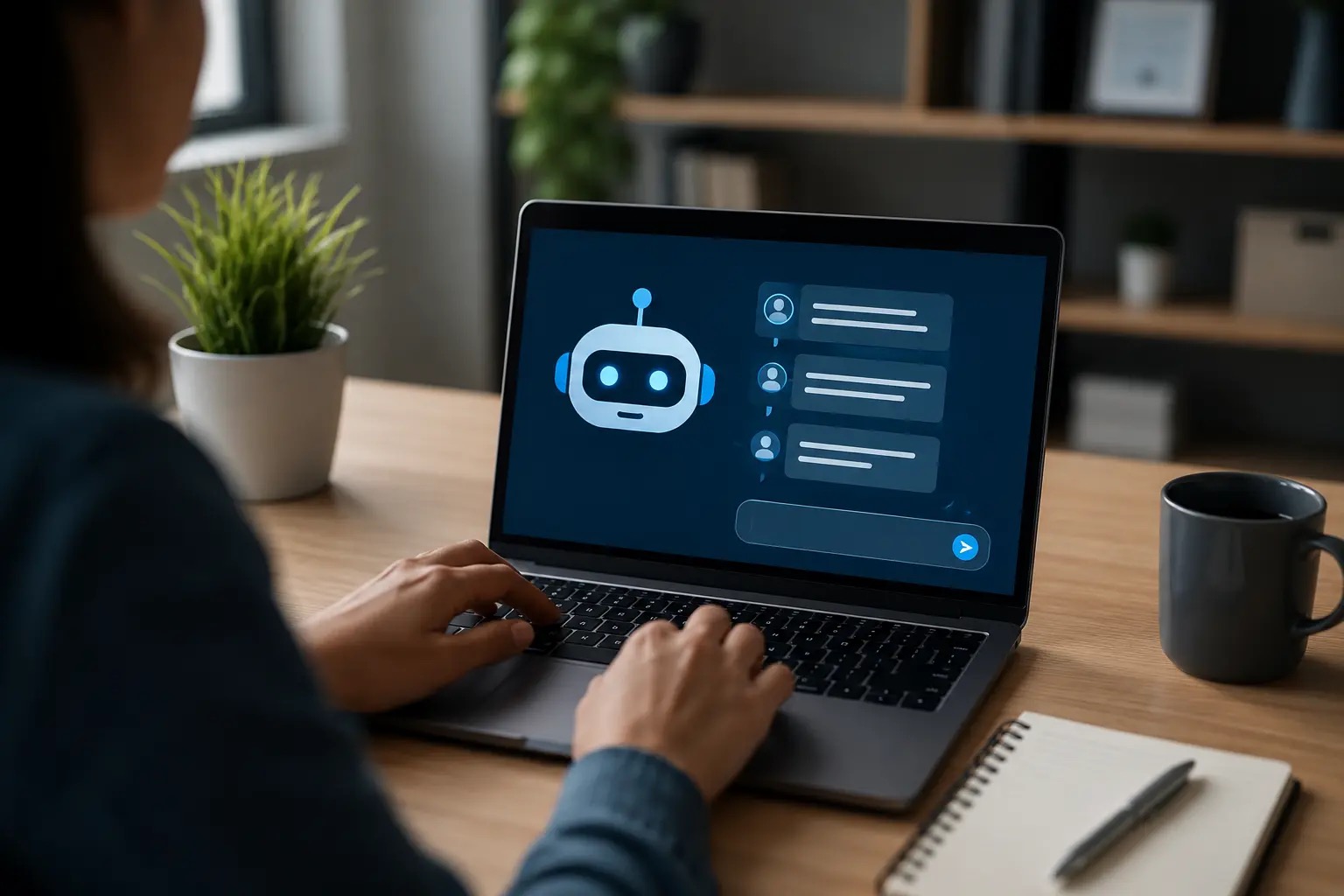
Today, nobody likes waiting around for a simple answer or navigating endless pages to find what they're looking for. AI chatbots are helping businesses spread across the globe meet these expectations while taking repetitive and mundane tasks off their employees' hands.
But what is it that makes AI chatbots a widely used option? The answer lies in how it understands the audience and their context, connects efficiently with business systems, and responds. This is where AI chatbot development services make all the difference. Let's first understand what an AI chatbot is all about.
What is an AI Chatbot?
An AI chatbot is a software application that uses artificial intelligence to interact with people, understand their inputs, whether they are questions or commands, and respond in a conversational tone.
Unlike traditional chatbots that follow fixed scripts or rely on specific keywords, AI chatbots can comprehend different ways of asking the same question, follow the flow of a conversation, and generate relevant answers. They use technologies like natural language processing (NLP) and machine learning to make these interactions more flexible and easier to follow.
These chatbots can do more than just answer user queries. They help customers find relevant products, resolve common problems, look up information, book appointments, and even assist employees with daily tasks. When they are integrated into a business app or database, they can efficiently retrieve information and help users get tasks done without needing to switch back and forth across many tools. Their capabilities depend on the AI models they use and the systems they're connected to.
Put simply, an AI chatbot makes it easier for people to interact with your business and explore services you offer with the help of everyday conversations. This eliminates the need to navigate complex menu screens or search through pages of information.
Benefits of AI Chatbots
Today, AI chatbots are changing the way organizations handle customer interactions, internal requests, and daily processes. All it takes is the right setup. One that saves time, makes it easy to access information, and offers customers a more convenient way to get assistance. Here's how businesses benefit from AI chatbots.
They handle queries without long waits
Most customers don't want to wait for an email reply or have a word with someone just to get a simple answer. This is where AI chatbots come in. They can handle the most commonly asked questions, offer information about products or services, and guide users through basic queries at any given time of day. Customers get help right away, while your team spends less time answering repetitive and routine questions.
They take care of repetitive and mundane tasks
From answering everyday questions to collecting customer information and scheduling appointments, chatbots can take care of tasks that otherwise need manual effort. With the help of professional AI chatbot development services, businesses can tailor these interactions to their workflows, allowing employees to spend more time on work that requires their utmost attention, judgement, and expertise.
They offer more relevant customer interactions
AI chatbots can use the context of a conversation to give more relevant responses instead of delivering the same generic answer to everyone. When connected to customer data or business systems, they can help users discover suitable products, understand services, or get answers on the basis of their specific needs.
Connect with existing business applications
Chatbots become more resourceful when they can work with the many tools a business already uses. They can be integrated into CRMs, websites, databases, ticketing platforms, and other apps to retrieve information or initiate tasks. Collaborating with an AI app development company can help businesses develop these integrations around their current systems rather than introducing disconnected tools.
They support business growth without adding more complexity
As customer queries grow and operations expand, handling everything efficiently manually becomes a difficult task. AI chatbots can manage multiple conversations at once and support routine interactions without needing the same increase in staffing. Businesses can also expand their chatbot capabilities over time, especially when working with an AI agent development company to move beyond basic responses towards task-oriented AI solutions.
How Do AI Chatbots Work?
AI chatbots combine language-processing technologies, AI models, and business data to get an understanding of what a user is asking about and respond accordingly. While the technology behind them can be quite complex, the interaction itself is fairly straightforward. Here's how an AI chatbot typically works.
1. They understand what the user is asking
When someone types a question or gives a command, the chatbot analyzes the input to understand the intent, context, and relevant details. For instance, if a customer says, "I want to know where my order is," the chatbot immediately recognizes that they're looking for shipping or tracking information.
Want AI doing the heavy lifting in your marketing?
I build the systems that handle the boring 80 percent, so you get your week back. Done properly, with the human kept in.
2. They retrieve relevant information
Now that the intent is understood, the chatbot looks for information to answer the same. This involves searching its knowledge base, accessing a database, or retrieving information from integrated business applications. As per the above example, it may look up the customer's order number and shipping status.
3. They generate a response
The chatbot uses the collected information to formulate a relevant reply. Instead of simply displaying a predefined message, it can explain the order's status in a conversational manner, share a tracking link, or let the customer know if the shipment is delayed or coming earlier.
4. They respond or act
Depending on how the chatbot is configured, it can go beyond answering questions. It can help schedule an appointment, initiate a return request, update customer details, or transfer the conversation to a human agent if and when required.
What to Consider When Developing an AI Chatbot
Developing an AI chatbot involves more than just choosing a model and adding a chat window to your website. It needs to serve a clear purpose, work with your available systems, and offer responses people can actually use. Here are a few things worth considering before getting started.
Define what you want the chatbot to do
Make a list of tasks you want the chatbot to handle, whether it's answering customer questions, generating leads, helping employees, or automating routine or mundane processes. A clear purpose helps determine the features and integrations it requires.
Choose the right AI model
Not every chatbot needs the same AI model. Simpler models may work well for basic queries, while more advanced ones can handle complex requests, follow conversational context, and manage multiple tasks.
Consider the systems it needs to connect with
Chatbots become very resourceful when integrated with CRM platforms, databases, inventory systems, and customer support tools. These integrations allow them to collect information and perform tasks instead of simply responding to user queries.
Prioritize data security and privacy
Chatbots most likely handle sensitive customer or business information. Consider how data is collected, stored, and accessed. Encryption, access controls, and secure integrations are integral parts of the development process.
Plan for testing and continued improvements
Test run the chatbot with a variety of questions and scenarios to find out gaps. Consider routine updates to help the chatbot keep up with evolving business needs.
Bottom Line
AI chatbots can make customer interactions seamless, streamline daily tasks, and help businesses use their time more effectively. Their success usually depends on thoughtful development, reliable integrations, and the right AI capabilities. Collaborating with AI development companies in Michigan allows businesses to address real needs and support long-term growth.