


- Choose a skill you will use, then make the task small enough to practise
- Give the AI a source and a standard before asking it to teach you
- Practice session 1: read a campaign result without inventing a winner
- Use the mistake to choose the next lesson
- Practice session 2: write a brief that can survive being handed to someone else
- Practice session 3: ask a customer a question that can teach you something
- A reusable AI tutoring prompt for your chosen skill
- Plan a short second session before you declare the skill learned
- Track independence as well as accuracy
- Common questions about learning a skill with AI
- Finish the session with evidence you can use
In this blog post, I'll show you how to use AI to learn a new skill you need in your business, with a way to check whether you can do the work yourself afterwards. It's for owners and small teams who need useful practice rather than another unfinished course. We'll work through reading campaign results, writing a clear brief and asking better customer questions, with exercises, worked answers and a reusable AI tutoring prompt.
The difficult part of learning with AI is that it can remove the very effort you need to make. It can produce the report, improve the brief and write the questions before you've worked out where you were stuck. You leave with a lovely document and roughly the same ability you arrived with. That may be fine when you need a document. It is less satisfactory when you thought you were buying yourself a skill.
I would decide which job I want before starting the conversation. Sometimes I want AI to finish something. Sometimes I want it to help me understand, judge or perform the work. When learning is the purpose, my own attempt needs to remain visible. The wrong answer is useful information; replacing it too quickly with a fluent one throws that information away.
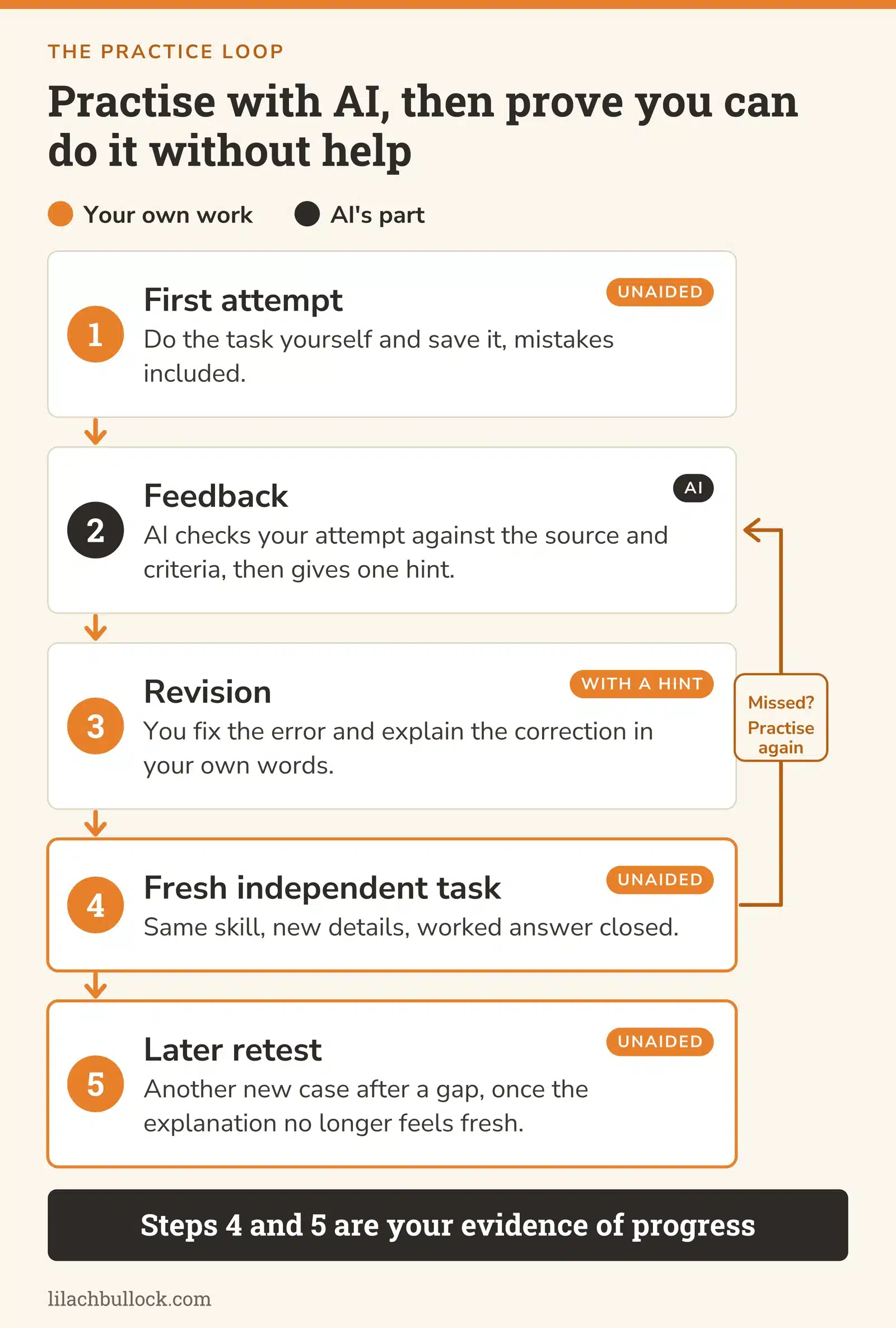
My guide to AI training for business owners looks at the broader training decision. This article gives you a smaller unit you can use today: one task, one attempt, specific feedback and a fresh test. You don't have to complete all three practice sessions. Choose the one that resembles something sitting unfinished in your business.
Choose a skill you will use, then make the task small enough to practise
"Learn marketing" is too broad to produce a useful first lesson. "Read last month's campaign table and explain which result improved" gives you an output to inspect. So does "write a brief someone can complete without three clarification emails" or "ask a customer about a purchase without leading them towards the answer I want".
The task should be something you can attempt in a short sitting and recognise when it is done. Narrow it until that is true. You can learn the rest later; it will still be there, looking enormous.
Start with a recurring difficulty, not the most fashionable skill. If reporting slows you down every month, a basic numerical interpretation skill has a clear use. If work repeatedly comes back wrong, briefing may matter more. If you collect plenty of customer comments but learn little from them, practise the questions. The delegation decision mini-guide can help you consider whether you need to learn the whole task, become competent at reviewing it or hand it to someone with more experience.
Be specific about the time you expect to recover. A task that takes you an extra hour every week may deserve more attention than a clever technique you might use once. The AI Savings Calculator is useful for an initial time-value estimate, but your learning target should be an observable ability rather than a promised number of hours saved.
You also need a reasonable boundary. Learning to spot an unsupported claim in a report is different from becoming a statistician. Learning to organise invoices is different from qualifying to advise on tax. AI can help you practise parts of a task without making you qualified to carry out the whole profession.
Give the AI a source and a standard before asking it to teach you
A tutoring conversation needs more than "teach me this". It needs the task, the material you will use, your current attempt and a description of a good result. Without those, the model can generate a perfectly respectable lesson aimed at somebody else.
For a calculation, the source might be a small table with defined measures and an independently checked answer. For writing, it might be a good approved example plus the requirements it meets. For a customer conversation, it might be an anonymised transcript and a clear rule about what counts as evidence. Choose material you are allowed to use and remove personal or commercially sensitive details that the exercise does not need.
The guide to writing an AI brief helps with that preparation. The prompt engineering cheat sheet can help you state the teaching behaviour: ask a question, wait for an attempt, give a hint and check the revision. A prompt remains an instruction, not a guarantee. If the model reveals the answer before you try, you will need a different case to test independence.
Set the standard before seeing your answer. Otherwise it is surprisingly easy to decide that whatever you managed was the important bit. A standard can be simple: correct calculation, appropriate conclusion and no invented cause. For a brief, it can be an explicit deliverable, intended audience, usable inputs, constraints and a checkable finish.
My AI audit experiment is relevant to feedback as well as finished work. The model's verdict needs a basis you can inspect. "Excellent analysis" is pleasant, but it leaves you with very little to practise.
Practice session 1: read a campaign result without inventing a winner
This exercise uses invented data. Both campaigns ran for the same duration and used the same measurement rules. Visitors means unique landing-page visitors. Buyers means unique visitors who bought within the defined follow-up period. We know nothing else about the campaigns yet.
| Campaign | Visitors | Buyers |
|---|---|---|
| A | 1,000 | 40 |
| B | 600 | 30 |
Before reading the explanation, write three sentences: which campaign produced more buyers, which converted a larger share of visitors and what you would need before recommending a budget change. Use a calculator if you want. Keep the attempt, including the bits you are unsure about.
If you have never calculated a conversion rate, the definition is buyers divided by visitors, multiplied by 100. The conversion-rate guide gives wider context, while the marketing metrics cheat sheet is a useful reference when similar-looking measures start getting mixed together. For this exercise, keep the definition fixed. Changing from people to sessions halfway through is not a minor formatting choice.
A converted 40 divided by 1,000, or 4%. B converted 30 divided by 600, or 5%. A produced ten more buyers, while B converted a greater proportion of its visitors. The difference is one percentage point. Relative to A's 4% rate, B's 5% rate is 25% higher: the one-point difference divided by the original four-point rate.
None of that tells us which campaign made more profit. We do not know the campaign costs, order values, delivery costs or refunds. We also do not know why the rates differ. The figures might reflect different audiences, offers or other conditions. With limited observations, the apparent advantage might not persist.
A sound answer would be: "A produced forty buyers compared with B's thirty. B converted 5% of visitors, compared with A's 4%, a difference of one percentage point. Before moving budget, I would check costs, customer value and whether the audience and measurement conditions are comparable."
Notice the work the final sentence does. It keeps the report from turning a limited observation into an expensive instruction. My newsletter design experiment is a useful real-world companion because changing several things together limits what you can attribute to any one change.
Use the mistake to choose the next lesson
Suppose your first answer was "B is better because its conversion rate increased by 1%." There are two things to repair. You have used percent where you mean percentage points, and you have declared a winner without defining better.
Ask the AI to work on one at a time. It could first ask: "What is the difference between 5% and 4%, expressed in percentage points?" After you answer, it could ask you to calculate the relative difference. Then you rewrite the sentence yourself. If the model writes the correction, you have seen a correction; you haven't yet shown you can make one.
Explain the change in your own words: "The rates differ by one percentage point. Because the starting rate was 4%, that difference is a quarter of the starting rate, so the relative increase is 25%." You do not need a more impressive explanation. You need one you understand well enough to reproduce when the numbers change.
If you were already comfortable with the arithmetic, move directly to interpretation. Ask what information is missing from the budget decision. The analytics insight prompt pack offers further ways to question a report; use it to compare approaches after making your own attempt, rather than asking it to produce the answer first.
When you take this into your own business, check how the data was labelled before analysing it. The UTM and campaign naming template helps keep future campaign records consistent. If the eventual question is why an ad is underperforming, the creative performance diagnosis cheat sheet is a more relevant next resource than another lesson in division. The learning task has changed, so the source should change with it.
Test the skill with a different table
Close the worked answer and try this invented example under the same definitions. Campaign C had 800 visitors and 32 buyers. Campaign D had 1,200 visitors and 42 buyers. Write the two rates, identify which produced more buyers and say what you cannot conclude.
C converted 4%; D converted 3.5%. D produced ten more buyers, but its rate was 0.5 percentage points lower. The relative reduction from C's rate is 12.5%. You still cannot identify the more profitable campaign or establish the cause of the difference.
In this table, the first campaign has the higher conversion rate and the second produces more buyers. Check both measures afresh rather than assuming the second row is better. The broader lesson remains the same: a campaign can bring in more buyers while converting a smaller proportion of its visitors.
For this task, a pass means both rates are correct, the count and rate are distinguished, percentage points are used correctly and the conclusion stays within the evidence. This is an exercise standard, not a professional qualification. If you miss one item, practise that item with another example. Three correct sentences do not cancel a fourth that tells the owner to spend money for the wrong reason.
Practice session 2: write a brief that can survive being handed to someone else
Numerical answers are convenient to mark. Most business skills are less obliging. You still need observable criteria, otherwise you and the AI can spend twenty minutes agreeing that the prose feels more strategic.
Here is a fictional request: "Can you make a one-page guide for new customers about getting ready for their first appointment? Keep it friendly and get it done this week."
Before rewriting it, identify what is missing. What kind of appointment? Who are the customers? What preparation is required? Where is the approved information? Is the deliverable an email, a printable page or a web page? Who checks it, and when does it need to be ready for that check? A writer can fill those gaps beautifully and still deliver the wrong thing.
Now use this invented source material. The business offers forty-five-minute online bookkeeping onboarding appointments. New customers are sole traders. Before the call, they need to confirm the meeting link works and prepare a list of the accounting tools they use. The guide must not ask them to email passwords, bank-login details or identity documents. The required output is a one-page PDF for a human to review on Wednesday before it is used the following week.
Write a brief using only those facts. Mark anything else as a question for the business owner. My guide to briefing freelancers and AI tools provides more context for this skill, but the exercise contains enough information to begin without opening another tab.
A workable answer would read:
"Create a one-page PDF preparation guide for sole traders attending their first forty-five-minute online bookkeeping onboarding appointment. Use the supplied appointment information. Explain how to check the meeting link and prepare a list of accounting tools in use. Keep the language friendly and plain. Do not request passwords, bank-login details or identity documents by email. Deliver a draft for human review on Wednesday; it will be used the following week. Flag any missing appointment or contact details rather than inventing them."
This brief still leaves design choices, but it establishes the task, reader, required content, boundary, format and review point. "Make it more engaging" would not have resolved any of the missing information.
Want AI doing the heavy lifting in your marketing?
I build the systems that handle the boring 80 percent, so you get your week back. Done properly, with the human kept in.
For a recurring process, the SOP writing prompt pack can help you turn agreed instructions into a procedure. If the content needs to sound like your business, the brand voice prompt template supports that separate requirement. Accuracy and completeness come first; a charming guide that requests the wrong documents is still the wrong guide.
Give feedback against requirements, not taste
Ask the AI to mark your brief against six checks: task, audience, supplied inputs, required content, constraints and acceptance point. For each, it must quote the passage in your attempt that meets the requirement or say that the requirement is missing. It should also identify any fact you introduced without support.
You can then inspect the feedback. If the model says your brief is missing the audience when you have written "sole traders", challenge that particular judgement by pointing to the phrase. If it rewards an invented cancellation policy as helpful detail, remove the policy. You are practising good briefing, which includes resisting an eager assistant's contribution to the fiction department.
The AI Agent Brief Template is useful if the thing you are briefing is an automated system. The workflow prompts for operations are relevant when you need to document how work moves between people and tools. Neither is a reason to turn this one-page writing exercise into a software project.
For the independent test, use a different source note: a local repair company needs a short SMS confirming a customer's Tuesday 10am to noon arrival window. The appointment reference is R204. Customers can reply to the message if access arrangements have changed. The draft must not promise an exact arrival time or quote a repair price. A human will review it before sending.
Write the brief, not the SMS. Check it against the same six requirements and the two prohibitions. A suitable answer is: "Draft a short appointment-confirmation SMS for the repair company's customer, using reference R204. Confirm Tuesday's 10am to noon arrival window and say the customer can reply if access arrangements have changed. Do not promise an exact arrival time or quote a repair price. Return the draft for human review before sending. Flag the missing calendar date and any required contact details for confirmation."
The missing calendar date matters: "Tuesday" can become ambiguous when a message is reused or delayed. You have enough information to prepare a draft, but the brief should expose that gap before sending. If you instead invent a date or promise a 10am arrival, you have found the part that needs more practice.
Practice session 3: ask a customer a question that can teach you something
AI can generate an interview script quickly. The skill worth learning is recognising when a question supplies the answer or asks people to predict behaviour they have no reason to predict accurately.
Here is a fictional question: "Wouldn't it be easier if our brilliant new booking system reminded you automatically and saved you all that admin?" It contains a product pitch, an assumed problem and an invitation to agree. A polite "yes" would tell you very little. You could collect fifty of them and still be none the wiser, though your presentation would have excellent charts.
Rewrite it to ask about a recent event. One possible version is: "Think about the last appointment you booked. What happened between making the booking and attending it?" Follow with "Was there any point where you had to chase information or change the arrangement?" Then ask for the detail behind whatever the person describes.
The customer interview prompt pack can help you develop the wider conversation. For this exercise, assess your question against three criteria: it does not imply the preferred answer, it asks about a specific experience and it leaves room for the customer to report that the supposed problem did not happen.
The discovery call note-taking template is useful for capturing what was said without losing the context. If you later extract themes from several conversations, keep the original statements attached. The voice-of-customer mining cheat sheet supports that analysis, but an interpretation should remain distinguishable from a customer's words.
For a fresh test, rewrite: "How much would you pay for an app that saves you hours on invoicing?" A better first question would ask the person to walk through the last time they sent an invoice, including where time was spent and what, if anything, caused difficulty. That does not determine willingness to pay. It establishes whether there is a relevant experience to investigate before you introduce your solution.
You can use AI to role-play a respondent while practising the mechanics of asking a question. Keep the boundary clear: a simulated answer is practice material, never customer research. No amount of convincing role-play turns a model into somebody who has bought, rejected or used your product.
A reusable AI tutoring prompt for your chosen skill
Use this after selecting a task and saving your first attempt. You do not need a special prompt for every variation. The important parts are the reference, the criteria and the requirement that you do the next piece of work.
Copy this prompt
Help me practise this business skill: [specific observable task].
Here is the task and its source material: [paste].
Here is my unaided first attempt: [paste].
Here is the checked answer, approved example or authoritative reference: [paste].
A successful attempt must meet these criteria: [list].Compare my attempt with the source and criteria. Identify one specific error or omission, quoting the part of my answer involved. If the reference cannot settle a point, mark it unresolved rather than inventing a rule.
Give one hint and wait for me to revise. Do not replace my answer. After the revision, ask me to explain the correction in my own words and check that explanation.
If I remain stuck, explain the relevant step using a small worked example. Mark that attempt assisted. Then provide a fresh task with different details so I have to apply the skill again. Keep the solution separate until I have attempted it.
Check the fresh answer against the original criteria. Distinguish an independent pass, an assisted pass and an unresolved error. Do not award a general mastery claim from one task. End by naming the one thing I should practise next.
The model may ignore the sequence or make a marking mistake. You remain responsible for checking its feedback against the reference. For consequential work, have a competent person review the standard as well as the answer. The AI Agent Guardrails Checklist is relevant when a practice environment has access to live systems: keep practice from sending, publishing or changing customer records.
Plan a short second session before you declare the skill learned
A correct answer immediately after a worked example is encouraging. It does not show whether you can retrieve the method later or recognise when to use it in a different setting. Put a second session in your calendar and use a new case without reopening the explanation first.
There is no universal ideal interval in this article. A couple of days is a practical suggestion, not a promise about how everyone's memory works. The useful design is that the later attempt happens after the explanation has stopped feeling freshly familiar. The article on microlearning in business training offers wider context for organising learning in smaller units.
For the numerical task, try this final invented pair: E has 900 visitors and 36 buyers; F has 500 visitors and 25 buyers. E produces eleven more buyers. E's conversion rate is 4%; F's is 5%. F's rate is one percentage point higher, or 25% higher relative to E's rate. You still need costs and further context before declaring a business winner.
For briefing, choose a small real task and remove sensitive details. For interviewing, rewrite a question you were planning to ask and check whether it assumes the problem already exists. These are transfers into work, so apply your normal review before using the output with anyone else.
Track independence as well as accuracy
Keep the record small. You need the task, date, result against the criteria, help used and the next correction. Preserve your attempt alongside it. An AI-generated summary of how well you are progressing is less useful than the answer you can reopen.
| Attempt | What to record | What it tells you |
|---|---|---|
| First attempt | Errors and uncertainties before help | Where to focus the lesson |
| After feedback | Correction made and hints used | Whether the explanation helped |
| Fresh task | Result without the worked answer | Whether you can apply the skill |
| Later task | Accuracy, help and time | Whether it remains usable after a gap |
Look for fewer repeated errors and less assistance. Add speed only when the work is reliably correct. If your report still confuses buyers with visitors, producing it forty seconds faster is not the improvement your business needs.
The weekly founder review prompts can give this a place in your existing review. Keep the learning record itself factual: what you attempted, what changed and what remains difficult.
Common questions about learning a skill with AI
Can AI teach me something if I am a complete beginner?
It can provide explanations, examples and practice, but you need a trustworthy starting reference because you may not yet recognise a wrong answer. Begin with a small task whose solution can be checked. If you cannot check either the answer or the marking criteria, bring in a suitable teacher or experienced reviewer before relying on the work.
Should I ask for the answer when I am stuck?
Yes, after an honest attempt and a useful hint have failed. There is little educational glamour in staring angrily at a percentage. Read the explanation, close it and try a different example. Record the first attempt as assisted so you don't mistake seeing the answer for producing it.
Do I need to practise every day?
Choose a schedule you can sustain and judge it by the quality of your independent work. Short sessions can fit around a business, but a daily streak is not the outcome. If you keep completing sessions without improving the task, change the reference, the feedback or the size of the task.
How do I know when I have learned enough?
When you can complete the defined task on new material, explain your choices, spot the important limitations and repeat the result later with the level of help your work allows. That is a bounded claim about one skill. It does not make you an expert in the whole subject, and it gives you a sensible next task instead of a certificate-shaped excuse to stop checking.
Finish the session with evidence you can use
Choose one of the exercises above and save your first answer before asking for help. Correct the first meaningful error, explain the correction and attempt the fresh case. If the second answer still fails, you have a clear subject for the next session. If it passes, schedule the later attempt and take the skill into a small piece of reviewed work.
That gives you more than a conversation about learning. You have an original attempt, a visible correction and evidence of what you can now do. The next time the report, brief or customer question lands on your desk, you should need a little less help. That is the result worth keeping.

