- Where Strategy Loses Its Grip
- When a Mandate Backfires
- Three Places Growth Can Come From
- What Makes the Next Project Cheaper
- Teach Judgment Before Tools
- Plan in Layers, Because Some Things Will Break
- Fund It Like a Portfolio
- Decide Who Can Say No
- Build Stages Around Evidence
- Measure Growth Without Fooling Yourself
- Keep the Board Informed in One Page
- Where Outside Help Fits
- A Practical First Step
Shopify's CEO wrote a memo on April 7, 2025, that drew plenty of attention. Before asking for another hire, a team had to explain why AI couldn't do the work.
That memo works since it changes a daily decision. A good artificial intelligence strategy does the same. It alters what a manager does on Tuesday morning.
Many plans never get that far stay as slides about growth. The person choosing what to automate next gets little guidance.
Here are the requirements long-term growth sets for an enterprise plan. It includes asset compounding, financing, ownership, and practice monitoring. For those who want a second opinion, AI strategy consulting can be introduced at this point. Which line in your current plan would change someone's week?
Where Strategy Loses Its Grip
Boards approve ambitions. Managers make choices. Between those two points, most plans lose their force. Perhaps that explains why so many AI programs feel busy and still pay back little.
Shopify's memo closes the distance with rules a manager can follow. Use the tools. Justify any request for more headcount. We can't say how well that works inside the company, since results aren't public. The design still teaches something.
You can test your plan by asking three middle managers who have to answer without opening the strategy document:
- Which routine tasks could your team hand to AI this week without asking anyone?
- When a new tool looks useful, who approves it, and how long does that usually take?
- If AI saves your team ten hours a week, where do those hours go?
You can infer that vague answers are still not thoroughly decided, unlike specific answers, however imperfect. Start with the vaguest answer. That's where the plan needs the most work.
When a Mandate Backfires
Usage targets are easy to set and easy to game. When reviews ask about AI use, people comply. Sometimes that means tasks where it adds nothing. We'd watch for a few early signs.
- Prompt counts climb while cycle times stay flat.
- Staff paste AI text into reports without editing it.
- Teams report hours saved, yet output hasn't changed.
Pair any usage expectation with an outcome check. Inquire about the changes made, as well as the one who approved it. Shopify's own rule hints at this, because it asks for reasons and not just activity.
Three Places Growth Can Come From
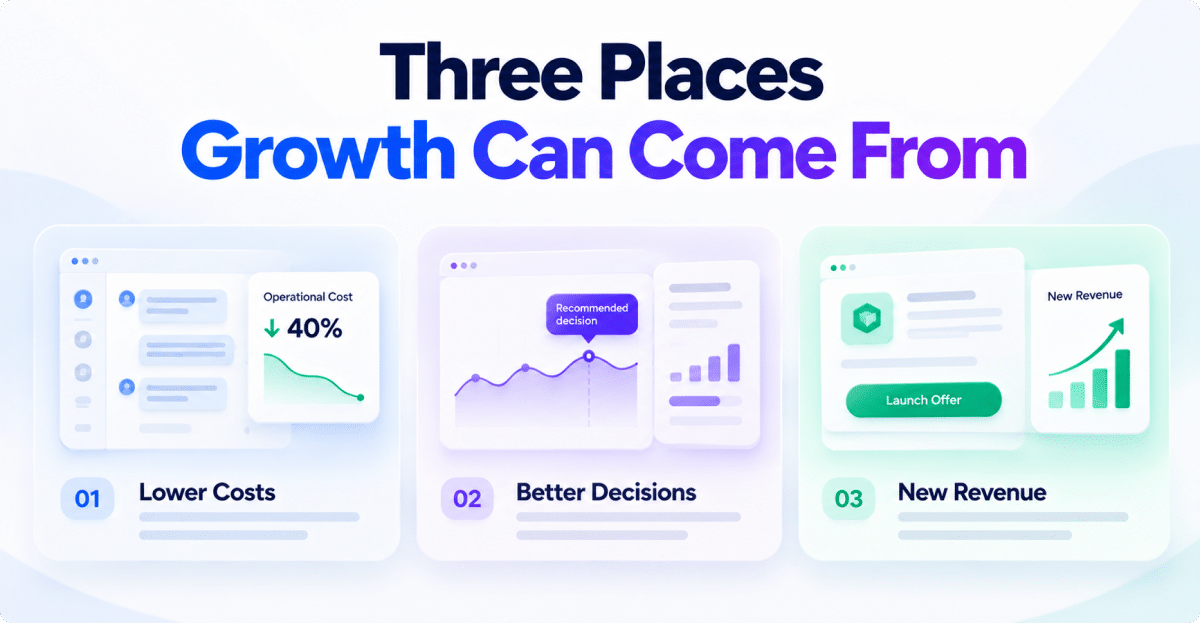
Not every use of AI grows a business. A mature artificial intelligence strategy names the growth it chases, in order.
- Less expensive to deliver work you're already doing, like helpdesk calls, invoice verification, or onboarding documentation. Finance can cost this out within a quarter. Savings taper off when the easy work is done.
- More effective decision making, as in how to price an unpopular product or how to interpret an incomplete loan application.
- New offers customers pay for. The upside is highest, and it needs product thinking more than engineering.
Most firms start with the first because the savings are visible by quarter end. That's sensible. Long-term growth still needs a dated plan to reach the third. Otherwise, the program stalls at cost cutting.
What Makes the Next Project Cheaper
A second project should cost less than the first, and a third less again. Licences and tools rarely do that. Four kinds of assets usually do.
- Data people trust: A documented customer table serves every later project. The cleanup cost gets paid once.
- Shared components: Think of a retrieval service, a test set of real questions, or an approval flow. Many teams can use each.
- Individuals who can recognize the incorrect solution even if it sounds good. There aren't many of them, and their training takes several months.
- Written decisions, including the ideas you turned down and why. New teams skip old arguments that way.
Enterprise AI adoption grows on what the first project leaves behind.
What counts as documented? We'd ask for three things.
- A named data owner who answers questions within a day.
- A refresh date printed on every report, so nobody wonders how old the figures are.
- A running list of known flaws, like customers entered twice or invoices with no date.
That list sounds minor. It saves the second team from rediscovering every flaw.
Here is an invented example with round numbers. Let's consider that a first claims-triage project takes seven months. It builds its own data pipeline, review screen, and test set. A second project reuses all three and ships in ten weeks. A third team, working alone, would have repeated the seven months.
The second number is the one worth tracking. Time to second deployment shows whether the first project left anything useful behind. If the figure barely improves, the company is buying one-off projects and little else.
Teach Judgment Before Tools
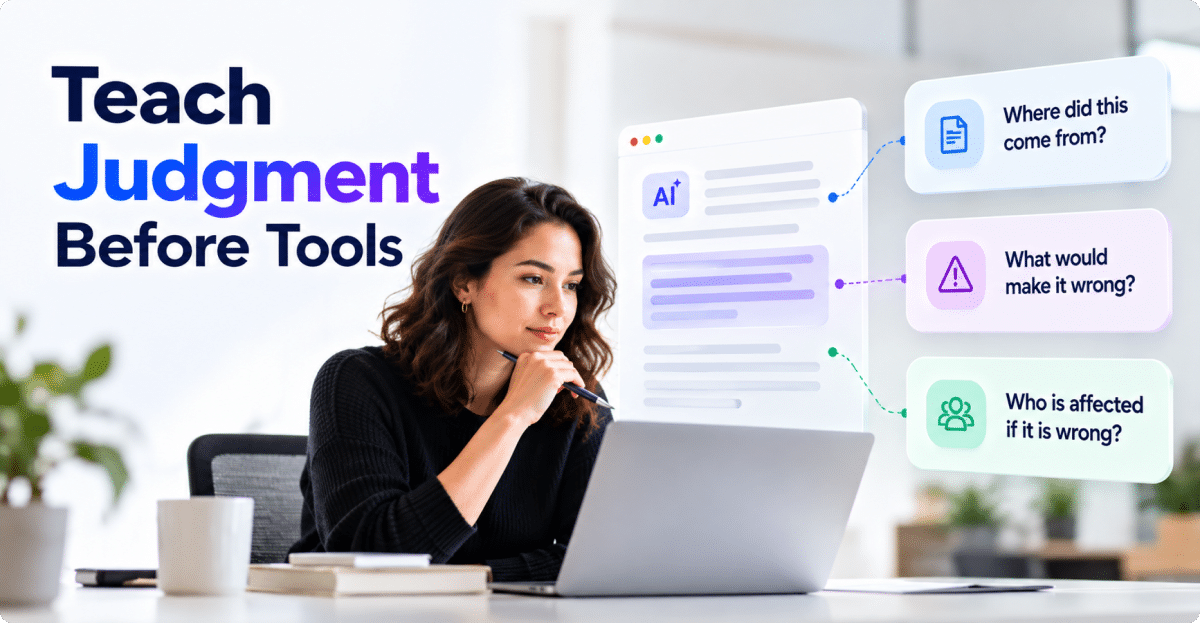
Training on buttons and prompts dates quickly. Judgment lasts longer. Teach people to ask three things of any output.
- Where did this come from?
- What would make it wrong?
- Who is affected if it is wrong?
Short sessions built on real cases from your own company work best. A claims team reviewing ten flawed summaries learns more than any slide deck could teach.
Plan in Layers, Because Some Things Will Break
On June 12, 2026, Anthropic announced the suspension of Fable 5 and Mythos 5 access following US export controls. Fable 5 access was restored on July 1, after the controls were lifted on June 30. However, Mythos 5 remained restricted to approved organizations, while Anthropic's other models stayed available.
We don't know how many customers felt it. The episode still shows a risk most plans never list.
A usable AI strategy framework splits the plan into a slow layer and a fast layer.
The fixed layer gets a yearly review.
- Business goals, each with the single metric finance will use to judge it.
- Who owns each dataset, and who may see it.
- Risk limits, including what AI may never decide alone.
- Funding rules.
The flexible layer gets a quarterly review.
Want AI doing the heavy lifting in your marketing?
I build the systems that handle the boring 80 percent, so you get your week back. Done properly, with the human kept in.
- Models and vendors.
- Prompts, tools, and integrations.
- Pricing assumptions.
- Which workflow runs on which model.
The flexible layer needs a fallback. For each critical workflow, name a second model that passes the same test set. Retest that second model every quarter. Fallbacks nobody tried tend to fail during the outage.
Fund It Like a Portfolio
Annual budgets are drafted with the assumptions that you will receive the desired outcomes. But AI work is seldom so predictable. So you should categorize your spending into three:
- Run covers live systems, including monitoring, output reviewers, and model fees.
- Grow takes a workflow that already works and extends it to another team or region.
- Explore funds small bets that carry a stop date, usually within one or two quarters.
Start near 60, 25, and 15 percent, then revisit after two quarters of real numbers. A pot gets more money only after its project clears a gate. Three questions work well at each one.
- Does it work on real data, including the messy cases?
- Do users still return after the second month?
- Does cost per task hold at full volume?
Buying changes the questions slightly. How do the various AI solutions compare regarding your ability to terminate them easily? Demo features are very similar. Look into data retrieval and contract termination costs. Check whether prices rise with usage.
Gates sometimes say no. Imagine a pilot that cuts handling time by a third in the demo. At full volume, reviewers spend as long checking answers as they once spent writing them. The gate catches that before the grow budget arrives. That team goes back to Explore and tests why review took so long.
Decide Who Can Say No
Shopify's rule gives managers permission and pressure. Regulated firms, such as banks and insurers, need a counterweight too. Someone needs the authority to halt a system mid-quarter. A credible enterprise AI strategy says who.
Try asking who in your company can pause a live AI system today. Hardly anyone answers quickly, and that delay costs the most during an incident.
A short list of decision rights helps.
- A named owner for every use case, with the name written in the plan.
- A small review group, perhaps four or five people, with authority to pause work.
- A rule for when business units may buy AI tools on their own.
- A log of every pause, with the reason and the outcome.
Thirty minutes each week usually covers it for a group this size. Monthly committees often meet after the problem has already grown.
Build Stages Around Evidence
Most roadmaps assign dates to projects. We'd assign evidence to stages. Each stage opens only when the last one produces a result. Here is how an AI roadmap could run across the first eighteen months.
- Months 1 to 3: Choose one workflow, write down what it costs today, and collect fifty real cases for testing.
- Months 4 to 9: Put it live with one team of ten or twenty people. Track cost per task and how many users return.
- Months 10 to 18: Move to a neighboring workflow, borrow the shared parts, and shut down the weakest pilot.
Expect delays. A late stage backed by evidence beats an on-time stage without it.
Some boards label all of this AI transformation. The phrase promises a finish line, which is a poor fit for planning. A company that expects to finish tends to stop reviewing.
Measure Growth Without Fooling Yourself
Give every use case one business outcome, and let finance or an operating head own the number. Everything else is a health check. These five travel well across industries.
- Time to second deployment, as described earlier.
- Share of critical workflows with a tested fallback.
- Cost per resolved task, tracked monthly.
- Share of trained users still active after sixty days.
- Number of projects paused or retired this year.
That last one surprises people. A company that never stops anything probably isn't looking closely.
A sound AI adoption strategy looks past logins. Each quarter, sample a few real tasks and see how people used the tool. Look for work people avoid giving the tool, since that reveals mistrust early.
Keep the Board Informed in One Page
Boards drown in AI updates and still ask the same question. Is this working? A single page each quarter usually answers it.
- One business outcome per use case, with the baseline beside it.
- The state of each fallback, tested or untested.
- Projects paused or retired, with reasons.
- The one decision you need from the board, and the date it's due.
We'd test any artificial intelligence strategy by asking whether it fits on one honest page. Forty pages usually get skimmed by the people who approve budgets.
Where Outside Help Fits
Some companies can run all of this alone. A firm with a strong data team may need only a light check. Others lack time or neutral ground. That's where outside review pays back fastest. Outsiders can challenge early assumptions while changing them costs little.
Good AI strategy services usually leave several things behind.
- A baseline that finance trusts.
- A cost model with a few stress cases.
- Decision rights written in plain language.
- A fallback plan for each critical model.
A few questions are worth putting to any partner.
- Have you run one of these systems in production for over a year?
- How do you handle a vendor change midway?
- Can you show a project you advised stopping?
A Practical First Step
Choose one automation that is already live, such as invoice matching or ticket routing. Put the three questions to its manager. The answers will show whether anyone close to the work has seen the plan. Perhaps the managers agree, or perhaps they give three different answers.
Then find its fallback model and run the same test set against it. A weak spot found this week costs less than one found mid-outage.
Take the results to your next budget meeting. If you've shipped two projects, show the time between them. Finance would usually appreciate numbers backed by a test. If the answers feel thin, AI strategy consulting costs far less than a mid-year reversal. We would book that review early, while changing course still costs little.