The gaming industry offers significant growth potential, yet building a company that can move from the startup stage to international scale requires careful planning. Successful gaming brands balance creative development with operational structure, regulatory compliance, and long-term audience engagement. Early decisions about leadership, technology, and distribution channels influence whether a company remains small or grows into a global competitor.
Establishing the Core Brand and Product Identity
Every successful gaming company begins with a clearly defined brand identity. This includes visual style, gameplay philosophy, and the type of audience the company aims to serve. Strong brand positioning allows players to recognize what makes a studio unique in a crowded market.
Product identity should also guide development choices. Some companies focus on mobile-first experiences, while others specialize in multiplayer platforms or competitive esports titles. Consistency between brand message and product design builds recognition and player loyalty.
Early-stage companies benefit from developing clear content guidelines and community communication standards. These practices help maintain consistency as the organization grows and additional teams become involved in production.
Building Scalable Technology Infrastructure
Technology architecture plays a major role in a gaming company’s ability to expand. Platforms must handle increasing player numbers, content updates, and data security requirements. Cloud-based systems and modular software development allow studios to scale operations without rebuilding core systems.
Many gaming founders also look closely at international business structures early on, particularly when building remote-first or digital gaming companies. Estonia has become a popular option because of its streamlined digital infrastructure and startup-friendly environment, and there are specialist providers offering Professional Services around company formation matters in Estonia for founders expanding internationally.
Scalable infrastructure also supports global distribution. Multiplayer games and online platforms require reliable servers, secure payment systems, and efficient content delivery networks. Investing in stable technology early prevents performance issues that could damage player trust.
Data analytics tools also provide valuable insight. Monitoring player engagement, gameplay patterns, and retention rates allows developers to refine features and prioritize future updates.
Regulatory and Market Considerations
International expansion introduces regulatory requirements that differ by region. Companies operating in competitive gaming sectors, such as online betting platforms, must ensure compliance with licensing regulations before entering new markets. Obtaining an iGaming license is often required for companies that offer wagering features or operate regulated gaming platforms.
Legal compliance extends beyond licensing. Privacy rules, payment regulations, and consumer protection laws vary widely across countries. Establishing a legal advisory structure helps companies maintain compliance while pursuing growth opportunities.
Localization is another factor during international expansion. Games may require language support, cultural adjustments, and region-specific marketing strategies to succeed in global markets.
Organizational Structure for Growth
A startup gaming studio often begins with a small group of developers and designers who manage multiple responsibilities. As the company grows, leadership roles become more specialized. Product management, community engagement, marketing, and customer support teams contribute to a sustainable structure.
Clear communication channels become increasingly important as teams expand. Project management systems and structured development timelines help maintain coordination across departments.
Want AI doing the heavy lifting in your marketing?
I build the systems that handle the boring 80 percent, so you get your week back. Done properly, with the human kept in.
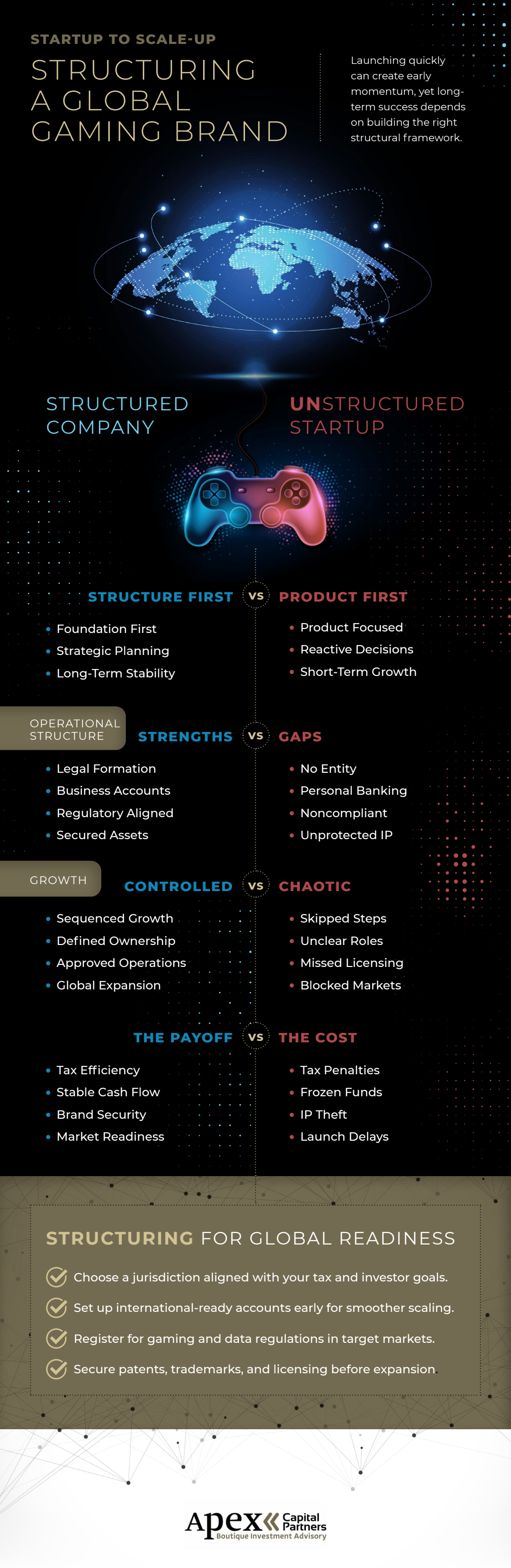
Building a global gaming brand requires balancing creative innovation with disciplined operational planning. Strong brand identity, scalable technology, regulatory awareness, and structured leadership allow gaming companies to move beyond the startup phase. Look over the infographic below for more information.
Related: How to Make Your Podcast Stand Out in a Saturated Market
I go much deeper on this in the digital marketing guide.
Related: how to streamline your business in 2021.
Related reading: AI and Brand Voice: Your Secret to Quality, Scalable Content and How do you build a successful global franchise business?.
The Publishing Deal That Almost Sank Us at Series B
I worked with a mobile gaming studio a few years back that had one hit title pulling in around 400,000 daily active users, and they signed a publishing deal that gave away 65% of ad revenue in exchange for a $2 million marketing spend commitment. On paper it looked like rocket fuel. In practice, the publisher underspent by nearly 40% in the first two quarters and the studio had no contractual clawback clause to force the issue. That single oversight cost them roughly eight months of growth they never fully recovered, because by the time they renegotiated, three competitor titles had already eaten their user acquisition channels at a much lower CPI.
The lesson I took from watching that unfold: never sign a publishing or distribution agreement without a minimum spend guarantee tied to specific dates, not just totals. A clause that says "$2 million over 24 months" is worthless if $1.8 million of it lands in month 23. Ask for quarterly benchmarks with a penalty or renegotiation trigger if the publisher falls behind by more than 15%. It sounds like a small contractual detail, but it is the difference between compounding growth and stalling out right when investors expect momentum.
On the flip side, I have also seen a studio in Warsaw structure their deal the right way. They kept 55% instead of 70% of revenue but locked in a hard quarterly spend floor with automatic renegotiation rights. That 15-point revenue haircut looked worse on the term sheet, but it gave them predictable growth they could forecast to their board, and predictability is what let them raise their Series C eighteen months later at a clean valuation instead of a down round.
Three things I now tell every founder before they sign anything with a publisher or platform partner:
- Get spend commitments broken into calendar quarters, not lump totals over a multi-year window.
- Negotiate a renegotiation trigger, not just a termination clause. Termination is a nuclear option nobody wants to use; a trigger keeps both sides at the table.
- Model your CPI sensitivity before signing. If your CPI rises even 20% during a slow-spend quarter, know exactly how many months of runway that costs you.
None of this shows up in the glossy case studies about scaling gaming companies, because most founders do not want to admit they nearly lost a year of growth over a contract clause. But it is often the boring paperwork, not the product or the marketing, that determines whether a studio makes it to global brand status.