Local business owners have a lot of options for promoting their business online, and may not be aware of all the things you can do to help drive traffic to your business. Remember that even as a local business, most people in your local community are using smartphones and the internet.
Unless your business is located in a very small town where everyone goes to the same hardware store and knows each other by first name, you cannot underestimate the effectiveness of online marketing.
In this handy article we’re going to show you a few creative marketing ideas you can do online for a local business. After reading through, you can check out this blog which contains even more small business marketing ideas.
Set up your Google My Business and Yelp
If you haven’t already, you should immediately add your business to Google My Business as well as Yelp.
Google My Business is a free service that allows you to completely manage your online presence on Google searches, as well as Google Maps - the latter being quite important for a local business.
It should be noted that a Google My Business listing should not be used as an alternative or replacement for having an actual website, but rather used as a complementary service. For example, you can embed a Google Map on your website, set to your business location.
As for Yelp, many business owners make the mistake of believing it is mostly a restaurant review service. This is quite untrue, as only 19% of businesses reviewed on Yelp are in the restaurant category. It may be the highest category, which gives Yelp that reputation, but all local business types have a place on Yelp.
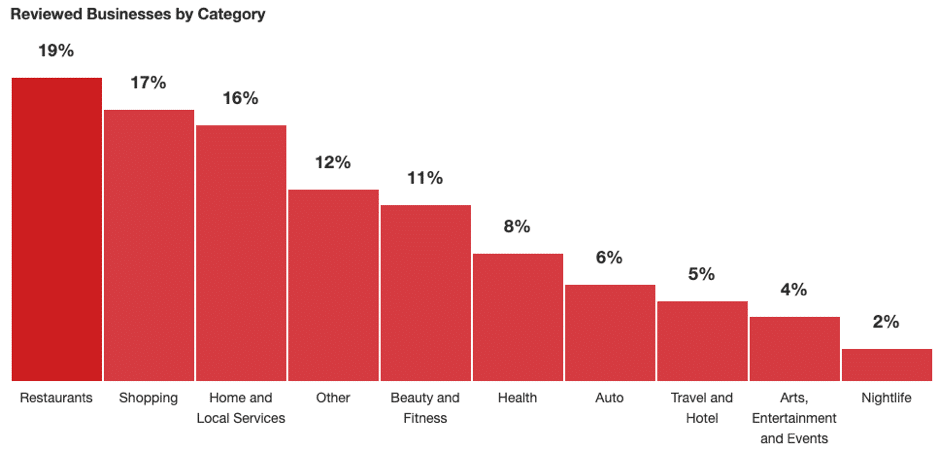
As you can see from this chart, shopping doesn’t fall far behind restaurants, followed by home and local services. Nightlife is actually the least reviewed business category, but to be honest, Yelp currently has 141 million users, so 2% is still a lot of people.
Start blogging
Blogging is a great way to promote your business and help yourself climb the Google search rankings. But of course, your blog should have a purpose, and not necessarily simply promoting your business or your 4th of July sales (that’s what social media is for).
Your blog should serve to illustrate that you’re an expert in your particular niche. So for example, if you own a mechanic and auto-parts shop, you should blog about things like car maintenance, going a bit in-depth on topics like using alcohol in air brake systems, mentioning specific products you have in stock, etc.
If you aren’t a talented writer, that’s okay - you can even outsource the writing to a freelancer or creative writing industry. The point is, your blog should be a source of valuable information, not a daily diary for your business.
Social media pages
Having social media pages is a great way to interact with the local community and people within your area, but I’m sure you’re already aware of that. One great thing you can do however, which is often overlooked by local business owners, is how precisely you can dial Facebook ads to an exact audience.
Business pages can purchase ads on Facebook, but you can get really in-depth with exactly who will see your ads. This can save you a lot of money on advertisements, and help you experiment to discover exactly who your target audience is.
For example, let’s say you want ads displayed to everyone between the ages of 18 - 45 within a 25 mile radius. That might cost a bit, right? But if you narrow it down - say, displaying your ads to only women between 18-25 in a 25-mile radius, that will drop the price of the ads a bit.
Now you can experiment with this - displaying your ads to various demographics, and monitoring your ad performance, to figure out which demographic gets the most engagement.
Partner with other local businesses
Finally, partnering with other local businesses in your area can be beneficial, especially through social media. You might agree to mention each other’s businesses on your social media pages, or host a local community event together. A daycare, for example, could mention sales being run by a local children’s boutique, while the boutique mentions the daycare’s enrollment offerings.
Want AI doing the heavy lifting in your marketing?
I build the systems that handle the boring 80 percent, so you get your week back. Done properly, with the human kept in.
Related reading
- 5 Ways to Make Your Business Digitally Attractive in 2025
- How Small Businesses Can Benefit from Account Based Marketing
- Navigating Funding Options For Your Business: A Strategic Guide
- Focus That Delivers: Setting Quarterly Priorities That Actually Move The Business
- how to start an online business
Related: these Facebook Messenger hacks
Why Most Local Businesses Botch Their Creative Ideas (And How to Fix It)
I see this pattern every week: a local business owner gets excited, copies a creative campaign they saw online, launches it on their own channels, and wonders why it flops. The mistake isn't the idea itself. It's that they skip the step that makes creativity work: mapping it to their specific customer and measuring what happens.
Here's what happens in practice. You have a hairdresser in Manchester who decides to do "before and afters on TikTok." Sounds creative, right? But if 95 percent of her clients are over 55 and booking through WhatsApp, TikTok is noise. She'd get better results filming short testimonials, putting them on her website, and asking her existing clients to share them via email. That's still creative. It's just targeted.
The second killer mistake is launching without a success metric. I worked with a local plumber who ran a "name that van" contest on Facebook. Fun idea. Zero entries. Why? He never told anyone who the target audience was. Should customers name it? Employees? His mates? The post didn't say. Vague creative always underperforms.
What changed in 2026 is that local search now rewards consistency and specificity more than novelty. Google and local directories prioritize businesses that show up predictably in their category with clear proof of service. This means your creative ideas need to feed into that system. A dental practice doing a "smile of the month" feature on Instagram isn't just posting nice photos. Those posts are also keyword-rich updates that tell Google the practice is active, the area they serve, and what they specialise in. That's creative work that serves your rankings.
The practical framework I use with clients is this: Start with the constraint, not the idea. What's your actual customer doing? Where are they? What problem are they solving? Once you know that, creative ideas flow naturally. A local accountant serving small e-commerce sellers could create a monthly tax checklist video. That's creative. It's also exactly what her audience needs. A gym targeting post-40 fitness could film real transformations and email them weekly to past members. That's creative. It drives re-engagement.
Then you measure. Not vanity metrics like likes. Real metrics: Did this idea bring inquiries? Did it improve retention? Did it increase email signups? A local restaurant's "introduce a friend" referral video campaign should be tracked by how many new customers it brings, not how many views it gets. Set that benchmark before you launch.
One more thing: test small. I tell every local business owner to run creative ideas for two weeks on a tiny budget or audience segment first. See what lands. Then scale what works. A salon trying a "first-time client hair consultation video" should post it in her email and WhatsApp group first, measure enquiries, then decide if it's worth promoting more widely. This kills costly mistakes fast.
For guest contributors covering this area, read Write for Us Culture and Art: Creative Business Blog Guest Post Guidelines.
More questions
How do I know if a creative idea is right for my local business?
Test it against this: Does it solve a real problem for your customer, can you do it consistently, and can you measure the result? If it's just "clever for clever's sake," it's waste. If it addresses something your customers ask about, builds on what you can repeat monthly, and has a trackable outcome (more bookings, higher email opens, more inquiries), it's worth doing.
Should I copy creative ideas from bigger brands and adapt them locally?
Only if you adapt them deeply. Don't just change the logo. Change the entire execution to match how your specific customers behave, what platform they use, and what they care about. A national brand's Instagram reel might not work for you if your customers are on Facebook Groups or WhatsApp. The principle might transfer. The tactic won't.
What's the minimum budget needed to test a creative marketing idea?
Zero for the first test. Use your email list, WhatsApp group, or existing social followers. If it works there, then invest in small paid promotion (50 to 100 pounds weekly for a fortnight). Never invest heavily in a creative idea until you've seen organic traction first. That tells you if the idea itself is sound or if you just have reach and budget disguising a weak concept.
Related reading: How to Create a Community in WhatsApp Business (Step by Step, With the N.