


- Social media fail no. 1: Be careful what you retweet: the IHOP vs. Hillary fiasco
- Social media fail no.2: the McDonalds vs. Trump Twitter fiasco
- Social media fail no. 3: Wendys - Think before you tweet
- Social media fail no. 4: United Airlines – Cameras are everywhere
- Social media fail no. 5: Yahoo! Finance - Always (!!) spellcheck your tweets
- What the Pepsi and Dove Disasters Cost in Real Numbers (And What Most Post-Mortems Get Wrong)
- Conclusion: the biggest social media fails of 2017
- Frequently asked questions
Social media fail no. 1: Be careful what you retweet: the IHOP vs. Hillary fiasco
Personally, when I think social media fail, I think “oh, someone’s posted something naughty…” but IHOP have proved that even something as simple as a retweet can turn the Internet against you. Politics are always inflammatory and they tend to spark a lot of controversy, so it’s never a good idea to get involved, as a business – even if it’s something as simple as a retweet. In IHOP’s case, it was this retweet that caused all of their problems: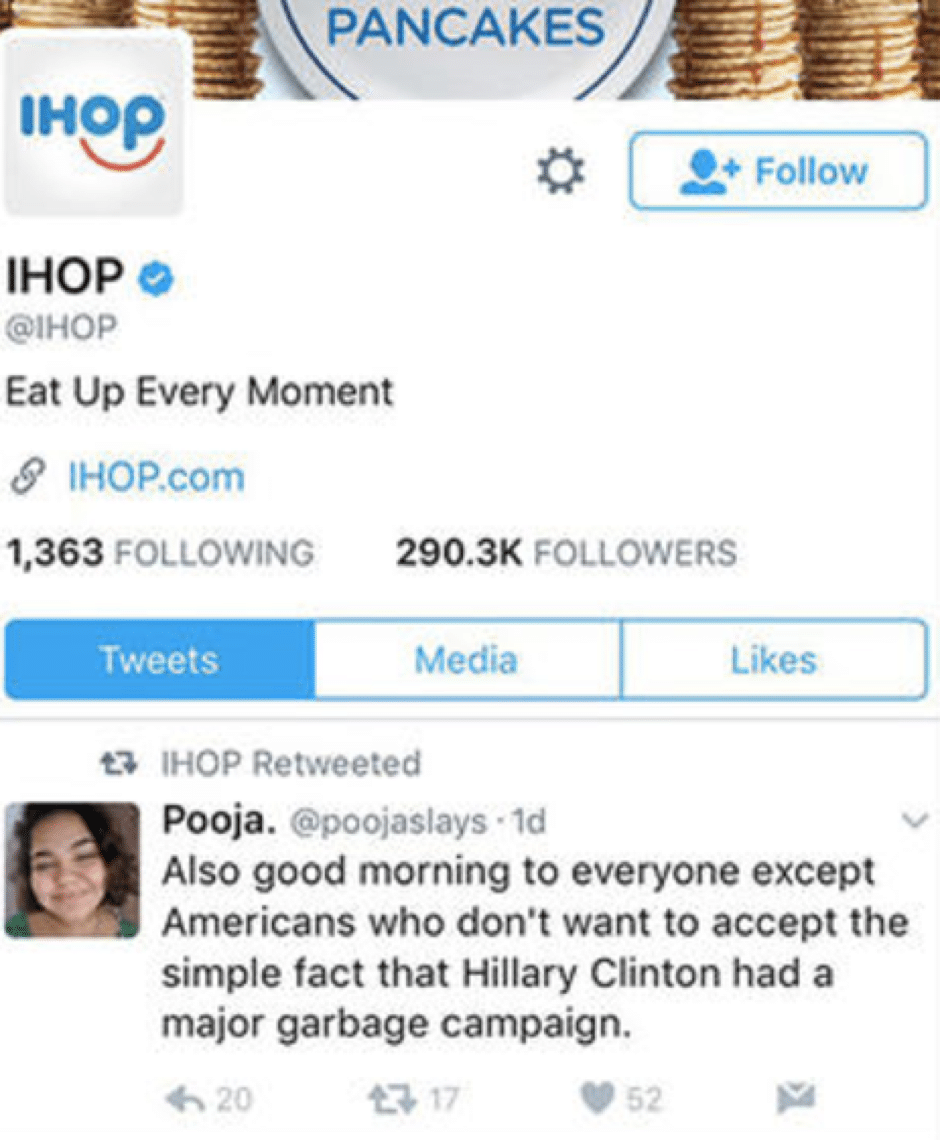
Social media fail no.2: the McDonalds vs. Trump Twitter fiasco
This is one of the biggest, most discussed social media fails of the year, so far – the McDonalds anti-Trump tweet where the president of the United States was called “disgusting”: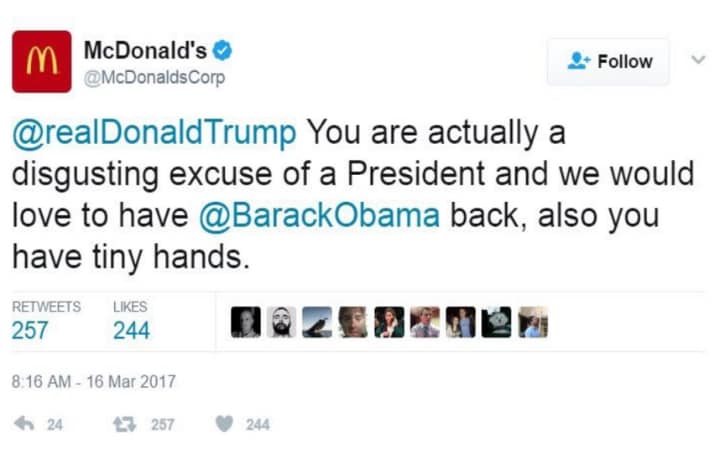
But, as we all know, the Internet moves fast – especially on Twitter. The tweet generated a lot of attention, with many users poking fun at McDonalds, but there were also plenty that took offense and claimed they won’t eat at the popular fast food chain. The most important thing to learn here is that you need to keep your social accounts safe; even as a small business, you’re in danger of getting your account hacked, so you should always make sure that your accounts are protected:Twitter notified us that our account was compromised. We deleted the tweet, secured our account and are now investigating this.
— McDonald's (@McDonaldsCorp) March 16, 2017
- Create unique passwords for each of your social media accounts and make sure they are at least 10 characters, using a mix of different symbols, numbers and so on.
- Use the two-step verification process to connect your Twitter account and your phone number
- Don’t connect your social accounts to apps that you’re not sure are OK to use.
Social media fail no. 3: Wendys - Think before you tweet
Wendy’s Twitter account is notorious for their roasting of other users; they are often hilarious in the way they deal with the people interacting with them, or even with other fast food chains:Or:@realJoshAbraham @McDonalds We'll stick to our fresh beef. They can have those ice chips they're serving.
— Wendy's (@Wendys) March 30, 2017
Even though their accounts’ wittiness is definitely working for them, as it gets them a lot of attention on social media and on traditional media, even they can take things a bit too far. In this case, Wendy’s tweeted a meme without checking its meaning – or, at least, that’s the assumption:@_inkedSnowFlake pic.twitter.com/IhRsonIUnJ
— Wendy's (@Wendys) January 3, 2017
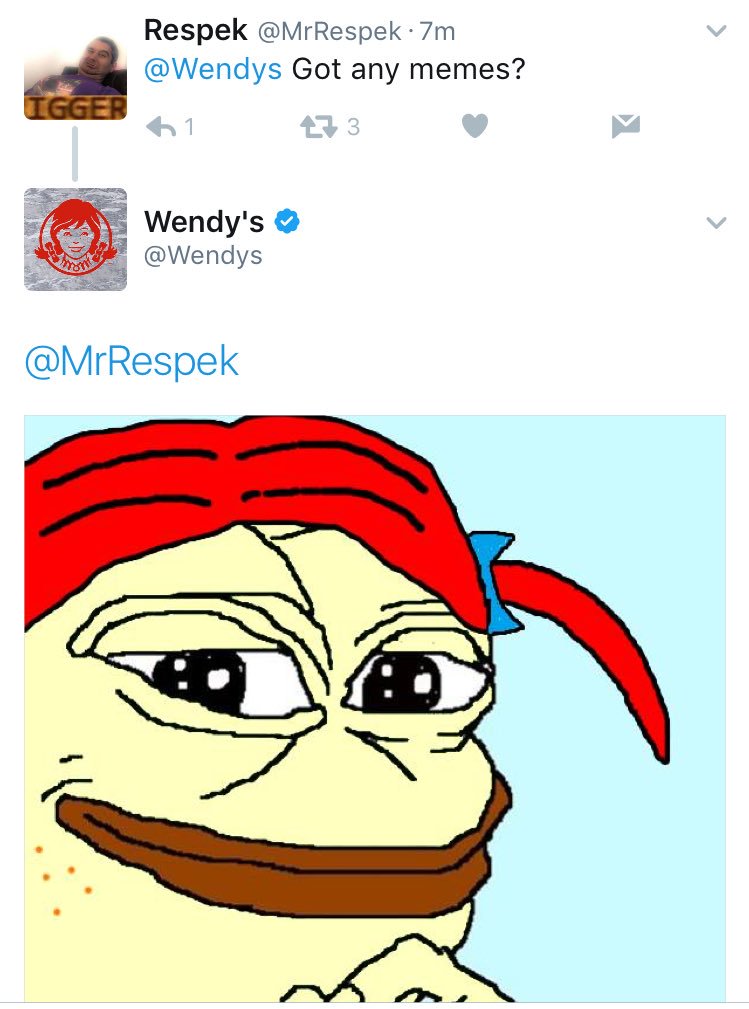
“the person who tweeted it did not know the meems new meaning, and promptly deleted it.”There’s an important lesson to learn here for businesses of any size on social media: if you’re not sure you know what a meme means, don’t post it – they’re fun, they’re popular, but the wrong meme can have a big negative impact on your success.
Social media fail no. 4: United Airlines – Cameras are everywhere
This is a very odd type of social media fail – but, in my opinion, it still is. In the United Airlines’ case, their failure to understand that everyone has a camera handy at all times and that you could be filmed at any given moment, has resulted in a worldwide scandal, a viral video and a huge drop in value for their stock. Fortunately for us, though, it also resulted in some very funny backlash on Twitter:United Airlines is pleased to announce new seating on all domestic flights- in addition to United First and Economy Plus we introduce.... pic.twitter.com/KQjPClU2d2
— McNeil (@Reflog_18) April 10, 2017
This fail teaches us that we need to always take care how we conduct ourselves in public; you can be filmed at any given time and you definitely don’t need to be famous to become viral.Board as a doctor, Leave as a patient. #NewUnitedAirlinesMottos
— Hrushikesh Apte (@hapte1) April 11, 2017
Social media fail no. 5: Yahoo! Finance - Always (!!) spellcheck your tweets
Yahoo! Finance made a very simple, yet devastating mistake – pressing on “n”, instead of “b” on their keyboard, which landed them in hot water, immediately:
What the Pepsi and Dove Disasters Cost in Real Numbers (And What Most Post-Mortems Get Wrong)
Most roundups of 2017's social media disasters stop at "the backlash was huge" and leave it there. That is not useful if you are trying to learn something actionable. So let me fill in the numbers people quietly skip over. Pepsi pulled the Kendall Jenner "Live For Now Moments Anthem" ad within 24 hours, but not before it had racked up roughly 1.6 million views on YouTube and generated an estimated 1.6 billion media impressions, according to tracking reported at the time. Here is the part most articles miss: a significant chunk of that coverage was not just negative in tone, it was specifically mocking the brand's creative judgment. That distinction matters enormously, because negative coverage about a product is survivable. Negative coverage that questions whether the people running your brand have any common sense at all is a different problem, and it lingers inside your agency relationships and internal teams long after the Twitter storm dies down.
Dove's "before and after" body wash ad, which appeared to show a Black woman transforming into a white woman, was pulled in October 2017 after a Facebook post screenshot went viral over a weekend. What the coverage rarely mentions is that the ad had been running for a month before it was flagged. One month. That tells you the failure was not a rogue post that slipped through; it was a systemic gap in the review process where nobody with the right perspective was sitting in the room when the final cut was approved. The cost was not just the brand equity hit. Dove's parent company Unilever had spent years building its "Real Beauty" platform, which by 2017 represented roughly a decade of marketing investment. A single creative oversight put that entire positioning in question in 48 hours.
The lesson most brand managers take away is "get more approvals." That is the wrong lesson. More approvals from the same homogeneous group of people produce the same blind spots. The actual fix is structural: you need people in the room who will feel the impact of the messaging in their own lives, not just assess it technically. I have spoken to several creative directors since 2017 who now run a specific "outside the building" review step before anything culturally sensitive goes live, where the work is shown to three to five people who had no involvement in making it. That one step, done honestly, would have caught both of these disasters before they went public.
There is also something worth saying about the speed at which brands apologised. Pepsi's statement came within hours and was relatively clean. Dove's initial response was clumsy and took multiple attempts to land correctly. The difference in how each brand recovered tracks almost exactly with the quality and speed of that first statement. An apology that sounds like it was written by a legal team trying to limit liability reads that way to every person who sees it, and it extends the story by another news cycle. A plain, human, specific acknowledgement of what went wrong shortens the story considerably.
- Pull the content first, then write the statement. Do not try to do both simultaneously under pressure.
- Name the specific thing that was wrong. Vague apologies read as insincere.
- Do not announce the internal review you are going to conduct. Show the result of it later.
- Brief your customer service team before the statement goes out, not after.
2017 was not the year brands started making social media mistakes. It was the year the speed of the pile-on made it impossible to pretend the old crisis playbook was still working. The brands that have come out of these moments in better shape are the ones that treated the failure as a genuine diagnostic rather than a PR problem to be managed away.
Conclusion: the biggest social media fails of 2017
Although big corporations have a bigger following and they are much more publicized than small businesses and entrepreneurs, their social media fails can teach us all a lot of valuable lessons. From spell-checking all of your social updates before publishing and making sure memes aren’t offensive, to protecting your account from hackers, these are important lessons to learn. What are some other funny, entertaining or even educational social media fails you’ve seen this year?Related: how to make money on instagram with just 1k followers
The short version: 2017 was a year that proved even the biggest brands can get social media spectacularly wrong, with tone-deaf campaigns and crisis mismanagement making headlines for all the wrong reasons. From Pepsi's ill-judged protest ad to United Airlines turning a PR disaster into an even bigger one, the lessons are clear: know your audience, move fast, and own your mistakes. The brands that failed hardest in 2017 were the ones that forgot social media is a conversation, not a broadcast.
Want AI doing the heavy lifting in your marketing?
I build the systems that handle the boring 80 percent, so you get your week back. Done properly, with the human kept in.
Frequently asked questions
What was the most talked-about social media fail of 2017?
The Pepsi ad featuring Kendall Jenner was arguably the biggest social media fail of 2017, drawing immediate and widespread backlash for trivializing protest movements. The brand pulled the ad within 24 hours, but the damage was already done and the conversation had taken on a life of its own.
How did brands make their social media crises worse in 2017?
Many brands compounded their initial mistakes by responding slowly, issuing defensive or insincere apologies, or simply going quiet and hoping the storm would pass. United Airlines became a textbook example of how a delayed and dismissive response can turn a bad situation into a full-scale reputation crisis.
What can marketers learn from the social media fails of 2017?
The biggest takeaway is that authenticity and speed matter more than polished corporate messaging when things go wrong. Brands that acknowledged their mistakes quickly, spoke like human beings, and took real action fared far better than those that hid behind scripted statements.
Were smaller brands also guilty of major social media fails in 2017?
Absolutely. Smaller brands and individual influencers had their share of damaging moments too, proving that poor judgment on social media is not limited to big corporations with big budgets. In fact, smaller accounts sometimes faced disproportionately harsh reactions because they lacked the crisis communication resources to respond effectively.
Related reading: How To Recover A Hacked Facebook Account (What Works In 2026).
Related reading: How to Get Started in Human Resources Work Remotely (The Path That Works.
Related reading: How to Delete an Instagram Story You Have Posted.
Related reading: Why Instagram Story Reactions Matter More Than You Think for Your Engage.
Related reading: How Do You Get Started With Law Related Remote Jobs?.
Related reading: How Twitter Age Verification Works for Businesses in 2026.

