


The path from idea to established business is rarely linear. Start-ups that survive early-stage chaos often find themselves at a different kind of crossroads during the scaling phase. Growth demands capital, but raising funds at this stage becomes more complex, even for companies with traction and a promising product.
From Seed to Series: Shifting Investor Expectations
During the seed phase, investors are often drawn to potential. Early funding hinges on vision, charisma, and perhaps a prototype. But as a company grows, metrics take center stage. Revenue projections, customer acquisition costs, and retention rates matter more than ambition. Start-ups scaling past their first few funding rounds must contend with an investor base that demands clarity over conviction.
At this point, valuation becomes a sticking point. Founders expect a significant bump in worth. Investors, on the other hand, want proof the business can scale efficiently. If growth has outpaced infrastructure, or if operational inefficiencies are eating into margins, it can be difficult to justify higher valuations. That disconnect can stall deals.
Cash Flow Versus Capital Access
For many start-ups, customer demand isn’t the problem. It’s the working capital gap. Scaling operations often means hiring staff, upgrading technology, or expanding production. These are upfront costs that don’t pay off immediately. Venture capital isn’t always the best fit here, and traditional lenders can be wary of firms without consistent cash flow or collateral.
Non-dilutive funding, such as revenue-based financing or grants, may help bridge this gap, but they are not always easy to secure at the speed scaling companies require. This is especially true in sectors like clean tech investing, where capital needs are steep and regulatory timelines can be unpredictable.
Overlooked Operational Challenges
Securing capital isn't the only challenge. Deploying it effectively can be just as difficult. Many founders learn the hard way that scaling isn’t just doing more of what worked at the start. Systems need to evolve. Leadership must shift from reactive to strategic. Teams require structure. Failing to plan for these changes can lead to burned capital and missed growth targets, both of which are red flags in future fundraising efforts.
Staying Fundable in a Shifting Market
The current investment climate adds more pressure. Market volatility and investor caution have reshaped term sheets and stretched fundraising timelines. Start-ups looking to raise need to show not just growth but resilience. Transparency, financial discipline, and an ability to adapt are increasingly the qualities that attract capital.
Want AI doing the heavy lifting in your marketing?
I build the systems that handle the boring 80 percent, so you get your week back. Done properly, with the human kept in.
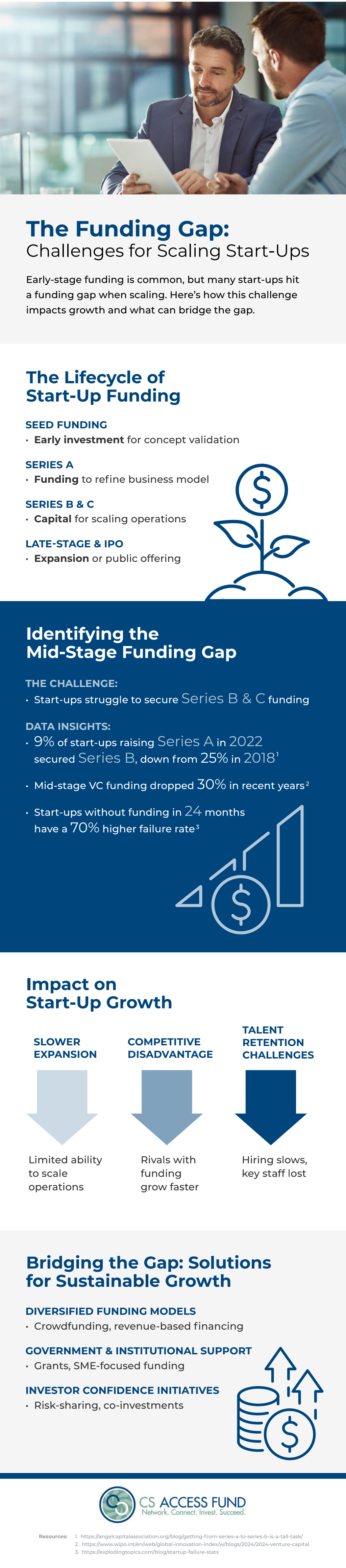
Raising funds during the scaling phase requires more than a good story. It demands evidence, preparation, and an honest assessment of the business’s operational foundation. The companies that succeed are those that recognize scaling as a stage where growth must be sustainable, not just fast. For more information, look over the infographic below.
Related: 8 qualities to look for in a reliable digital marketing service provider.
Related reading: Virtual Assistant Business: The Complete, Honest Guide to Starting, Scaling, and Making Money and How Twitter Chats Can Grow Your Business Audience (And Why Most People Quit Before They Work).
You can also write for us about finance.
Bottom line: Scaling a start-up isn't just about getting more customers, it's about having the cash flow and funding structure to support growth without breaking under the weight of it. Many founders hit a wall not because their business idea fails, but because their funding strategy doesn't evolve as fast as their growth does.
Frequently asked questions
What is the biggest funding challenge start-ups face when scaling?
Cash flow gaps are the biggest issue. Revenue grows, but so do costs like hiring, stock, and operations, often faster than the money comes in. This mismatch catches out even businesses that look successful on paper.
When should a start-up look for growth funding?
Before you desperately need it. The best time to raise funding is when your business is showing strong momentum, not when you're scrambling to cover payroll. Investors and lenders want to see growth backed by a plan, not a business in crisis.
Is debt or equity better for scaling a business?
It depends on your goals and how much control you want to keep. Debt lets you retain ownership but adds repayment pressure, while equity brings in capital and expertise but means giving up a share of the business. Many start-ups end up using a mix of both at different stages.
Can a start-up scale too quickly?
Yes, and it's one of the most common causes of failure. Scaling too fast without the systems, staff, or funding to support it can strain a business just as much as not growing at all. Sustainable growth requires pacing that matches your financial and operational capacity.

