- How to boost your site's conversion rate
- Use a countdown timer (with a genuine limited time offer)
- Use interactive content
- 3. Use a callback solution
- 4. Follow your competitor's flow
- 5. Make use of videos and animation for your content
- Conclusion: boost your site's conversion rate
- About the author:
- Frequently asked questions
A conversion rate represents the number of customers and clients that you have succeeded in converting into a sales opportunity. And let’s be honest, who would not want to increase their conversion rate? It is one of the hardest things to succeed in. Only 22%of the businesses are satisfied with their conversion rates. (Econsultancy, 2016).
And it is therefore important to properly analyze which ways work best without losing time on the things that don't work. In this article, I’ll share 5 lesser known tips that can help boost your site' conversion rate.
Let’s get to it!
How to boost your site's conversion rate
-
Use a countdown timer (with a genuine limited time offer)
One way to boost your site's conversion rate is by making use of a countdown timer which creates urgency to buy. If the customers want a product, they need to take action or the offer will become invalid.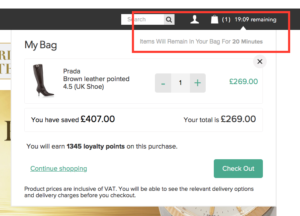
“Countdown timers aren't just applicable in the world of eCommerce, they’re also useful if you're trying to get people to sign up for your company’s course, webinar, or something else”. - Cherie Foo, Marketing Exec at UpLead
With a countdown timer, you increase the urgency of your offer by utilizing a countdown timer to highlight the time left until your introductory price or promotion price is no longer valid.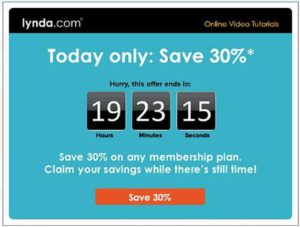
If you use them right, they can be very effective but it’s important to stay honest. Urgency is an effective tactic, but it has to be used carefully and truthfully or you risk getting annoyed customers.
For example, some companies offer a webinar for only 6 hours. And if you return the next day, it shows 10 hours for that same webinar. There are still many buyers that fall for these false low stock levels, a common practice by e-retailers. But people are becoming more aware of the misuse of such timers which, ultimately, results in drops in conversion rate.
So in short, make sure you stay honest, in that way your audience will trust you.
-
Use interactive content
Focus on your audience’s biggest pain points and greatest desires - unleash empathy and emotions. An effective example to do this with is making use of personalized content and interactive content.
Personalized content doesn't require expensive setups and AI. A lot can be achieved by building little pieces of content that are interactive and that return personalized information that is of value to your audience.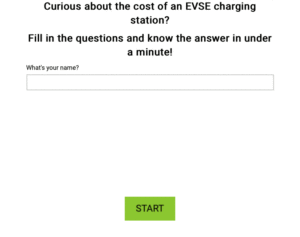
Take this calculator for example. In which Eneco used Survey Anyplace to create a calculator that could give people an idea of what it would cost to buy an EVSE (“Electric Vehicle Service Equipment”, a home charger for your electric car) and convert them into leads.
By offering this content interactively, people found out more quickly what they needed (what type of charging station they needed for electric cars).
The content therefore not only provides information, that information is also highly relevant and gives an answer just what the site visitor needs.
In exchange, Eneco was able to collect more than 1000 leads in just 6 weeks, additionally, they have the data from the questionnaire to help each lead with exactly what they are looking for.
Offering tailor-made information is extremely valuable. In addition to the personalized result from a calculator or any type of interactive content, you could use the collected data to auto-generate a PDF report.
Such a personalized PDF report can take your content to the next level and increase your conversions even more. Knowing that a detailed report with deeper insights, extra tips is waiting for them is a great stimulus to leave their contact data.
Offering something that makes your respondent feel special and appreciated as an individual is always a good way to go!
3. Use a callback solution
A new way to boost your conversion rate which you might not have heard of is using a callback solution instead of just a number on your page. Your website often gets visits from visitors that are still hesitating and they leave without completely understanding your product or service. Maybe your website did not answer their questions?
Making use of a callback solution is a good example to avoid scaring potential customers away by asking for their data. They do not want to receive weekly emails about newsletters if they only have a specific question about the product you offer.
With a callback solution, website users can fill in a widget to schedule a call with website representatives or can get you in contact with a professional right away.
Any conversation can be a conversion right?
Using a callback solution could increase your conversion up to 80% according to Limecall. This and Novocall are examples of a callback software that allows users to schedule a call instantly.
A platform, like these, gives a personal one-on-one answer to your potential customer questions and allows for callbacks with your sales team.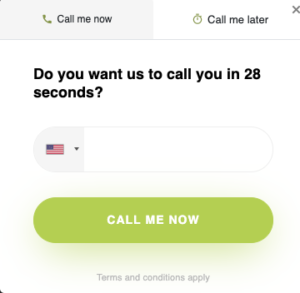
4. Follow your competitor's flow
Focus on unique value propositions, especially on your landing pages.
But a pro-tip? Follow your competitor’s flow…
Want AI doing the heavy lifting in your marketing?
I build the systems that handle the boring 80 percent, so you get your week back. Done properly, with the human kept in.
They've invested a lot of money in their websites, so there’s no need to reinvent the wheel. For example, if their call to action button is: "Register Here For 14-day Free Trial", this is a good indication of how to build up your own CTAs.
Blatant copying isn’t advised, but taking the same concepts and shaping them to fit your own unique product or service will help you set up more effectively converting landing pages with less trial-and-error.
Knowing what your competition changes on their website will allow you to stay ahead of the curve and possess the vital information necessary for strategic decision making. So the intention is that you look closely at your competitors and therefore respond to that and offer a better version than they do.
You won’t waste time on tests because you implement changes and improvements which you know are already working for your competitors. Regularly visiting and scrolling through your competitors websites requires time. An app that ensures that you can use that time for something else is Competitors app. On the Image below you can see a dashboard with an overview of all competitors' activities.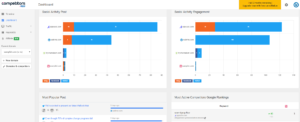
5. Make use of videos and animation for your content
The creation of landing pages that convert is all about clearly expressing your value as soon as possible. So that the visitors know exactly where you stand for as a company. It doesn’t mean that you have to explain all the benefits of your offer or service onto the first page.
Instead of using too much information you can create gifs, videos or interesting images that will explain your company. Studies show that people remember 80% of what they see, while only 20% of what they read and 10% of what they hear. On top of that, content with visuals is usually viewed 94% more than without. So you could conclude that strong visuals have way more impact than just information.
The more interactive your animations are, the more engagement you should see.
“Making use of video testimonials and tweets testimonials by industry leaders could help you as well. Many sites are using fake testimonials, and that's obvious. Often you will see that if you right click on the image of the person who gave the testimonial you see that it's just a stock photo image. That's terrible and it kills trust.”- Georgi Todorov, Marketing Consultant.
If you use real video testimonials, tweet testimonials by industry leaders, well-known people in your niche, you will get more conversion. In fact, Using videos on landing pages will increase conversions by 86%.
Like this landing page on the Clickcease site which shows exactly what the feature can do. Which is excluding invalid IPs and block fake clicks with their fraud protection software.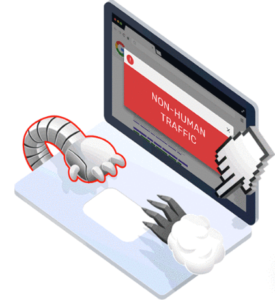
Conclusion: boost your site's conversion rate
So, if you want to boost your site's conversion rate you know what to do. Just make sure you apply these tips properly and you will see a remarkable change in your conversion rates. If you have any other unconventional ways to boost your site’s conversion rate please let me know in the comment section below.
And please do share if you liked the blog!
About the author:

The short version: Conversion rates climb when you stop following the playbook and start testing what your specific audience responds to. The most powerful boosts often come from small, unexpected changes like removing friction points, building genuine trust signals, or rethinking your call-to-action placement entirely.
See also 3 Ways to Effectively Increase Your Website’s Conversion Rate, which picks up where this leaves off.
Frequently asked questions
What makes an unconventional conversion strategy different from standard best practices?
Standard practices work for many businesses, but unconventional strategies are tailored to your unique audience and industry. They challenge assumptions about what "should" work and test alternatives that competitors might overlook. This means you're not just copying what everyone else does, you're finding what works specifically for your customers.
How do you know which unconventional tactic to try first?
Start by analyzing where visitors drop off in your funnel. Look at your bounce rates, scroll depth, and where people abandon forms or carts. Once you identify your biggest friction point, brainstorm three to five unconventional solutions and test them one at a time so you can measure what moves the needle.
Can unconventional methods work for all types of businesses?
Yes, but the specific methods will differ. An e-commerce store might focus on checkout friction, while a SaaS company might test trust-building approaches differently. The principle stays the same: question assumptions, test alternatives, and measure results. What works depends on your audience, not your industry.
How long should you test an unconventional strategy before deciding if it works?
Run tests long enough to collect meaningful data, typically at least two weeks, and ideally until you reach statistical significance. This usually means 100 to 200 conversions per variation, depending on your baseline conversion rate. Jumping to conclusions too quickly leads to false positives and wasted effort.
Related reading: Customer Service Representatives Work From Home Jobs: The Unglamorous Tr.
Related reading: Customer Service Representatives Remote Jobs: The Real Pay, Real Demands.
Related reading: Best Free Alternatives to Expensive Marketing Tools (Real Ones That Repl.
Related reading: AI Marketing Calculator: How to Measure What Your Marketing Actually Ret.