
Follow Lilach
Know your customer: 3 proven ways to understand your audience better
Knowing as much as possible about your audience – and your customer – is an essential part of improving your website’s success rate. How much do you know about your own audience? Why are they visiting your website, and what are they looking for? In this blog post, I will be looking at the types of personalities that generally make up website visitors so that you can better understand your audience.
If you’ve read my previous blog posts on conversion optimisation, then you’ll remember I’ve spoken about the 4 different personality types and what they each imply; this time, however, I want to go in a bit more detail for each group, as the more you know about them, the better you can optimise your website and improve your sales.
The importance of identifying your customers
 As a business, you need to know who your customers are so that you can sell to them better. But if you’re an online business, you need to understand more about their behaviour while they are online.
These people will reach your website through different methods – web searches, social media, web ads – they will be interested in different parts of your website and they will also have varying buyer characteristics. There are no two customers who will behave identically on your website, which means that in order to get the best possible results for your business and getting to the top, you need to at the very least group them into smaller segments, and offer them different customer experiences that will appeal to them more.
The more you know about each group of people, the better your marketing will be, and it will also be easier to anticipate what their reactions would be and to convince them to make a buying decision. Ask yourself this:
- What types of people are interested in your business?
- How do your visitors make the decision to buy and what motivates them?
- Are your website visitors more logical, or more emotional by nature?
- How quickly are they making decisions?
- Are your visitors more spontaneous, or are they rather more methodical in their decision making?
[clickToTweet tweet=”The importance of identifying your customers via @lilachbullock #conversion #optimisation” quote=”The importance of identifying your customers via @lilachbullock #conversion #optimisation”]
Knowing about your visitors’ decision making process can help you improve the information you give them in order to inspire a purchase.
At the end of the day, it’s all about helping the visitor buy – and not just about making as many sales as possible. Customers’ goals are very different to a businesses’, so we need to take that into account when optimising our website.
The selling process vs. the buying process
When creating an online business, you’ll most likely be tempted to create it with the selling process in mind; after all, that’s what you’re after, making as many sales as possible. But as I mentioned before, the customer’s buying process will not be the same as the businesses’ selling process. Customers need to go through certain steps in order to make the decision to buy, which are important to keep in mind when designing your online business.
In order to achieve a better, more optimised website for the visitor and buyer, you need to find a way to put yourself in their shoes and examine the process from their perspective.
In many cases, the modern buyer will evaluate their buying decision before they buy. They could be doing this by checking out your competitors, reading and viewing reviews of your products and your competitors’ to compare them and generally compare multiple sources of information before they actually buy.
Don’t confuse making a buying decision with adding a product or service to the online shopping cart. Shopping cart abandonment is a huge issue for online businesses, as sometimes as little as 12% of the items placed in online shopping carts actually proceed to checkout.
[clickToTweet tweet=”The selling process vs. the buying process via @lilachbullock #conversion #optimisation” quote=”The selling process vs. the buying process via @lilachbullock #conversion #optimisation”]
The essential elements of persuasion
So, you want your visitors to take more action on your website and convert at a higher rate? If so, it’s up to you to find ways of persuading your visitors.
You can start by answering these questions:
- Who are you trying to persuade? The more you know about your target audience, the better you can persuade them to take action and buy.
- What action do you want the visitor to take on your website? You need to have a clear definition of what action you want the visitor to take.
- What is it that will give your visitor the confidence to take that action? Provide your visitors will all the information and guarantee the need in order to give them the conviction that they should take action
[clickToTweet tweet=”The essential elements of persuasion for #conversion #optimisation via @lilachbullock ” quote=”The essential elements of persuasion for #conversion #optimisation via @lilachbullock “]
Modelling buying persuasion
As you learn more about your customers, you will be able to better predict their behaviour at different stages of the buying process and what type of information they are looking for. By building some predictive models, you will be able to get to know your customers even better, as you study their habits, behaviour and particularities in more detail.
You can start your modelling with more simple personas to break your customers into different groups, based on decision making styles, buying stages and so on. As you evolve and learn more, you can start creating more robust personas that will allow you to delve deeper into your customer’s personalities and help you understand more about how they think, how they act and what makes them buy, as well as the different angles and approaches they might take when they are looking for your product.
The 4 main online buyer personas
When it comes to buyer personas, they usually fall into one of these 4 major groups:
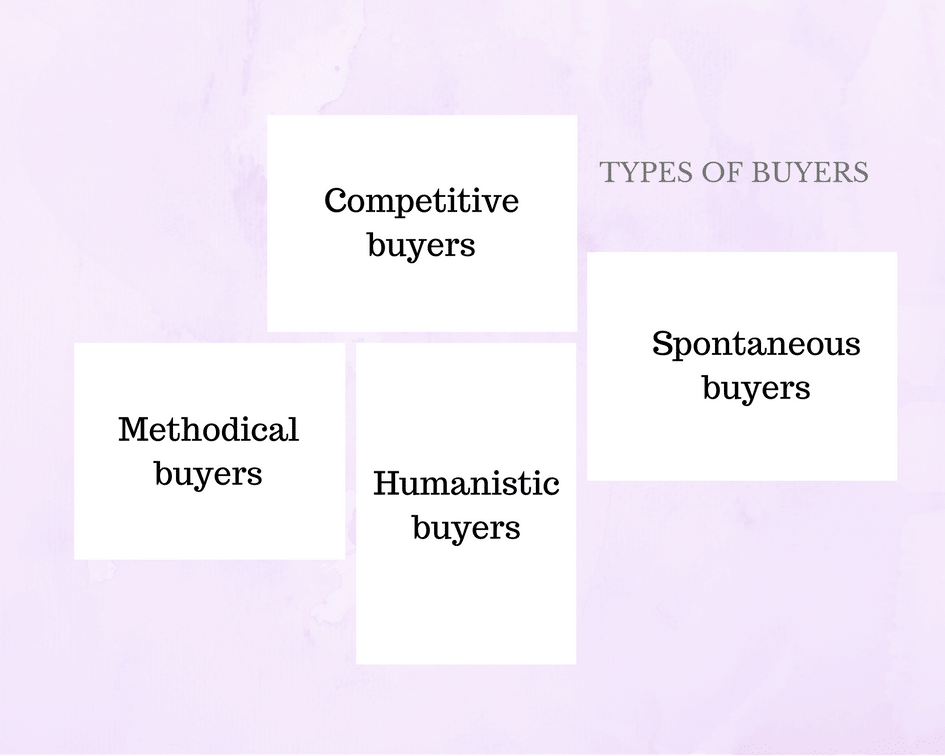
- Competitive visitors: competitive visitors will likely rush around the page, and only hunt for the information that they need, before moving on quickly to a different page or website. They won’t stick around to consume all of the information you’re giving them, but just the most relevant to them
- Methodical visitors: methodical visitors are basically the opposite of those that are competitive. These types of visitors will spend more time on each page, studying each part of it carefully, so as to make sure they’re not missing any important information by skipping some parts.
- Spontaneous visitors: as you can probably tell, these visitors are more emotional, and tend to make the buying decision more spontaneously. They are also more likely to be attracted by any interactive content on your page.
- Humanistic visitors: just like spontaneous visitors, humanistic visitors tend to be more emotional. A big difference between the two, though, is that humanistic visitors are usually not nearly as quick to make a buying decision. They also tend to be more interested in the more human elements on your page.
[clickToTweet tweet=”The 4 main online buyer personas you need to know #conversion #optimisation via @lilachbullock ” quote=”The 4 main online buyer personas you need to know #conversion #optimisation via @lilachbullock “]
You’ll most likely be seeing visitors off all 4 kinds on your website, day by day. Because of this, you need to identify in which groups your visitors lie, so you can properly optimise your website.
Here are some of the main characteristics you will find in each of the buyer groups:
Competitive visitors
 When it comes to competitive visitors, they are most likely to respond well to evidence: this means things like case studies, testimonials, before and after pictures and so on. They are quick and efficient in their decision-making process and they are looking for facts when deciding to buy something, not an emotional connection.
Some of the main questions they would like answered are:
- What makes your product or service the best possible choice?
- Is your business reliable, can it be trusted?
- How exactly will your offered solution help me become more productive, or more successful?
- What are your credentials?
- How exactly can you help me achieve my goals?
[clickToTweet tweet=”What are competitive visitors? #conversion #optimisation via @lilachbullock ” quote=”What are competitive visitors? #conversion #optimisation via @lilachbullock “]
Competitive visitors will want to buy the best product from the best business – make sure your web copy responds to all of these questions in a quick, efficient manner and that it shows that you have the competitive advantage.
Methodical visitors
While competitive visitors are also looking for relevant information to help them decide whether to buy or not, methodical visitors take this to the next level. In fact, they’ll probably take that page, or even the website, to task and go through all of the information before making a decision. As you can imagine, they usually take their time when deciding, so as to get the best possible thing.
Here’s what the methodical visitor will ask:
- What is the fine print for this product or service?
- How exactly does it work?
- What parts are you using to build your product and why?
- What are the product specifications?
- What kind of guarantee do I have if I buy from you?
[clickToTweet tweet=”What are methodical visitors? #conversion #optimisation via @lilachbullock ” quote=”What are methodical visitors? #conversion #optimisation via @lilachbullock “]
The more relevant details you can give your methodical visitors, the better.
Spontaneous visitors
Spontaneous visitors like to be in constant movement and will probably jump from one thing to the next. They also probably won’t be planning to buy anything much in advance and will make decisions spontaneously. Because of this, they are also likely to care more about speed, as well as about interactive content that attracts their attention.
These are some of the main questions a spontaneous visitor will need answered when buying something:
- How quickly can I get this delivered?
- Are you offering the best service on the market?
- How quickly can I achieve my goals with your product or service?
- Will buying this help better my life in some way?
[clickToTweet tweet=”What are spontaneous visitors? #conversion #optimisation via @lilachbullock ” quote=”What are spontaneous visitors? #conversion #optimisation via @lilachbullock “]
The humanistic visitor
Humanistic types tend to be more interested and passionate about people, rather than facts and figures. One of the best ways of persuading them is to give them a sense that your business is people-oriented and that there are some actual humans behind your business.
You can better convince the humanistic visitor to buy by adding testimonials to your product pages, adding images and detailed biographies on the ‘about us’ page and so on – the more you show your personal side, the better.
Some of the questions they might want answered are:
- Who are you?
- Who is using your products or services?
- What does it feel like to work with you?
- What are your values as a company?
- What do others have to say about the experience of working with you?
[clickToTweet tweet=”What are humanistic visitors? #conversion #optimisation via @lilachbullock ” quote=”What are humanistic visitors? #conversion #optimisation via @lilachbullock “]
Conclusion
Segmenting your visitors into smaller groups and knowing more about each of them can be of huge help when it comes to conversion rate optimisation. You will be able to write better, more appealing content, improve your messaging and design better websites and buying processes – all of which will help you make more conversions. What methods are you using to group your website visitors? Let me know and please share 🙂
Follow Lilach