


What is marketing automation?
As marketers, there are a lot of different tasks that take a lot of our time. Thankfully, there are plenty of tools out there that aim to help you save this time by automating these tasks, which leaves you with more time to focus on what you need to do in order to achieve your goals. With a good software to help, you can become more efficient at your job and get more results, in less time. [sc_fs_faq sc_id="fs_faqvgdc5mn5x" html="true" headline="p" img="" question="What is marketing automation?" img_alt="" css_class="" ]Marketing automation refers to the tools and software that marketers use to automate repetitive tasks. Most notably, marketing automation is thought of as "email marketing automation", which refers to email marketing software that lets you send automated emails based on various triggers.[/sc_fs_faq] Many marketers are already using some form of marketing automation – whether it’s a DM you send every time you get a new follower on Twitter or the emails your new website subscribers get. Investing in more marketing automation, though, can help you become more successful and generate more revenue for your company in the long run. One of the main concerns for small and medium businesses is that there aren’t enough marketing automation tools that will not only get them better results but also won’t cost them an arm and a leg. Here are some of the best options for SMBs right now:- GetResponse
- Hubspot Marketing Automation
- MailChimp Marketing Automation
1. GetResponse
GetResponse is an email marketing tool with a powerful marketing automation platform; for years, it's slowly moved toward becoming an all-in-one marketing software for small and medium businesses, rather than just an email marketing tool. While GetResponse is a great tool for email marketing as well as for webinars, I want to focus more on its marketing automation abilities. The first thing I noticed by using it, is that it’s very easy to set up and use, which is not always the case with marketing automation and it doesn’t require a full-time manager like Marketo or Hubspot do. It’s also very affordable ($49 for the Pro plan with marketing automation), particularly if you have an SMB and considering it has a lot of different features, it offers great value for money. To set up your marketing automation on GetResponse, you use their drag-and-drop workflow building, which allows you to design user experiences from start to finish.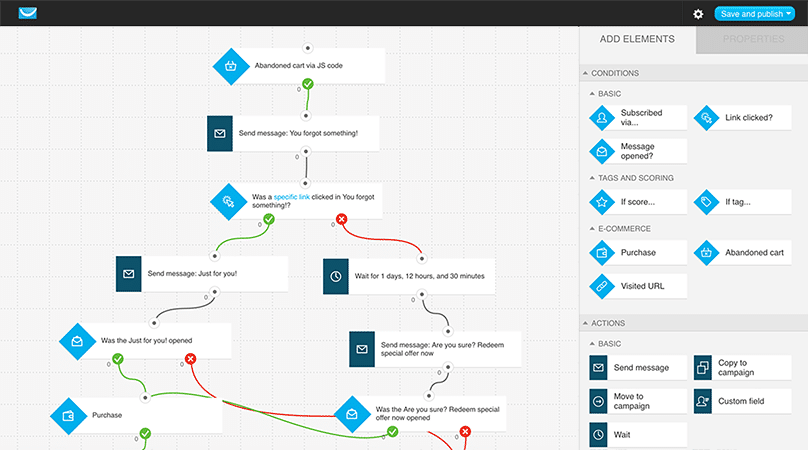 There are hundreds of scenarios that you can create with their builder:
- Conditions – base your marketing automation on the actions your website visitors take (click on a particular link, abandoned cart, purchase made, subscribing, opening a specific email, visiting a certain URL, etc.)
- Actions – then, it’s time to set what actions you want to take for each condition: it can be sending a particular email, adding or subtracting points from targeted subscribers, tagging users, moving to a different campaign and assigning or removing custom fields. You can also set up what time to wait before taking action.
- Apply filters – to take your targeting to the next level, you can apply certain filters, such as a particular range of users, the users from a certain campaign, and more.
Hubspot Marketing Automation
Hubspot is probably one of the best-known marketing automation tools on the market. The software allows you to build simple campaigns for follow-ups, as well as more complex workflows for every stage of the customer lifecycle. Just like with GetResponse, there are dozens of actions, triggers and conditions to play around with: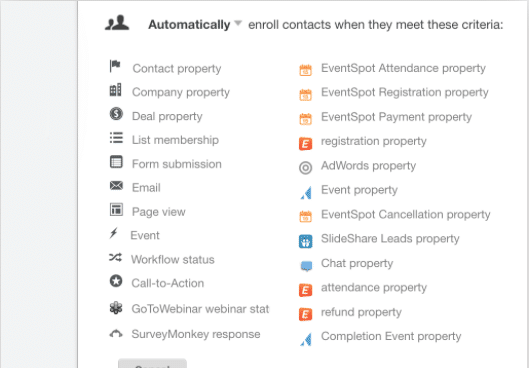 Hubspot also allows you to segment your list so that you can more easily organise users and send automated personalised content.
The only issue with Hubspot is that it can be difficult to figure out how some things work, so I would recommend going through the training courses and you might have to Google some solutions at times. It is also a bit pricey, especially for small businesses and start-ups, as the pro plan is £560 a month, and the cheapest plan (at £140 a month) doesn’t provide marketing automation.
[clickToTweet tweet="Top #marketingautomation tools @hubspot via @lilachbullock" quote="Top #marketingautomation tools @hubspot via @lilachbullock"]
Hubspot also allows you to segment your list so that you can more easily organise users and send automated personalised content.
The only issue with Hubspot is that it can be difficult to figure out how some things work, so I would recommend going through the training courses and you might have to Google some solutions at times. It is also a bit pricey, especially for small businesses and start-ups, as the pro plan is £560 a month, and the cheapest plan (at £140 a month) doesn’t provide marketing automation.
[clickToTweet tweet="Top #marketingautomation tools @hubspot via @lilachbullock" quote="Top #marketingautomation tools @hubspot via @lilachbullock"]
MailChimp Marketing Automation
MailChimp is an email marketing tool designed with online stores in mind, but it also works well with other types of websites. The tool provides several pre-set workflow options for all kinds of scenarios, such as abandoned cart email, first purchase, specific product follow-up, best customers and much more. They also have different types of workflows depending on your type of business (e-commerce and retail, education, non-profit, music and more).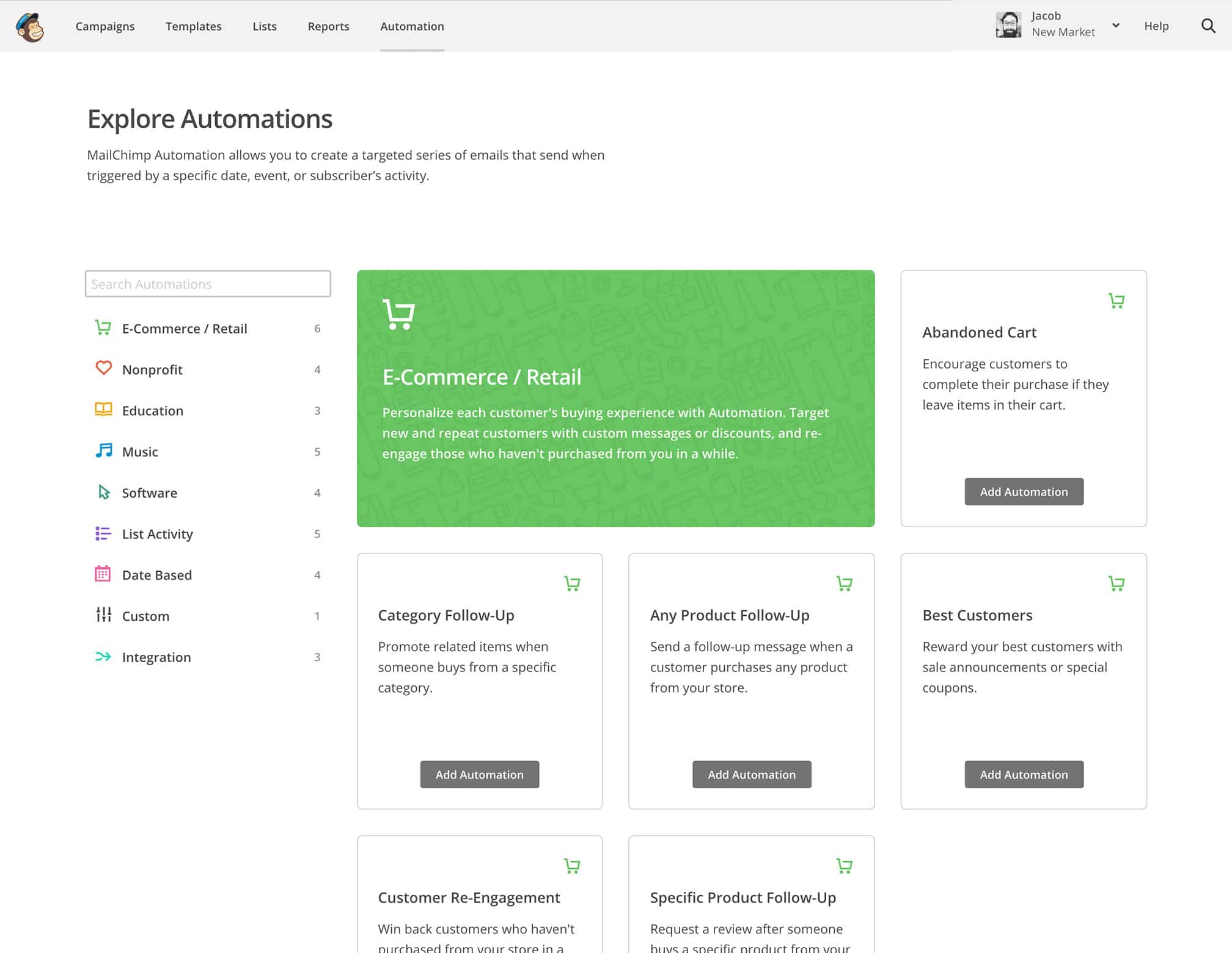 You can also use it to create custom workflows, but I would say it doesn’t give you the creative freedom that other tools do.
If you want to set up marketing automation based on the actions taken on your website, but mostly based on what pages they’ve viewed, or when they last visited your website, for example.
One of the things I’ve found using MailChimp is that it’s not always easy customising your emails and your campaigns if you want to go beyond the templates they provide. This is a bit annoying if you want to stand out from the crowd and grab your audience’s attention.
If you want marketing automation, prices start at $20 for a maximum of 1,500 subscribers and going to $35 for a maximum of 2,600 subscribers. Although it’s a very good tool, particularly for start-ups who don’t have a big list, as you grow and evolve, MailChimp might not be enough.
[clickToTweet tweet="Top #marketingautomation tools @mailchimp via @lilachbullock" quote="Top #marketingautomation tools @mailchimp via @lilachbullock"]
You can also use it to create custom workflows, but I would say it doesn’t give you the creative freedom that other tools do.
If you want to set up marketing automation based on the actions taken on your website, but mostly based on what pages they’ve viewed, or when they last visited your website, for example.
One of the things I’ve found using MailChimp is that it’s not always easy customising your emails and your campaigns if you want to go beyond the templates they provide. This is a bit annoying if you want to stand out from the crowd and grab your audience’s attention.
If you want marketing automation, prices start at $20 for a maximum of 1,500 subscribers and going to $35 for a maximum of 2,600 subscribers. Although it’s a very good tool, particularly for start-ups who don’t have a big list, as you grow and evolve, MailChimp might not be enough.
[clickToTweet tweet="Top #marketingautomation tools @mailchimp via @lilachbullock" quote="Top #marketingautomation tools @mailchimp via @lilachbullock"]
What Marketing Automation Cost Us in Year One (And Where We Wasted Money)
Most comparison articles list pricing tiers but never tell you what you will spend when you factor in setup, migration, and the inevitable "we picked the wrong plan" tax. When I moved a client's e-commerce business onto a mid-tier automation platform eighteen months ago, the advertised cost was £299 per month. The real first-year cost landed at just over £6,200 once we accounted for the onboarding call package (£400), a data cleaning service to fix their contact list before import (£320), three months on the wrong plan before we realised the contact limit was too low (£897), and a freelance developer for four days to connect their Shopify store via a custom integration (£960). None of that is the platform's fault, but none of it appears in any review I have ever read either.
Worth reading next: How to Prepare Your Small Business for AI Automation (Before You Buy Any Tools).
Worth reading next: Zap Automation flow chart.pdf.
The single biggest hidden cost for small businesses is almost always the contact list. Platforms charge by the number of contacts stored, not just the number of emails sent. If you are running any kind of lead generation campaign, your list grows whether you want it to or not, and you cross a pricing threshold before you notice. I now tell every client to take the plan tier that covers double their current list size, sit there for six months, then reassess. That advice alone has saved several of them from mid-campaign billing shocks that disrupted their cash flow.
Here is what I recommend auditing before you commit to any platform for your SMB:
- Check whether inactive or unsubscribed contacts still count toward your billing limit, because on several popular platforms they do.
- Find out if landing pages, SMS sends, or transactional emails are included or billed separately, since these are frequently where costs balloon.
- Ask specifically what happens to your automations if you downgrade your plan mid-year, as some platforms pause or delete workflows rather than preserve them.
- Calculate the cost of native integrations versus API connections for the three tools you use most, because native integrations that save you developer fees can justify a higher monthly plan on their own.
The feature that consistently delivers the fastest return for SMBs is not the flashy AI content generator or the predictive send-time tool. It is the abandoned cart or abandoned enquiry sequence, kept to three emails, sent over five days. One client selling professional training courses recovered £23,000 in revenue in the first ninety days purely from a three-email sequence we built in an afternoon. The emails were plain text, personalised by first name and course name, and the third email offered a modest ten percent discount. No elaborate design, no complex branching logic. The point is that the basics, done consistently and automatically, outperform sophisticated features you do not have the time or data to use well.
My honest opinion, having tested or implemented automation tools for clients across retail, professional services, and SaaS over the past several years, is that most SMBs are better served by a simpler platform they will use than by an enterprise-grade tool they will configure once and then fear touching. Complexity is the enemy of consistency in a small team. Pick the tool where your least technical team member can build a basic sequence without calling anyone for help, and you will get better results than any feature comparison chart will suggest.
Conclusion: what marketing automation tools are you using?
With so many marketing automation tools available, it can be difficult picking the right one for your business. If you’re a small or medium business and want to get good results without paying a fortune, it can get even more difficult to find the perfect solution. The trick is to find a software that is easy to use and set up marketing automation so that you don’t lose time trying to figure out how to create a proper workflow or how to best segment your list. And, of course, you want to make sure you’re not spending too much when you could get the same features for much smaller prices. Personally, I’m a bigger fan of GetResponse than the others on the list because not only is it easy to use, but it also gets results and offers great value for money for SMBs. That said, there are a lot of other amazing marketing automation tools out there – which ones have you tried and which do you prefer? Let me know in your comments and please share:)Related reading: Money-Saving Tips That Moved the Needle for Me (No Fluff, No Judgment).
Related reading: The AI Tools That Are Moving the Needle for Small Businesses Right Now.
Related reading: What to Automate First When You Bring AI Into Marketing.
The short version: Marketing automation tools help small and medium businesses save time, cut costs, and compete with larger brands by putting repetitive tasks on autopilot. The best platforms for SMBs balance ease of use with powerful features like email workflows, CRM integration, and lead scoring. Choosing the right tool depends on your budget, your team size, and the specific marketing channels you want to automate.
Want AI doing the heavy lifting in your marketing?
I build the systems that handle the boring 80 percent, so you get your week back. Done properly, with the human kept in.
Related: marketing automation (this site).
Frequently asked questions
What is the best marketing automation tool for a small business on a tight budget?
Platforms like Mailchimp, Brevo, and HubSpot all offer free or low-cost entry plans that give small businesses access to email automation, contact management, and basic analytics without a large upfront investment. The right choice depends on how many contacts you have and which features matter most to your growth goals.
Do small businesses really need marketing automation?
Yes, even a one-person marketing team can benefit enormously from automation because it handles repetitive tasks like sending welcome emails, following up with leads, and posting to social media, freeing you to focus on strategy and creativity. Businesses that automate their marketing consistently see higher engagement rates and better return on their time.
How do I choose between so many marketing automation platforms?
Start by listing the channels you use most, such as email, SMS, or social media, and then look for a platform that covers those channels while fitting your monthly budget. Always test a free trial before committing, and check whether the tool connects easily with your existing CRM or e-commerce software.
Can marketing automation tools replace a human marketing team?
No, these tools are designed to support your team, not replace it. Automation handles the repetitive, time-consuming work, but strategy, creative direction, and genuine customer relationships still require a human touch to be effective.
Related reading: AI Automation for Professional Services Firms.
Related reading: Your Team Is Already Using AI Without Telling You (Here's the One-Page P.
Related reading: Your Team Is Already Using AI at Work. You Just Don't Have a Policy for .



